
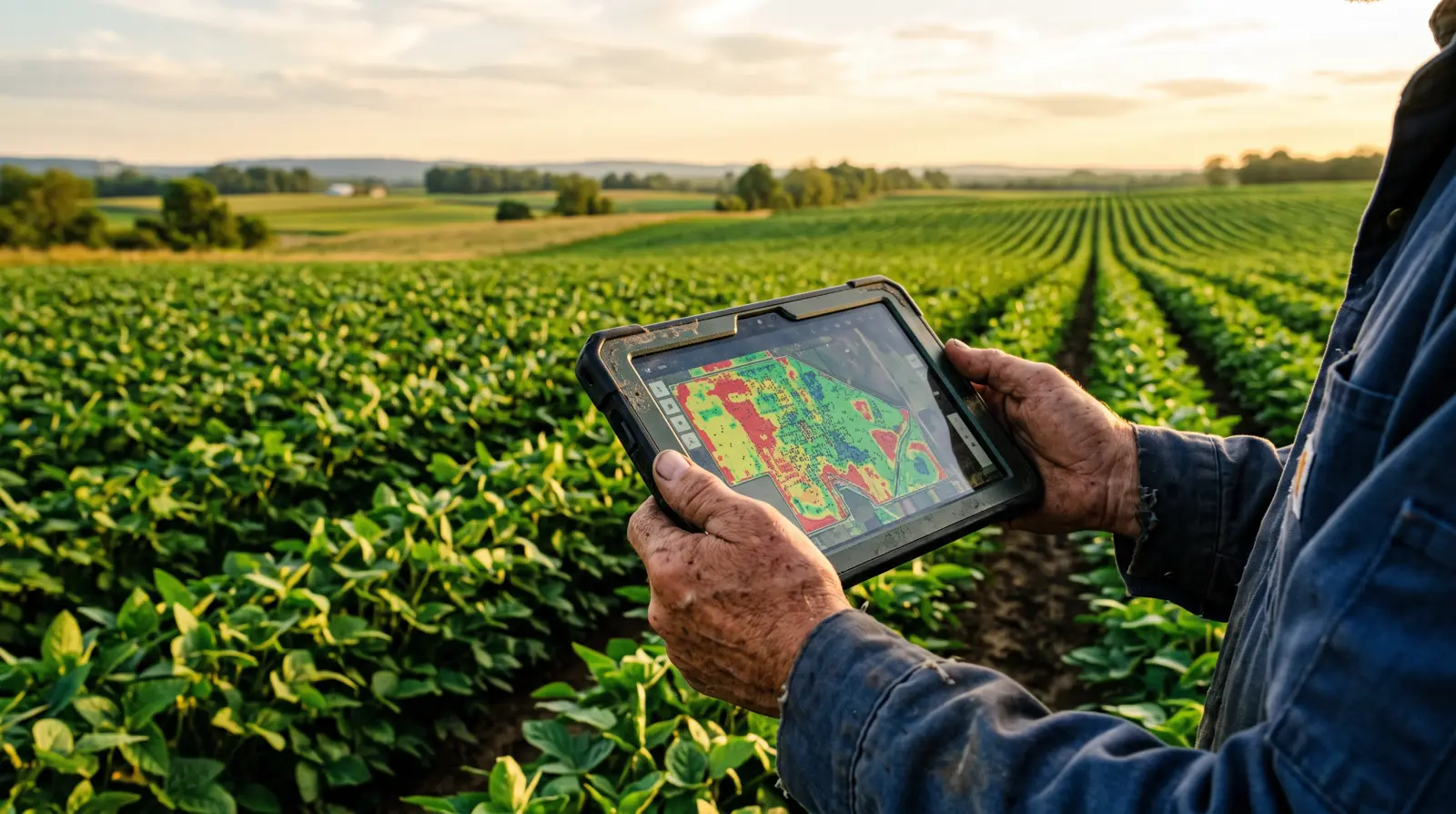
The AI crop scouting marketing has gotten ahead of the AI crop scouting reality. The agricultural technology vendors are putting machine learning labels on every product that touches an image, the implements at the equipment shows have screens advertising real-time AI weed detection, the satellite imagery providers are pitching AI-powered field health analysis, and the drone services are selling AI prescriptions for variable rate applications. Some of it works in the field. Some of it works in the demo and falls apart at the headland. Some of it is genuinely useful for one specific problem and gets oversold for problems it cannot solve. The job for a working operator is figuring out which is which without spending the equipment payment on a subscription that does not pencil out.
This article is the practical look at AI crop scouting in 2026. It covers what machine learning is actually doing under the hood, the categories of agricultural problems where it works well and where it does not, the major platforms and what they are best at, the data quality issues that quietly destroy the accuracy of every model, the integration story with the rest of the precision agriculture stack, the cost reality of subscription pricing for the analytical layer, the legal and data ownership questions that show up when models are trained on your fields, and concrete recommendations for the operations that should adopt this technology now versus the ones that should wait another two years.
The phrase AI crop scouting covers several different technologies that mostly share the property of using a trained computer vision or pattern recognition model on imagery or sensor data from fields. The training is the key part. Someone, somewhere, took a large set of images of weeds, diseases, pest damage, nutrient deficiencies, or yield-related crop characteristics, labeled them by hand or with semi-automated tools, and used those labels to train a model that can identify similar features in new images. The model then runs on imagery from your fields and outputs a map, a count, a prescription, or an alert.
The technology is genuinely powerful for specific narrow tasks. A model trained on hundreds of thousands of labeled images of palmer amaranth at various growth stages can identify palmer amaranth in a new field image with high accuracy, often higher than a human scout walking through with a notebook. A model trained on labeled images of soybean rust can identify the early stages of rust before a human eye can reliably distinguish it from other foliar issues. A model trained on labeled tassel emergence in corn can produce stand counts and estimate uniformity at a level of detail that would take a person all day to do manually.
The technology is also brittle in ways that the marketing material understates. A model trained on palmer amaranth in southern soybean fields may misidentify lambsquarter in northern soybean fields. A model trained on rust under one set of weather conditions may miss it under another. A model trained on imagery from one camera system at one altitude may produce poor results when applied to imagery from a different camera at a different altitude. The narrowness of the training is invisible to the user and explains a lot of the disappointment that hits in the second season after adoption.
The other thing worth understanding is the difference between supervised models that recognize specific things they were trained on, and unsupervised or semi-supervised approaches that look for anomalies in field data. Most current AI crop scouting platforms use supervised models for specific weed, disease, and pest detection, and use simpler statistical methods for general field health analysis based on vegetation indices like NDVI. The marketing tends to put the AI label on both, which obscures the fact that the field health analysis is mostly the same math that satellite imagery providers have been doing for fifteen years.
Several specific applications have moved past the demo phase into reliable operational use, and the operators using them have evidence of value rather than hope.
Targeted weed detection in growing crops is the application that has matured the fastest. The combination of cameras mounted on sprayers, drones, or autonomous vehicles with machine learning models trained on the major weeds in major crops produces weed maps that can drive variable rate herbicide applications or trigger mechanical cultivation. The savings on herbicide are real, with documented reductions of 40 to 70 percent in row crop applications when the technology is properly deployed. The catch is that the technology only works for weeds the model was trained on, and the regional variation in weed pressure means that a system trained primarily in the Midwest may underperform in the Mid-South or the Plains.
Stand count and emergence assessment in corn and soybeans has also matured into reliable operational use. A drone flight at the right growth stage with the right altitude and the right camera produces an emergence map that quantifies stand uniformity, gaps, and percentage of stand achieved against the seeding rate. This information is genuinely useful for replant decisions in early season and for evaluating planter performance after the season. The technology is consistent enough that it has become a routine offering from custom drone services, and several of the platforms can be operated by an experienced farmer or hired hand.
Disease detection in specialty crops, particularly tree fruit and grapes, has reached operational accuracy for some of the major diseases. Apple scab, fire blight, powdery mildew in grapes, and several others have models that can identify presence and approximate severity from drone imagery or fixed camera installations. The accuracy is high enough to drive treatment decisions with reasonable confidence, particularly when combined with weather-based disease risk models. The economics are good in high-value crops where a single missed treatment window can cost more than the technology subscription.
Yield estimation from imagery has improved significantly, particularly in row crops. Models that combine satellite imagery, drone imagery at key growth stages, and weather data can produce yield estimates several weeks before harvest with accuracy in the range of plus or minus 8 to 12 percent for corn and soybeans. This is useful for forward selling decisions, storage planning, and labor scheduling, and has become reliable enough that some grain marketing services use it as part of their advisory work.
Pest counting in specific systems, particularly traps for monitoring insect pressure, has reached genuine operational accuracy for several of the major pests. A camera-equipped pheromone trap that uses image recognition to count and identify trapped insects can run for a season with no human intervention and produce daily counts that drive treatment decisions. This is one of the cleaner success stories because the trap controls the environment that the camera sees, which makes the model's job much easier than identifying weeds in a varying field background.
Several applications get marketed heavily but have not delivered on the promises in real-world use.
General field health analysis using AI is mostly a relabeling of vegetation index analysis that has been around for decades. The platforms that pitch AI-powered field health are typically running NDVI or similar indices on satellite or drone imagery and adding a presentation layer that highlights areas of low vigor. This is useful information, but it is not the AI breakthrough the marketing implies, and the actual value depends much more on the resolution of the imagery and the timing of the flights than on the analytical layer.
Nutrient deficiency identification from imagery is hit and miss and tends to identify problems that are already obvious by the time they show up in a vegetation index. The early-season nitrogen deficiency that you would actually want to catch tends to look identical to several other things that are not nitrogen deficiency, and the model accuracy in real-world conditions is much lower than the demo accuracy. Tissue testing remains the more reliable approach for in-season nutrient diagnosis, and the AI tools are best treated as a screening layer that flags areas worth sampling rather than a replacement for sampling.
Disease detection in row crops has not matured to the same level as in specialty crops, primarily because the row crop diseases are typically managed with calendar-based or weather-based programs rather than detection-based programs. By the time AI imagery can reliably detect a row crop disease, the treatment decision has usually already been made or already been missed. The exceptions are some of the soilborne diseases where late-season imagery can support next-year decisions, and a few of the foliar diseases in seed corn production where the value of detection justifies the investment.
Insect damage detection from imagery in growing crops is mostly unreliable in the broader row crop world. The models confuse insect damage with hail damage, herbicide damage, weather stress, and other things that look similar in imagery. Scouting still requires people walking fields for the major row crop pests, with the AI tools serving as a flagging layer at best.
Real-time decision support during field operations from AI scouting is still mostly an aspiration. The vision of a tractor or sprayer that gets in-cab AI guidance about where to spray, where to scout, or where to adjust application rates is plausible for specific narrow tasks but not yet a general capability. Most of what gets pitched as real-time AI is either pre-loaded prescription maps generated from earlier AI analysis or simple sensor-based control that has been around for years.
The AI crop scouting platform landscape has consolidated significantly over the past few years. Several early entrants have been acquired or shut down, and the remaining platforms have specialized into specific niches.
Climate FieldView, owned by Bayer, has integrated machine learning analysis into its broader field data management platform. The strength is the combination of multiple data layers, including planting data, application records, satellite imagery, and weather, into a single interface that supports decision-making across the season. The AI analysis is more of a feature within the platform than the headline product, and the platform is most valuable for operations that are already using FieldView for general field data management.
The pricing is bundled with the broader FieldView subscription, which runs $1500 to $5000 per year depending on acreage and modules. The AI features are mostly included in the higher tiers. The platform is a reasonable choice for Bayer customers who want analytical capabilities integrated with their existing field records, and a less compelling choice for operators who do not already use FieldView.
Taranis is a platform built specifically around AI-driven crop scouting using drone-captured high-resolution imagery. The service flies drones over enrolled fields at key growth stages, runs the imagery through machine learning models for weed identification, disease detection, stand counts, and pest scouting, and delivers reports through a web and mobile interface. The model coverage is broad for major row crops in major regions.
The strength is the depth of the AI scouting analysis, which goes beyond what most other platforms offer for individual fields. The weakness is the cost, which is among the higher options in the market, and the dependence on flight scheduling that requires advance planning. Taranis is a reasonable choice for operations that want a turnkey AI scouting service and have the budget to support it. It is less appropriate for operations that already have their own drone capability and want to handle imagery analysis in-house.
Pricing in 2026 runs $8 to $15 per acre per year depending on the level of service and the regional pricing, with higher tiers including additional flights and more analytical depth.
Sentera makes drone hardware and the FieldAgent platform that runs imagery analysis on drone or aerial imagery. The platform is more appropriate for operations that own drones and want to process their own imagery, with the analytical layer providing weed maps, stand counts, disease alerts, and other AI-driven outputs.
The strength is the flexibility, since the same platform can ingest imagery from various sources and produce useful outputs. The weakness is that the operator has to handle the flying, which adds a meaningful labor and skill requirement. Sentera is a reasonable choice for larger operations that have invested in drone capability and want to process imagery internally rather than relying on external services.
Pricing for the FieldAgent platform runs $500 to $2500 per year depending on the modules and the analytical depth, plus the cost of drone hardware and flight labor.
One Smart Spray (the BASF and Bosch joint venture) and See and Spray Ultimate (the John Deere offering) are the two main platforms for AI-driven targeted herbicide application during spraying. The platforms identify weeds in real-time on the spray boom and trigger only the nozzles over weeds rather than applying broadcast herbicide.
The strength is the documented herbicide savings, which are large enough to pay for the technology in a few seasons on most row crop operations with significant herbicide costs. The weakness is the upfront equipment cost, which involves either retrofitting an existing sprayer or trading for new equipment with the capability built in. The technology is best suited to row crop operations with significant acreage and significant herbicide spending.
Pricing varies dramatically based on whether the system is retrofitted or factory installed and on the size of the sprayer. Retrofits typically run $50,000 to $150,000 depending on boom width and complexity, with the savings on herbicide typically returning the investment in two to four seasons on operations with appropriate scale.
Several smaller and regional platforms offer drone-based crop scouting with AI analysis, often through local custom drone service operators who fly the fields and run the analysis through licensed software. These services tend to be more flexible and less expensive than the national platforms, but the analytical depth varies based on which models the local operator has access to.
For operations that want a more relationship-based scouting service rather than a national platform subscription, the local custom drone service route can be a reasonable middle path. The pricing is typically $5 to $12 per acre per flight, with multiple flights per season being the norm.
The accuracy of any AI crop scouting tool depends heavily on the quality of the data going into it, and the data quality problem is the most underestimated issue in the entire technology category.
Image resolution matters more than most operators realize. A model trained on 2-centimeter resolution drone imagery will not work well on 30-centimeter resolution satellite imagery. The marketing material often glosses over the resolution requirements, and the practical effect is that a satellite-based service may have good models but cannot apply them to the imagery it has, while a drone-based service may have lower-quality models but better imagery, and the actual accuracy depends on the combination.
Imagery timing is similarly important. A weed identification model that works well at the four-leaf stage may produce poor results at the two-leaf stage or the six-leaf stage. Disease models have similar timing windows that have to be matched to the imagery flight schedule. The platforms that work best are the ones that schedule imagery capture at the right windows for the analyses being run, and operators who try to apply models to imagery captured at the wrong times will get disappointing results.
Cloud cover, dust, and weather conditions affect imagery quality in ways that propagate into model outputs. A satellite image taken through thin cloud cover may produce vegetation index values that look like crop stress when they are really just atmospheric attenuation. A drone image taken in dusty conditions during planting season may have reduced contrast that confuses weed identification models. Operators have to learn the conditions under which to disregard outputs.
Calibration drift over the season is real. Models trained on one growth stage may produce different accuracy at other stages, and many platforms do not automatically adjust for this. The reports may look the same in May and August, but the accuracy of those reports is different, and the operator has to know enough to interpret accordingly.
The training data bias issue is the deepest problem. A model trained primarily on Midwest corn and soybeans will be less accurate when applied to wheat, cotton, or specialty crops, and a model trained primarily in the Plains will be less accurate when applied to irrigated systems in the West. The platforms tend to expand their training coverage over time, but the geographic and crop biases are usually not transparent to the user.
The cost of AI crop scouting tools is the biggest barrier to adoption for most operations, and the return on investment math depends heavily on what specific problem the technology is solving.
Targeted spraying with one of the AI sprayer systems pencils out best for operations with high herbicide costs and large enough acreage to justify the equipment investment. The savings are documented at 40 to 70 percent of broadcast herbicide costs, which on a 2000-acre row crop operation with $80,000 in annual herbicide spending translates to $32,000 to $56,000 per year in savings. Against a $100,000 retrofit cost, the payback is two to three years, and after that the operation captures the full savings annually. This is a clear win for operations at appropriate scale.
Drone-based AI scouting with a third-party service pencils out best for operations with specific high-value problems that the technology can solve, such as tree fruit operations that need disease and pest pressure monitoring, seed corn operations that need stand uniformity verification, or large row crop operations that need late-season scouting at scale. The economics are less clean than the targeted spraying case because the savings are diffuse rather than concentrated, but operations that already pay for traditional scouting services often find the AI-augmented services to be cost-comparable with better data.
Subscription platforms like Climate FieldView with AI features are best valued as part of a broader field data management strategy rather than purely on the strength of the AI scouting layer. The AI is one of many features, and the cost-benefit calculation depends on whether the operation is using the platform's other capabilities like prescription generation, equipment integration, and recordkeeping.
The hidden costs that get missed in the initial cost calculation include the labor to integrate the platform with existing workflows, the time spent learning to interpret outputs and ignore the false positives, the connectivity costs at the farm to support cloud-based platforms, and the data exit costs if the operation later decides to switch platforms. These costs are real and add 20 to 40 percent to the headline subscription cost over the long term.
The question of who owns the field data that gets fed into AI scouting platforms has become more important as the platforms have matured and the analytical insights have become more valuable. The platforms vary significantly in how they handle this, and the contract language deserves a careful read before signing up.
Some platforms claim broad rights to use the imagery and data from enrolled fields for model training, anonymized aggregation, and other purposes. Others restrict their use to providing service to the specific customer. The differences matter both for direct privacy concerns and for the broader question of whether the operation is contributing to a model that will then be sold back to it or to its competitors.
The American Farm Bureau Federation has been pushing for clearer standards in this area, and several platforms have signed onto the Privacy and Security Principles for Farm Data, which is a useful baseline but not legally binding. Operations that care about this issue should read the terms carefully, ask direct questions about data use, and prefer platforms with clear policies over platforms with vague language.
The portability issue is similarly important. An operation that builds up several years of data on one platform and then wants to move to another platform may face significant friction in extracting its data in usable form. Some platforms make this easy, others make it deliberately difficult, and operators should understand the export situation before getting deeply committed to any single platform.
The right adoption path for AI crop scouting depends heavily on the operation type, the scale, and the existing technology stack.
For row crop operations of 2000 acres or more with significant herbicide costs, targeted spraying with one of the AI sprayer systems is the highest-value single technology adoption available in this category. The economics are clear, the technology is mature, and the operational benefits are concentrated rather than diffuse.
For row crop operations of moderate scale that already have a precision agriculture stack, integrating an AI scouting platform with existing field data management software is a reasonable next step, with Climate FieldView being a default choice for operations already in the Bayer ecosystem and Taranis being a default choice for operations that want a more drone-focused approach.
For specialty crop operations, particularly tree fruit and grapes, drone-based AI scouting for disease and pest pressure has matured to the point of being a reasonable adoption for operations with the connectivity and equipment to support it. The economics are best on the higher-value crops with critical disease pressure.
For smaller operations or operations that are early in their precision agriculture journey, the right path is usually to focus on the foundational layers like soil sampling, yield monitoring, and basic field records before adding AI scouting capabilities. The AI tools work best when integrated with a well-established data foundation, and operations that try to start with AI tools without that foundation often end up with reports they cannot act on.
For all operations, the key principle is to adopt AI tools for specific problems where the technology has demonstrated reliability rather than as a general-purpose enhancement. The marketing tends to position AI as a broad uplift to the operation, but the practical wins are narrow and specific, and operations that match technology to specific problems get better results than operations that buy into the broader vision.
AI crop scouting is going to keep improving, and the operations that have already adopted the mature applications will be in a better position to adopt the next wave as it becomes reliable. The current frontier areas where the technology is improving rapidly include in-season variable rate fertility prescriptions, autonomous mechanical weeding in row crops, real-time disease detection in row crops at meaningful early stages, and integrated seed selection and management based on field-specific historical performance.
Most of these are still in the early stages where adoption is risky, but several will likely move into mature operational use over the next two to four years. The operations that maintain a working understanding of the technology, follow the platform updates, and selectively adopt the proven applications will be better positioned than the ones that either dismissed the category or bought too aggressively into the early hype.
The bottom line for AI crop scouting in 2026 is that the technology has moved past the demo phase for several specific applications and is genuinely useful for the operations that match it to the right problems. The marketing has gotten ahead of the reality in some places, but the reality has caught up enough that there are real wins available for operations willing to adopt selectively. The job for a working farmer is figuring out which of those wins apply to the specific operation, and ignoring the rest of the noise until the technology proves itself for the harder problems.
Yes, when it fits the operation. Camera-and-model targeted spraying systems have documented herbicide reductions of 40 to 70 percent in row crops, because they trigger only the nozzles over weeds instead of broadcasting. The catch is that a model only recognizes the weeds it was trained on, so a system trained mainly in the Midwest can underperform in the Mid-South or the Plains.
Models that combine satellite imagery, drone flights at key growth stages, and weather data can estimate corn and soybean yields several weeks before harvest to within about plus or minus 8 to 12 percent. That is close enough to guide forward selling, storage planning, and labor scheduling, and some grain marketing advisors now fold it into their advice, though it does not replace the scale ticket.
Retrofitting an existing sprayer with real-time targeted spray technology typically runs 50,000 to 150,000 dollars depending on boom width and complexity. On a large row crop operation with heavy herbicide spending, the 40 to 70 percent chemical savings usually returns that investment in two to four seasons, which is why the systems pencil out best at significant acreage rather than on small farms.
Only unreliably. Early-season nitrogen shortfall, the kind you would actually want to catch, looks nearly identical in imagery to several problems that are not nitrogen, so real-world accuracy falls well below the demo. Tissue testing remains the dependable in-season diagnosis. Treat the AI layer as a screen that flags areas worth sampling rather than a substitute for pulling tissue samples.
Join our list for practical guides on farm tech, precision agriculture, and tools that work.