
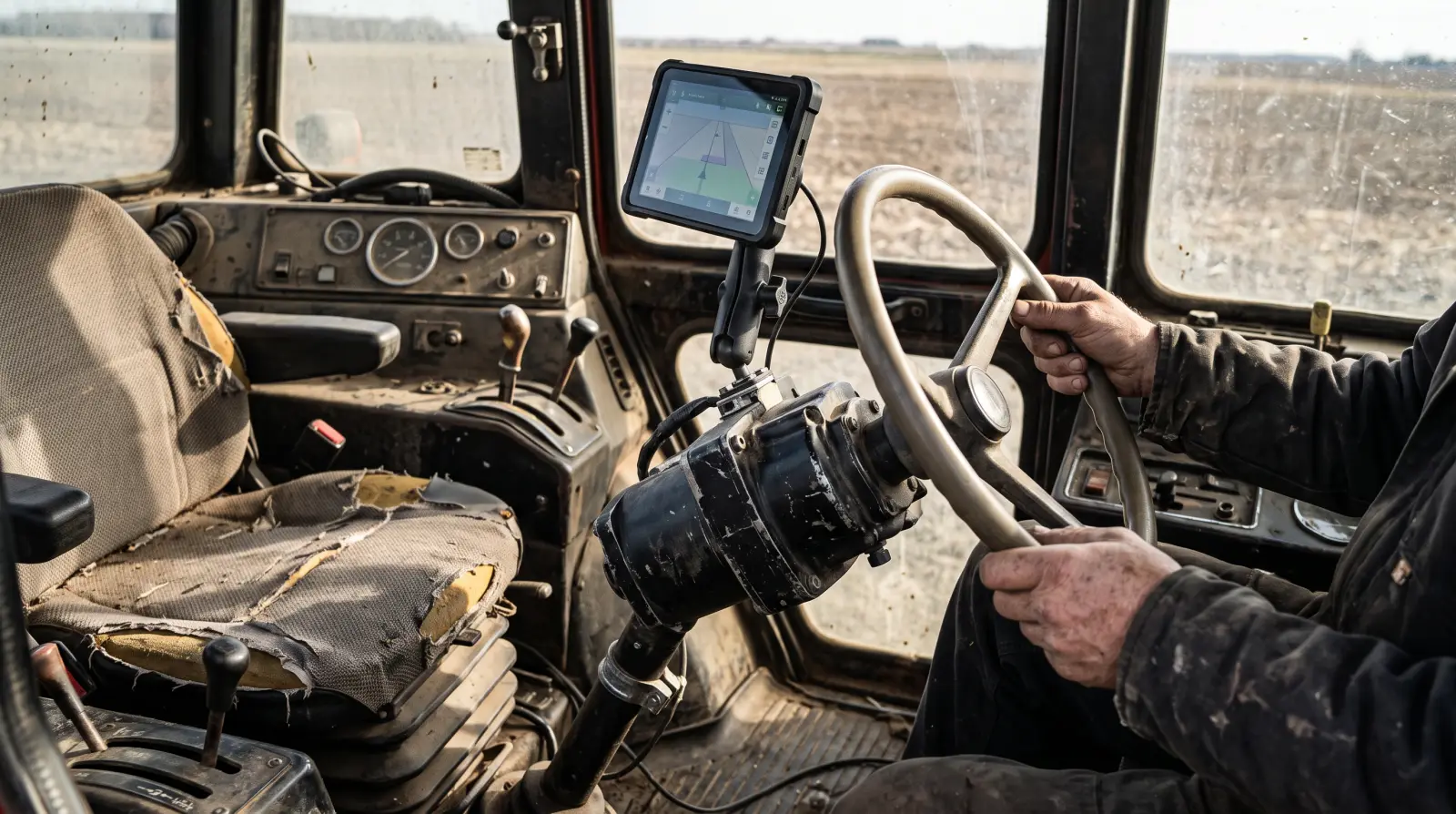
Auto steer used to be a feature you bought with the tractor, which meant that if your tractor was fifteen years old and paid for, the technology was effectively off the table unless you traded into a newer machine you did not need and could not justify. That has changed. The aftermarket retrofit kit - a steering wheel motor or a hydraulic valve, a GPS receiver, and a control display that you install on the tractor you already own - has matured into a genuinely good tool, and the prices have come down far enough that the math now works for operations that would have laughed at the idea a few years ago. The honest read in 2026 is that a retrofit auto steer kit is one of the highest-return technology purchases a row crop or hay operation can make, provided you buy the right kind of kit for your tractor and your accuracy needs and you go in understanding what the install actually involves. The category has also gotten crowded and a little noisy, with the low-cost entrants making accuracy claims that deserve a careful read, so a buyer who understands the tradeoffs can avoid both overspending on capability they will never use and underspending on a kit that disappoints in the field.
This is a working farmer's guide to aftermarket auto steer retrofits as the technology stands in 2026: the difference between the wheel-motor kits and the hydraulic kits and why that choice drives everything else, what the correction sources mean for your real-world accuracy, where FJDynamics fits against the established players like Ag Leader and Trimble, what a retrofit actually costs once you add up every line on the invoice, how the install goes on an older tractor, and how to decide whether the kit pencils out for your acres. The goal is enough detail to make the call rather than enough enthusiasm to make the sale.
The first and most important decision in a retrofit is whether you go with a steering wheel motor kit or a hydraulic kit, because that single choice determines the price, the install difficulty, the accuracy ceiling, and how the system feels in the field. Understanding the difference is the foundation everything else sits on.
A steering wheel motor kit does exactly what the name says. It bolts an electric motor onto the steering column, usually replacing the steering wheel with the motor in line and a new wheel on top, and the motor physically turns the wheel the same way your hands would. The control system reads the GPS position, decides how much correction is needed, and commands the motor to turn the wheel. This is the universal, tractor-agnostic approach, because almost every tractor has a steering wheel and a column the motor can attach to. It installs in a few hours with hand tools, it moves from one tractor to another with a mounting kit swap, and it is the lower-cost path. The tradeoff is that it steers the tractor through the existing steering system, with all the slop, lag, and play that an older steering box and worn linkage carry, so the response is a half-step slower and the accuracy ceiling is a touch lower than a system that talks directly to the hydraulics.
A hydraulic kit takes a different path. Instead of turning the wheel, it installs a valve into the tractor's steering hydraulic circuit and steers by directing hydraulic flow to the steering cylinder directly, bypassing the wheel entirely. This is how factory auto steer works on a machine that came with it. The valve responds faster, holds the line tighter, and is not fighting the play in the steering column, so the accuracy and the response are both a step better. The cost is that the install is a real job - you are plumbing into the hydraulic system, which means the right valve for your tractor's steering setup, careful work to keep contamination out of the circuit, and on some tractors a steering sensor and other plumbing that the wheel kit does not need. It is more money, more install time, and more tractor-specific, and on some older or simpler hydraulic systems it is either not available or not worth the trouble.
The practical guidance is that the wheel motor kit is the right starting point for most operations retrofitting an older tractor, and especially for the operation that wants to move the kit between tractors or that is buying its first auto steer and wants to prove the value before committing to a deeper install. The hydraulic kit earns its premium when you are running tight-tolerance work like strip till or planting on RTK where the last inch of accuracy and the last fraction of a second of response time actually change your outcome, or when you are committing the kit permanently to one high-hour tractor where the better feel pays back every season. Buy the wheel kit unless you have a specific reason to need the hydraulic, and most operations that think they need the hydraulic discover the wheel kit does the job.
The steering hardware only matters if the GPS knows where the tractor is, and the accuracy of that position depends entirely on the correction source you feed the receiver. This is the part of the auto steer conversation where the marketing gets loosest and where a buyer needs to be the most careful, because a kit's accuracy claim is meaningless without stating which correction source produced it.
At the bottom of the accuracy ladder is uncorrected GPS, sometimes dressed up with a free satellite-based augmentation like SBAS or WAAS, which gets you pass-to-pass accuracy in the range of a foot or so and year-to-year repeatability that is much worse. This is fine for some jobs - spreading, spraying with a wide boom, tillage where a foot of overlap does not cost you much - and it is the accuracy you get with no subscription and no base station. A lot of buyers are perfectly served here and should not pay for more.
The middle of the ladder is a subscription correction service, where the receiver pulls a correction signal over satellite or cellular that tightens accuracy to a few inches pass-to-pass with decent repeatability. These services carry an annual fee, the accuracy tiers and prices vary, and the value depends on whether your work needs the few-inch band. For a lot of row crop operations this is the sweet spot, delivering accuracy good enough for planting and cultivating without the cost and infrastructure of RTK.
At the top is RTK, real-time kinematic correction, which delivers sub-inch accuracy and the year-to-year repeatability that lets you come back to the exact same rows season after season. RTK needs a correction source - either your own base station, a subscription to a network of base stations delivered over cellular, or in some newer systems a satellite-delivered RTK-class service. RTK is what you need for controlled traffic farming, for strip till where you plant into last year's strips, for tight-row vegetable work, and for any system where repeatability over time is the whole point. It is also the most expensive correction to obtain and maintain, and a meaningful share of operations that buy RTK-capable kits run them on a lesser correction most of the time because their actual work does not need the sub-inch band.
The buying lesson is to separate the steering kit from the correction source in your own mind and to price both. A cheap kit advertised with an RTK accuracy number is quoting an accuracy you only get if you also pay for RTK correction, which may be a subscription on top of the kit or a base station you have to buy and site. Decide what accuracy your work actually requires first, then buy the cheapest combination of kit and correction that reliably delivers it, and ignore the headline accuracy numbers that assume a correction source you are not going to pay for.
The aftermarket auto steer market in 2026 has a clear split between the established precision ag companies and the newer low-cost entrants, and FJDynamics is the name that has driven the most change by pushing the price floor down hard.
FJDynamics built its position on a complete wheel-motor auto steer kit at a price well below what the established players had been charging, bundling the steering motor, the GPS receiver, and the display into a package aimed squarely at the operation that wanted auto steer but had been priced out. The field experience has been broadly positive for what it is - a capable wheel-motor system that does the core job of holding a line well, installs without specialized help, and delivers real value at a price that opened the technology up to smaller operations and to older tractors that would never have justified the cost of a premium system. The honest read is that FJDynamics is a strong value buy for the operation whose accuracy needs sit in the foot-to-few-inches range and that wants a straightforward wheel kit, and the things to watch are the depth of the dealer support network in your area, the long-term parts and software support, and whether the higher-accuracy tiers actually deliver what is claimed in your conditions. The hardware does the job; the questions are about the ecosystem around it.
Ag Leader occupies the established-American-company position, with a deep history in precision ag, a strong dealer and support network, and a product line that spans wheel-motor and hydraulic steering, displays that do a lot more than steer, and an ecosystem that ties auto steer to rate control, mapping, and data handling. You pay more than you do for the value entrants, and what you are buying for the premium is the support network, the integration with the rest of the precision ag stack, the proven long-term reliability, and the confidence that parts and software updates will be there for years. For the operation that wants one system to handle steering plus planter and sprayer control plus data, and that values a dealer who will stand behind it, Ag Leader is a strong choice and the premium is often justified.
Trimble sits in a similar premium tier with a long track record, broad tractor compatibility, both wheel and hydraulic options, and an ecosystem reach that extends well beyond steering, and it carries the same general tradeoff as Ag Leader: more money, more capability, deeper support. The choice between the premium players often comes down to which dealer in your area is strongest, because the support relationship matters more over the life of the system than the spec-sheet differences between comparable products.
The way to think about the field is that the low-cost entrants led by FJDynamics have made auto steer affordable for operations that were locked out, and they are the right buy when the core steering job is what you need and your accuracy requirements are moderate. The established players earn their premium when you need the deeper ecosystem integration, the strongest support network, and the long-horizon confidence, and especially when auto steer is the first piece of a larger precision ag buildout rather than a standalone purchase. Both are legitimate buys; the mistake is paying premium prices for capability you will not use, or buying the cheapest kit when your operation genuinely needs the integration and support that only the premium tier delivers.
The sticker price on an auto steer kit is the beginning of the cost conversation, not the end, and an honest budget adds up every line rather than just the headline number.
The kit itself is the biggest line. A wheel-motor kit from a value entrant runs in the low thousands of dollars for the complete package of motor, receiver, and display, while a comparable kit from a premium player runs meaningfully higher, and a hydraulic kit adds to either number because of the valve and the additional components. The spread between the cheapest capable wheel kit and a premium hydraulic system is large enough that the kit choice alone can swing the total by a multiple, which is exactly why matching the kit to your real needs matters so much.
The correction source is the line most buyers underestimate. If a free or built-in correction meets your needs, this line is zero and stays zero. If you need a subscription correction, that is an annual recurring cost that continues for as long as you run the system, and it should be in the budget as a yearly number rather than a one-time cost. If you need RTK from your own base station, the base station is a substantial up-front purchase plus siting and setup, while RTK over a cellular network is a recurring subscription. The correction cost over the life of the system can rival the kit cost, and leaving it out of the budget is the single most common way a retrofit ends up costing more than the buyer planned.
The install is a line whether you do it yourself or pay for it. A wheel kit you install yourself costs you a few hours and no cash, which is the common path and part of why the wheel kit is so popular. A hydraulic kit, or a wheel kit on an awkward tractor, may mean paying a dealer for the install, and that labor is real money. Mounting brackets specific to your tractor model, any steering sensors a hydraulic install needs, and the odd adapter or cable are small lines individually that add up.
Then there are the ongoing lines beyond correction: software or activation subscriptions on some systems, the cost of moving the kit between tractors if you go that route, and eventual repairs or replacements over the years. None of these is large, but a full-life budget includes them.
The return side of the ledger is where the retrofit usually wins. Auto steer pays back through reduced overlap on every pass - the few inches or the foot you used to overlap to be safe is seed, fertilizer, chemical, fuel, and time you stop wasting on every round of every field. On a row crop operation of meaningful acreage, the input savings alone from cutting overlap often pay for a wheel kit in a season or two, before you count the reduced operator fatigue that lets you run longer and straighter at the end of a long day, the ability to run accurately in dust and darkness, and the better job the equipment does when the operator is freed from steering to watch the implement. The operations that have retrofitted older tractors with wheel kits have, broadly, been glad they did, and the regret cases tend to be buyers who overbought capability or who underbudgeted the correction source.
The retrofit install on an older tractor is the part that worries first-time buyers and turns out, for a wheel kit, to be more approachable than they expect. The wheel-motor kit is designed for owner installation, and the core of the job is mechanical: mount the motor on the steering column with the tractor-specific bracket, mount the GPS receiver up high on the cab roof or a mast where it has a clear view of the sky, mount the display where the operator can see it, and run the wiring between them and to power. A handy operator with the instructions and a few hours gets it done with hand tools, and the kit makers have install guides and videos for the common tractor models that cover the bracket fitment and the wiring routing.
The older tractor does bring a few specific considerations. The steering system on a high-hour tractor has play in it - a worn steering box, loose tie rod ends, slop in the linkage - and that play directly limits how well any wheel-motor system can hold a line, because the motor turns the wheel but the play between the wheel and the tires eats some of the correction. The fix is not the auto steer; it is the steering maintenance, and the right sequence is to tighten up the steering before you install the kit so the system has good mechanics to work with. A tractor with badly worn steering will disappoint with even the best kit, and a tractor with tight steering will perform beautifully with a modest one.
Power and electrical are the other older-tractor wrinkle. The kit needs clean, adequate power, and an older tractor's electrical system may need a dedicated power lead run properly to the battery rather than tapped into an existing circuit, and the charging system needs to be healthy enough to carry the added load. None of this is hard, but it is worth doing right, because intermittent power is a frustrating and hard-to-diagnose source of auto steer problems.
The receiver mounting matters more than people expect. The GPS receiver needs a clear, unobstructed view of the sky to hold a good position, which means mounting it high and away from anything that blocks or reflects the signal. On a cab tractor it goes on the roof; on an open-station older tractor it goes on a mast where the operator and the structure do not shadow it. A poorly sited receiver is a common cause of accuracy that falls short of the kit's capability, and it is entirely within the installer's control.
The hydraulic install is a different level of job and, on an older tractor, the place to think hard about whether to do it yourself or pay a dealer. Plumbing into the steering hydraulics demands cleanliness - contamination introduced during the install can damage the steering system - and it demands the right valve and components for your specific tractor's hydraulic configuration. For most older-tractor retrofits the wheel kit sidesteps all of this, which is another reason it is the default recommendation.
The decision comes down to matching three things to your operation: the accuracy your work actually needs, the kind of kit that delivers it, and the acreage over which the savings accumulate.
Start with accuracy, honestly. Walk through the field operations you would run under auto steer and ask what accuracy each one truly requires. Tillage, spreading, and wide-boom spraying are forgiving and live happily on free or low-cost correction. Planting and cultivating row crops want a few inches and the mid-tier correction. Strip till, controlled traffic, and anything where you return to the exact same rows year after year need RTK and its repeatability. Most operations have a mix, and the right target is the accuracy the most demanding job you will actually run under auto steer requires - not the most demanding job you can imagine, and not the loosest job you run.
Then match the kit. For moderate accuracy needs on an older tractor, a wheel-motor kit from a value player like FJDynamics is very likely the right buy, delivering the core function at a price that pays back fast. For an operation building out a broader precision ag system, valuing deep support, or needing tight integration with planter and sprayer control, a premium wheel or hydraulic system from Ag Leader or Trimble earns its cost. For sub-inch repeatability work, plan on a hydraulic kit and RTK correction and budget accordingly.
Finally, weigh the acreage. The input and time savings from reduced overlap scale directly with how many acres you cover, so the more acres you run the faster any kit pays back and the easier the decision. A large row crop operation retrofitting a wheel kit onto a paid-off tractor is often looking at a payback measured in months. A small operation with modest acres has a longer payback and should lean toward the lowest-cost kit that meets its accuracy needs, while a hobby-scale operation may find the savings do not justify even a value kit, and that is a legitimate conclusion rather than a failure of the technology.
The overall picture in 2026 is that the aftermarket retrofit has turned auto steer from a feature locked behind a new-tractor purchase into an affordable upgrade for the machines farmers already own, and the value entrants led by FJDynamics have done most of the work of bringing the price within reach. Buy the wheel kit unless you have a specific reason for the hydraulic, separate the correction cost from the kit cost and budget both, tighten up the older tractor's steering before you install, site the receiver well, and match the accuracy to the work rather than to the brochure. Do that and a retrofit auto steer kit is one of the surest technology investments a working operation can make.
For most older-tractor retrofits, start with the wheel motor kit. It bolts an electric motor onto the steering column, installs in a few hours with hand tools, costs less, and moves between tractors. A hydraulic kit plumbs a valve into the steering circuit for tighter, faster response, but it costs more and is a real install. Buy the wheel kit unless strip till or RTK work needs the last inch.
They are different accuracy tiers. A subscription correction service tightens position to a few inches pass-to-pass and suits most planting and cultivating. RTK delivers sub-inch accuracy and the year-to-year repeatability that lets you return to the exact same rows, which controlled traffic and strip till require. RTK needs a base station or a cellular network and costs the most to obtain and maintain.
For moderate accuracy needs it is a strong value. FJDynamics pushed the price floor down with a complete wheel motor kit well below what the established brands charged, and field experience holding a line has been broadly positive. The hardware does the core job; the things to check are local dealer support, long-term parts and software backing, and whether the higher-accuracy tiers deliver in your conditions.
Not well until you fix the steering first. A wheel motor turns the wheel, but play from a worn steering box, loose tie rod ends, or sloppy linkage eats the correction before it reaches the tires. Tighten the steering up before installing the kit. A high-hour tractor with tight steering performs beautifully with a modest kit, while worn steering disappoints even the best system.
Join our list for practical guides on farm tech, precision agriculture, and tools that work.