
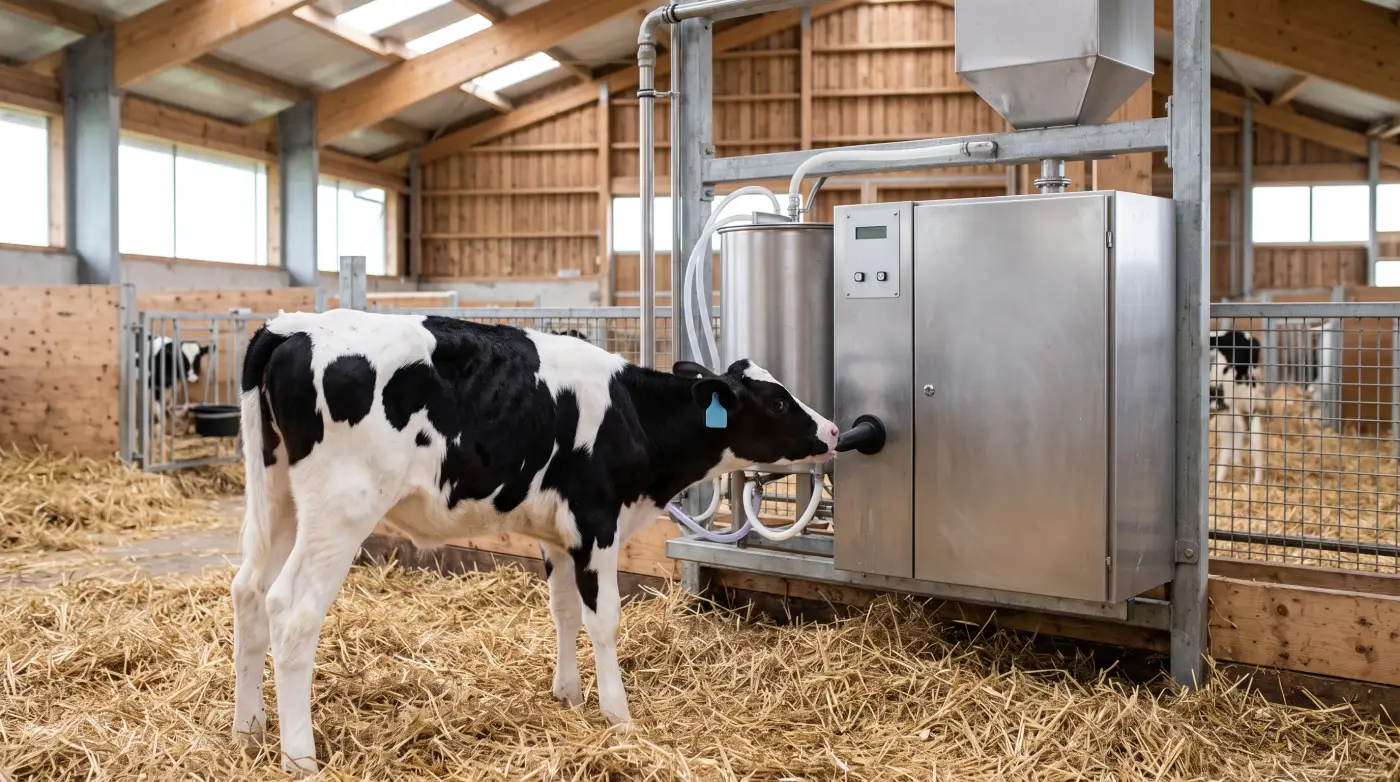
Feeding milk to a barn full of calves twice a day is one of the most labor-bound jobs on a dairy. It does not flex. The calves need milk at the same times every morning and every night, weekends and holidays included, and there is no way to batch it or push it to a slow day. An automated calf feeder changes the shape of that job. Instead of mixing buckets and walking the rows twice a day, the calves drink small meals throughout the day from a programmable station that mixes warm milk replacer fresh for each visit, tracks how much each calf drinks, and flags the ones that are backing off feed before they look sick. This guide covers how the machines actually work, what they cost, where they earn their keep, and the part most sales pitches skip - the management discipline that separates a feeder that works from one that becomes an expensive way to spread scours.
An automated calf feeder is a station, usually housed in a small insulated cabinet, that mixes powdered milk replacer with heated water on demand and dispenses it through one or two rubber nipples into a group pen of calves. Each calf wears an electronic ID - almost always an RFID ear tag, the same low-frequency technology used across the rest of the livestock world - and when a calf puts its head into the feed stall, an antenna reads the tag and the controller looks up that animal's feeding plan.
The machine decides, in that moment, whether the calf is allowed a meal. If the calf has drunk its allotted milk for the current period, the station knows it and dispenses nothing, or only water, so the calf cannot overdrink. If the calf is due for milk, the machine mixes a fresh portion at the programmed concentration and temperature and lets the calf drink. Every visit - successful or refused - is logged against that calf's tag.
That is the core of it: identification, a per-animal feeding plan, fresh mixing on demand, and a complete record of who drank what and when. A single station typically feeds 25 to 30 calves, sometimes more on lighter feeding programs, and the calves live in a group pen with free access to the feeder around the clock.
The machines are made by a handful of established manufacturers - Förster-Technik (whose units are sold under several brand names including the Holm & Laue and some Calf-Tel and GEA-badged systems), Lely with the Calm feeder, DeLaval, and Urban among the most common in North America and Europe. The underlying approach is similar across brands; they differ in mixing mechanism, cleaning automation, sensor options, and software.
The thing that makes an automated feeder different from a milk taxi or a bucket line is that it mixes each meal individually rather than making a big batch that sits and cools.
When a calf is cleared for a meal, the controller heats water to the target temperature - usually around 105 to 107 degrees Fahrenheit, close to body temperature - and dispenses a measured amount of powder from a hopper into a small mixing bowl or jug. An auger or a metered dosing wheel controls the powder amount. The water and powder are agitated together, often with a small mixer, and the resulting milk is delivered to the nipple while still warm. Because the portion is small and made fresh, the calf gets milk at a consistent temperature and concentration every single visit, which is something a hand-fed barn almost never achieves.
Most stations can run on milk replacer powder, on whole milk or saleable milk, or on a combination. Powder is the most common because it stores easily and mixes consistently, but operations with surplus or waste milk can run units that meter and heat liquid milk instead, or blend powder into milk to standardize the solids. Running waste milk - milk from treated or fresh cows that cannot be sold - saves money but introduces variability in solids and a pathogen risk if the milk is not pasteurized, which is a real consideration covered further down.
The concentration is set as grams of powder per liter of mixed milk, or as a percent solids target. A typical program might run 150 grams per liter, but accelerated or intensive feeding programs push higher, to 160 or 180 grams per liter, to drive more growth in the first weeks. The machine holds that concentration consistently because it is metering both the powder and the water for every portion, rather than relying on a person eyeballing a scoop.
The feeding plan is the heart of the system and the reason these machines are worth more than a simpler automatic dispenser. Each calf is on an individual curve that the software ramps up and down automatically based on the calf's age - measured from the date you entered it into the system.
A standard plan looks something like this. A new calf entered into the group starts at a moderate allowance, the machine ramps the daily milk allowance up over the first week or two to a peak - often 8 to 10 liters per day on an intensive program, sometimes more - holds at that peak through the main growing phase, and then gradually steps the allowance down over the final week or two before weaning. The step-down is what encourages the calf to start eating more starter grain and water, so it is eating dry feed well before the milk is cut off entirely. Weaning by gradual milk reduction, driven by the calf's age and sometimes by its measured starter intake, produces far less of a growth check than the abrupt bucket-weaning many operations still use.
Critically, the daily allowance is divided into multiple meals. Rather than two large feedings, the calf might be allowed six or eight smaller meals spread across 24 hours, with a minimum interval between meals so the calf cannot drink its whole day's milk in one sitting. Small, frequent meals match how a calf would nurse naturally and are easier on the calf's digestion than two big slugs of milk. The calf decides when to come and drink within the structure the plan allows; the machine enforces the limits.
This is the management leverage. You set the curve once, and the machine applies it to every calf individually based on its own age, ramping up, holding, and weaning each animal on its own schedule, all in the same group pen. A pen of 25 calves spanning four weeks of age difference can all be on the right portion of the curve simultaneously without anyone tracking it by hand.
The labor savings get a feeder in the door, but the early-illness detection is what convinces most operators to keep it. A calf that is getting sick almost always backs off feed before it shows obvious clinical signs - drooping ears, a snotty nose, a scoured tail. By the time a person walking the pen notices those signs, the calf has often been declining for a day or more.
The feeder sees the decline immediately because it is recording every visit and every liter for every calf. The software flags calves that drink less than their plan allows, that visit the station but drink slowly or quit early, or that show a drop in drinking speed - the rate at which they pull milk, which falls off when a calf is weak or losing appetite. Some systems track drinking speed as a distinct metric precisely because it is one of the earliest indicators; a calf that normally drinks fast and suddenly drinks slowly is worth looking at even if its total intake has not dropped much yet.
Every morning the operator pulls up a list - on the controller screen, a tablet, or a phone app - of the calves the system has flagged. Instead of inspecting 30 calves closely, you go straight to the three or four the machine is worried about. You check them, take temperatures, and treat the ones that need it, often a full day earlier than you would have caught them otherwise. A scours or pneumonia case caught a day early is a dramatically easier, cheaper, and more survivable case than one caught after the calf has gone off feed entirely.
This is genuinely the strongest argument for the technology. The economics of calf raising are dominated by the cost of sick calves - treatment, labor, setbacks in growth, and deaths. A system that consistently flags illness a day earlier moves the needle on all of those. But - and this matters - the flags are only worth something if someone reads them and acts every single day. The machine does not treat the calf. It tells you which calf to look at. An operation that does not assign someone to review the alerts every morning gets none of this benefit.
Equipment costs vary with brand, number of stations, and options, but rough ranges in recent years, in US dollars, look like this:
A practical single-station setup feeding around 25 to 30 calves, installed with cleaning automation, generally lands in the $15,000 to $25,000 range. A two-station operation feeding 50 to 60 calves runs proportionally higher but not double, since some controller and infrastructure costs are shared.
On top of the equipment, budget for the consumables and the building. The calves need a clean, well-bedded, well-ventilated group pen with the feeder positioned so the milk lines stay warm and the area around the nipple stays drainable and clean. Milk replacer cost is the same per calf as any other feeding method - the feeder does not change what you spend on powder, only how it is delivered.
The honest answer is that it depends almost entirely on labor and scale, and on whether you actually use the health data.
The labor math is the clearest part. Hand-feeding milk to calves is a fixed, twice-daily, every-day labor commitment - mixing, hauling, feeding, and washing buckets. For an operation feeding 50 or more calves, the daily labor of bucket or bottle feeding adds up to a significant fraction of a full-time position, and it is labor that cannot be deferred or scheduled around. An automated feeder collapses the daily feeding labor to mixing powder into the hopper, monitoring the alert list, and managing the cleaning system. The feeding itself becomes the machine's job, around the clock.
For an operation raising calves continuously - a dairy raising its own replacements, or a dedicated calf raiser - feeding 50 head and up, the labor savings alone make a strong case over a three-to-five-year horizon, especially where hired labor is expensive or hard to find at all. The around-the-clock availability of milk also tends to improve growth, because calves on automated feeders typically consume more total milk in more frequent meals than a twice-a-day program delivers, and that extra early growth has lasting value in age at first calving and lifetime production.
For smaller operations - raising 20 or 30 calves at a time on a seasonal basis - the capital cost is harder to justify on labor alone. At that scale, the feeder can still make sense if the operator values the seven-day-a-week flexibility and the health monitoring highly, but the payback period stretches and the decision becomes more about quality of life and calf health than pure cost reduction.
The part that is easy to overstate is the health benefit in dollars. It is real, but it only materializes in operations that act on the data. The feeder that flags a sick calf at 6 a.m. saves money only if someone treats that calf at 6:30. Where the alert list goes unread, the health economics evaporate and you are left with just the labor savings - which may still justify the machine, but not at the return the salesperson promised.
This is the section that matters most and gets the least attention in sales presentations. An automated calf feeder is a shared nipple that 25 to 30 calves drink from, dozens of times a day, in a group pen. That is, by design, an efficient way to transmit disease if hygiene slips. The same features that make group housing and automated feeding good for calves - social contact, free access, frequent small meals - also make a poorly managed feeder a scours and pneumonia distribution system.
Getting the hygiene right is not optional, and it is the single biggest determinant of whether the system succeeds. Several things have to be in place.
The machine must clean itself thoroughly and frequently. Modern feeders run automatic cleaning cycles - rinsing the mixing bowl and milk lines several times a day and running a full hot detergent clean-in-place cycle at least once or twice daily. The CIP system circulates hot cleaning solution through every milk-contact surface. If the feeder you are considering does not automate this well, the manual cleaning burden eats much of the labor you were trying to save, and the temptation to skip a cleaning is exactly how biofilm builds up in the lines and the calves start getting sick. Pay for good cleaning automation. It is not the place to save money.
The nipple and the stall need regular manual attention on top of the automated cleaning. The nipple gets chewed, fouled, and worn, and it needs to be checked and replaced on a schedule. The area around the feed stall collects spilled milk and needs to stay clean and dry.
Colostrum and immunity come first, before the feeder ever touches the calf. The automated feeder works with calves that arrive at the group pen with good passive immunity from adequate, timely, clean colostrum. A calf that did not get enough good colostrum is vulnerable no matter how the milk is delivered, and putting an immune-compromised calf into a shared-nipple group pen is asking for trouble. The feeder is not a substitute for a solid colostrum protocol; it sits downstream of one.
Group size and all-in/all-out management reduce disease pressure. Smaller groups, consistent ages within a group, and cleaning and resting the pen between groups all lower the transmission risk. Continuously adding very young calves to a pen with older calves that may be shedding pathogens is a known risk pattern.
If you feed waste milk or unpasteurized milk through the system, pasteurize it. Waste milk from treated and fresh cows can carry pathogens and, in the case of antibiotic residues, contributes to selecting for resistance. Feeding raw waste milk through a shared nipple to a group of young calves multiplies the risk. An on-farm pasteurizer feeding into the system addresses this but adds cost and another piece of equipment to manage.
None of this is a reason to avoid automated feeders. Well-managed automated feeding operations routinely run excellent calf health. But the technology rewards discipline and punishes neglect more sharply than bucket feeding does, because the failure mode is shared rather than isolated to one bucket.
A practical detail that surprises first-time users: calves do not automatically know how to use the feeder. A newborn or newly grouped calf has to be taught to find the nipple and associate the stall with milk. For the first few days after a calf joins the group, someone needs to guide it to the feeder, get its head into the stall so the tag reads, and start it drinking, sometimes for several feedings until the calf reliably comes on its own.
This training labor is real and is part of the daily routine that does not go away. It is far less than feeding the whole group by hand, but new arrivals need hands-on attention until they are established on the machine. Calves that are slow to learn show up on the alert list as low-intake animals, which is useful, but the operator has to know the difference between a sick calf and one that simply has not figured out the nipple yet. That judgment comes with experience and is one reason the system works best when the same person manages it consistently.
Like most modern livestock equipment, the value of the records accumulates over time beyond the daily health alerts.
The feeder builds an intake history for every calf - total milk consumed, number of visits, drinking speed, and growth trajectory if the system is paired with a weigh platform or scale at the feeder, which some configurations offer. Over a group, this tells you how your calves are performing and lets you compare groups, seasons, milk replacer products, or protocol changes against real consumption data rather than impressions.
The records also document weaning readiness. Systems that track starter grain intake alongside milk - through a separate computerized concentrate feeder integrated with the milk station - can wean calves based on whether they are actually eating enough dry feed to support themselves, rather than on age alone. That produces smoother weaning transitions and fewer post-weaning growth checks.
Most systems export their data to herd-management software or to spreadsheets, and the better ones integrate with the dairy's existing records so a calf's early-life feeding and health history follows it into the milking herd. As with any farm data system, the integration is better than it used to be but still imperfect across brands - confirm export and integration capability before buying if connecting to your existing records matters to you.
An automated calf feeder is a feeding and monitoring tool. It is not a calf-raising program. A few limits are worth stating plainly.
It does not improve poor colostrum management, poor ventilation, or a dirty barn. Drop a good feeder into a badly managed calf operation and you get a badly managed operation with a feeder in it. The technology amplifies whatever management you bring to it.
It requires daily human engagement to deliver its main benefit. The health alerts are only as good as the person reading them. An operation that buys the machine for labor savings and then ignores the alert list is leaving the most valuable feature unused.
It concentrates disease risk in exchange for labor savings, and that trade only works with disciplined hygiene. The cleaning systems must run, the nipples must be maintained, the pens must be managed, and the milk must be safe. These are not occasional tasks; they are the daily price of the labor savings.
It does not handle the calf for anything other than feeding. Vaccinations, dehorning, navel care, treatments, and individual handling still require a person and a plan. The feeder removes the feeding labor; it does not remove calf care.
For very small operations raising a handful of calves at a time, the economics rarely work and a couple of bottles or buckets remain the sensible tool. The feeder needs enough calves moving through it, consistently, to justify the capital and to keep the machine in continuous, well-managed use.
Automated calf feeders solve a genuine problem for operations of the right size and management style. They remove the rigid, every-day, twice-daily labor of feeding milk by hand; they deliver milk fresh, warm, and consistent in small frequent meals that suit a calf's digestion and tend to improve early growth; and they catch sick calves a day earlier than a person walking the pen typically can, which is the feature that most often justifies the cost. The technology is mature, with several established manufacturers and well-proven mixing, cleaning, and monitoring systems.
Where it is oversold: it will not rescue a sloppy operation, and its headline health benefit only appears for operators who read the alert list and act on it every morning. The shared-nipple group-feeding model that makes the system efficient also makes hygiene non-negotiable - the cleaning systems must run faithfully, the colostrum program upstream must be solid, and waste milk must be pasteurized. Done well, automated feeding operations raise excellent, healthy calves with a fraction of the daily labor. Done carelessly, the same machine spreads scours through a pen faster than buckets ever could.
For dairies and calf raisers feeding 50 head and up on a continuous basis, with someone willing to own the daily monitoring and hygiene discipline, an automated feeder is one of the better labor and calf-health investments available. For smaller or seasonal operations, the case rests more on flexibility and animal care than on payback, and that is a fair reason to buy one too - as long as you go in clear-eyed about the management it demands rather than expecting the machine to do the managing for you.
A single station typically feeds 25 to 30 calves, sometimes more on a lighter feeding program, all living together in one group pen with around-the-clock access. Each calf wears an RFID ear tag that the station reads to look up its individual feeding plan. Two-station machines scale to roughly 50 to 60 calves while sharing some controller and infrastructure cost.
It logs every visit and every liter for each tagged calf, so it flags animals that drink less than their plan, quit early, or slow their drinking speed, the rate at which they pull milk. A calf usually backs off feed a day before clinical signs appear, so the morning alert list points you to the three or four calves worth checking, often a full day sooner.
A single-station unit runs about 12,000 to 20,000 dollars, and a practical setup feeding 25 to 30 calves with cleaning automation installed generally lands between 15,000 and 25,000 dollars. Two-station machines feeding 50 to 60 calves cost more but not double, since controller and infrastructure are shared. RFID ear tags add 2 to 4 dollars per calf on top.
Yes, many stations meter and heat whole or waste milk instead of powder, which saves money. But waste milk from treated and fresh cows can carry pathogens, and a shared nipple feeding a group of young calves multiplies that risk, so pasteurize it first with an on-farm unit. The feeder also cannot fix weak colostrum upstream, which still determines a calf's immunity.
Join our list for practical guides on farm tech, precision agriculture, and tools that work.