
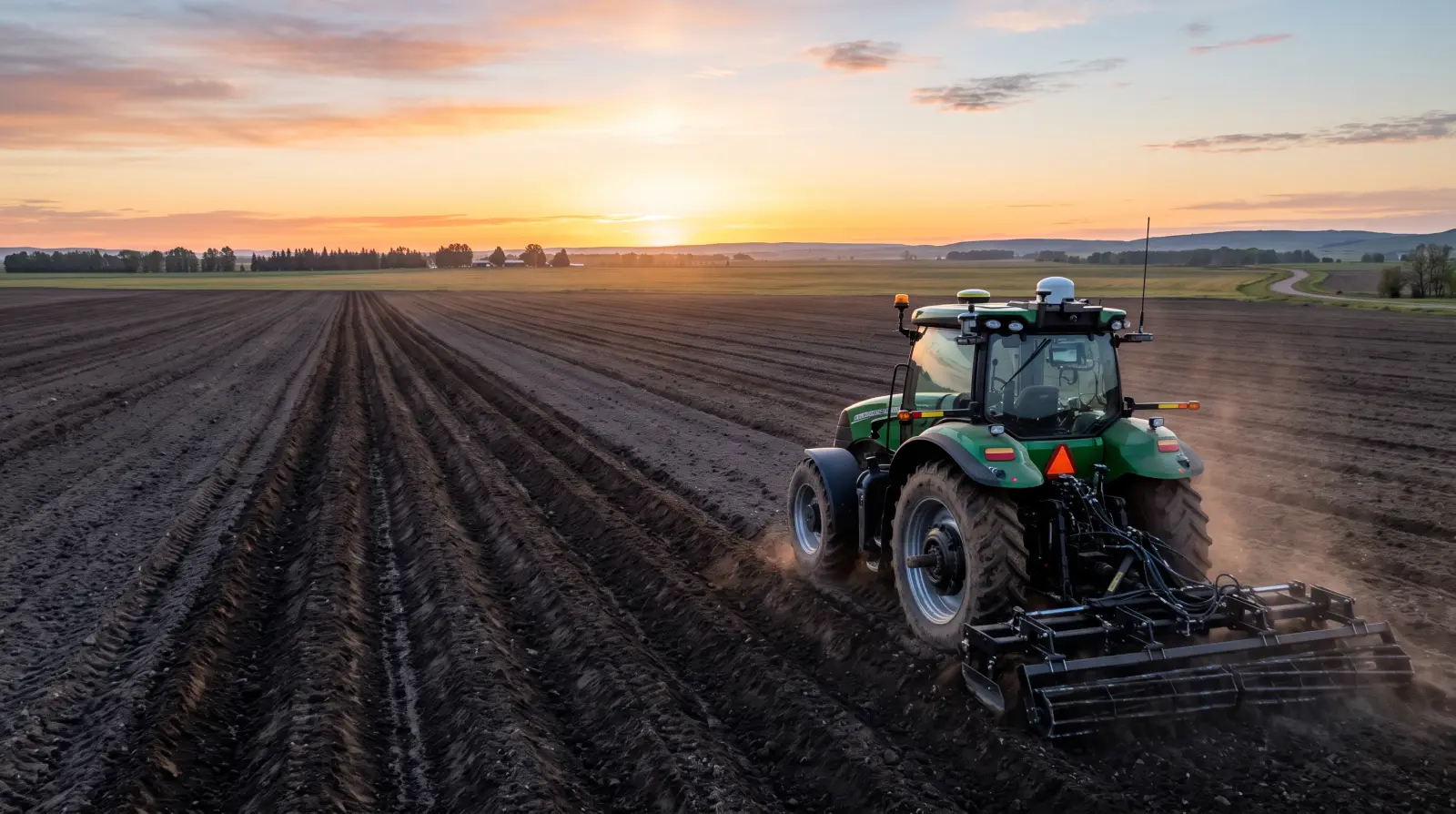
The autonomous tractor pitch has been on the trade show floor for a decade now, and the gap between the renderings on the booth banner and the iron actually working in fields has been embarrassing for most of that time. The shift in 2026 is that the gap has narrowed to the point where some of this technology is genuinely operational on real farms doing real work, while a meaningful share of it is still vapor wrapped in a press release. The job for an operator deciding whether to spend money on robotics this year is figuring out which category each specific product falls into, because the dealers and the manufacturers have an obvious incentive to blur that line until the deposit is signed.
This article is a working operator's read on what is actually ready to put to work in 2026, what is in serious pilot phase but not yet ready for a cash purchase, and what is still mostly a render and a rollout deck. It covers driverless tractors from the major manufacturers, the new wave of smaller purpose-built field robots, autonomous spraying and weeding systems, the autonomous orchard and vineyard equipment that has matured faster than most people expect, the labor and economic case that has to pencil out before any of this matters, the data and connectivity infrastructure these machines actually need to function, the safety and liability questions that are still unresolved in most jurisdictions, and concrete recommendations for the operations that should adopt now versus the operations that should wait for the next product cycle.
Before getting into specific products, the language has to be sorted out, because the manufacturers use the word autonomous to mean three very different things and the difference matters when the check is being written.
The first category is supervised autonomy, where the machine drives itself but a human has to be in the cab or in the field watching it. The autosteer systems that have been standard on row crop tractors for a decade are the simple version of this. The newer systems extend the autonomy to headland turns, implement raise and lower, and full coverage of a field, but still require an operator in the seat to handle anything unexpected. This is by far the most mature category and is delivering real value on most modern row crop operations.
The second category is remote-supervised autonomy, where the machine operates without a human on board but is being monitored by an operator who can see what it is doing through cameras and intervene when something goes wrong. This is where the genuinely interesting commercial deployments are happening in 2026. The operator might be at the home shop watching three or four tractors work different fields, or might be a contractor monitoring fleet across multiple farms. The technology has reached the point where this works for tillage, planting, and some other tasks under reasonable conditions, but it is not yet a fire-and-forget capability.
The third category is fully autonomous operation, where the machine is sent out to do a job and figures out everything on its own with no human watching. This is the category where most of the marketing lives and most of the actual products do not. There are some narrow exceptions in highly controlled environments like greenhouse operations and some very specific orchard tasks, but for general field work this remains aspirational. The press releases and the demo videos are not lying, but they are showing the best fifteen minutes of a system that struggles with the other twenty-three hours.
The honest answer to "are autonomous tractors here yet" depends entirely on which of these three categories the question is about. Category one is shipped and working. Category two is shipping and operational on real farms with caveats. Category three is mostly still vapor for general row crop work outside of narrow controlled environments.
Several specific products and platforms have moved from the demo phase into operational deployment with enough customer base to validate that they actually work in the field.
John Deere has the most mature commercial autonomous tractor product in the row crop market. The autonomous 8R, originally launched for tillage and now extended to other tillage and some seeding applications, is operating on a meaningful number of farms across the corn belt and is no longer purely a pilot product. The 9RX autonomous, launched at the 2026 model year, extends the capability to higher horsepower applications and adds support for a broader range of implements.
The actual operating model is the remote-supervised category described above. The tractor goes out and does its work while the operator monitors through the John Deere Operations Center mobile app, which streams camera feeds and operational data and allows the operator to intervene if something looks wrong. The system handles route planning, headland turns, implement control, and most of the routine variation that comes up during tillage. It does not handle hitching implements, refueling, refilling seed, or unexpected obstacles like a stuck deer or a wash-out across a turn row.
The pricing is meaningful. The autonomy package adds roughly $80,000 to $130,000 to the cost of a comparable conventional tractor, and the connectivity and software subscriptions add several thousand dollars per year on top. The economic case depends heavily on whether the operation can use the autonomy to displace labor or to extend the working window, which in turn depends on the operation's scale, labor situation, and crop mix. For a large operation that struggles to find quality help during planting and tillage, the math can pencil. For a smaller operation that has reliable family labor, it usually does not.
CNH Industrial has been slower to market with a full autonomous product than John Deere, but the 2026 lineup now includes autonomous capability on the larger Magnum and Steiger tractors through the company's partnership with Raven and the integration of Raven's autonomous technology after the 2021 acquisition. The product is more limited in operational scope than the John Deere offering and is targeted primarily at tillage and seeding applications.
The remote supervision model is similar to John Deere's, with the operator monitoring through the AFS Connect platform. The pricing is somewhat lower than the John Deere autonomy package, in part because the feature set is more limited. The economic case is similar to John Deere's, with the autonomy paying off in operations that have scale and labor constraints and not paying off in operations that do not.
AGCO has taken a more measured approach to autonomy and has focused on what they call partial autonomy that extends the existing autosteer and section control capability rather than full driverless operation. The Fendt 1100 MT and the Massey 9S series in 2026 model year include enhanced automation features that handle more of the operational decision-making but still require an operator in the cab. AGCO has stated that they will release driverless capability when they are confident in the safety and reliability, which has been read as both a virtue and a delay depending on who is talking.
For operations that already run AGCO equipment, the partial autonomy capability is a meaningful upgrade and reduces operator fatigue and the skill requirement for the seat. For operations looking specifically for driverless capability, AGCO is not currently the answer.
Monarch Tractor is the most interesting non-traditional entrant in the autonomous space. The product is a smaller electric tractor in the 70 to 75 horsepower range, designed primarily for orchard, vineyard, and specialty crop operations. The autonomy is a remote-supervised model similar to the major manufacturers, and the electric drive eliminates the diesel cost and the emissions for operations that have access to charging infrastructure.
The Monarch product has found genuine commercial traction in California vineyard and orchard operations, where the operating environment is more controlled and the labor cost is high enough to make the autonomy economics work. It is less applicable to broad acre row crop operations because the size and the electric range are not appropriate for that use case. The current pricing runs roughly $90,000 for the base autonomous configuration, which is competitive with comparable diesel tractors of similar size when the autonomy and the fuel savings are factored in.
The wave of smaller purpose-built field robots has produced several products that are operational in 2026, mostly in specialty crops and high-value vegetable production. Carbon Robotics' LaserWeeder, the BoniRob and similar German weeding robots from various manufacturers, the FarmWise weeding implements, and several others have moved from pilot deployments into commercial use on operations that have the appropriate crops and the appropriate scale.
The pricing varies dramatically by product, with the larger LaserWeeder running into the high six figures and the smaller weeding robots from various startups running anywhere from $50,000 to $250,000 depending on the configuration. The economic case is most compelling for organic vegetable operations where the alternative is hand weeding or expensive mechanical cultivation, and for high-value specialty crops where the per-acre revenue justifies a meaningful capital investment in weed control.
For row crop operators looking at this category, the honest answer is that most of these products are not appropriate for that use case. The economics work in specialty crops and break down in commodity row crops where the per-acre revenue does not support the equipment cost.
Several products have moved past pure marketing but are not yet ready for a normal commercial purchase decision.
Several manufacturers have shown driverless combine prototypes and have run pilots on customer farms, but no major manufacturer is yet selling a driverless combine as a standard product in 2026. The reasons are partly technical, since combines are more complex to automate than tractors due to the variability of crop conditions and the consequences of doing the job wrong, and partly commercial, since the manufacturers want to validate the safety and the customer support model before broad release. Expect this to begin shipping in limited markets in 2027 or 2028.
The major sprayer manufacturers have all shown autonomous sprayer concepts and several have run pilots, but the commercial release is still ahead. The combination of the chemical handling, the safety implications of running an autonomous machine spraying chemicals near roads and waterways, and the regulatory uncertainty has slowed the commercial rollout compared to autonomous tractors. The exception is autonomous spot spraying with the see-and-spray category covered in detail in our previous article on AI weed detection, which is operational but is currently sold as a feature on operator-driven sprayers rather than as a fully autonomous product.
Several startups are working on smaller field robots in the 30 to 80 horsepower range that would handle a variety of field tasks autonomously. The Solinftec Solix, the Sabanto autonomy kits that retrofit existing smaller tractors, the various European startups in this space, and others have shown working prototypes and run pilots but have not yet reached broad commercial availability with the support infrastructure that would make a confident purchase.
The Sabanto autonomy retrofit kit is particularly interesting because it allows existing tractors to be converted to autonomous operation rather than requiring a new tractor purchase. The pilot operations have produced mixed results, with some operations getting genuine value and others finding the system more trouble than it is worth. This is worth watching but is not yet a confident purchase decision.
The combination of autonomous tractors with autonomous grain carts and autonomous trucks for in-field material movement has been demonstrated by several manufacturers but is not yet a commercially shipping product. This is the category where the labor savings could be largest because the supporting roles around a combine or a forage harvester are often the harder ones to staff. Expect commercial product in this space within the next two to three years.
Several heavily-marketed concepts remain more rendering than reality.
The vision of sending a tractor out to do a job without any human monitoring is still aspirational for general row crop work. The current commercial products all require a human watching, either in the cab or remotely. The leap to no monitoring at all involves solving a number of unsolved problems including reliable obstacle detection in dust and low light, reliable handling of uncommon situations, and the legal and insurance framework for an unattended machine doing work in environments that the public may enter. Do not believe a 2026 marketing claim of fully unattended autonomous operation outside of carefully controlled environments.
The vision of multiple autonomous machines working a field together with one machine planting, another applying starter fertilizer, and a third doing residual herbicide all coordinated by a fleet management system, has been shown in concept but is not commercially available. The technology to do this exists in pieces but the integration and the commercial product has not been delivered. Expect this in the late 2020s, not in 2026.
The vision of a large number of small robots replacing one large machine has been pitched by various startups for years and has produced some interesting prototypes but no commercially viable product for row crop operations. The economics of having many small machines instead of one large machine do not pencil when the labor for managing many machines is factored in, and the productivity per unit cost of a small robot has not caught up to a large conventional machine. This may eventually be a category but it is not 2026 or 2027.
The vision of autonomous robots handling livestock care, feeding, and management has produced some interesting products in dairy and a few in confinement hog operations, but the open pasture livestock operations that are common in many regions remain firmly human-operated. Expect continued progress in confinement operations and limited progress in extensive grazing operations.
Before getting deep into product selection, the operation has to think clearly about whether autonomy will actually pay for itself, and the answer for most operations is conditional and not obvious.
The labor displacement case is the most straightforward in concept and the most variable in practice. If the operation is currently paying for hired labor for the tasks the autonomy would perform, the savings are real and quantifiable. The math for an operation paying $25 per hour for a tractor operator working 1500 hours per year is roughly $37,500 per year in direct labor savings, which is a meaningful number against an autonomy package that costs $80,000 to $130,000. The payback in this scenario is several years and pencils for many operations.
The math for an operation that is using family labor or owner labor is different. The hourly cost is harder to quantify, the willingness to substitute autonomy for the in-cab time is variable, and the operation may value the in-cab time as a way to know what is happening in the fields rather than as a labor cost. For these operations, the economic case has to come from elsewhere.
The window extension case is real for operations that are constrained by the limited daylight hours during planting or tillage. An autonomous tractor that can run 20 hours per day during the planting window adds productive capacity that can mean the difference between getting the crop in on time or losing yield potential. The value of this capacity depends on how often the operation actually hits the limit, which varies with operation size, weather, and equipment fleet.
The data and analytics case is more speculative. The autonomous tractors are gathering significant data about field conditions, equipment performance, and operational details, and the manufacturers are pitching the analytical value of this data as part of the autonomy purchase. The actual realized value of this data is still being validated and should not be the primary justification for an autonomy purchase.
The reduced operator fatigue case is real but hard to quantify. An operation where the principal is doing 20 hour days during planting will probably benefit from offloading some of the seat time to autonomy even if the cash savings are modest. This is more of a quality-of-life argument than a financial argument and should be considered as such.
The autonomous machines depend on reliable connectivity and the rural connectivity reality varies widely. The major manufacturers have built their systems to operate with intermittent connectivity, but reliable cellular or satellite connectivity is required for the remote supervision model to function. Operations in areas with poor cellular coverage need to plan for this with high gain antennas, signal repeaters, satellite backup connectivity, or some combination, and the cost of this infrastructure is a real part of the autonomy adoption budget.
The Starlink rollout has materially improved the connectivity picture for rural operations and is now a credible primary or backup connectivity solution for autonomous equipment monitoring. The terminal cost has come down to a few hundred dollars and the monthly service is reasonable for what it provides. For operations where cellular is marginal, this is the connectivity infrastructure to invest in.
The on-equipment compute and the edge intelligence has matured to the point where the autonomous machines can handle most of the routine decision-making locally without continuous cloud connectivity. The connectivity is required for monitoring and intervention rather than for the basic operation, which makes intermittent connectivity workable. The systems gracefully handle connectivity loss by stopping safely and waiting for connectivity to be restored.
The base station infrastructure for high-precision GPS guidance is essentially the same infrastructure that is already in place for advanced autosteer and is not a significant additional investment for operations that already have RTK capability. Operations that are looking at autonomous capability without an existing RTK infrastructure should plan for that as part of the cost.
The legal and insurance framework for autonomous farm equipment is still evolving in 2026 and varies significantly by state and country. Most of the major manufacturers have worked through the basic insurance and liability questions for their autonomous products in their primary markets, but the framework is less settled in some smaller markets and in some states with more cautious regulators.
The basic insurance question is whether the operation's existing farm liability coverage extends to autonomous equipment operation, and the answer in most cases is yes with some specific carve-outs and required notifications to the insurance carrier. The premium impact has been modest in most cases. Operations should specifically discuss this with their insurance carrier before putting an autonomous machine to work, because finding out after an incident that the coverage was inadequate is the worst possible time to learn.
The liability question if an autonomous machine causes property damage or injury is largely unsettled in case law because there have not yet been many incidents that have produced precedent. The consensus among the manufacturers is that the operator remains liable for the equipment even when it is operating autonomously, which is similar to the autopilot situation in aviation and the autonomous vehicle situation on public roads. This means the operator has to be paying attention to the remote monitoring and has to have the ability to intervene, and ignoring the equipment while it is working autonomously is not the safe choice from a liability perspective.
The road transport question for autonomous equipment moving between fields is more clearly resolved against autonomous operation in most jurisdictions. The current commercial autonomous tractors require a human operator for road transport and only operate autonomously in the field. This is unlikely to change significantly in the near term and adds a labor requirement back into the operation that the autonomy was supposed to displace.
For large row crop operations with significant scale and persistent labor challenges, the autonomous tractor purchase decision is genuinely worth considering in 2026 if the operation already has the infrastructure and the operational discipline to support it. The John Deere autonomous 8R or 9RX is the most mature commercial product and is the safer purchase decision. Expect a multi-year payback and plan for the connectivity, training, and operational adjustments that will come with adoption.
For mid-size row crop operations with adequate labor, the recommendation is to wait one or two more product cycles. The technology will continue to mature, the price will continue to come down, the support infrastructure will continue to improve, and the early adoption risk will be substantially reduced. There is no compelling reason for these operations to be on the leading edge in 2026.
For specialty crop operations with high labor costs, the autonomous weeding and field robot category is genuinely worth evaluating now. The economic case for products like the Carbon Robotics LaserWeeder in organic vegetable operations is strong and the technology has matured to the point of being a confident purchase. Look at the specific products that match the crops and the operation, and run the actual labor displacement math against the equipment cost.
For orchard and vineyard operations in regions with high labor cost, the Monarch Tractor and similar products in the smaller autonomous tractor category are worth evaluating. The combination of the autonomy and the electric drive is genuinely compelling for these operations and the products are mature enough to support a commercial purchase decision.
For livestock operations, autonomous robotics is mostly not yet relevant outside of specific dairy and confinement applications. The progress will continue but is not at the point of operational relevance for most pasture-based livestock operations.
For all operations, the connectivity and infrastructure question should be addressed regardless of whether autonomous equipment is being adopted. Reliable connectivity for monitoring, data, and basic communications is a foundational investment that pays for itself in a number of ways and should not be deferred.
The trajectory of farm autonomy in 2026 and beyond is reasonably clear. The remote supervised category will continue to mature and broaden, with more manufacturers, more equipment categories, and lower costs. The autonomous combines and sprayers will reach commercial release in the 2027 to 2028 timeframe. The fully unattended autonomy will remain elusive for general field work but will continue to make progress in controlled environments. The smaller field robots will continue to find product-market fit in specific specialty crop and vegetable applications.
The economic case will continue to improve as costs come down and as the labor situation continues to tighten in many regions. The connectivity infrastructure will continue to improve through Starlink and other satellite providers, removing one of the historical adoption barriers. The legal and insurance framework will continue to settle as more operations adopt the technology and produce more operational experience.
The bottom line for operators in 2026 is that some of this technology is genuinely ready and worth buying, some of it is close enough to monitor seriously, and some of it remains the marketing department's wishful thinking. The job is to know which is which before the check is signed, and to make the autonomy purchase decision based on the actual economics of the specific operation rather than on the marketing pitch of the technology category.
Not for general row crop work. Today's commercial products are remote-supervised: the tractor drives itself while an operator watches through an app and can intervene, as with the John Deere autonomous 8R and 9RX. Fully unattended operation with no human monitoring exists only in narrow controlled settings like greenhouses. Any 2026 marketing claim of fire-and-forget field autonomy is ahead of the reality.
John Deere's autonomy package adds roughly 80,000 to 130,000 dollars over a comparable conventional tractor, with connectivity and software subscriptions running several thousand dollars a year on top. Against labor priced near 25 dollars an hour for 1,500 hours, about 37,500 dollars a year, the payback runs several years and pencils mainly for large operations with persistent hired-labor shortages.
Yes. The current systems are remote-supervised, so an operator monitors camera feeds and operational data and steps in for anything the machine cannot handle, such as hitching implements, refueling, refilling seed, or an unexpected obstacle. Manufacturers and the emerging liability consensus hold the operator responsible even during autonomous work, so ignoring the machine while it runs is not the safe choice.
No. Current commercial autonomous tractors operate driverless only in the field and require a human operator to move them between fields on public roads, and that is unlikely to change soon in most jurisdictions. It quietly adds back a labor requirement the autonomy was meant to remove, so road transport between scattered fields still needs a person in the seat.
Join our list for practical guides on farm tech, precision agriculture, and tools that work.