
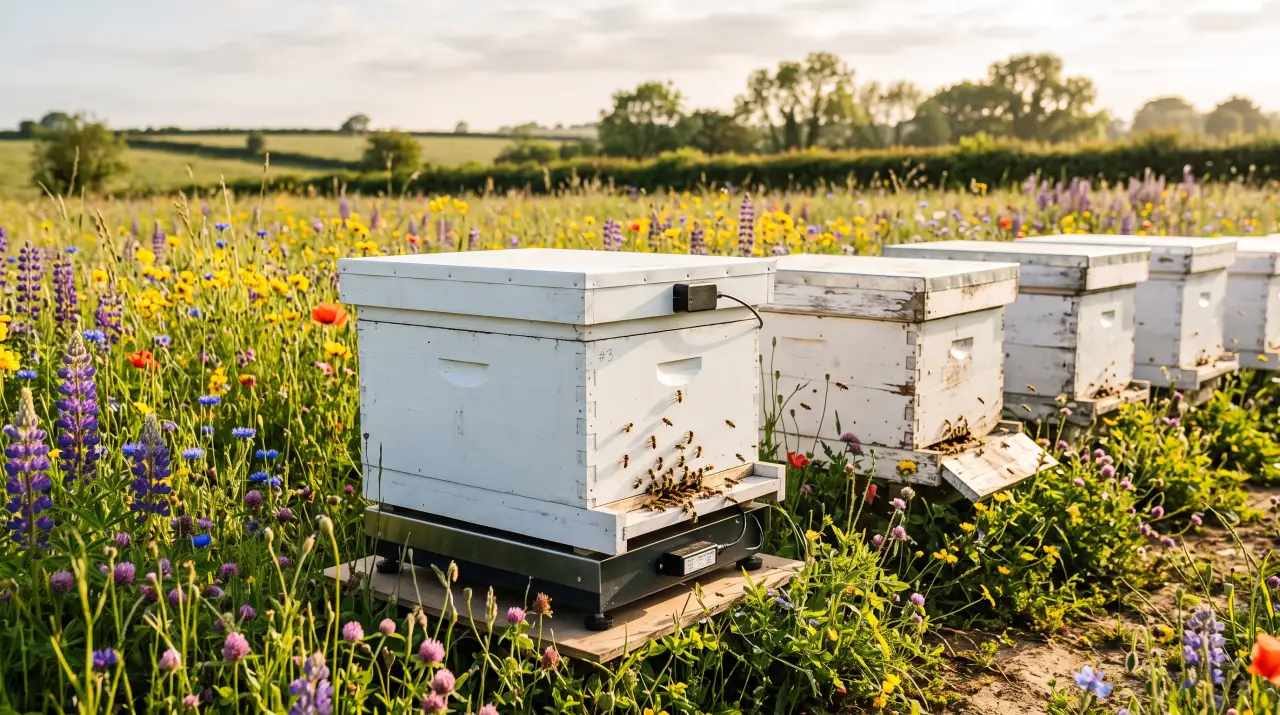
A colony of honey bees is one of the few livestock units on a farm that gives almost no warning before it fails. A herd of cattle looks sick before it dies. A field of corn shows stress for days before a yield loss locks in. A bee colony, by contrast, can be queenless for three weeks, can be robbed out in an afternoon, can starve in a January cold snap, or can swarm away half its workforce on a warm morning, and the beekeeper standing in the same yard a week later may have no idea any of it happened until the next full inspection. Hive monitoring technology exists to close that information gap. It will not run the operation, and it does not replace the skill of reading a frame, but it changes the timing of when a beekeeper learns that something is wrong, and in beekeeping the timing of that knowledge is most of the game. This guide is the working version of what the monitoring hardware actually measures, what each sensor type is good and bad at, what it costs, and how to turn the data into decisions instead of into a dashboard nobody looks at.
The instinct of a beekeeper new to monitoring is to want every possible data stream on every hive. That is the wrong way to start, because each sensor type answers a different question, and the questions are not equally valuable. The honest ranking, for a working operation, runs roughly like this: weight tells you the most for the least money and effort, temperature tells you a useful but narrower story, acoustic monitoring is the most interesting and the least mature, and humidity and gas sensors are mostly supporting players. A beekeeper who understands what each stream is actually reporting will spend money in the right order and avoid the common mistake of buying a fully instrumented hive that produces a flood of numbers and no clear actions.
The other thing worth saying up front is that monitoring is most valuable on the hives a beekeeper cannot easily get to. A backyard beekeeper with four hives in the garden gets modest value from sensors, because the cost of walking out and lifting the lid is close to zero. A sideline or commercial operation with yards spread across fifty or a hundred miles gets enormous value, because every drive to a remote yard costs fuel and an hour or more, and a sensor that says "do not bother driving to the Henderson yard this week, everything is normal" is saving real money on every reading. The economic case for monitoring scales with the distance between the beekeeper and the bees.
If a beekeeper is going to instrument hives with exactly one sensor, it should be a scale. Continuous weight is the richest single data stream in beekeeping because the weight of a hive is the sum of almost everything that matters, and the rate of change of that weight is even more informative than the absolute number.
A hive scale is a load cell, or a set of load cells, placed under the hive that records total weight on a schedule, typically every fifteen minutes to every hour. The raw weight by itself is useful - it tells you roughly how much stores the colony is sitting on - but the daily and seasonal weight curve is where the real information lives. During a strong nectar flow a healthy colony will gain weight steadily through the day and lose a small amount overnight as the bees cure honey and drive off water, producing a stair-step climb that can run three to fifteen pounds a day depending on the forage and the colony's strength. When that climb flattens, the flow is ending, and the beekeeper knows to start thinking about pulling supers and about whether the bees will need feeding. When the curve turns into a slow daily decline through late summer and fall, the colony is consuming its stores, and the slope of that decline is a direct forecast of whether the hive will have enough to reach spring.
The events a scale catches are the ones that matter most. A swarm shows up as a sudden weight drop of two to five pounds in the space of fifteen or thirty minutes on a warm late-morning - the departing bees and the honey in their stomachs leave all at once, and no other event produces that signature. A robbing event shows up as a steep, sustained weight loss over hours, often late in a dearth, as a stronger colony strips a weaker one. A dead-out shows up as the daily foraging rhythm flattening to a dead-flat line, because there are no foragers leaving in the morning and returning at night. A queenless colony slowly loses its foraging rhythm as the population ages out with no replacements. Starvation shows up as the weight curve hitting a floor in winter and the colony going silent. A beekeeper reading a scale graph learns most of this without ever opening the hive.
The winter value of a scale is hard to overstate. Opening a hive in cold weather is stressful for the colony and tells the beekeeper very little, because the cluster cannot be properly inspected without breaking it apart. A scale lets the beekeeper watch the slow, steady drawdown of winter stores from a warm office and know, weeks ahead, which colonies are on track and which are running their stores down too fast and will need emergency feed. The difference between catching a starving winter colony in week two of the problem versus discovering it dead in March is the difference between a save and a loss.
Scale hardware ranges widely in price and quality. A simple single-load-cell or two-load-cell setup that the beekeeper builds or buys as a kit runs $50 to $150 plus a connectivity solution. A full four-corner commercial scale platform with its own cellular link and a multi-year battery runs $200 to $500 per hive. The cheaper setups are sensitive to how the hive sits on them and to temperature drift in the load cells, which shows up as a slow daily wobble in the data that has nothing to do with the bees - good units compensate for this and cheap ones do not. For a commercial operation, the right pattern is usually not to scale every hive but to scale two or three representative hives per yard and treat them as the yard's instrument, because hives in the same yard on the same forage move together closely enough that a few scaled hives report for the whole group.
Temperature is the second data stream worth having, and it tells a specific story: a honey bee colony with an active laying queen and developing brood holds the brood nest at a remarkably stable 93 to 95 degrees Fahrenheit, and it holds that temperature with far more precision than the outside air, regulating it through the bees' own metabolism and behavior. That biological fact is what makes brood-nest temperature a useful sensor.
A temperature probe placed in the center of the brood nest, between the frames where the brood is, will read in that 93 to 95 degree band whenever the colony is broodright and healthy. When the probe reading starts tracking the outside air more closely, or when it falls and stays low, the colony has stopped maintaining a brood nest - which usually means it has gone queenless, has become hopelessly weak, or has died. A temperature sensor will not tell the beekeeper why the brood nest collapsed, but it will tell them that it has, often a week or more before a hive inspection would catch it. For an operation trying to find its queen problems early, brood temperature is a genuinely useful early-warning channel.
Temperature also reads the winter cluster. In cold weather the colony forms a cluster and a probe in the right spot will show the cluster's presence and, as the cluster shifts and contracts, give a rough sense of colony vitality. A cluster that has gone cold and stays cold is a dead-out. Temperature data in winter is best read alongside the scale data - the two together tell a much clearer story than either alone.
The practical weakness of temperature sensing is placement. A probe an inch from the brood reads beautifully; a probe on the wall of the box or in the wrong corner reads mostly the weather. The bees also move the brood nest through the season, so a probe that was in the brood in April may be in the honey by July. Multi-probe strips that run several sensors up through the hive solve this by always having at least one sensor near the action, and the better monitoring systems use exactly that approach. A single fixed probe is cheap but its reading needs to be interpreted with the knowledge that placement, not just colony health, drives the number.
A beehive is a noisy place, and the noise carries information. Beekeepers have known for centuries that a colony's sound changes with its state - the old practice of judging a colony by ear at the entrance, or by rapping the box and listening to the response, is acoustic monitoring done with the human ear. Modern acoustic sensors put a microphone or a vibration sensor inside or against the hive and analyze the frequency content of the sound continuously. The promise is large and the technology is real, but it is also the least mature of the monitoring tools, and a beekeeper should buy into it with clear eyes.
The signal that acoustic monitoring reads most reliably is the queenless roar. A colony that loses its queen changes its sound within hours to a day - the steady, contented hum shifts toward a higher, more agitated, less organized sound that experienced beekeepers describe as a roar or a wail. Acoustic systems can detect this shift, and queenlessness detection is the acoustic feature with the strongest track record. Catching a queen loss a day after it happens, rather than at the next inspection three weeks later, is worth real money, because a colony caught queenless early can still be requeened before its population crashes.
The other acoustic signal with good support is swarm prediction. In the days before a colony swarms, the sound changes in ways the systems can pick up, including the distinctive piping of queens, and a swarm itself produces an unmistakable acoustic and weight signature when it happens. A system that flags a colony as building toward a swarm gives the beekeeper a window to intervene with a split or other swarm-control measures before the colony leaves and takes the honey crop with it.
Beyond queenlessness and swarming, acoustic claims get softer. Vendors market acoustic detection of colony strength, of foraging activity, of mite load, and of general health, and some of these have research behind them while others are closer to marketing than to settled science. A beekeeper evaluating an acoustic product should ask specifically which detections the vendor stands behind with field data, treat the queenless and swarm features as the proven core, and treat the rest as promising but unproven. Acoustic monitoring is improving fast, and it is worth watching, but it is not yet a tool a working beekeeper should rely on for the subtler diagnoses.
Every honest discussion of hive monitoring has to be clear about varroa. The varroa mite is the single largest killer of honey bee colonies in most of the world, and a sensor that could report a colony's mite load continuously and accurately would be the most valuable monitoring tool ever built. That sensor does not yet exist in a form a beekeeper can trust.
There are products and research efforts working on it. Some use cameras at the hive entrance with image analysis to count mites visible on returning foragers. Some use acoustic or behavioral proxies. Some use other indirect signals. The research is genuine and progress is being made, but as of now there is no monitoring product that a beekeeper can install and rely on to replace a physical mite count. The beekeeper still has to do the work - an alcohol wash, a sugar roll, or a sticky-board count - to know a colony's mite load with the accuracy that treatment decisions require.
What monitoring does contribute to mite management is indirect and still useful. A colony that is failing from a heavy mite load and the viruses the mites carry will often show it in the other data streams first: weight that stops climbing or starts falling out of season, a brood temperature that destabilizes, an acoustic profile that drifts. Monitoring can flag the colony as in trouble and prompt the beekeeper to go pull a mite count. That is worth having. But a beekeeper who buys a monitoring system expecting it to manage varroa for them has misunderstood what the technology can currently do, and that misunderstanding can be fatal to the bees. Physical mite testing on a schedule remains non-negotiable.
The sensors are the interesting part of hive monitoring, but the connectivity and power are the part that determines whether a system actually works in the field for years, and beekeepers consistently underestimate this. A sensor that produces perfect data and then cannot get that data off a hive in a valley with no cell signal is worthless.
There are three common connectivity approaches and they suit different situations. The first is cellular - each hive unit, or each yard gateway, has its own cellular modem and SIM and uploads directly to the vendor's servers. Cellular is simple and works anywhere there is a usable signal, which in rural and remote bee yards is not a given - many good forage locations are exactly the places with poor coverage. Cellular also carries an ongoing data plan cost, usually a few dollars per month per unit or per gateway. The second approach is LoRa, a low-power long-range radio - the hive units talk over LoRa to a single gateway in the yard, and only the gateway needs cellular or internet backhaul. LoRa is the right architecture for a yard with many instrumented hives, because it puts the expensive, power-hungry cellular link in one place instead of in every hive. The third approach is store-and-forward, where units log data locally and the beekeeper collects it over Bluetooth or short-range radio when they visit the yard. Store-and-forward needs no signal and no data plan, but it gives up the entire remote-monitoring advantage, because the beekeeper only sees the data when they are already standing at the hive.
Power is the other half of the field-reliability problem. A monitoring unit that needs its battery changed every few months in a remote yard will get neglected and will quietly stop reporting. The good systems either run a primary battery sized to last one to three years, or pair a small solar panel with a rechargeable battery for indefinite operation. Solar is the right answer for permanent yards, with the caveat that the panel has to be placed and angled so it actually gets sun and does not get covered by vegetation, snow, or the bees' own propolis and debris. Cold weather also cuts battery performance hard, and a system that runs fine in summer can go quiet in a January cold snap exactly when the winter weight data is most valuable - worth checking that a system is rated for the beekeeper's actual winter temperatures.
Hive theft is a real and growing problem, particularly in regions where hives are trucked in for pollination contracts and concentrated in large, valuable, poorly guarded blocks. A pallet of strong colonies represents thousands of dollars, and organized hive theft has become serious enough in some pollination regions that it is treated as a law-enforcement category of its own.
Monitoring helps with this in a few ways. A scale registers a theft immediately - a hive that goes from its normal weight to zero, or that shows the weight signature of being lifted and moved, generates an alert in real time rather than being discovered missing on the next yard visit. GPS tracking units, hidden inside a hive body or under a pallet, let a stolen hive be located and recovered, and a number of thefts have been solved exactly this way. Some systems add an accelerometer that detects tipping or movement and alerts on it, which catches both theft and the more mundane problem of a bear, livestock, or wind knocking hives over. For an operation doing pollination contracts in high-theft areas, the security function alone can justify instrumenting the yards, separate from any of the biological monitoring value.
The failure mode of hive monitoring is not bad sensors. It is good sensors feeding a dashboard that the beekeeper checks obsessively for the first month and then never opens again. Monitoring only pays off if it changes what the beekeeper does, and that requires setting it up around decisions rather than around data.
The practical approach is to run the system on alerts, not on graphs. The beekeeper should not be expected to study weight curves every morning. The system should be configured to push a notification only when something actionable happens: a swarm-signature weight drop, a sustained robbing loss, a brood temperature that has collapsed, a hive that has gone to a dead-flat foraging line, a unit that has stopped reporting. A beekeeper who gets a quiet phone most days and a specific, meaningful alert when a hive needs attention will keep using the system for years. A beekeeper who has to go interpret graphs to extract the same information will drift away from it within a season.
The second principle is to use monitoring to triage yard visits, not to replace them. The data tells the beekeeper which yards and which hives need a physical visit this week and which can wait, which turns a fixed inspection rotation into a priority-driven one. The remote yard with three normal scale curves can be skipped; the yard with one hive showing a swarm signature gets visited today. Over a season spread across many yards, that triage saves a large amount of driving and concentrates the beekeeper's hands-on time where it actually matters. The hive inspection does not go away - frames still have to be pulled, brood patterns still have to be read, mites still have to be counted - but monitoring decides when and where that work happens.
A realistic budget for hive monitoring depends entirely on the architecture. Instrumenting a single hive fully - scale, temperature, acoustic, with its own cellular link - runs $200 to $600 in hardware plus an ongoing connectivity and platform subscription of a few dollars a month. Instrumenting a yard with a LoRa gateway and lighter sensor units on a representative sample of hives spreads the cellular cost and brings the per-hive number down substantially. A beekeeper who builds simple scales from load-cell kits and handles their own data can get the per-hive hardware cost into the $50 to $150 range at the expense of more setup labor and less polish.
The return is easiest to see in three places. The first is prevented winter losses - a beekeeper who catches starving colonies in time to feed them, across a winter, can save several colonies that would otherwise be dead by spring, and a replacement colony costs $150 to $250 in a package or nuc plus the lost season of production. The second is saved swarms - a swarm caught and prevented keeps a colony's foraging force intact through the honey flow, and the difference between a hive that swarmed in May and one that did not can be a full super or more of honey. The third is saved driving, which is pure operating cost: a sideline beekeeper with yards spread over a county can cut a meaningful fraction of their windshield time by visiting on data instead of on a calendar. For a hobbyist with a few hives in the backyard the numbers rarely justify a full system, and that is fine - monitoring is a tool that earns its place as the operation gets bigger and more spread out.
It is worth being blunt about the limits. Hive monitoring does not requeen a colony, does not treat mites, does not feed a starving hive, and does not read a brood frame for laying pattern, disease, or queen quality. It does not replace the skill of beekeeping and it does not replace the inspection. American foulbrood, European foulbrood, chalkbrood, a failing queen laying a spotty pattern, the early signs of a colony preparing to supersede - these are seen with the eyes and hands, on the frames, by a beekeeper who knows what they are looking at. A beekeeper who treats a monitoring dashboard as a substitute for opening hives will miss exactly the things that the dashboard cannot see, and some of those things kill colonies and spread to neighbors.
The right mental model is that monitoring changes the timing and the targeting of the beekeeper's attention. It tells them sooner that a colony is in trouble, and it tells them which colony, so the skilled work happens earlier and in the right place. It is a scheduling and early-warning tool wrapped around a craft that still has to be practiced by hand. A beekeeper who buys it with that understanding will get years of value out of it. A beekeeper who buys it expecting it to keep bees for them will be disappointed, and so will the bees.
For a beekeeper deciding where to start, the sensible progression is clear. Begin with scales, and not on every hive - put a quality scale under two or three representative hives per yard and learn to read the curves through a full season, flow, dearth, and winter. That single step delivers most of the available value and teaches the beekeeper what monitoring data actually looks like for their bees and their forage. Add temperature sensing next, particularly if queen problems are a recurring headache, because brood-nest temperature is the cleanest early signal of a colony losing its queen. Treat acoustic monitoring as a worthwhile addition for queenless and swarm detection, while staying skeptical of the broader claims. Add GPS and security sensors wherever theft is a credible risk, especially on pollination hives. And under all of it, keep doing the physical work - the inspections, and above all the regular mite counts - because no sensor on the market yet replaces them.
Used this way, hive monitoring is one of the better technology investments a growing bee operation can make. It does not make the bees easier to keep, but it makes the beekeeper's knowledge of the bees timelier and more accurate, and in an animal that fails fast and quietly, timely and accurate knowledge is most of what stands between a colony and a dead-out.
A scale. Continuous weight is the richest single data stream because a hive's weight sums almost everything that matters, and its rate of change tells even more. Rather than instrumenting every hive, put a quality scale under two or three representative hives per yard, since colonies on the same forage move together closely enough that a few report for the whole group.
Yes, distinctively. A swarm shows up as a sudden weight drop of two to five pounds within fifteen to thirty minutes on a warm late morning, as the departing bees and the honey in their stomachs leave all at once. No other event produces that signature. Robbing, by contrast, reads as a steep sustained loss over hours, usually during a dearth.
Not reliably yet. No monitoring product can replace a physical mite count, so an alcohol wash, sugar roll, or sticky-board count on a schedule remains non-negotiable. What sensors do offer is indirect: a colony failing from mites often shows it first as weight that stops climbing, a destabilizing brood temperature, or a drifting acoustic profile, which prompts the beekeeper to go pull a count.
A colony with an active laying queen and developing brood holds the brood nest at a remarkably stable 93 to 95 degrees Fahrenheit, regulating it far more precisely than the outside air. When a center-nest probe starts tracking outdoor temperature instead, the colony has usually gone queenless, grown hopelessly weak, or died, often a week before an inspection would reveal it.
Join our list for practical guides on farm tech, precision agriculture, and tools that work.