
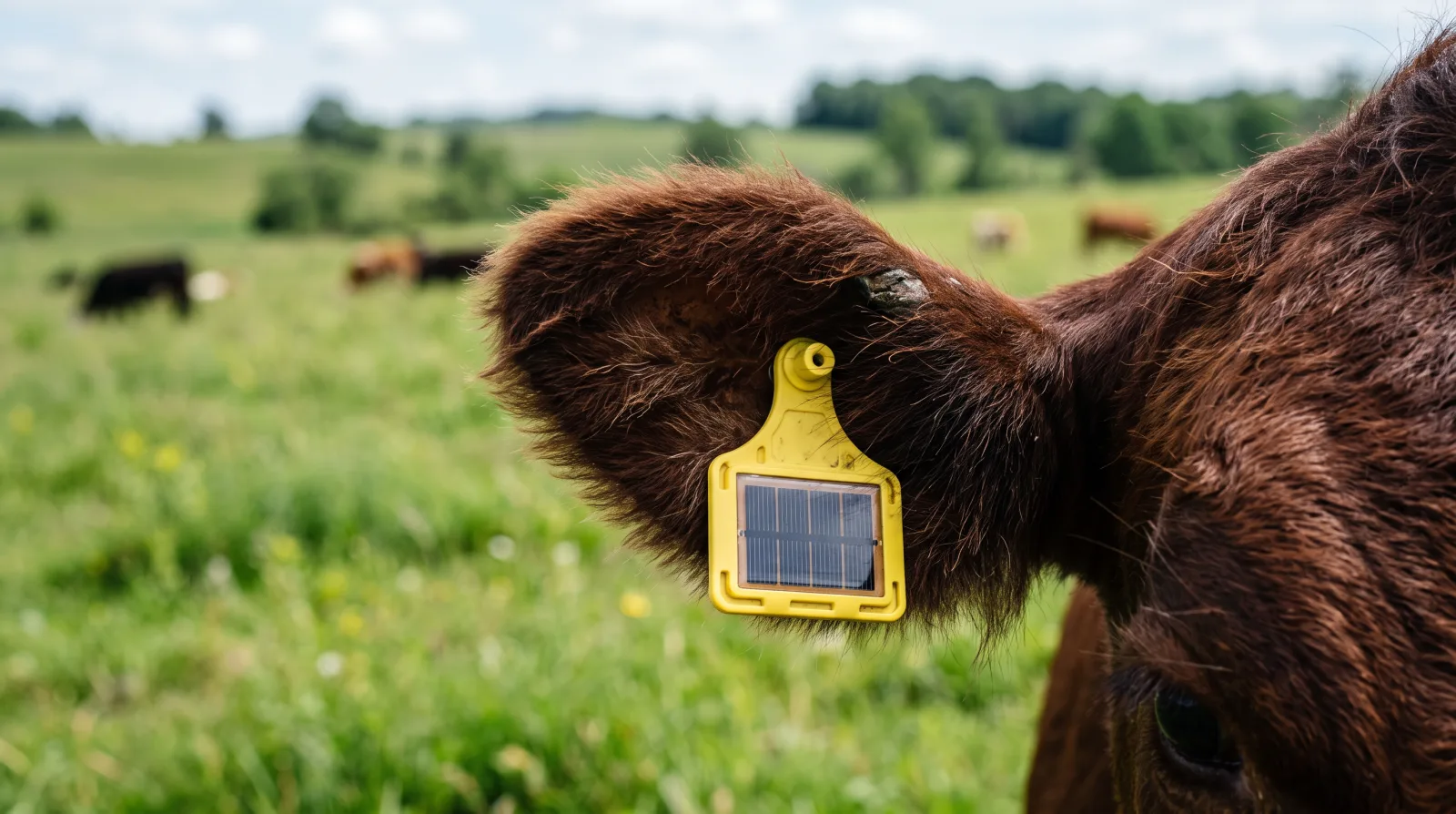
Cattle GPS ear tags arrived on the scene with a pitch that any rancher who has spent an afternoon fitting and adjusting collars finds immediately appealing: put the locating hardware in the ear, where you are already tagging the animal, and skip the collar entirely. The promise is a lighter device, a familiar handling workflow, no neck-fit problem to manage across a season of changing body condition, and a path to the same herd location data that the collar systems deliver. The 2026 reality is more nuanced than the pitch, and the honest read for a working operation is that GPS ear tags have become a genuinely useful tool for tracking, location, and animal welfare monitoring, while the virtual fencing function that gets bundled into the same conversation remains, for the most part, a collar job rather than an ear tag job. Understanding why that split exists is the difference between buying hardware that solves your problem and buying hardware that solves a problem you do not have.
This is a working rancher's read on cattle GPS ear tags and virtual fencing as the technology stands in 2026: what the ear tag form factor actually does well, where it falls short of the collar systems, why the physics of virtual fencing pushes the active containment function toward the collar, what the field performance has looked like across different terrains and herd sizes, and how to decide which form factor and which system fit your operation. The goal is to give you enough detail to make the call rather than enough enthusiasm to make the sale, because the marketing in this category has gotten ahead of the field experience in a few places and a careful buyer can avoid the gap.
The first thing to get straight is that GPS ear tags and virtual fencing collars are not two brands of the same product. They are two different form factors built around two different sets of physical constraints, and those constraints determine what each one can actually do. A collar wraps the animal's neck, which gives it room for a larger battery, a meaningful solar panel, a speaker positioned near the ear for an audio cue, and electrodes that sit against the neck for the electrical stimulus that makes virtual fencing work. An ear tag has none of that real estate. It is a small device that has to fit in the ear, weigh little enough that it does not tear out or cause irritation, and run on a battery small enough to fit the package.
That size constraint cascades through everything. The ear tag has less battery capacity, a smaller solar surface, less room for a radio antenna, and no practical way to deliver the kind of electrical stimulus that trains an animal to respect a virtual boundary. What the ear tag gives up in capability it gains in three places that matter to a working operation. It fits the handling workflow that ranchers already run, because you are already putting tags in ears and the GPS tag goes in at the same time as the EID and visual tags. It eliminates the neck-fit management problem that is a real recurring chore with collars, where a tag too loose rotates and loses electrode contact and a tag too tight causes irritation. And it tends to be lighter on the animal, which matters for welfare and for the smaller and younger animals where a collar is awkward.
The practical implication is that the form factor decision should follow the job. If the job is knowing where the cattle are, getting an alert when an animal stops moving or leaves an area, finding strays in rough country, and picking up the early welfare signals that show in movement data, the ear tag is a strong fit and often the better fit. If the job is active containment - keeping cattle inside a boundary that you drew on a map without building physical fence - the collar is still the tool that does it, and the ear tag is not a substitute. A surprising number of operations buy into the technology without separating these two jobs in their own minds, and the result is either disappointment that the ear tags do not contain the herd or wasted spending on collars where simple tracking tags would have done the work.
A modern cattle GPS ear tag packs a GPS or GNSS receiver, a low-power radio for sending position data off the animal, a small battery, and in most designs a small solar cell to extend the battery life. The tag wakes on a schedule, takes a position fix, and transmits that fix to a backhaul network that carries it to a cloud platform where the rancher sees it on a phone app or web dashboard. The whole design is an exercise in power budgeting, because the battery is small and every position fix and every transmission costs energy. That is why the update interval on most ear tags is measured in hours rather than minutes, and why pushing for more frequent updates drains the battery faster and shortens the deployment.
The backhaul - how the position data gets from the tag to the cloud - is the single biggest design difference between systems and the thing a rancher should look at hardest. Some tags use cellular, which works where there is cell coverage and fails where there is not, which describes a great deal of the extensive grazing country where location data would be most valuable. Some use LoRaWAN or a similar low-power long-range radio that talks to base stations the operation installs on towers, windmills, or high points, which works well in a defined area but requires the infrastructure investment and the line-of-sight planning to set up. And some, most notably the satellite-connected tags, transmit directly to low-earth-orbit satellites, which solves the coverage problem entirely at the cost of a lower update frequency and a dependence on the satellite provider's network and pricing.
The satellite approach is the one that has gotten the most attention for extensive rangeland because it is the only backhaul that works everywhere with no ground infrastructure. Ceres Tag, an Australian company, built its product around direct-to-satellite connectivity specifically so that the tag works in country with no cell coverage and no base station network, and the design tradeoff is that the position updates come a few times a day rather than continuously. For an operation that wants to know roughly where the cattle are and get an alert if an animal leaves the property or stops moving, a few fixes a day is plenty. For an operation that wants minute-by-minute tracking during a gather, it is not, and that mismatch is exactly the kind of thing a buyer should sort out before the purchase rather than after.
The data the tags produce is more than just a dot on a map. Movement patterns are a genuine welfare signal, and the systems have built alerting around it. An animal that stops moving for an unusual stretch, an animal that breaks from its normal grazing pattern, an animal that leaves a defined area - all of these throw alerts that a rancher can act on. The welfare case is often stronger than the location case for operations that run cattle in country where a sick or down animal might otherwise go unnoticed for days, because the movement data flags the problem before any other symptom is visible from a truck or a horse.
Virtual fencing is the function that gets people excited, and it is the function where the ear tag form factor runs into the wall. Virtual fencing works by training the animal to respect a boundary drawn on a map. As the animal approaches the line, the device plays an escalating audio tone, and if the animal crosses anyway, it delivers a brief electrical stimulus. Over a training period of days to a few weeks, the animal learns to turn back at the audio cue, and a trained herd responds to the tone alone the large majority of the time so that the stimulus is rarely actually delivered.
That training loop depends on hardware that an ear tag does not have room for. The audio cue needs a speaker loud and clear enough for the animal to associate with the boundary, and the stimulus needs electrodes with enough contact and enough delivery capability to register as a meaningful correction. A collar carries both comfortably, with the speaker near the ear and the electrodes against the neck where contact is reliable. An ear tag has a tiny package, a small power budget, and an electrode contact situation in the ear that is far less favorable for delivering the kind of consistent, well-located cue that effective and welfare-acceptable training requires. The result is that the established, field-proven virtual fencing systems - the ones with real containment data behind them - are collar systems, not ear tag systems.
This is not a marketing problem that the next product cycle solves. It is a physics and power problem, and it is the reason the honest framing of the category in 2026 is that GPS ear tags are tracking and monitoring devices, while virtual fencing is a collar function. There is real research and development work aimed at shrinking the active containment hardware toward an ear tag form factor, and it is plausible that the gap narrows over the next several years, but a rancher buying today should treat virtual fencing and ear tags as separate purchases addressing separate jobs rather than assuming a single ear tag does both. When a product pitch implies that an ear tag will both track and contain the herd, that is the claim to dig into hardest, because it is the claim most likely to be ahead of the field evidence.
For the operations that genuinely need active containment, the collar systems are the proven path, and the field experience with them is now substantial. Vence, a U.S. company acquired by Merck Animal Health, is focused on cattle in extensive grazing and has built a mesh-network architecture that handles the connectivity problem in poor-coverage country better than cellular-direct designs. Halter, out of New Zealand, has the deepest track record in pastoral dairy and intensive rotation. Nofence, the Norwegian company with the longest commercial history, covers cattle along with sheep and goats. Gallagher's eShepherd, commercialized from the CSIRO research in Australia, rounds out the set. All of these are collar systems, and an operation that needs virtual fencing is shopping in that group rather than in the ear tag group.
The field results split cleanly along the tracking-versus-containment line, which is the cleanest evidence that the two jobs really are different jobs. On the tracking side, the ear tag experience has been broadly positive for the operations that bought the right tool for the right job. Ranchers running extensive country with poor cell coverage and a satellite-connected tag report that the location and welfare alerting deliver real value: strays get found faster, theft and predation get caught sooner, down or sick animals get flagged days earlier than they would have been otherwise, and the documentation of where cattle are spending their time has improved grazing distribution decisions. The value is concentrated in operations where the cattle are spread across enough country, in enough timber or rough terrain, that simply locating an animal was previously a real time cost.
The performance limitations on the tracking side are mostly about update frequency and battery life rather than about whether the basic function works. Operations that expected continuous tracking and bought a tag designed for a few fixes a day were disappointed, which is an expectations-setting failure rather than a hardware failure. Battery life in field conditions has generally met the manufacturers' claims when the deployment matches the design assumptions, and has fallen short when operations pushed the update frequency higher than the solar and battery budget supported. Tag retention - whether the tag stays in the ear over months and seasons - has been the other real-world variable, and it tracks closely with application technique and ear tag placement, the same as it does with conventional EID tags.
On the containment side, the collar field results have been encouraging with well-understood caveats. Multi-year trials by university and USDA research groups on rangeland cattle have shown containment rates above 95 percent for trained herds across most conditions. The exceptions are instructive and consistent across studies: containment drops in the first week on a new boundary in unfamiliar terrain, drops where GPS signal is degraded by canyon walls or heavy timber, drops when collar batteries run low or backhaul goes intermittent, and drops with bulls during breeding season when the social drive overrides the trained avoidance. Pastoral dairy operations running daily strip grazing with collars have reported labor savings on the order of one to two hours a day along with better pasture utilization, and rotational grazing operations running many paddock moves per season have offset a meaningful share of the collar cost against the polywire labor they no longer do. None of those containment results come from ear tags, which is the point.
The two specifications that determine whether a GPS ear tag works for your operation are battery life and connectivity, and they are linked. Battery life depends on how often the tag takes a fix and transmits, how much solar charging the package can capture, and how power-hungry the radio is. A tag that updates a few times a day over a low-power satellite link can run for years on a small battery with modest solar input. A tag pushed to update every fifteen minutes over cellular will run down far faster. The honest way to read a battery life claim is to ask what update interval and what backhaul it assumes, because a number quoted without those assumptions is not comparable across products.
Connectivity is where the extensive operations win or lose with this technology. Cellular tags are fine in country with coverage and useless in the dead zones that describe most rangeland, and a cellular tag that loses coverage simply stops reporting until the animal wanders back into a signal. LoRaWAN and similar systems work well across a defined area once the base station infrastructure is in place, which means the rancher is buying and siting towers or repeaters and planning for line of sight, an investment that makes sense for a fixed operation and less sense for leased or scattered ground. Satellite tags solve coverage at the cost of update frequency and a dependence on the satellite network's pricing and continued operation, which is a real consideration for a multi-year deployment where the subscription economics matter as much as the hardware.
The coverage question deserves a hard look before any purchase because it is the single most common source of buyer disappointment in this category. An operation in good cell country can buy a cellular tag and be happy. An operation in a dead zone that buys a cellular tag because it was cheaper will get a device that reports only when the cattle happen to be near the highway, which is worse than useless because it gives a false sense of coverage. Map your actual coverage against the tag's backhaul before you buy, and when the country is genuinely remote, the satellite-connected tags are usually the only honest answer even though they cost more and update less often.
The cost picture for GPS ear tags is meaningfully different from the collar cost picture, and it is part of why the form factor decision matters for the budget as well as the function. Ear tags carry a per-tag hardware cost plus a subscription for the connectivity and the platform, and the per-head economics generally run lower than the virtual fencing collars because the hardware is simpler and the subscription does not have to support the containment platform and the heavier data flow. The exact numbers move around with the system, the contract length, and the backhaul, but the ear tag tracking systems sit at the lower end of the precision livestock spending range while the virtual fencing collar systems sit at the higher end, often running from roughly forty dollars per head per year up to a hundred and fifty depending on the system and the terms.
Where the ear tag tracking spend pencils is in operations with a real location or welfare problem that the data directly addresses. Extensive operations where finding cattle across large or rough country is a recurring time cost can justify the spend on the labor saved in gathering and checking. Operations with a meaningful theft or predation loss history can justify it on loss prevention alone, particularly where insurance is unavailable or carries a large deductible. Operations where catching a sick or down animal days earlier prevents real losses can justify it on the welfare alerting. The common thread is a specific recurring cost that the data displaces, the same logic that governs every farm technology purchase that actually pays off.
Where the spend does not pencil is the operation that buys the tags because the technology is interesting rather than because it solves a defined problem. A tightly fenced operation on manageable acreage where the cattle are easy to find and easy to check is unlikely to recover the per-head cost from marginal convenience. The same discipline applies to the collar systems and the virtual fencing function: the operations that get value are the ones converting a real labor or capital cost into a lower one, and the operations that come away underwhelmed are the ones that went in without a specific problem the technology was solving. The technology is real in both form factors. The economic case requires a real underlying problem, and the buyer who is honest with himself about whether that problem exists is the buyer who does not waste the money.
Every form factor has its recurring management chore, and for ear tags it is retention and application. A GPS ear tag is heavier and bulkier than a conventional visual or EID tag, which raises the stakes on getting the application right. A tag placed too low or too far out on the ear, or applied with poor technique, is more prone to tearing out, and a lost tag is lost hardware and lost data until it is replaced. The retention experience that operations report tracks closely with application care and with the same ear placement principles that govern conventional tagging, and the operations with low loss rates are the ones that treated the GPS tag application with the attention the hardware cost warrants rather than running it through like a cheap visual tag.
The flip side is that the ear tag avoids the collar's recurring fit chore entirely. There is no neck-fit to check and adjust across a season of changing body condition, no collar rotating and losing electrode contact, no tightness causing irritation as a young animal grows. For operations that found the collar fit management to be a real and tedious recurring item, the elimination of that chore is a genuine advantage of the ear tag form factor that does not always get the weight it deserves in the comparison. The chores do not disappear; they change shape, from fit management with collars to application and retention discipline with tags.
The other practical item is integration with the rest of the operation. The location and welfare data is only worth what the operation does with it, and a tag that reports to an app the rancher checks occasionally produces far less value than a system whose alerts are wired into the daily routine and whose data feeds the herd records and the grazing plan. The operations getting the most from GPS ear tags are the ones that integrated the tag data into the management workflow they already run, and the ones getting the least are the ones that bought the hardware and never built the habit of acting on what it tells them. That integration work is rarely as seamless as the marketing implies and is worth budgeting time for as part of the deployment rather than assuming it happens on its own.
The system choice follows the job, and the job is the first thing to pin down. If the job is tracking, location, and welfare monitoring, you are shopping for an ear tag, and the deciding variable is backhaul matched to your coverage. In genuinely remote country with no cell service, a satellite-connected tag like Ceres Tag is usually the only honest answer despite the lower update frequency, because it is the only design that reports from everywhere with no ground infrastructure. In country with reliable cell coverage, a cellular ear tag will update more often and cost less to run. In a fixed operation willing to invest in base station infrastructure across a defined area, a LoRaWAN system can deliver frequent updates economically once the towers are sited. Match the backhaul to the coverage first, then compare battery life claims on an apples-to-apples update interval, then look at the platform and the integration with your existing records.
If the job is active containment, you are shopping for a virtual fencing collar, not an ear tag, and the choice is among the established collar systems. For extensive western operations with coverage challenges, Vence's mesh architecture and Merck Animal Health backing make the strongest case in that segment despite higher pricing and meaningful lock-in. For pastoral dairy and intensive rotation in good-coverage regions, Halter has the deepest track record and the most refined platform for daily strip grazing. For mixed cattle, sheep, and goat operations, Nofence offers the broadest species support and the longest commercial history with flexible contract terms. For an operation that wants to evaluate with minimal commitment, Gallagher's eShepherd and a few regional systems offer entry-level pricing for a smaller trial deployment.
The trial approach is the right approach in both form factors. Buy enough hardware for a single management group, run it for a full season including the seasonal weather extremes and, for collars, the training period, evaluate the actual performance against the specific problem you bought it to solve, and make the larger commitment based on the real experience rather than the pre-purchase forecast. The systems are mature enough that a season of honest evaluation will give you a reliable answer, and that answer will be worth more than any case study or sales pitch because it comes from your country, your cattle, and your coverage.
Cattle GPS ear tags are a real and useful technology in 2026, and the clearest way to think about them is as tracking and welfare monitoring devices rather than as containment devices. They fit the handling workflow ranchers already run, they eliminate the collar fit chore, they sit lighter on the animal, and in operations with a genuine location or welfare problem across enough country, they earn their keep. Virtual fencing, the function that draws the most interest, remains a collar job because the hardware needed to train an animal to a boundary does not fit comfortably into an ear tag, and a buyer who keeps those two jobs separate will spend his money where it actually does work rather than where the marketing suggests it might.
The operations getting the most from this technology are the ones that defined the problem before they shopped, matched the form factor and the backhaul to that problem, ran an honest trial before committing the herd, and wired the data into the routine they already run. The operations that come away disappointed are the ones that bought hardware because it was interesting, expected an ear tag to contain cattle, or bought a cellular device for country with no coverage. The hardware is good enough that careful buyers will be satisfied and casual buyers will not, which is the normal state of affairs for farm technology that has matured past the novelty stage.
The trajectory points toward lower costs, better battery life, more capable backhaul, and a slow narrowing of the gap between what an ear tag can do and what a collar can do, including the long-running effort to bring active containment toward smaller form factors. An operation that buys the right tool for the right job in 2026 is making a reasonable decision, and an operation that waits another season or two for prices to fall and capabilities to grow is not falling behind in any way that matters. As with every tool that has come onto a working ranch, the technology extends good stockmanship and pasture management rather than replacing it, and the operations that already have those skills are the ones that will get value from cattle GPS ear tags and virtual fencing alike.
Not today. Active containment needs a speaker for the audio cue and neck electrodes for the electrical stimulus, and an ear tag has room for neither. Virtual fencing remains a collar function, and the field-proven systems from Vence, Halter, and Nofence are all collars showing containment above 95 percent for trained herds. Treat tracking and containment as two separate purchases.
Most tags report every few hours rather than continuously, because each position fix and transmission drains a small battery. Satellite-connected designs like Ceres Tag typically send only a few fixes a day, which is plenty for finding strays but not for minute-by-minute tracking during a gather. Cellular tags can update as often as every fifteen minutes at the cost of far shorter battery life.
Pricing runs roughly forty to one hundred fifty dollars per head per year, with simpler ear tag tracking systems at the low end and virtual fencing collars at the high end. The spread reflects the collar's heavier hardware, containment platform, and larger data flow. The spend pencils only where a specific recurring cost, such as gathering labor or predation loss, is genuinely displaced.
Cellular tags stop reporting the moment cattle wander into a dead zone, which describes most extensive rangeland. Satellite-connected tags such as Ceres Tag report from everywhere with no ground infrastructure, trading frequent updates for full coverage. LoRaWAN systems work across a defined area but require you to buy and site base stations on towers or high points. Match backhaul to your actual coverage before buying.
Join our list for practical guides on farm tech, precision agriculture, and tools that work.