
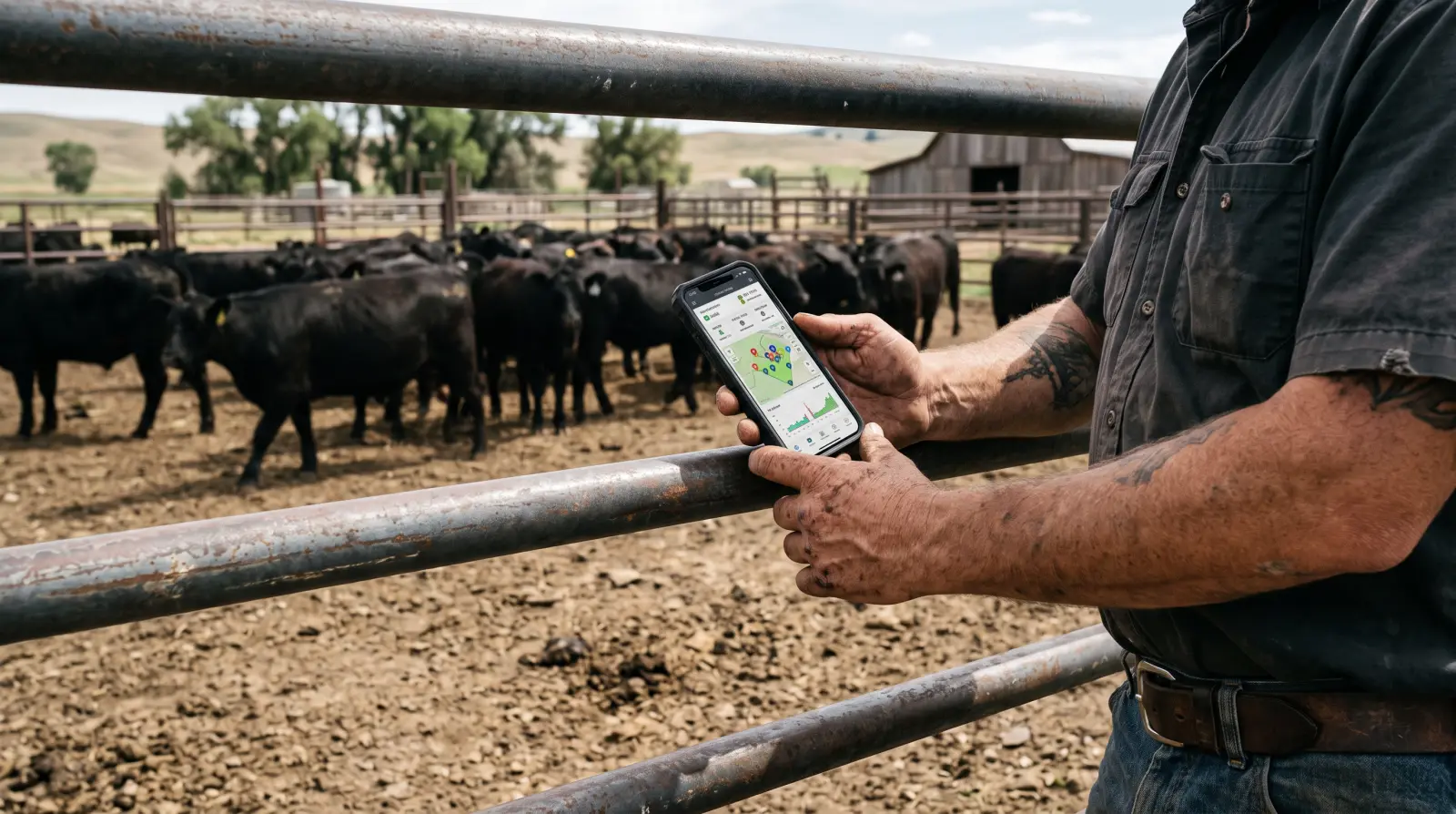
Cattle management software has gone from a curiosity that mostly large feedlot operations bothered with to a practical tool that pencils out for almost any commercial herd of fifty head or more. The reasons are not glamorous. The state and federal traceability rules keep getting tighter, the cost of missing a calf or a treatment record keeps going up, the buyer at the sale barn is starting to ask for documented health and genetic data, and the alternative is still a stack of Big Chief tablets in the truck console with the bottom one waterlogged from a thermos that tipped over in March.
This guide is the practical comparison of cattle management software in 2026. It covers what the software actually has to do for a working operation, the major options worth considering for cow-calf, stocker, and seedstock producers, the pricing realities including the hidden costs that none of the marketing pages mention, the hardware integration story for RFID tag readers and scales, the cloud versus offline argument that matters more than vendors admit, the data ownership question that most operators do not think about until they want to switch, and concrete recommendations by herd size and operation type.
Before any comparison can happen, the requirements have to be spelled out, because most software comparisons get hijacked by feature lists that do not matter and miss things that do.
A cow-calf operation needs to track individual animal identification, dam and sire records, calving records including birth weight and any assistance, weaning weights, treatment and vaccination records with the specific lot numbers required for residue avoidance and any future Beef Quality Assurance audit, breeding records, pregnancy check results, and culling decisions. The minimum useful retention period is the productive life of a cow plus seven years for tax records, which means twenty years on the long end. The data has to survive a phone replacement, a software vendor going out of business, and a switch to a different platform. None of that is a feature on the marketing page.
A stocker or backgrounder operation needs lot-level tracking more than individual records. The questions are how many head are in a lot, what they cost, what they have been treated with, what their average daily gain is, and what they have to sell for to make money. Individual records are useful for sick pulls and for terminal sales of high-value animals, but lot averages drive the business.
A seedstock operation needs the most. Pedigree records going back many generations, registry integration with the breed association, expected progeny differences for the genetic merit calculations, performance data including weights at standardized ages, ultrasound carcass data, DNA test results, and the documentation required to make a registered animal sale. The seedstock requirements bracket every other use case, which is why most of the serious cattle software started in the seedstock world and worked outward.
A feedlot needs ration tracking, daily intake monitoring, lot performance, animal health protocols, and integration with feed mill software and trucking schedules. Most working feedlots run a different class of software that integrates accounting, feed delivery, and animal health in a single platform. Operations of that scale are not the focus of this article.
The shared requirements across all of these are reliable data entry under field conditions, accurate identification through RFID tags or visual tags, treatment records that meet Beef Quality Assurance standards, and reports that are useful at sale time and tax time without three days of data wrangling.
The cattle management software market has consolidated significantly over the past decade. There used to be dozens of small platforms, most of them written by a former rancher with one specific operation in mind, most of them running on a Windows desktop, and most of them now abandoned. The current market has roughly six platforms that are worth a serious look for North American operations, each with a different fit profile.
CattleMax is the desktop and cloud platform with the longest track record. It started in 1999 as a Windows application and has been running continuously since, which means there are operations that have twenty years of data in CattleMax format. The platform has both a desktop installation and a cloud version, and the cloud version is what new operations should be evaluating in 2026.
The strengths are the depth of records on individual animals, the seedstock features including breed registry integration, the EPD calculation support, the carcass data tracking, and the report library. CattleMax has reports that show up at the AAA and other breed registries by name because they are the format the registry expects.
The weaknesses are a user interface that still looks like 2010 in places, a mobile app that is functional but not slick, and pricing that is on the higher end for cow-calf operations that do not need the seedstock features. CattleMax is the right answer for seedstock and registered cattle operations and a reasonable answer for any operation over 200 head that wants the depth.
Pricing in 2026 runs $25 per month for the cloud version on small herds with annual billing, scaling up by herd size to roughly $80 per month for herds over 500 head. The desktop version is a one-time license at around $400 with annual maintenance. The pricing has been relatively stable, which is itself a useful signal in a market where some competitors have raised prices substantially.
Herdwatch started in Ireland and has expanded to the UK, Australia, and now the US. The platform is mobile-first in a way that the older competitors are not, and the data entry experience on a phone is genuinely good. The Irish origin shows up in some terminology and in the strong support for European traceability standards, which a US operation does not need but does not actually hurt.
The strengths are the mobile experience, the speed of common workflows like recording treatments or tagging a new calf, the integration with Bluetooth weighing equipment, and a clean reporting layer. The weakness for a US operation is that the breed registry integration is mostly oriented toward Irish and UK registries, so a Hereford or Angus seedstock operation looking for AAA registry submission directly from the platform is not going to find it.
For a commercial cow-calf or stocker operation, the registry gap does not matter. Herdwatch is a strong contender at any scale and an especially strong contender for operations that want the data entry to happen in real time at the chute rather than later in the office.
Pricing in 2026 is roughly $20 per month for small herds, $40 per month for typical commercial operations, and around $70 per month for larger herds with multiple users. The pricing is competitive but it is per month, which means the lifetime cost over twenty years is meaningful.
Performance Beef is owned by Performance Livestock Analytics and is part of a larger commercial ecosystem that includes Performance Cow-Calf, Performance Stocker, and Performance Feedlot. The platform is positioned at commercial operations rather than seedstock, and the strength of the platform is the analysis layer rather than the data entry layer.
The platform takes data from animal records, weights, and treatment records and produces operation-level reports on cost of gain, breakeven prices, and profitability by lot. For a stocker operation that buys calves on the open market, runs them, and sells them at slaughter weights, this is exactly the analytical layer that turns animal records into management decisions.
The weakness is that the platform requires good data hygiene to produce useful analysis. An operation that enters records inconsistently or skips treatments will get garbage reports. The platform also has a steeper learning curve than the simpler herd-tracking apps because it is doing more.
Pricing for Performance Beef varies more than the other platforms because it is often sold as part of a larger package or through a livestock supplier or feed company. Standalone pricing in 2026 is roughly $40 to $80 per month depending on herd size and modules. Operations that buy genetics or feed from a supplier that resells Performance Beef sometimes get the software at a discount or bundled with a service contract.
CattlePro is the platform that many smaller commercial operations end up on after trying one of the larger platforms and finding it heavier than they need. The interface is straightforward, the data entry is fast, and the reports are useful for tax and herd health purposes without being overengineered.
The platform handles individual animal records, treatment tracking, breeding records, calving records, and basic financials. It does not have the seedstock depth of CattleMax or the analytical depth of Performance Beef, but it covers the actual needs of an 80-head cow-calf operation that wants real records without learning a new full-time job.
Pricing is on the lower end, around $15 to $25 per month for typical commercial herds. The platform has a free tier for very small herds, which is one of the few free tiers in the market that is genuinely usable rather than a marketing teaser.
Ranchr is a newer entrant that has built up a following in the past few years, particularly among younger operators who came in expecting modern app experiences and were not impressed with what they found in the established platforms. The interface is clean, the mobile app is the primary experience rather than an afterthought, and the pricing is aggressive.
The platform handles individual animal tracking, calving records, treatment records, breeding records, weight tracking, and basic financial summaries. The reporting is less deep than the established competitors, but the day-to-day experience is faster and less frustrating.
The risk with a newer platform is the long-term viability question. A platform that has been running since 1999 like CattleMax has a track record of surviving and a track record of preserving customer data through transitions. A platform that launched in 2022 has neither yet, and the cattle data being entered today has to last twenty years. The Ranchr team appears to be well capitalized and well staffed, but operators who are betting twenty years of records on the platform should at least understand they are taking on more vendor risk than the established options.
Pricing for Ranchr in 2026 is around $15 per month for small herds and $40 per month for larger herds, with a free tier that is more limited than CattlePro's free tier but still functional.
AgriWebb is an Australian-origin platform that has built strong adoption in the US and is positioned more as a whole-operation platform than a pure cattle records platform. It handles cattle, sheep, goats, and farm-level mapping, infrastructure tracking, paddock management, and grazing planning alongside individual animal records.
For an operation that wants the cattle records to live alongside the grazing plan and the infrastructure database, AgriWebb is a strong fit. For an operation that just wants cattle records and is going to keep grazing notes in a spreadsheet anyway, AgriWebb is more software than the operation will use.
Pricing in 2026 is on the higher end, around $50 to $120 per month depending on the modules and the number of users. The whole-operation positioning means the cost is justified when the whole platform gets used, and overpriced when only the cattle module gets used.
The hardware integration question is where most software comparisons fall apart, because the marketing material from each vendor implies that any RFID reader and any scale will work, and the reality is messier.
The RFID standard for North American cattle is ISO 11784/11785, which is what the official 840 tags use. Any reader that supports this standard can read the tags. The variation is in how the reader connects to the phone or tablet, what software protocol it uses, and whether the cattle management app supports that specific reader model out of the box.
The most common reader brands are Allflex, Datamars, Y-Tex, Tru-Test, and Gallagher. The most common connection methods are Bluetooth Low Energy for handheld stick readers, USB serial for desktop readers, and proprietary apps that bridge between the reader and the cattle software.
Herdwatch has the broadest reader compatibility and supports most of the major brands directly. CattleMax supports the major brands but sometimes requires an intermediate driver. Performance Beef has tight integration with specific Tru-Test and Datamars products. Ranchr supports the common Bluetooth readers but has gaps in the less common ones. AgriWebb supports the major brands.
The scale integration is similar in principle but messier in practice. The scale brands include Tru-Test, Gallagher, Cattle-Trac, and a long tail of smaller brands. The connection is usually Bluetooth or wired serial. Most cattle management apps support direct scale integration for at least one or two scale brands, but operators who are buying both scale and software in 2026 should specifically test the integration before committing to either purchase. A scale that is supposed to send weights directly to the app and instead requires manual entry every time will get bypassed within a month, and the data quality drops with it.
The practical recommendation is that any operation that is going to use RFID tags and electronic weighing should pick the scale and the software together, and should test the actual integration with one specific reader and one specific scale on one specific phone before committing. The marketing material is often more optimistic than the actual driver support.
The cloud versus offline question is one that most software vendors do not want to discuss honestly because the answer for cattle operations is more complicated than it is for most other businesses.
The cloud-first platforms work well when the data entry happens at the chute and the chute has cell coverage or wifi. They struggle when the data entry happens in a remote pasture, in a chute located behind a hill, or in any of the many corners of any working ranch where the cell signal does not reach.
Almost every modern cattle app advertises offline support, and almost all of them have it in some form. The actual offline experience varies enormously. Some platforms cache the herd locally and sync when the connection returns. Others require an active connection for any meaningful data entry. The marketing claims are uniform; the reality is not.
For an operation that has reliable cell coverage at every place data entry will happen, the cloud question is mostly academic. For an operation that does pregnancy checks at a remote facility with no signal, or that records calving information in pastures that are three miles from the nearest cell tower, the offline behavior is a make-or-break feature.
The way to evaluate offline support is not to read the marketing page but to put the device in airplane mode and try to do every common workflow. Add a new calf, record a treatment, weigh an animal, look up an animal's history, generate a report. If any of those fail in airplane mode, the offline support is not real for that operation.
CattleMax has strong offline support in the desktop product and reasonable offline support in the cloud product. Herdwatch has good offline support in the mobile app. Ranchr has reasonable offline support but with some workflow gaps. AgriWebb has good offline support. Performance Beef requires more connectivity than the others because the analytics layer pulls from cloud data.
The data ownership question is the one that almost no operator thinks about until they want to switch platforms or until a vendor is acquired or shuts down. The question is simple. If the operation decides in three years that the current platform is not working, what does it take to get all the data out in a usable form?
The honest answer for most platforms is that getting the data out is possible but painful. The platforms typically support exports to CSV files, which preserve the raw data but lose the relationships between records, the photos, and any custom fields the operation has set up. Importing those CSV files into a new platform requires custom work or vendor assistance, and the new platform often does not have an exact match for every field in the old platform.
The platforms with the best data export stories are CattleMax, AgriWebb, and Herdwatch, each of which provides comprehensive exports including the relational structure of the data. The platforms with the worst data export stories are not worth naming because they will probably not exist in five years anyway.
The practical advice is to do a test export in the first month of using any new platform. The export should include every record, every photo, every field, and the relational structure between records. If the export comes out clean, the operation is in a good position to switch later if needed. If the export is missing data or comes out in a format that nothing else can read, that is the operation's first warning that the lock-in is real.
The other practical advice is to keep a parallel copy of the most critical records in a format that does not depend on the vendor. A simple CSV file of dam, sire, birth date, and EID tag for every animal, exported quarterly to a shared drive or external backup, is enough to reconstruct the herd from any platform if necessary. Some operations also keep paper backups of calving books, which is not a bad practice as long as the paper is legible and stored somewhere that does not get rained on.
The headline price for cattle management software is usually the monthly subscription, but the total cost for an operation includes several other line items that the marketing material does not mention.
The first additional cost is the hardware. A working setup typically includes a phone or tablet, an RFID stick reader, a Bluetooth scale or scale head, and possibly a printer for tag printing. The phone or tablet is often something the operation already has. The RFID reader is $400 to $1,200 depending on the brand and features. The Bluetooth scale head or weight indicator is $800 to $2,500. The total hardware cost for a fully integrated chute setup is usually $1,500 to $3,500 for the first year, with replacement and repair costs on top.
The second additional cost is the data entry time. The first year of using any platform is the most labor-intensive because the existing herd has to be entered, the historical records have to be migrated, and the operator has to learn the workflows. The realistic time investment for a 200-head cow-calf operation is fifty to a hundred hours over the first year, dropping to ten to twenty hours per month after that.
The third cost is the training and support. Most platforms include some level of support in the subscription, but operations that want hands-on training, custom report development, or vendor-assisted data migration usually pay extra. The training cost ranges from free to several thousand dollars depending on the platform and the depth of the engagement.
The fourth cost is the integration. Connecting the cattle software to the operation's accounting software, to the breed registry, to the auction house, or to a buyer's procurement system often requires either a paid integration module or custom work. The cost ranges from negligible to several thousand dollars per integration.
For a typical 200-head commercial cow-calf operation, the all-in first year cost of getting onto a cattle management platform is around $2,500 to $5,000 including software, hardware, and labor. The ongoing annual cost after the first year is around $400 to $1,000 in software subscriptions plus the labor time. That is real money, but it is small relative to the value of the herd and small relative to the cost of a single missed treatment that gets a load of cattle rejected at the packer.
For a small commercial cow-calf operation under 100 head, the right answer in 2026 is usually CattlePro or Ranchr. Both platforms are inexpensive, easy to learn, and have enough depth for the records that actually matter. The choice between them comes down to personal preference on the interface and the operator's tolerance for vendor risk on a newer platform.
For a typical commercial cow-calf operation between 100 and 500 head, the right answer is usually Herdwatch or CattleMax. Herdwatch wins on mobile experience and is the right choice for operations that want fast data entry at the chute. CattleMax wins on depth and is the right choice for operations that value report flexibility and a long track record.
For a stocker or backgrounding operation, the right answer is usually Performance Beef. The analytical layer that turns weight gain and treatment records into cost-of-gain analysis is the entire point of the operation, and Performance Beef is built around that analysis.
For a seedstock operation, the right answer is usually CattleMax, with the caveat that the specific breed registry integration should be confirmed before purchase. Operations registered with multiple breeds should test the registry submission workflow on each one.
For an operation that wants to integrate cattle records with grazing planning, infrastructure mapping, and whole-farm management, AgriWebb is the right answer. The cost is higher but the integration is real.
For a feedlot, the right answer is not in this article. Feedlot software is a different category and has different requirements that include feed mill integration, ration tracking, and packer-facing data submission.
A few patterns are worth avoiding regardless of which platform an operation chooses.
Avoid picking a platform based purely on the marketing demo. Every platform looks great in a demo. The actual experience under field conditions, with cold hands, in a dusty chute, with a calf that does not want to be processed, is different. Test the platform in the actual conditions where it will be used before committing.
Avoid building the operation around a feature that is only available in one platform. Vendor lock-in through workflow dependence is harder to break than vendor lock-in through data format. If a platform is the only one that does some specific thing, ask whether that thing is genuinely important or whether it is a nice-to-have that has gotten elevated to a hard requirement.
Avoid free platforms that are not from established vendors. The cattle records have to last twenty years. A free platform from a developer who is going to lose interest in two years is more expensive than a paid platform from a vendor that will be in business in 2046.
Avoid skipping the data export test. The first month on any new platform is when the export should be tested, before the operation depends on the platform for its records.
Avoid the assumption that the platform will solve the data quality problem. The platform records what the operator enters. An operator who skips treatments or misenters tag numbers will produce bad data on any platform. The discipline of consistent, accurate, real-time data entry is what makes the records valuable, and no software replaces that discipline.
The cattle management software market in 2026 has matured to the point where any commercial operation that wants real records can find a platform that fits. The cost is reasonable, the hardware is functional, and the data ownership story is workable for most of the major platforms. The failure mode is no longer the software. It is the operator who buys the software, uses it for three months, and then drifts back to the Big Chief tablets when the system gets uncomfortable. That is a discipline problem, not a software problem, and the operations that solve it are the ones that get the value.
Subscriptions range from about fifteen dollars a month for a small commercial herd on CattlePro or Ranchr to roughly eighty to one hundred twenty dollars a month for larger multi-user operations on CattleMax or AgriWebb. Budget for more than the subscription: an all-in first year for a 200-head cow-calf operation, including hardware and setup labor, typically runs 2,500 to 5,000 dollars.
For a commercial herd under 100 head, CattlePro or Ranchr are usually the right fit. Both are inexpensive at roughly fifteen to twenty-five dollars a month, quick to learn, and deep enough for the records that matter. The choice comes down to interface preference and how much vendor risk you accept on Ranchr, which launched in 2022 rather than surviving decades like CattleMax.
Beyond a phone or tablet you already own, a working chute setup adds an RFID stick reader at 400 to 1,200 dollars and a Bluetooth scale head at 800 to 2,500 dollars. Tags must meet the ISO 11784/11785 standard used by official 840 tags. Test one specific reader and scale with your phone before buying, because driver support is often thinner than the marketing claims.
Most platforms export to CSV, which preserves raw data but often loses record relationships, photos, and custom fields. CattleMax, AgriWebb, and Herdwatch offer the most complete exports including relational structure. Run a full test export in your first month, and keep a quarterly backup of dam, sire, birth date, and EID tag so you can rebuild the herd from any platform.
Join our list for practical guides on farm tech, precision agriculture, and tools that work.