
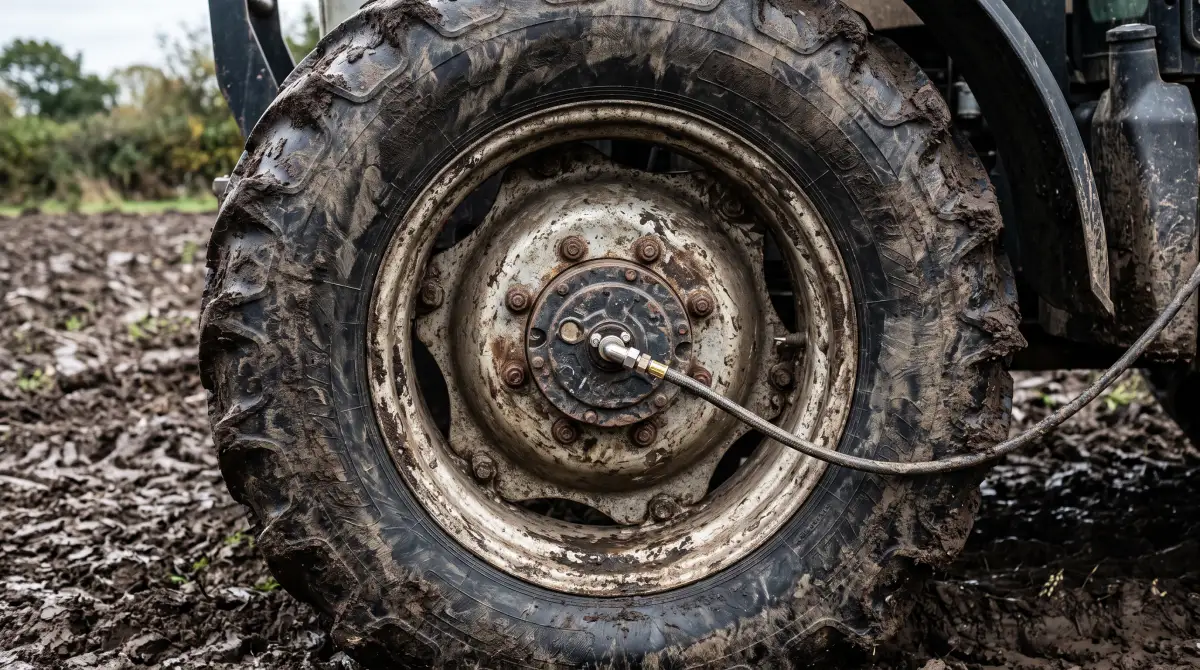
Most farms run their tractor tires at one pressure all year, and that pressure is wrong almost all the time. It is too hard for the field, where a softer tire would spread the load and save the topsoil, and it is often too soft for the road, where a firmer tire would roll easier and last longer. The pressure that works for one job is the wrong pressure for the other, so picking a single number means living with a compromise on every pass and every mile. A central tire inflation system exists to erase that compromise: air down to a soft field pressure for traction, air back up to a firm road pressure for transport, all from the cab without stopping. Whether it is worth the money is a real question, and the honest answer depends on your ground, your road miles, and your crop. This guide walks through what a CTIS actually does, the two separate wins it delivers, the one compaction problem it cannot solve, and how to tell whether the math works on your operation.
Tire pressure is a trade-off, not a setting. Run a field tire soft and it flattens into a longer, wider contact patch, spreading the machine's weight over more ground, reducing slip, and pressing less hard on the soil surface. Run that same tire hard and the contact patch shrinks to a small, concentrated footprint that digs in, slips more, and packs the topsoil tighter. For the road, the logic flips. A hard tire holds its shape, flexes less, rolls with less resistance, and runs cooler at transport speed, while a soft tire flexes, heats, and wears faster every mile you drive it on pavement.
So the right number for the field is low and the right number for the road is high, and they are not close. Common field pressures run as low as about 9 psi, and some machines go lower, while a sensible road pressure sits near the tire's rated maximum. The "set it and forget it" habit splits the difference at something like 23 psi, which is too hard for the dirt and too soft for the highway. CTIS is the tool that lets you stop splitting the difference.
A central tire inflation system plumbs air to every tire through rotary seals at the hubs and adjusts pressure to preset targets at the push of a button. You set a field preset and a road preset, and the system airs the tires up or down to match, on the move, with no need to stop or get out. Control is either a standalone unit or, on newer tractors, the ISObus display already in the cab. Most systems use the tractor's own air compressor, with an external compressor available when you need more airflow.
The one thing to understand before you fall in love with the idea: it is fast, but it is not instant. John Deere rates an 8R tractor at under 6.5 minutes to air up from roughly 12 to 26 psi, and about 4 minutes to air back down. That is quick enough to be practical and slow enough that you plan the change at the headland or the gate, not in the middle of a pass. Treat airing up and down as a transition you trigger when you leave the field, the same way you fold the implement or switch on the lights.
Airing down is about the contact patch. When you drop field pressure, the tire spreads out, and that bigger footprint does two useful things at once. It puts more lugs on the ground for traction, which cuts wheel slip and the wasted fuel and torn-up soil that slip causes, and it spreads the machine's weight so the tire presses less hard on the surface. John Deere studies cite roughly a 25 percent larger footprint translating into a 2 to 4 percent reduction in slip and about 3 percent lower ground pressure. Treat those as manufacturer figures, but the mechanism is real and well understood.
This is also where modern tire casings matter. IF-rated tires (improved flexion) carry the same load at about 20 percent lower pressure than a conventional tire of the same size, and VF-rated tires (very high flexion) do it at about 40 percent lower. A CTIS gets the most out of those casings, because the whole point of an IF or VF tire is the ability to run genuinely soft in the field, and a CTIS is what lets you do that without leaving the tire dangerously soft when you hit the road.
The payoff farmers care about is less topsoil compaction and, downstream, better yield on the headlands and wheel tracks that take the most traffic. An AGCO trial found that adjusting pressure with the inflation system cut compaction depth about 17 percent compared with leaving pressure alone, and a widely repeated figure puts the reduction "as much as 30 percent" against standard pressures. Take the 30 percent as a best-case, conditions-dependent number rather than a promise. On the yield side, Michelin reports around a 4 percent gain from reduced compaction, and trial figures collected by Valtra range from modest soybean gains to as much as 8 percent on winter wheat and 11 percent on spring barley. Those are real studies, but the range is wide because yield response depends heavily on soil type and the year, so plan around the low end and treat the high end as upside.
The road benefit is a different mechanism, and it is worth keeping separate in your head. Airing up for transport firms the tire so it flexes less and rolls easier, which cuts rolling resistance and the fuel burned to overcome it. Precision Inflation cites a UC Davis figure of a 7.3 percent fuel-economy improvement at 7 psi higher and 11.4 percent at 14 psi higher on roads. Headline fuel-saving claims from the industry cluster around 5 to 10 percent overall, with some vendors quoting as high as 15 percent. Read all of those as reported ranges, not guarantees, and attribute them to the sellers who published them.
Wear is the quieter half of the road case. A tire that is too soft for road speed flexes and heats up, and heat is what kills a casing. Run a field-soft tire down the highway for miles and you are slowly cooking it, shortening its life and risking the carcass. The correct firm road pressure protects the tire by keeping it from over-flexing. This is the same compromise from the top of the article, seen from the tire's point of view: there is a field-optimal pressure and a road-optimal pressure, they are different numbers, and without a CTIS you are sacrificing one of them on every trip.
Here is the part that separates an honest case for CTIS from a sales pitch. Lowering tire pressure helps topsoil compaction. It does not prevent deep subsoil compaction, and anyone selling it as a fix for that is overselling it.
The reason is physics, not marketing. Surface ground pressure - what the tire presses into the top few inches - is governed mostly by tire pressure and footprint, which is exactly what a CTIS controls. But how deep compaction reaches is governed by axle load, the total weight riding on that axle, and tire pressure barely touches it. Penn State Extension and Ohio State agronomists are clear on this: deep subsoil compaction is driven by heavy axle loads, and it is essentially permanent, far below the reach of tillage. You can air your tires down to the floor and still drive a compaction layer two feet deep if the axle is heavy enough.
So the rule that actually protects your subsoil is a weight rule, not a pressure rule. Keep axle loads down - a common guideline is under about 10 tons per axle, and lighter is better - and stay off wet ground when you can, because wet soil compacts far more easily and far deeper. If the problem you are trying to solve is a hardpan you can feel in the yield map, a CTIS is the wrong tool. Managing axle load and avoiding wet fieldwork does more for that than any tire pressure ever will. CTIS earns its keep on the topsoil and the traction, and it is worth being straight about where its help stops.
CTIS is not cheap, and the pricing data is mostly European, so treat the dollar figures as rough conversions that will vary by dealer and tractor. A retrofit system of the PTG/Michelin type runs roughly £6,000 to £8,000 in UK trade pricing, which is on the order of $7,500 to $10,000, with a lighter "flow control" retrofit quoted lower. Factory-fit options cost more: John Deere's CTIS lists around £13,490 and Fendt's VarioGrip around £14,585, call it $17,000 to $18,500, which works out to roughly 3.5 to 4.5 percent of the tractor's price. Trailer and implement retrofits run on the order of $1,500 per wheel up to a few thousand per trailer. Install labor is real too, roughly 10 to 12 hours per axle.
The one clean comparison the trade makes: CTIS is generally much less expensive than rubber tracks, and it delivers a chunk of the same footprint and flotation benefit while keeping you on tires for the road. Whether it clears its own cost depends on how hard you use it. The savings come from fuel, longer tire life, less slip, and yield protection on trafficked ground, and all four of those scale with road miles between fields, with how heavy and wet your soil is, and with how valuable your crop is. A system that sits on one preset all season saves you nothing.
Most of the brand names and pricing above come from Europe, where CTIS adoption is further along, but the systems are available stateside. PTG, the benchmark maker, has built these systems for more than 30 years and has been part of the Michelin group since 2018, and in North America NTS Tire Supply is a primary PTG dealer and installer - a reasonable first call to scope a system for a specific tractor. Factory CTIS is also an order option on new John Deere and Fendt machines if you are buying the tractor anyway, which is often the cheaper path than retrofitting later.
Two practical notes for a real install. First, airflow: the tractor's onboard compressor is fine for a single tractor system, but if you are inflating large volumes fast or plumbing a trailer too, ask about an external compressor so the air-up times stay reasonable. Second, plan for the labor, because the 10-to-12-hours-per-axle figure is not a detail - it is a meaningful share of the total cost and worth getting a firm quote on before you commit.
Run your operation through this before you spend the money:
If you have significant road transport, heavy or wet soils, and high-value crops, a CTIS is a genuine win and probably pays back in a reasonable window. If your fields are close, your ground is light and dry, and your axle loads are modest, it is an expensive nice-to-have, and the honest move is to wait.
The whole CTIS decision comes down to per-acre and per-mile math that is specific to your operation, and that is the kind of thing worth working out before a dealer works it out for you. If you want to start by getting your field sizes and input costs straight, the free Field Boundary and Input Calculator at manleyfarms.com lets you draw your fields and run the seed and fertilizer math, which is a good baseline for figuring out how much a few percent of yield or fuel is actually worth to you. We build these tools for exactly this kind of decision, and they are free to use - if you want a heads-up when new ones land, the email list is the place to be. Technology for the land, no sales pitch attached.
Only the topsoil kind. Lowering tire pressure spreads the footprint and reduces surface ground pressure, but deep subsoil compaction is driven by axle load, which tire pressure barely affects. Penn State and Ohio State agronomists treat deep compaction as essentially permanent. To protect the subsoil, keep axle loads under about 10 tons and stay off wet ground; a CTIS will not fix a hardpan.
It is fast but not instant. John Deere rates an 8R tractor at under 6.5 minutes to air up from roughly 12 to 26 psi and about 4 minutes to air back down. That is quick enough to be practical but slow enough that you trigger the change at the headland or the gate, treating it like folding the implement rather than a mid-pass adjustment.
A PTG-type retrofit runs roughly 7,500 to 10,000 dollars, while factory-fit options on John Deere or Fendt tractors land around 17,000 to 18,500 dollars, about 3.5 to 4.5 percent of the tractor's price. Trailer and implement retrofits run on the order of 1,500 dollars per wheel. Budget for install labor too, roughly 10 to 12 hours per axle.
Field and road pressures are far apart. Common field pressures run as low as about 9 psi to spread the footprint for traction, while a sensible road pressure sits near the tire's rated maximum to cut flex and heat. A single year-round setting near 23 psi is too hard for dirt and too soft for pavement. IF and VF tires let you run even softer in the field.
Join our list for practical guides on farm tech, precision agriculture, and tools that work.