
Climate-resilient crop planning is no longer a topic reserved for academic conferences and policy papers. It is the working margin between an operation that puts up a profit in a bad weather year and one that hands the difference back to the bank. The 2026 picture is that growing conditions are more variable than they were when most current operators learned the trade, that the planting and harvest windows are no longer as predictable as the long-term averages would suggest, and that the cost of guessing wrong on hybrid selection, planting date, or crop mix has gone up sharply because input costs are higher and crop prices are not always there to bail out a bad agronomic decision. The tools to plan around this volatility have improved at the same time, and the operations that are using them well are quietly running better margins than the operations that are still planning the way their grandfathers did.
This is a working operator's read on climate-resilient crop planning in 2026: what the actual climate picture looks like at the field level, what the risk models can and cannot tell you, what the practical hybrid and crop mix decisions look like under variable conditions, what the planting window and management flex points are, and how to actually pull the planning tools into a workflow that runs through the season without becoming a second job. The goal is not to predict the weather, because no one can do that with the precision that decision-making would require, but to build a plan that performs across the realistic range of weather a particular operation is going to see, with explicit hedges built in for the years that go sideways.
The climate change conversation at the national and global level often gets pulled into political territory that does not help an operator make a planting decision. The field-level picture is more useful and more concrete. The trend lines that matter for crop planning are observable, are documented in the climate division data the National Centers for Environmental Information publishes, and are showing up in the actual growing season records farmers are keeping.
The first change that matters is that the growing season has lengthened in most of the U.S. corn belt and across much of the Great Plains and Midwest. The last spring frost is coming earlier on average and the first fall frost is coming later, which adds frost-free days to the calendar. The naive read on this is that the longer season is good news because it lets a longer-maturity hybrid run to full maturity. The more careful read is that the longer season also means the back end of the planting window is wider, the back end of the harvest window is wider, and the temptation to take risks with planting dates and hybrid maturities has increased because the buffer looks larger than it really is.
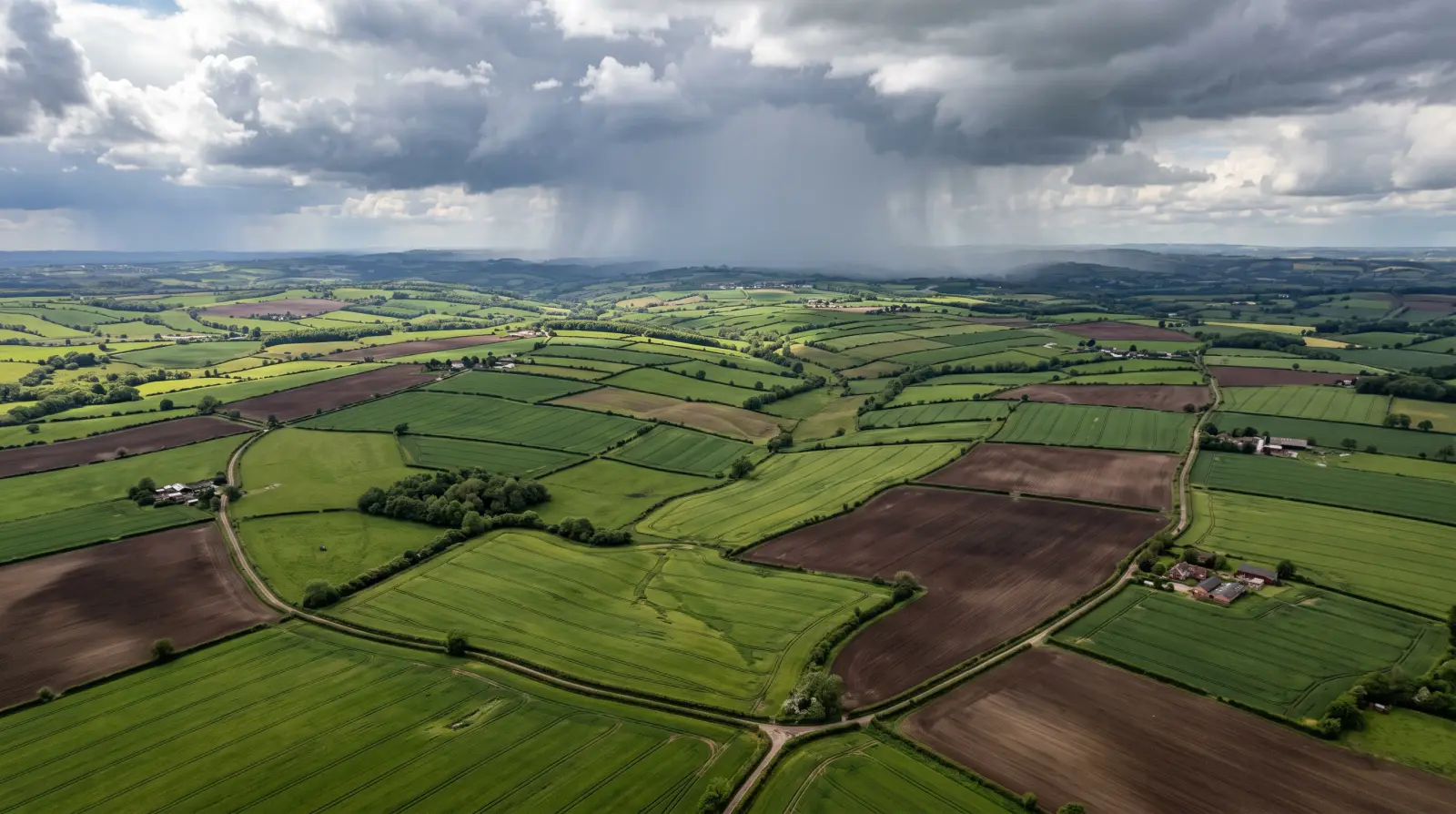
The second change is that precipitation is more variable in both directions. The annual totals across most of the corn belt have not changed dramatically, but the distribution of that precipitation has. There are more events that drop two or three inches in a day, more dry stretches that run three to six weeks at the wrong time of the season, and more years where the precipitation pattern looks nothing like the thirty-year average. The agronomic implication is that the mismatch between when you need water and when you actually get it has increased, which puts more pressure on soil water holding capacity, on planting date decisions that affect when the critical pollination window falls, and on whether your operation can flex when the rain does not show up on schedule.
The third change is heat events during the reproductive window. Average temperatures have moved up modestly in most of the corn belt, but the more consequential change is the frequency of nighttime temperatures above 70 degrees during pollination and grain fill, which suppresses yields in corn and soybeans even when daytime conditions look fine. The high-temperature stress conversation used to be a southern Plains problem and is now a corn belt problem in a meaningful number of years.
The fourth change is wind. Derecho events, which used to be rare enough that most operators went a career without seeing one, are showing up more frequently and across a broader geographic range. The 2020 Iowa derecho was a wake-up call for operations that had not thought about straight-line wind as a planning factor, and the planning conversation in the years since has explicitly included standability, harvest readiness flexibility, and the recognition that a single weather event can take a crop from above-trend to below-breakeven in eight hours.
The fifth change is the El Nino-La Nina cycle and its effects on the corn belt and Plains. The pattern itself is not new, but the strength and timing of recent cycles, combined with the cost of getting hybrid and acreage decisions wrong, has made the seasonal climate forecast a more important input to crop planning than it was a decade ago. The forecasts are not deterministic and should not be treated as such, but ignoring them is no longer a defensible default.
The tools available for climate risk assessment in 2026 fall into several categories with very different appropriate uses. Understanding what each category is actually doing under the hood is the difference between getting useful planning information and getting confidently wrong predictions.
Climate normals and historical statistics are the foundation. The thirty-year normal data from NOAA, the climate division summaries, and the long-term station records are the baseline that everything else is built on. The honest framing is that the climate normals are a description of what has happened on average, not a prediction of what will happen in any specific year. The thirty-year period that defines the normal also matters, because the 1991-2020 normal looks meaningfully different from the 1981-2010 normal in many regions, and the choice of which baseline you compare a forecast against affects how the forecast reads.
Seasonal climate forecasts from NOAA's Climate Prediction Center and the various private providers are probabilistic forecasts that go out three to six months. They tell you the probability that a given region will be above, below, or near normal for temperature and precipitation in a given month or three-month window. The honest framing is that these forecasts have skill, meaning they are better than guessing, but the skill is modest and is concentrated in the months and regions where the El Nino-La Nina signal is strongest. Treating a probabilistic forecast as a deterministic prediction is the most common mistake operators make with these tools, and the operations that use them well are the ones that integrate them as one input among several rather than as a planning input that overrides agronomic judgment.
Crop simulation models are the third category and are where the more sophisticated planning tools live. APSIM, DSSAT, and the various commercial implementations of similar approaches simulate crop growth and yield under specified weather, soil, and management inputs. The strength of these models is that they can run thousands of weather scenarios and produce probability distributions of yield outcomes for different planting dates, hybrids, and management decisions, which is exactly the kind of information that makes a hedging decision possible. The weakness is that the models are calibrated against historical data and may not capture the behavior of new genetics or extreme weather conditions accurately, and the model outputs are only as good as the soil and weather inputs you feed them.
Field-level risk dashboards are the fourth category and are increasingly available through farm management software platforms. Climate FieldView, Granular, FBN, and the major equipment manufacturer platforms all offer some version of weather risk visualization, planting window optimization, and hybrid placement recommendations. The honest framing is that these tools are useful for visualization and for getting a structured view of the variables, but the recommendations they produce are typically based on relatively simple decision rules and should be treated as one input rather than as a planning answer.
Insurance-based risk tools are the fifth category and include the various crop insurance modeling tools, the Whole-Farm Revenue Protection planning calculators, and the hedging-oriented tools that connect crop insurance decisions to marketing plans. These tools are explicitly built around the financial risk question rather than the agronomic question, which is exactly the right framing for the planning conversation, but they require accurate inputs about expected yields, costs, and price scenarios to produce useful outputs.
The practical workflow for an operator is to use these tools in combination. The climate normals and seasonal forecast establish the baseline expectation for the year. The crop simulation tools or field-level dashboards translate that expectation into a range of yield outcomes for different planting dates and hybrid choices. The insurance and financial tools translate the agronomic outcomes into financial outcomes and let you see which planning decisions have the best risk-adjusted return. None of the tools alone is sufficient, and the operations that get the most value from them treat them as a stack rather than as substitutes for each other.
The hybrid selection conversation has changed significantly in the past decade and the operations that are still selecting hybrids the way they did in 2010 are leaving meaningful margin on the table. The traditional approach was to pick a relative maturity that matched the local growing degree day accumulation, pick a few yield-leading hybrids in that maturity from the seed dealer's lineup, spread acres across two or three to manage risk, and move on. The 2026 approach is more granular, more data-driven, and more explicitly oriented toward managing the range of weather conditions the operation is going to see rather than optimizing for the average year.
The first change is that hybrid placement by field rather than by farm has become standard practice on operations that are running variable rate planting or that have detailed soil and yield data. The traits that matter for placement include drought tolerance score, standability score, disease package, pollination period heat tolerance, and the agronomic notes the seed company provides about soil type fit. The operations that are doing this well are placing different hybrids on the heavier ground than on the sandier ground, on the well-drained fields than on the lower-lying fields, and on the irrigated than the dryland portions of the operation rather than treating the operation as a single uniform planting decision.
The second change is that maturity spread within a maturity zone has become a more deliberate hedging tool. Planting all of the corn at a single relative maturity concentrates the pollination window into a narrow band, which means that a heat or drought event during that band hits the entire operation at once. Spreading the maturity range across three or four points, even if the average maturity is the same, spreads the pollination window across two or three weeks and reduces the probability that a single weather event takes down the entire crop. The yield cost of the spread, when there is one, is often less than the risk reduction is worth.
The third change is that drought tolerance ratings have become more reliable and more usable. The major seed companies have all published drought tolerance scores for their hybrids, and the third-party trial data from university extension programs and farmer-led trial networks has accumulated to the point where the scores can be cross-checked. The honest read is that the drought tolerance differences between modern hybrids are real but modest in absolute terms, with the better-rated hybrids losing five to fifteen bushels less per acre under drought stress than the worse-rated hybrids in side-by-side trials. That is not enough to save a crop in a severe drought year, but it is enough to materially affect the margin in a moderately stressed year, which is the more common case.
The fourth change is that the disease package conversation has gotten more sophisticated as the disease pressure picture has changed. Tar spot in corn has expanded its range significantly in the past five years and is now a planning factor in regions where it was not on the radar a decade ago. Southern rust pressure has increased in the eastern corn belt. White mold in soybeans is showing up more frequently in years with cool wet conditions during flowering. The hybrid and variety disease packages need to be matched to the local pressure picture, and the local pressure picture is changing more quickly than the historical assumptions would suggest.
The fifth change is that the soybean variety selection conversation has caught up with the corn hybrid selection conversation in terms of the volume of trial data and the granularity of the placement recommendations. The maturity group spread is the soybean equivalent of the corn maturity spread hedging strategy, and the operations that are running soybean acres on a planning basis comparable to their corn acres are getting more out of the soybean program than the operations that are still treating soybeans as the secondary crop that gets whatever decisions are left over.
The crop mix conversation is harder than the hybrid selection conversation because it involves capital investment, equipment fit, marketing relationships, and rotation effects that play out over multiple years. The climate-resilient framing of the crop mix question is whether the current rotation is robust to the range of weather conditions the operation is likely to see and whether there are cost-effective diversification moves that would improve the risk-adjusted return.
The most common climate-resilient rotation move is to shift from a corn-soybean rotation to a corn-soybean-small grain rotation or to add a cover crop layer that functions as a quasi-third crop in the rotation. The agronomic case is that the longer rotation breaks pest and disease cycles, builds soil health and water holding capacity, and reduces the concentration of risk into two crops with similar weather sensitivities. The financial case depends heavily on local price differentials, on whether the small grain has a cost-effective market outlet, and on whether the operation has the equipment and marketing infrastructure to handle the additional crop without significant new investment.
The second diversification move is to shift acres into specialty crops or contract production where the operation has the agronomic capability and where the contract terms shift weather risk to the buyer. Seed corn and seed soybean production, food-grade soybean contracts, popcorn, organic production, and various specialty oilseed and grain contracts can all play this role in the right operation. The honest framing is that these contracts are not a free lunch, that they typically come with production requirements that constrain the management decisions the operation can make, and that the contract market in any given specialty is only as robust as the local processor or marketer base. The diversification benefit is real but the operational complexity is real too.
The third diversification move is to add livestock or to expand existing livestock enterprises so that the operation has a market for crops that go through the livestock rather than through the commodity grain market. This is a longer-term decision that requires capital investment and labor commitment that goes well beyond crop planning, but the climate-resilient case is that livestock provides a market for crops in years when the commodity market is unfavorable and provides a value-added pathway that smooths out the year-to-year revenue picture.
The fourth diversification move is to expand the geographic footprint of the operation through cash rent or custom farming relationships in areas that have different weather patterns from the home base. This is a real strategy in some regions and is particularly relevant for operations near climate transition zones where a meaningful portion of weather risk is geographic rather than temporal. The operational complexity of running ground that is hours away from the home shop is real and the strategy only works for operations that have the management capacity and the equipment fleet to support it.
The fifth diversification move that has become more relevant in the past several years is the addition of carbon credit, ecosystem services, or sustainability program enrollment to the revenue mix. The case here is that these programs provide a revenue stream that is uncorrelated with crop yields and prices and that can offset the cost of cover crops, reduced tillage, or other practices that have agronomic resilience benefits in their own right. The honest framing is that the carbon program economics have been volatile, that the contractual terms require careful evaluation, and that the programs work best when the underlying practices are ones the operation would have wanted to adopt anyway.
The planting decision is where climate-resilient planning meets the daily management calendar most directly. The traditional view of the planting window was that there was an optimum date and a penalty for planting earlier or later, and that the goal was to hit the optimum across as many acres as possible. The 2026 view is more nuanced and treats the planting window as a hedging decision in itself.
The first principle of climate-resilient planting is that the optimum date is a probability distribution, not a single date. The crop simulation models will show that for a given region, a given hybrid maturity, and a given soil type, the highest-yielding planting date varies by year depending on the spring weather pattern, the soil moisture conditions, and the pollination period weather that the planting date implies. Across a range of weather scenarios, the optimum planting window is typically two to three weeks wide rather than a single date. The implication is that spreading the planting across the window, rather than racing to plant everything on the optimum date, is often the better risk-adjusted decision.
The second principle is that the cost of planting too early into cold or wet soil is often understated and the cost of planting too late is often overstated. Planting into 50-degree soil with a wet forecast ahead can produce stand losses, replant decisions, and root development problems that follow the crop through the season. Planting two weeks past the calendar optimum into good conditions typically costs less than the early planting penalty in years when the early planting goes wrong. The operations that are best at managing the front end of the planting window are the ones that are most willing to wait for conditions to be right rather than to start because the calendar says to.
The third principle is that the planting decision interacts with the hybrid maturity decision. A longer-maturity hybrid planted on the early side of the window can pull the pollination period into a more favorable position than a shorter-maturity hybrid planted at the same time, but it also commits the operation to a longer growing season and more weather exposure. A shorter-maturity hybrid planted on the late side of the window can compress the season and reduce weather exposure, but it gives up yield potential in years with favorable weather. The combinations of planting date and maturity that minimize risk and the combinations that maximize expected yield are not the same combinations, and the planning decision should be explicit about which one is being optimized for which acres.
The fourth principle is that in-season management flexibility has economic value that should be priced into the planting decision. An operation that is set up to side-dress nitrogen rather than apply all of the nitrogen at planting has the option to scale the nitrogen rate to the actual season conditions, which is a real hedging tool against both a wet spring that loses nitrogen and a dry spring that signals lower yield potential. An operation that is set up to apply fungicide at tasseling has the option to respond to actual disease pressure rather than to make a preventive blanket application. The infrastructure and equipment investments that create these in-season options have real costs but also real value in years when the season conditions deviate from the planning expectations.
The fifth principle is that the harvest window has flexibility that is often underused. Hybrid maturity spread, in addition to spreading pollination risk, also spreads harvest. An operation that is set up to start harvest at higher moisture and finish at lower moisture, with the drying capacity to make that work economically, has more flexibility to harvest around weather windows than an operation that is forced to wait until the entire crop is field-ready. The flexibility costs propane and runs through more equipment hours, but it is a real risk reduction tool in years when the fall weather pattern is unfavorable.
The variable precipitation picture means that soil water holding capacity has become a more important determinant of yield resilience than it was when precipitation patterns were more predictable. The agronomic and management practices that build and protect soil water holding capacity are climate resilience practices in their own right, regardless of how they are framed in marketing materials or program documents.
The first lever is organic matter. Soil organic matter holds water at a roughly 4-to-1 ratio by weight, which means that a 1 percent increase in soil organic matter on a typical silt loam adds about 25,000 gallons per acre of water holding capacity in the root zone. The mechanisms that build organic matter, including cover cropping, reduced tillage, manure application, and crop residue retention, all contribute to the climate resilience picture by improving the soil's ability to capture and hold the precipitation that does fall and to release it during the dry periods.
The second lever is soil structure and aggregate stability. The same practices that build organic matter also build soil structure, which improves infiltration during the heavy precipitation events that are now more common and reduces runoff and erosion losses. The climate change reality of more intense precipitation events makes infiltration capacity a first-order resilience factor in many regions, because a soil that can take three inches of rain in an hour without runoff is a fundamentally different production system from a soil that runs off most of that rainfall and then sits dry through the next three weeks.
The third lever is rooting depth and root architecture. Compaction layers that limit rooting depth limit access to soil water that is physically present in the profile, which means that soil compaction management is a climate resilience practice. The diagnostic tools for identifying compaction problems have improved significantly, with penetrometer testing, soil pit observations, and the various electrical conductivity mapping technologies all offering useful information at different price points.
The fourth lever is residue management. The crop residue left on the surface reduces evaporation losses, moderates soil temperature, and improves infiltration. The reduced tillage and no-till management systems that maintain residue cover are climate resilience tools in addition to whatever other agronomic and economic case they have. The residue management decision interacts with the planting equipment, the planting date decision, and the hybrid selection in ways that need to be planned together.
The fifth lever is irrigation infrastructure and management for operations that have the option. The operations with irrigation capacity have a fundamentally different climate resilience profile than dryland operations in the same region, and the irrigation management decisions, including the soil moisture monitoring infrastructure, the scheduling tools, and the application rate decisions, have become more sophisticated and more important as the precipitation variability has increased. The water rights and water cost picture in many irrigated regions has also tightened, which means that the irrigation efficiency conversation has moved from a nice-to-have to a regulatory and economic necessity in some areas.
The volume of available planning tools and information sources can become its own problem if it is not pulled into a workflow that an operator can actually run during the planning and growing seasons. The workflow that the operations getting the most out of these tools tend to follow has roughly the following shape.
The fall and winter planning cycle starts with a review of the previous season's data, including yield maps, as-applied maps, scouting records, weather records, and the financial picture by field and by enterprise. The goal of this review is to understand what worked, what did not, and what the season-to-season variability looks like across the operation. The data assembly for this review is often the limiting factor and is where the farm management software and platform investments pay off if they are being used well.
The mid-winter planning step pulls in the climate normals, the seasonal forecast, and the various hybrid and variety trial data to build a hybrid and variety selection plan that is matched to the field-level placement information. The hybrid selection conversation with the seed dealer is more productive when the operator comes in with a clear view of which fields need which traits rather than asking the dealer to recommend the lineup.
The late winter and early spring planning step finalizes the planting plan, the input plan, and the contingency plans for the management decisions that will need to be made during the season. The contingency planning piece is the one that is most often skipped and that pays off most often when conditions deviate from expectations. Having a written plan for how the operation will respond to a wet spring that delays planting, a dry summer that suppresses yield potential, a disease event that requires fungicide application, or a fall weather pattern that disrupts harvest is much more useful when the situation arises than trying to make those decisions on the fly.
The in-season execution step uses the weather monitoring tools, the field-level scouting, and the soil moisture and crop development data to track the season as it unfolds and to trigger the contingency plans when conditions warrant. The operations that are doing this well have a regular rhythm of season tracking, often weekly during the active growing season, that pulls in the weather data, the field observations, and the decision triggers in a structured way rather than relying on the operator's ability to keep all of the information in their head.
The post-season review closes the loop by feeding the actual outcomes back into the planning data and the assumptions used in the next year's planning cycle. The continuous improvement piece of climate-resilient planning depends on this feedback loop running every year and on the operation actually learning from the data rather than treating each year as an independent event.
Climate-resilient crop planning is not a separate program from the regular planning and management work of the operation. It is a way of doing the regular planning and management work that takes the realistic range of weather conditions seriously and builds explicit hedges and flexibility into the plan. The operations that are doing it well are not running fundamentally different practices from their neighbors. They are running the same practices with more deliberate attention to the placement, timing, and contingency planning decisions that determine whether the practices perform across the range of years rather than only in the years that look like the average.
The tools to support this kind of planning have improved meaningfully in the past decade, with better climate data, better simulation models, better field-level dashboards, and better integration between the agronomic and financial sides of the planning conversation. The tools are not a substitute for agronomic judgment and are not predictive in a deterministic sense, but they are useful inputs that should be in the planning workflow of any operation that takes the planning side of the business seriously.
The financial case for taking climate resilience seriously is straightforward. The cost of getting planning decisions wrong has gone up because input costs are higher and crop prices are not always there to bail out a bad agronomic decision. The variability of weather conditions has increased in ways that put more weight on the planning decisions and on the in-season flexibility the planning creates. The operations that are taking these realities seriously and adjusting their planning processes are running better margins than the operations that are still planning the way they did when conditions were more predictable. That gap is going to widen, not close, over the next decade.
Soil organic matter holds water at roughly a 4-to-1 ratio by weight, so raising it 1 percent on a typical silt loam adds about 25,000 gallons per acre of water holding capacity in the root zone. Cover cropping, reduced tillage, manure, and residue retention all build it, letting the soil capture heavy rainfall and release it during the dry stretches that variable precipitation now delivers.
Spreading maturities across three or four points, even when the average stays the same, widens the pollination window from a narrow band to two or three weeks. That reduces the chance a single heat or drought event during pollination takes down the whole crop at once. The yield cost of the spread, when there is one, is usually smaller than the risk reduction is worth.
They have real skill but only modest amounts. NOAA's Climate Prediction Center and private providers issue probabilistic forecasts three to six months out, telling you the odds of above, below, or near normal conditions rather than a definite outcome. The skill is strongest when the El Nino or La Nina signal is pronounced. Use the forecast as one input among several, never as a deterministic prediction.
The differences are real but modest. In side-by-side university and farmer trials, better-rated hybrids lose roughly five to fifteen fewer bushels per acre under drought stress than worse-rated ones. That is not enough to save a crop in a severe drought, but it can materially protect your margin in a moderately stressed year, which is the more common case across most seasons.
Join our list for practical guides on farm tech, precision agriculture, and tools that work.