
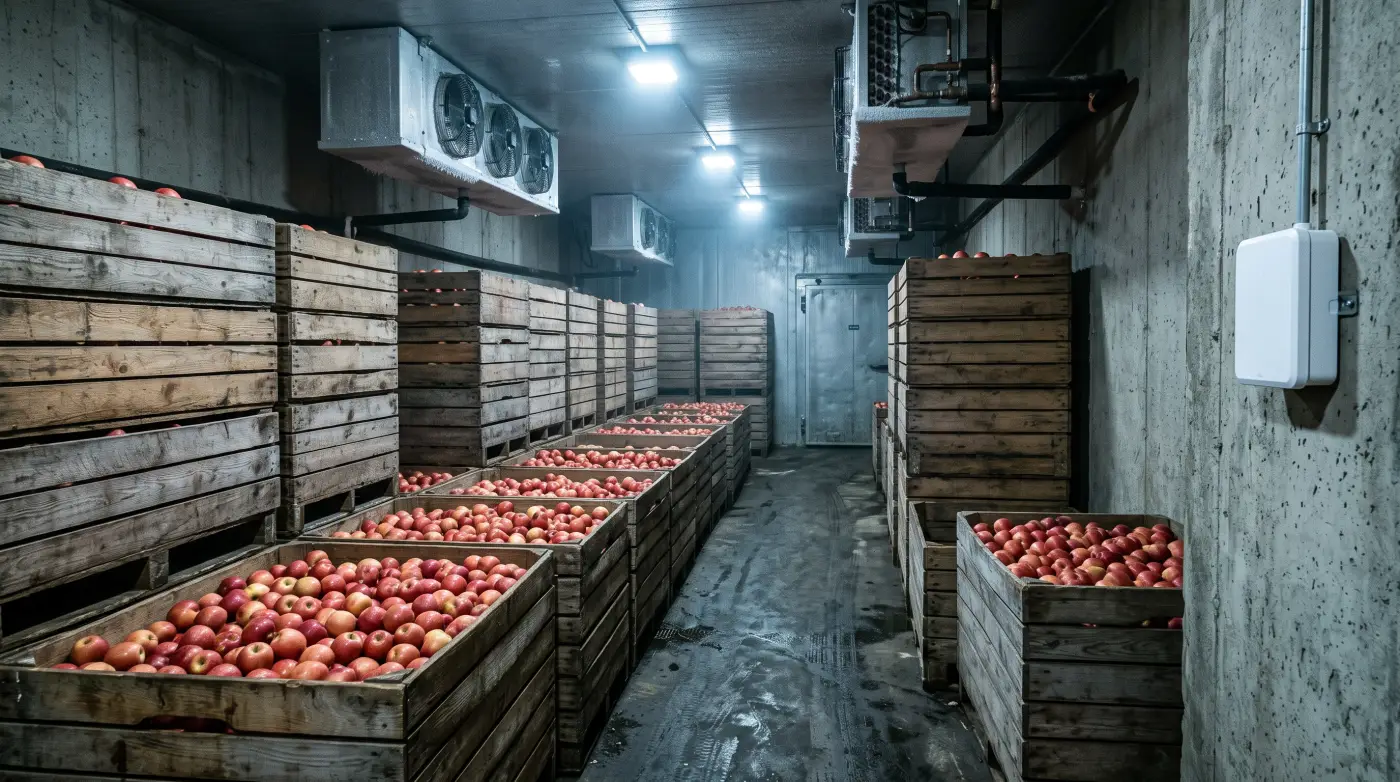
A produce farm's cold storage monitor does two things a cheap thermometer cannot: it alarms your phone the moment the cooler drifts out of range, especially overnight when a compressor failure can cost thousands, and it logs temperature and humidity against your crop's real needs, since produce like tomatoes and cucumbers is damaged by cold, not just heat.
Most guides on cooler sensors read like they were written for a restaurant. Put a probe in the walk-in, set an alarm for anything above 40 F, done. That model is fine for a case of chicken. It is wrong for a cooler full of tomatoes, and following it will cost you product while telling you everything is fine.
The sensor itself is the cheap part. A wireless temperature tag runs $25 to $150. What you are actually buying is a 2 a.m. phone call when the compressor quits, and a quality instrument that tells you whether your cooler is holding the conditions this crop needs, not just whether it is "cold." Get that framing right and the rest of the decisions fall into place.
Cold storage fails a produce farm in two ways, and they are almost opposites.
The first is catastrophic and obvious in hindsight. A compressor quits Friday night. Nobody is in the barn over the weekend. By the time someone opens the cooler Monday morning, a room full of product has been sitting warm for two days. Compressor failure is the most common cause of a walk-in temperature excursion, and it has a cruel habit of striking overnight or on weekends when no one is present. USDA's danger zone for pathogens starts at 40 F, but for produce the quality clock starts spinning the moment the air warms. This single event is the entire return-on-investment case for an alarm. One caught failure pays for the whole system many times over.
The second failure is quiet and expensive in a way you may never trace back to the cooler. The room runs "cold" at a steady 34 F, and you feel good about that number, while it slowly gives your cucumbers chilling injury or dries your greens to limp in a cooler running too low on humidity. There is no alarm because nothing crossed the 40 F line. The damage shows up as shorter shelf life, customer complaints, and product you compost instead of sell.
A restaurant walk-in alarm answers one dumb question: is it below 40 F? A produce farm needs a monitor that answers a smarter one: is this room holding the right spec for what is actually in it? That is the difference between a thermometer and a monitoring system.
There is no single correct setpoint, and that is the whole problem. Storage conditions for fresh produce run roughly 32 F to 55 F with relative humidity between 80 and 95 percent, but the right point inside that range varies sharply by crop.
Temperate crops like apples, carrots, and most leafy greens want to sit right near 32 F to 34 F. Chilling-sensitive and tropical crops are a different animal. They are damaged by storage that is too cold:
This is why a produce alarm needs a high limit and a low limit, set per room and per crop. Set only a high limit and you are blind to half the risk. If you store mixed crops with very different needs, that is a room-separation problem no sensor can solve, but a monitor will at least document which room is running off-spec for what is in it.
The definitive spec sheet already exists. USDA Agriculture Handbook 66, "The Commercial Storage of Fruits, Vegetables, and Florist and Nursery Stocks," lists the ideal temperature and humidity for essentially every crop you might grow. Pull the numbers for your crops from it, then set your alarm limits to match. That handbook, not a vendor's default, is your source of truth.
The biggest mistake after buying a sensor is trusting the wrong number. Air temperature is not product temperature, and the gap between them is where false alarms and missed problems both live.
Air temperature swings hard every time the door opens and every time the unit runs a defrost cycle. Both are normal. Neither means your product is in danger. But a bare sensor reading raw air will spike during defrost and fire an alert, and after enough of those junk alerts you will mute the system. False-alarm fatigue is the documented way a good monitor gets ignored and then misses the real event. The alarm that cried wolf is worse than no alarm, because it taught you to ignore it.
The fix is to measure product temperature, not air. Put the probe in a buffered enclosure, a small bottle of glycol or a product-simulating mass, so it reads the slow, stable temperature of the produce instead of the twitchy air around it. A buffered probe rides straight through a defrost cycle without blinking. If your system cannot buffer the probe, use a time-delayed threshold so a brief door-open spike does not trigger an alert.
Placement matters just as much. A sensor reads wrong if you put it in the return air stream, on a coil, in a door draft, or where the afternoon sun hits it through a window. Set it in a representative zone in the product, roughly where an average box of produce sits, away from all of those distortions. A perfectly accurate sensor in a bad spot gives you perfectly accurate garbage.
Because it is a separate failure mode, and it is the one most temperature-only setups ignore entirely.
Fresh produce generally needs 80 to 95 percent relative humidity. Below that range, transpiration accelerates. The produce breathes moisture out into the dry air and loses salable weight and firmness. Greens go limp, roots shrivel, and everything looks a day older than it is. A root cellar or cooler running too dry quietly shrinks your inventory. You are literally selling water, and dry storage evaporates your margin.
A temperature-only sensor cannot see any of this. The room can hold a flawless 34 F while running at 60 percent humidity and steadily degrading everything in it. If you are storing anything that wilts or shrinks, and that is most vegetables and nearly all roots, a combined temperature-and-humidity sensor is not optional. It closes the failure mode that a temperature probe leaves wide open. For a root cellar in particular, humidity is often the number that matters most.
This is the real buying decision, and it is not about the sensor. It is about how the alarm gets to your phone. A sensor that logs perfect data but cannot reach you when the compressor dies has failed at its only important job.
You have three connectivity options:
For most produce operations the honest answer is cellular if your WiFi does not reliably reach the cooler, and WiFi only if you have tested that it does. Whatever you pick, the notification needs to escalate. A text is easy to sleep through. Look for a system that will text, then call, then email, and ideally notify a second person, so a failure at 2 a.m. actually wakes somebody.
Match the spend to what is sitting in the cooler. These are vendor-typical ranges, and prices and plans change, so treat them as a starting map, not a quote.
The math is simple. Add up what a full cooler is worth. If losing it once would hurt, the sensor tier that reliably wakes you is cheap insurance. If the cooler holds a weekend's worth of a farm stand's greens, the consumer tier plus a gateway is a fair fit.
Yes, and it is a genuine second benefit, but it is not the reason to buy. Continuous automatic logging produces a tamper-resistant temperature and humidity history, exactly the kind of record that food-safety audits, packers, and larger buyers increasingly ask for under FSMA-era expectations. If you sell wholesale or plan to, that log can save you a scramble when someone asks to see your cold-chain records.
Treat it as a bonus, not the pitch. Compliance is the boring reason to monitor. The alarm that saves a cooler full of product on a Friday night is the real one. The audit trail just happens to come free with the same hardware.
Once you have the framing right, setup is short:
Do those seven and the system pays for itself the first night the compressor dies.
Cold storage monitoring is one of the few links in the produce cold chain you own outright. Sector-wide, roughly 20 to 50 percent of fruits and vegetables are lost before anyone eats them, and the International Institute of Refrigeration attributes about 12 percent of global food loss specifically to an insufficient cold chain. Those are macro numbers, not your farm's loss rate, but the link they point at is the one sitting in your barn. You cannot fix the whole chain. You can make sure your own cooler never fails silently.
If you want the crop-by-crop storage numbers in one place, keep our farm monitoring guides on hand and join the Manley Farms email list, where we work through the practical ag-tech decisions like this one without the sales pitch.
It depends on the crop. Fresh produce generally stores between 32 F and 55 F at 80 to 95 percent humidity, but temperate crops like apples and greens want near 32 F to 34 F, while chilling-sensitive crops like tomatoes, cucumbers, and sweet potatoes need 50 F to 55 F. Pull exact numbers for your crops from USDA Agriculture Handbook 66.
Because for many crops, too cold is the problem. Tomatoes, cucumbers, sweet potatoes, and most tropical produce suffer chilling injury when stored below about 50 F. The damage, pitting and decay, often only appears after the produce warms back up, so it is invisible at the point of sale unless you caught the cold excursion with a low-limit alarm.
Use WiFi only if you have tested that the signal reliably reaches the cooler, since metal-clad coolers on rural properties are often exactly where farm WiFi dies. If the signal is weak, use a cellular sensor, which skips WiFi entirely on a 4G or LTE connection. Cellular carries a monthly data fee, commonly $5 to $30, so budget for it.
Measure product temperature instead of air. Put the sensor in a buffered enclosure, like a small bottle of glycol, so it reads the slow, stable temperature of the produce rather than the twitchy air that spikes during defrost cycles and door openings. If you cannot buffer the probe, set a time-delayed threshold so brief spikes do not trigger alerts.
Consumer and prosumer sensors run about $25 to $150, though some need a separate gateway to alert you remotely. Cellular standalone sensors run about $200 to $400 plus a monthly plan. Commercial logging systems from brands like Monnit or Onset run about $200 to $800 per sensor with better durability and audit-grade records. Match the tier to your cooler's value.
Join our list for practical guides on farm tech, precision agriculture, and tools that work.