
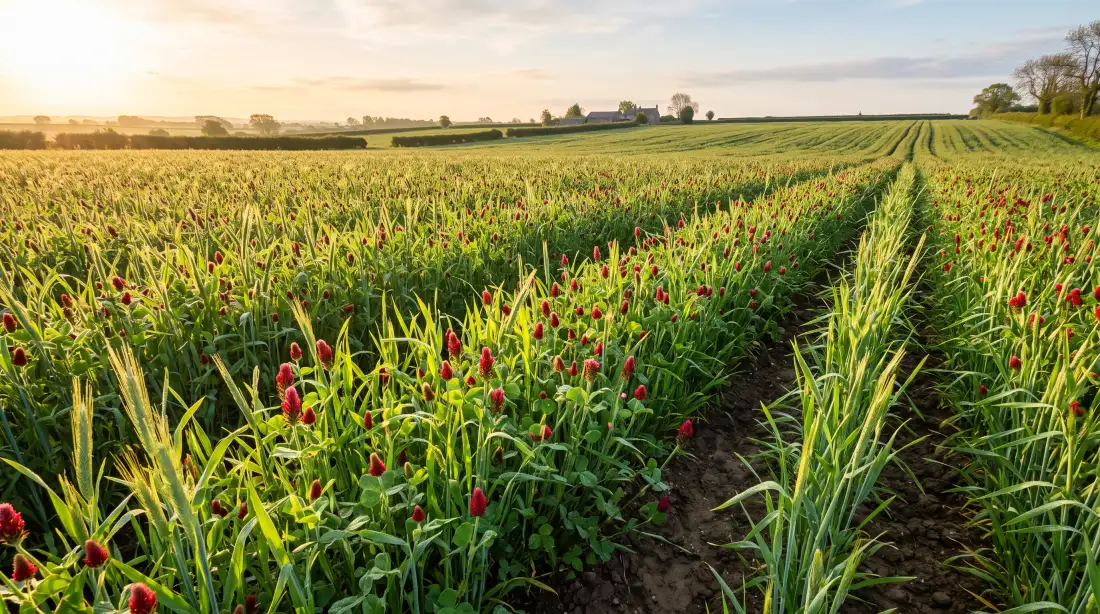
Cover crops are not a silver bullet. They are a tool that can solve real problems on working farms when you pick the right species, hit the timing, and manage the transition into your cash crop. This guide focuses on practical decisions: what to plant, when to plant and terminate, how cover crops change soil function, how the economics pencil out, and how to fit cover crops into real rotations in the Pacific Northwest and Midwest.
Cover crops are crops grown primarily to protect and improve the soil between cash crops. They can be planted after harvest, interseeded into a standing crop, or used as a short-season crop in a rotation. The goal is not grain, hay, or seed. The goal is soil function and system resilience.
Why they matter: - Soil is a living system. Keeping living roots in the ground longer feeds soil biology and improves aggregation. - Bare ground loses soil. Erosion can remove topsoil at rates that are hard to replace. A cover crop keeps the soil covered when the risk of wind and water erosion is highest. - Water is limited. Better infiltration and water-holding capacity help you use rainfall more effectively. - Nutrients are expensive. Cover crops can keep nutrients from leaching, capture leftover nitrogen, and supply nitrogen when legumes are used.
Most cover crops fit into three functional groups: legumes, grasses, and brassicas. Mixes can provide multiple benefits, but single species can be the right choice when you want simple management or a specific outcome.
Common options: red clover, crimson clover, hairy vetch, winter pea, field pea, lentil.
Why plant them: - Fix atmospheric nitrogen. A good legume stand can add 40 to 100 lb of plant-available nitrogen per acre, depending on species, biomass, and termination timing. - Improve soil biology. Legume residues generally have lower carbon-to-nitrogen ratios, which supports faster nutrient cycling.
When they fit: - When nitrogen costs are high and you can afford to let the cover grow to build biomass. - In systems where spring nitrogen availability matters, such as corn, potatoes, or vegetables.
Watchouts: - Legumes can be harder to terminate if you let them mature. Plan termination timing before flowering for easier control.
Typical seeding rates: - Red clover: 8 to 12 lb per acre drilled, 10 to 14 lb per acre broadcast. - Crimson clover: 15 to 20 lb per acre drilled. - Hairy vetch: 15 to 25 lb per acre drilled. - Winter pea: 50 to 80 lb per acre drilled.
Common options: cereal rye, winter wheat, triticale, oats, barley, annual ryegrass.
Why plant them: - Fast biomass and ground cover. Grasses are the workhorses for erosion control and weed suppression. - Scavenge leftover nitrogen. A cereal rye cover can capture 20 to 60 lb of nitrogen per acre that might otherwise leach. - Strong root systems that build soil structure.
When they fit: - Following corn silage, potatoes, or vegetables where you need quick soil cover. - In corn - soybean rotations where you want an easy-to-manage winter cover.
Watchouts: - High carbon-to-nitrogen residues can tie up nitrogen early in the cash crop. Plan nitrogen management or use a legume mix if that is a concern.
Typical seeding rates: - Cereal rye: 50 to 90 lb per acre drilled, 70 to 110 lb per acre broadcast. - Oats: 60 to 100 lb per acre drilled. - Triticale: 60 to 100 lb per acre drilled. - Annual ryegrass: 15 to 25 lb per acre drilled.
Common options: oilseed radish, daikon radish, turnip, mustard.
Why plant them: - Deep taproots that can break through shallow compaction and open channels for water and root growth. - Fast fall growth and good nutrient scavenging. - Some mustards can provide a biofumigation effect when incorporated, which can help manage certain soil-borne pests in vegetable and potato systems.
When they fit: - Where compaction or poor infiltration is limiting yields. - In irrigated systems where you can push late-season growth.
Watchouts: - Brassicas winter-kill in many regions, leaving soil exposed by late winter if not mixed with a winter-hardy grass. - They do not fix nitrogen and their residue breaks down quickly.
Typical seeding rates: - Oilseed radish: 6 to 10 lb per acre drilled. - Mustard: 8 to 12 lb per acre drilled. - Turnip: 3 to 5 lb per acre drilled.
Mixes can stack benefits, but they also add cost and complexity. A common approach is a grass - legume mix so you get biomass plus nitrogen. A three-way mix of cereal rye, vetch, and radish can cover erosion, nitrogen, and compaction, but you need to be confident on termination timing and herbicide selection.
Practical rules for mixes: - Keep it simple. Two or three species is usually enough. - Know your herbicide plan for the following crop and check labels.
Cover crops work through four main pathways: soil structure, water movement, nutrient cycling, and biology. You will not see full benefits in one season. Most farms see meaningful changes after 3 to 5 years of consistent use, with continued gains over longer periods.
Roots and residue build aggregates. Aggregates improve pore space, reduce crusting, and allow roots to explore deeper. Grasses build a dense root network in the top 6 to 12 inches, which strengthens the soil. Brassicas punch deep holes that can open up hard pans. Legumes add easily decomposed residues that help soil particles stick together.
Practical outcomes: - Better seedbed tilth with less tillage. - Improved trafficability in spring because soil handles equipment without smearing. - Reduced surface crusting and seedling emergence issues.
Surface cover reduces raindrop impact and keeps soil pores open. Root channels increase infiltration. Organic matter holds water. These changes add up, especially on soils with low organic matter or heavy texture.
Practical outcomes: - Less runoff and ponding after heavy rains. - More even soil moisture across the field. - Improved drought tolerance for the cash crop.
A modest increase in soil organic matter, even 0.2 to 0.5 percentage points over several years, can noticeably improve water-holding capacity. The effect is strongest on sandy or degraded soils.
Cover crops capture leftover nutrients and reduce loss. Grasses are strong scavengers of nitrate. Legumes can fix nitrogen. Brassicas and grasses can also capture sulfur and other nutrients that might leach in fall and winter.
Practical outcomes: - Less nitrate loss between fall harvest and spring planting. - More consistent nitrogen supply when legume covers are timed well. - Reduced need for starter nitrogen in some systems.
Typical nitrogen contribution ranges: - Legume covers can supply 40 to 100 lb N per acre if they reach full biomass. - Mixed covers often contribute 20 to 60 lb N per acre, depending on legume proportion. - Grasses mainly conserve nitrogen rather than add it, but can prevent 20 to 60 lb N per acre from leaching.
The key is timing. If you terminate too early, nitrogen contribution drops. If you terminate too late, residues can delay nitrogen release and tie up N early in the cash crop.
Living roots feed soil microbes. A diverse cover crop can increase microbial activity and help balance residue breakdown and nutrient cycling. Over time this can reduce disease carryover risk in some rotations and improve root vigor.
Timing is the difference between a cover crop that helps and one that causes headaches. Work backward from your cash crop planting date and match your cover crop to the window you have.
Post-harvest planting: - Works well after small grains, silage, early vegetables, and some seed crops. - Aim to plant within 7 to 14 days of harvest to capture soil moisture and fall growing degree days.
Interseeding into standing crops: - Useful in corn, soybean, and some vegetable systems when harvest is late. - Interseed at V4 to V6 in corn or R1 to R3 in soybeans, depending on equipment and canopy. - Choose shade-tolerant species such as annual ryegrass, clover, or small-seeded brassicas.
Late-season planting: - If planting after late harvest, choose winter-hardy grasses like cereal rye. Even a thin stand helps reduce erosion and capture nutrients.
Drill seeding is most reliable for stand uniformity. Broadcast with light incorporation can work in a hurry, but expect more variability. Aerial seeding can be effective for interseeding but depends on timely rain. Plant small seeds 0.25 to 0.5 inches deep and larger seeds 0.75 to 1.5 inches deep in a firm seedbed.
Termination options: - Herbicide termination is common for winter annuals and perennial covers. - Rolling - crimping can work on cereal rye at anthesis or early milk stage, but requires proper timing. - Winter-kill is a natural termination for oats and many brassicas in cold climates.
Timing guidelines: - Terminate 10 to 21 days before planting if you need soil to warm and dry in spring. - Terminate 2 to 7 days before planting if moisture conservation is more important than soil warming. - For legumes, terminate around early bloom for maximum nitrogen contribution while still manageable. - For cereal rye before corn, terminate at 12 to 18 inches tall if you want to avoid nitrogen tie-up and planting issues.
Cover crops are an investment. They add costs up front but can reduce costs and improve yield stability over time. The economics depend on your goals, your rotation, and how well you execute.
These are common ranges for many regions: - Seed cost: $20 to $60 per acre for single species, $30 to $90 per acre for mixes. - Seeding cost: $10 to $25 per acre, depending on method and fuel. - Termination cost: $10 to $25 per acre for herbicide or rolling, more if multiple passes are needed. - Total direct cost: $40 to $110 per acre for most cover crop programs.
Costs can be lower if you use on-farm seed, combine cover crop passes with other operations, or graze the cover to recover value.
Short-term returns are often indirect: - Reduced erosion and improved field access can save labor and repairs. - In dry springs, residue can conserve moisture and improve stand establishment. - Legumes can reduce purchased nitrogen by 20 to 60 lb per acre in some rotations.
Long-term benefits are where cover crops pay. These include: - Improved soil organic matter and structure, reducing the need for aggressive tillage. - More consistent yields in wet or dry years, which can reduce income variability. - Reduced nutrient loss, which keeps fertilizer dollars in your field.
Many farms report that the net cost drops after 3 to 5 years as management improves and soil response builds. If you add grazing, you can often recover a significant part of the cost in a single season.
Practical strategies include starting with high-risk fields, choosing low-cost species for year one, and tracking costs against tangible savings like reduced nitrogen and fewer passes. Assign a conservative value to avoided erosion and improved field access so the economics are not understated.
Cover crops must fit the rotation you already have. The best plan is the one you can execute year after year without causing delays or compaction.
Common approach: - Cereal rye after corn or soybeans, terminated in spring before planting corn or soybeans. - Interseeding clover or ryegrass into corn at V4 to V6 to ensure green cover after harvest.
Considerations: - If you plant rye before corn, terminate early and be ready to manage nitrogen availability. - For soybeans, you can terminate later and even plant green in wetter regions.
Common approach: - After wheat or barley harvest, plant a summer cover mix that includes a legume and a grass.
Considerations: - Manage volunteer grain and weeds early to avoid competition.
Common approach: - Use fast-growing brassicas or mixes in the short fall window after harvest, especially in irrigated systems.
Considerations: - Avoid covers that might host disease or pests for your next crop. - Mustards can offer biofumigation benefits, but management timing and incorporation are critical.
Common approach: - Use winter-hardy grasses or legumes during fallow periods if moisture is adequate. - Keep biomass modest to avoid excessive soil water use.
Considerations: - Moisture is the limiting factor. Terminate early if soil moisture is low.
Grazing is a powerful tool to make cover crops pay. Grazed covers can: - Generate immediate revenue or feed savings. - Cycle nutrients back into the soil. - Encourage root growth if grazing is managed to avoid overgrazing.
Key management points: - Use temporary fencing to control grazing intensity. - Avoid grazing when soils are saturated to reduce compaction. - Leave enough residue to protect the soil surface.
Technology can make cover crops easier to manage and evaluate. You do not need the latest platform or a fancy dashboard. You need tools that help you answer practical questions: Is my stand uniform? Did I hit my biomass target? Is soil moisture where I need it to be?
Satellite imagery can show stand uniformity and growth patterns. Most platforms provide NDVI or similar indices. These indices are not perfect, but they help you spot weak areas, compaction zones, and drainage issues.
Practical uses: - Compare fields to see which covers establish best. - Identify areas with poor emergence or high residue. - Track growth to plan termination timing.
A useful rule of thumb is to look for consistent NDVI patterns rather than absolute numbers. If one zone is consistently 0.15 to 0.25 lower than the rest of the field, it likely needs attention.
Soil sensors can help you decide when to terminate. If soil is drying out too quickly in spring, a cover may need to come off sooner. If the soil is holding moisture and temperatures are slow to rise, you may need a wider termination window.
Practical uses: - Track soil moisture at 4 to 12 inches to evaluate water use by the cover. - Measure soil temperature at planting depth to avoid cold soil planting issues.
You do not need a lab to estimate biomass. A 1 square foot or 1 square meter clip sample, dried and weighed, can provide a solid estimate. Target biomass for most covers is 2,000 to 5,000 lb per acre, depending on goals and equipment.
A quick field method: - Clip all biomass in a 1 square foot area. - Weigh fresh and dry in a low-heat oven or air-dry if time allows.
If nitrogen timing is critical, use a pre-plant nitrate test. It can show whether a legume cover released N when you need it. If nitrate is low, plan for a starter application.
Practical uses: - Adjust spring nitrogen rates based on soil test results. - Avoid over-application when a legume cover provided more N than expected.
Below are common, real-world cover crop programs that match regional conditions. These are based on typical systems rather than a single named farm, but the management details reflect what is used in the field.
System: - Winter wheat followed by a fallow period. - Soil moisture is limited, and erosion risk is high in late fall and early spring winds.
Cover crop approach: - After winter wheat harvest in July, a short-season cover mix is planted in August if late-summer moisture is adequate. - The mix is dominated by oats and peas at moderate seeding rates to limit water use, for example 40 lb per acre oats and 30 lb per acre peas. - Termination occurs by early October to conserve soil moisture for the next wheat planting.
Results farmers target: - Improved residue cover to reduce erosion through winter. - Better soil tilth and infiltration without reducing yield in the following wheat crop.
System: - Corn - soybean rotation with fall harvest. - Erosion risk on sloping ground and nutrient loss over winter.
Cover crop approach: - Cereal rye drilled immediately after soybean harvest at 60 to 80 lb per acre. - Termination 10 to 14 days before corn planting, or later before soybean planting. - In years with wet springs, some farmers plant soybeans into green rye and terminate 3 to 7 days after planting to manage moisture and weeds.
Results farmers target: - Reduced nitrate loss and improved spring soil trafficability. - Weed suppression, especially on early-season broadleaves. - More consistent yields in wet years due to improved infiltration.
If you are new to cover crops, start with a small acreage and a clear goal. The most successful programs are built over time with careful observation and adjustments.
Step-by-step approach: - Choose one field with manageable logistics and moderate risk. - Define your main goal - erosion control, nitrogen, compaction, or weed suppression. - Pick a simple species that matches your goal and your planting window. - Set a termination date before you plant. - Track costs, stand establishment, and any changes in soil condition or yield.
Cover crops are a practical tool for building soil health and managing risk. They can improve soil structure, water infiltration, and nutrient cycling when managed with clear goals and realistic timing. They do not replace good agronomy, but they can make good agronomy work better.
Start with a simple plan, measure what matters, and adjust each year. In most systems, the cover crop itself is not the limitation. The limitation is timing and management. Get those right, and the soil will do the rest.
A legume cover such as hairy vetch or crimson clover can supply 40 to 100 pounds of plant-available nitrogen per acre if it reaches full biomass before termination. Grasses like cereal rye do not fix nitrogen but scavenge 20 to 60 pounds per acre that would otherwise leach over winter. Mixes typically land in the 20 to 60 pound range depending on the legume proportion.
Do not expect full benefits in one season. Most farms see meaningful changes in soil structure, infiltration, and biology after 3 to 5 years of consistent cover cropping, with gains continuing over longer periods. Even a modest 0.2 to 0.5 percentage point rise in soil organic matter over several years noticeably improves water-holding capacity, and the effect is strongest on sandy or degraded soils.
For most programs, seed runs 20 to 60 dollars per acre for a single species and 30 to 90 dollars for a mix, seeding adds 10 to 25 dollars, and termination another 10 to 25 dollars. Total direct cost usually lands between 40 and 110 dollars per acre. Grazing the cover, using on-farm seed, or combining passes can recover a meaningful share of that.
Terminate 10 to 21 days ahead if you need the soil to warm and dry, or 2 to 7 days ahead when conserving moisture matters more. Kill legumes around early bloom for maximum nitrogen while they are still manageable. For cereal rye going before corn, terminate at 12 to 18 inches tall to avoid nitrogen tie-up and planting problems.
Join our list for practical guides on farm tech, precision agriculture, and tools that work.