
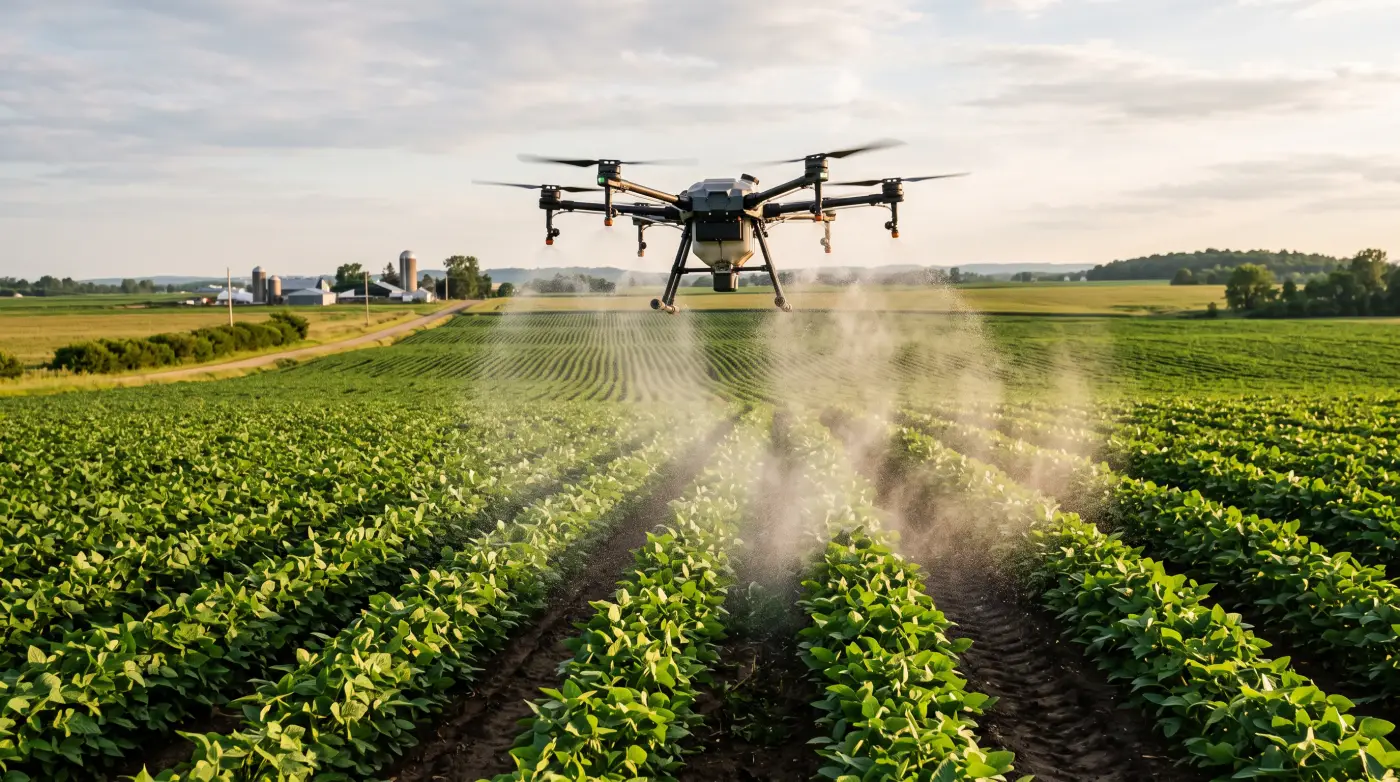
If you've watched a spray drone work a field of tall corn in August, it's hard not to stop and stare. The machine runs its lines at 15 feet above the canopy, droplets going down through the leaves rather than sitting on top, and the boom never touches a stalk. That novelty has worn off for operators who've been flying them since 2021 or 2022. What's replaced it is a more honest accounting: drones are a real tool with a real use case, and they're also a limited one. This guide is written for farmers trying to figure out which side of that line their operation falls on - not to sell you on ag drones, but to give you the numbers and tradeoffs before you commit to anything.
An agricultural spray drone is a multi-rotor unmanned aircraft - usually 6 or 8 rotors - carrying a liquid tank, a pump, and a set of nozzles designed to apply crop protection chemistry or fertilizer from the air. That's the baseline definition, but the working details matter.
Tank sizes on purpose-built ag drones run from about 5 gallons on the smaller commercial units up to 10 - 13 gallons on the current large-platform machines. The DJI Agras T40, which has become the de facto reference machine for this class, carries about 10.5 gallons (40 L) of spray solution. The T50 that followed it bumps that to 13 gallons (50 L). Some operators on row crops push those limits; most work with 8 - 10 gallons loaded to keep flight time reasonable and avoid the handling issues that come with a heavy machine near terrain features.
Swath width on a large drone like the T40 or T50 is typically 7 - 9 meters (roughly 23 - 30 feet) effective width, depending on application rate, forward speed, and droplet size target. That's narrower than a 90- or 120-foot boom, which is the first thing a ground-rig operator notices about throughput math.
Droplets from drone nozzles are typically produced through hydraulic flat-fan nozzles or centrifugal (rotary atomizer) heads. The rotor downwash from the drone pushes droplets down into the canopy rather than leaving them to settle, which is part of the story for canopy penetration. Applications on labeled drone jobs usually target medium to coarse droplets - 200 to 400 micron VMD range - to balance canopy penetration against drift risk. You'll see centrifugal nozzles on some platforms that allow wider droplet-size adjustment through spin speed.
RTK guidance is now standard on the serious machines. DJI's Agras line uses their own RTK module that talks to a base station or NTRIP network, giving you 2 - 4 cm positional accuracy. That matters for row overlap consistency and for flying tight buffer zones next to water or sensitive areas. Flight planning is done in the companion app - you import a field boundary (often drawn or imported from a shapefile), set the spray parameters, and the machine flies the mission autonomously. The operator watches, manages the refill logistics, and takes manual control if something goes wrong.
Terrain following uses radar and ultrasonic sensors to maintain a constant height above the crop surface rather than above sea level. On rolling terrain, this keeps the spray height consistent without the operator manually adjusting - critical for both efficacy and drift compliance. Most current platforms can follow terrain variation of 30 feet or more without issues.
DJI's Agras line is the market share leader in the US for agricultural spray drones by a wide margin. The T40 was the breakout machine - it set the template for what a practical large-payload ag drone looks like: foldable arms, fast tank fill with a pressure-fitting intake, active phased-array radar for terrain following, and a relatively mature flight planning app in DJI Agras. The T50 followed with a larger tank, improved pump system, and some changes to the spreading system (it can also broadcast granular materials with an add-on). For a two-person custom-application crew in the US, the T40 or T50 is the baseline most operators are building around as of 2025.
XAG is the other major purpose-built agricultural drone manufacturer with a real US distribution and support presence. Their P100 Pro is in the same payload class. Some operators prefer the XAG platform's software or support relationship with their dealer. For most working farmers evaluating these, the DJI vs. XAG question comes down to local dealer support, training access, and what your custom applicator is already flying.
There are also US-assembled machines from companies like Hylio (Texas-based, the AG-272 and larger units) targeting operators who want domestic parts availability and a company they can call. Throughput numbers are similar in the same payload class, but dealer network and parts support differ considerably from the import brands.
What all the serious machines in this class share: RTK or GNSS precision, terrain following radar, centrifugal or hydraulic atomizing nozzles, tank capacities in the 10 - 15 gallon range, and flight planning software that generates autonomous spray missions from imported boundaries.
This is where a lot of promotional material gets soft. Here are numbers that reflect what experienced two-person crews actually report in US row crop conditions.
A T40 at typical row crop application rates (1 - 2 gallons per acre for fungicide or herbicide) can cover roughly 20 - 30 acres per hour in the air. The 20 acres/hour figure is conservative but achievable in average conditions. The 30 acres/hour figure is what operators see on larger fields with clean geometry, minimal obstacles, and faster forward speeds.
But time in the air is not the same as acres-per-day throughput. The T40 carries enough solution for 5 - 10 acres per tank at 1 gallon per acre, or 2.5 - 5 acres at 2 gallons per acre. Battery flight time is roughly 15 - 20 minutes per charge under load. That means a well-run two-person crew is executing refills and battery swaps every 10 - 15 minutes of productive flying time.
With three battery sets (charging two while flying one) and a tender setup that includes a clean water tank and a mixing station, an experienced crew running smooth field conditions can realistically get 150 - 200 acres of good field in a 10-hour day at 1 gallon per acre application rates. If you're running 2 gallons per acre, halve that. If your water source is 15 minutes away, cut further. These numbers assume a 100 - 200 gallon water tender on-site, good field organization, and no maintenance stops.
Compare that to a 90-foot ground sprayer running at 12 mph: you're looking at 50 - 70 acres per hour in comparable field conditions, or 400 - 500+ acres per day for a capable operator. A single-engine aerial applicator (ag plane) working row crops can put down 500 - 800 acres per day and more.
The honest conclusion: a drone spraying crew is not replacing a large ground rig for volume. They're replacing it for situations where the ground rig can't or shouldn't go.
This is the actual case for drone crop spraying, and it's meaningful if your operation has any of these conditions.
Wet fields. The most clear-cut case. If you're trying to make a fungicide application on corn or soybeans in July and the field has been too wet to run a ground rig for ten days, you have options with a drone where you'd otherwise be waiting. Wheel tracks in wet soils cause yield loss from compaction - studies have put this at 5 - 15% in the track zones, sometimes higher. In a year with a persistent wet spell during tasseling or early grain fill, getting that fungicide on when the label window is open can pay back the drone application cost several times over.
Tall and late-canopy corn. By R2 or R3, you're not running a ground rig with a drop-nozzle system through most corn anyway without significant physical damage. A drone can apply fungicide at VT through early grain fill stages where a high-clearance machine would struggle or require specific high-clearance equipment that most operations don't own. The rotor downwash actually helps penetrate the canopy to get product to the ear zone and upper leaves where the fungicide label targets are.
Point rows, odd corners, and irregular field geometry. Any farmer with pivot corners, tree-line borders, or creek-shaped field edges knows the areas that ground equipment skips, doubles, or handles poorly. A drone operating from an imported field boundary applies to the actual edge of the field. This is particularly relevant in irregular-shaped fields that cause a ground rig to leave unsprayed wedges or make tight turns that increase application time and operator fatigue.
Waterways and buffer strips. A drone operator can fly a field boundary that respects a 15- or 30-foot buffer from a surface water feature with precision that a ground operator matching flags or fence posts cannot. In states with buffer requirements tied to pesticide labels or nutrient management plans, this matters for compliance.
Spot treatment of weed escapes and disease hot spots. This is arguably the most economically interesting use case. A spot spray drone application on a 3-acre marestail escape in an otherwise clean soybean field - or a gray leaf spot pressure zone in the northeast corner of a corn field - uses a fraction of the chemistry and time that a full-field pass would require. More on this in the spot spraying section below.
Fungicide timing on narrow application windows. Corn fungicide applications at VT-R1 have a documented window where they pay most consistently - and that window can be 5 - 10 days depending on hybrid and weather. If that window coincides with 4 inches of rain across a week, the drone is the tool that can actually make the application. Custom drone applicators are increasingly booking this window specifically.
No wheel-track yield loss. For high-yield corn especially, wheel tracks across wet soil in August can leave visible yield drag in the following year's strip maps. Drone application eliminates this entirely.
Honest accounting requires covering the limitations in equal depth.
Broad-acre burndown at scale. Preplant or post-harvest burndown across 800 acres of soybeans is not a drone job. The throughput math just doesn't work for a single crew. If you have a large ground rig and clean access, use it.
High gallon-per-acre needs. Some applications call for 10 - 15 gallons per acre - certain herbicide programs, some fungicide tank mixes on heavy residue - and the drone simply can't deliver that efficiently. The tank has to land every 2 - 3 acres and the cycle time kills you. At 1 gallon per acre you can make a drone work; at 10 gallons per acre you're running an absurdly small operation per flight.
Wind. Most ag drone operating guidelines specify a 15 - 20 mph wind ceiling, and effective drift-controlled application really wants winds under 10 mph. In the plains states during spring burndown or in coastal areas with afternoon sea breezes, the window that is simultaneously warm enough, not raining, and under 10 mph wind can be short. This is not hypothetical - it is the binding constraint that limits field days for drone applicators in many US regions.
Water-hauling logistics. The drone needs a continuous water and product supply that a ground rig carries with it for hundreds of acres. A drone crew needs to either position a large tender in the field or run a shuttle. In fields without interior road access or that are far from a suitable water supply, the logistics cost eats your time advantage fast.
Regulatory load. This is covered more below, but managing the FAA requirements, state pesticide applicator licensing, label compliance, and recordkeeping is a real workload that doesn't exist for a ground rig operator.
Temperature and extreme weather. Drones are not rated for operation in precipitation or sustained high-wind events, obviously, and most manufacturers specify operating temperature ranges that affect battery performance. Cold early spring days or high summer heat both affect battery capacity and electronics reliability in ways a ground rig doesn't face.
Targeted application - sometimes called spot spraying or variable-rate application - is where the drone's precision and low throughput stop being a weakness and become the entire point.
The scenario: you scout a 400-acre soybean field in late June. You find marestail pressure confined to about 15 acres along the north edge where soil dried out first and got a head start on germination. The rest of the field is clean. A full-field post-emerge application with your ground rig costs you $8 - $12 per acre in product plus your time and equipment cost. A drone spot treatment on those 15 acres - with a prescription map drawn from your scouting notes or from a simple drone imagery pass - costs a fraction of that and keeps chemistry off clean acres.
The green-on-brown detection idea (visual discrimination between green weed growth and bare or brown background) is useful in burndown scenarios - some operations use this ahead of a crop emergence window. The more practical version for most working farmers right now is simpler: you already know from scouting where the pressure is. You draw the treatment zones in the flight planning app and fly only those. You don't need computer vision to benefit from targeted application - you need a good scout and a drone operator who can translate a field map into a mission.
The chemical savings math is straightforward. If you're treating 15 out of 400 acres, you've used 3.75% of the product a full-field pass would have consumed. At $30/acre material cost for a post-emerge herbicide program, that's $450 in chemistry versus $12,000. Even at $20/acre custom drone application rates, a 15-acre spot treatment costs $300 and saves $11,700 in product. The break-even on the math is not complicated - it's the scouting discipline and logistics that are the friction point.
Disease hot spots work the same way. If you have a gray leaf spot or Northern corn leaf blight infestation concentrated in a historically low-ground or irrigation tail-water zone in your field, treating those 20 acres rather than all 300 is a real cost option that wasn't practical with ground equipment.
Purchase prices (2025 US market):
A complete DJI Agras T40 setup ready to operate commercially - drone, remote controller, charger, and a base station - runs approximately $16,000 - $18,000 through US dealers. Add a second battery set ($1,500 - $2,500 depending on configuration), a generator or vehicle-mounted charging system ($1,500 - $3,000 for a purpose-built charging station), and a water tender setup (a 150 - 300 gallon tank on a UTV or small trailer with a pump, $2,000 - $4,000 new), and you're at $22,000 - $28,000 for a functional operation. That does not include the FAA licensing costs, training, and consumables.
Custom application rates:
In the US market as of 2025, drone spraying custom rates for row crops typically run $15 - $25 per acre for fungicide or herbicide applications at 1 - 2 gallons per acre. Rates at the lower end are for larger fields with good access and simple geometry. Rates at the upper end reflect smaller fields, spot treatment, or difficult logistics. Some operators charge a minimum call-out fee of $200 - $300 regardless of acreage.
Compare this to a commercial aerial application fixed-wing cost of $12 - $18 per acre for fungicide (product not included, just the application), and to ground application custom rates of $8 - $14 per acre for similar programs. The drone is not the cheapest per-acre application method at scale - it's the method with capabilities the other two don't have.
Payback math for a custom applicator business:
If you're buying a T40 setup at $25,000 total cost and running custom application, you need roughly 1,250 - 1,500 acres at $18/acre to break even on equipment cost (not counting labor, fuel, travel, or licensing). A two-person crew logging 150 acres per day on a good day, working 60 field days per year, can do 9,000 acres per season. At $18/acre that's $162,000 gross revenue. After labor, travel, licensing, insurance, and consumables, margin is tight but real for an operator who builds a dense local customer base.
For an individual farm operator buying a drone for their own operation: the math is harder to make work on acreage alone. The case is the situation-specific value - the fungicide application that saves a wet-year yield loss, the spot treatment that saves $8,000 in chemistry, the edge treatment that lets you stop paying a custom applicator $22/acre. If those situations apply to your farm 3 - 5 times per season and involve meaningful acreage, the numbers move toward justification.
This section is not legal advice, but it is a candid map of the regulatory landscape as it stood heading into the 2025 - 2026 growing season.
FAA Part 107: Commercial drone operation in the US requires at minimum an FAA Remote Pilot Certificate under Part 107 (14 CFR Part 107). This is the remote pilot written exam, $175 currently to take, good for 24 months before recurrency. Part 107 covers drones under 55 lb operating by visual line of sight. Most spray drones fly under this weight limit for the aircraft itself but the loaded weight with tank and batteries can exceed it - which changes the calculus.
FAA Part 137: Agricultural aircraft operator certification has historically applied to manned aerial applicators, but the FAA has clarified that commercial unmanned aerial application of pesticides constitutes aerial application and falls under the Part 137 framework. This means a commercial operator needs a Part 137 Agricultural Aircraft Operator Certificate, which requires a practical test and carries operational requirements beyond Part 107. Part 137 also requires the drone to be registered as an aircraft.
Section 44807 / FAA Exemption for >55 lb drones: Drones over 55 lb MTOW require an exemption under Section 44807 of the FAA Reauthorization Act (formerly Section 333 exemption pathway) to fly commercially. A T40 loaded weighs significantly over 55 lb. Most commercial drone spray operations flying full-size ag drones are operating under Section 44807 exemptions that the FAA has been granting for agricultural spray. These exemptions are aircraft-specific and require a new application or amendment for each drone.
State pesticide aerial applicator licensing: This is where it gets complicated at the farm level. Pesticide application is regulated state-by-state, and most states consider aerial application - including drone application - to require an Aerial Applicator Pesticide License separate from a ground applicator license. Requirements vary. Some states have updated their licensing structure to include unmanned aerial applicators; others are still working from older statutes written for manned aircraft. You need to check your specific state's Department of Agriculture requirements before operating commercially or hiring someone to spray for you.
Label compliance and registered chemistry: This is non-negotiable. Pesticide labels are federal law. A product must be registered for aerial application and its label must permit aerial use - not all products do. The drone is considered an aerial application method under FIFRA. Products you can apply from a ground rig may not have aerial application on their label. Check every label for an aerial application section before loading the drone, and retain records of what was applied, where, when, and at what rate.
Recordkeeping: Part 137 and most state licensing frameworks require maintenance of application records for commercial operations. Beyond compliance, recordkeeping is practical - knowing what you applied and where is essential for crop insurance documentation, re-entry interval tracking, and field history.
Drift is the central concern on every ag drone application, and it's worth being direct about it rather than glossing over it.
The fine droplets that maximize canopy penetration are also the droplets most susceptible to off-target movement. The rotor downwash from an ag drone creates a localized downward airflow that pushes spray into the canopy and reduces drift compared to an unassisted fine spray - this is genuine and documented. But it does not eliminate drift risk, and it does not override label buffer zone requirements.
Most current ag drone labels and application guidelines target medium to coarse droplets (VMD 200 - 400 microns and above) for field crop applications to manage drift. If you're running centrifugal atomizers, calibrate them to the appropriate droplet size category for the application and wind conditions. The DJI Agras app and competitive flight planning tools allow nozzle and droplet configuration - use the right setting, not the setting that looks like it covers the most acres per tank.
Label buffer zones are label buffer zones regardless of how modern your equipment is. A product with a 150-foot buffer from surface water needs that buffer maintained even if you're flying RTK and your boundary file has centimeter accuracy. The boundary file keeps you honest; it doesn't change the chemistry requirement.
Operating altitude matters for drift. Most guidance and FAA exemption conditions specify operating below 10 feet above the crop canopy - sometimes 3 - 6 feet for certain applications. Lower flight height dramatically reduces drift potential. This is non-negotiable in operations near sensitive areas.
Wind is the dominant drift factor. If the wind is above 10 mph, stop flying pesticides. This is not a soft recommendation - it is the effective practical limit for most applications and is reflected in many state commercial licensing requirements.
Custom-hire first before you buy. Find a licensed drone spray operator in your area and hire them for the applications where you genuinely need the capability - the wet-field fungicide window, the corner-lot spot treatment, the tall-canopy late application. Get a season or two of real-world data on what the service costs you, what yield response you see, and how the logistics actually work on your farm. That data is worth more than any spec sheet.
If you're buying for custom application work: You're starting a business with meaningful licensing, insurance, and operating requirements. Budget for the Part 137 practical test, the state pesticide aerial applicator license in every state you plan to work, a good insurance policy (at minimum $1M liability; some ag chemical contracts require $2M), training from the manufacturer or a qualified operator, and 40 - 60 hours of flight practice before you're billing customers. DJI and several third-party training operations offer structured ag drone training programs in the US. Take one before you fly any commercial applications.
What breaks: Nozzles and nozzle tips are consumables - budget for replacements every season. Motors are the primary wear item on the aircraft itself. The battery situation is serious: drone batteries have a cycle life (typically 200 - 400 charge cycles for a LiPo pack), degrade in cold weather, and need to be stored and charged carefully. A dead battery pack mid-season can cost $800 - $1,200 to replace. Carry spares and check capacity regularly. The tank seal and pump seals are the chemical-contact components most likely to need attention on a well-used machine.
Support: Buy from a dealer with field support coverage in your region, not the cheapest online source. When a T40 throws a sensor error at 7 AM on the only dry morning in a two-week window, you need someone who can talk you through it or get you a replacement part that day.
Crew: Two people is the right operating number for a drone spray crew. One pilots and monitors; one handles refills, battery swaps, and tender logistics. A single operator can fly solo legally and on small fields, but they will be slower, more fatigued, and more likely to miss something important.
A drone spraying program - whether custom-hired or owner-operated - makes clear sense for:
It makes less immediate sense for:
The honest summary is that agricultural spray drones are a real precision application tool that fills a specific gap in the row crop sprayer toolkit - not a replacement for the ground rig. The farmers getting the most value from them are the ones who have identified the specific situations on their operation where the ground rig either can't go or costs more in compaction, wheel-track yield loss, or missed timing than the drone application charges. If you've got three or four of those situations per season on meaningful acreage, the math starts to work. If your fields are flat, well-drained, and accessible, the ground rig is probably still your primary tool - and that's fine.
The technology is mature enough now that waiting another season to evaluate it is a reasonable choice. Waiting another five years and then buying yesterday's platform is less so.
A DJI Agras T40 covers roughly 20 to 30 acres per hour in the air at 1 to 2 gallons per acre, but refills and battery swaps every 10 to 15 minutes cut real output. A well-run two-person crew realistically does 150 to 200 acres in a 10-hour day at 1 gallon per acre. A 90-foot ground rig, by contrast, handles 400 to 500 acres daily.
Drones win where the ground rig cannot or should not go: wet fields where wheel tracks would cause 5 to 15 percent compaction yield loss, tall late-canopy corn at VT through grain fill, irregular geometry and point rows, buffer strips near water, and spot treatment of weed or disease hot spots. For flat, well-drained, accessible acreage at volume, the ground rig usually stays your primary tool.
Custom drone application in the US runs roughly 15 to 25 dollars per acre for fungicide or herbicide at 1 to 2 gallons per acre, with some operators charging a 200 to 300 dollar minimum. Buying a T40 outfit costs about 16,000 to 18,000 dollars for the drone alone, or 22,000 to 28,000 dollars once you add batteries, charging, and a water tender.
Yes, several. Commercial operation requires an FAA Part 107 remote pilot certificate, and pesticide application pushes you into Part 137 agricultural aircraft certification. A fully loaded T40 exceeds 55 pounds, which also demands a Section 44807 exemption. On top of the federal layers, most states require a separate aerial applicator pesticide license, so check your state Department of Agriculture before flying.
Join our list for practical guides on farm tech, precision agriculture, and tools that work.