
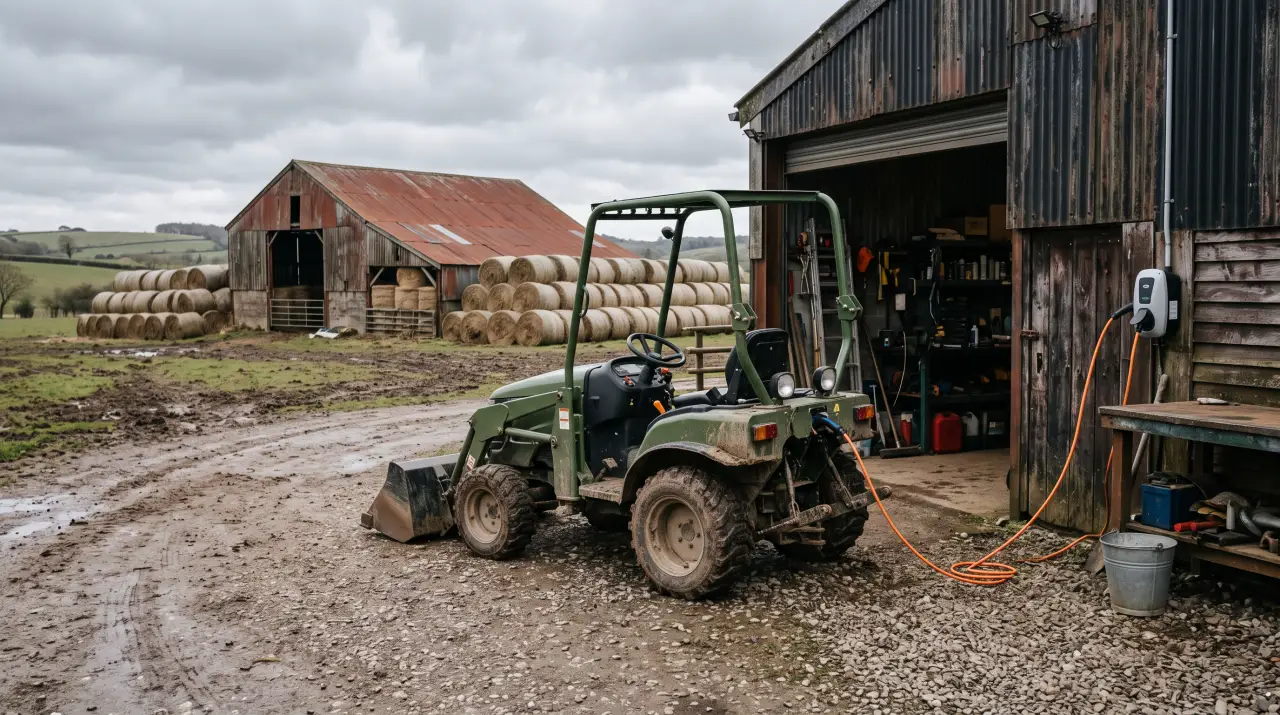
Electric utility tractors have moved out of the press release stage and onto real farms, and the question has shifted from whether they work to where they fit and what it takes to keep one running. A working farmer does not care about the marketing case for going electric; he cares whether the machine will do the chores he needs done, how long it runs before it has to charge, what the charging setup costs to put in, and whether the whole arrangement saves enough on fuel and maintenance to justify a purchase price that still runs higher than a comparable diesel. Those are answerable questions, and the honest answers are more encouraging for some operations than for others. An electric tractor is not a diesel replacement across the board in 2026, but for a specific and common set of jobs it is already the better tool, and knowing which jobs those are is the difference between a machine that earns its keep and one that sits on the charger while the diesel does the work.
This is a practical read on electric utility tractors as they actually stand for chore-scale work: the loader-and-mower, livestock-feeding, around-the-yard duty that fills most of the hours on a small or mid-size place. It covers how the battery and run time really work and how to read a run-time figure honestly rather than off the spec sheet, what the charging setup involves from a plain wall outlet up to a dedicated circuit, how to size that charging infrastructure to the way the tractor gets used, what the thing costs once the charger and electrician are counted in, and the cold-weather and terrain realities that eat into range. The aim is to let an operation decide whether an electric utility tractor fits the work it actually has, not to sell the idea or dismiss it.
The electric utility tractor lives in the chore-tractor slot, and that is where the case for it is strongest by a wide margin. This is the machine in the twenty-five to seventy horsepower range that runs the loader, feeds hay and grain, scrapes the lot, mows the lanes and the yard, moves pallets and round bales, and handles the hundred small jobs that fill a livestock or small-acreage operation's day without ever asking for the sustained heavy draft of fieldwork. These jobs share a profile that suits a battery well: they are intermittent rather than continuous, they happen close to the buildings where power is available, and they rarely run the machine flat out for hours on end. A loader tractor spends most of its working time idling, repositioning, and lifting in short bursts, and an electric drivetrain wastes nothing while it sits, which is exactly where a diesel burns fuel for no work.
The poor fit, by contrast, is sustained heavy draft work far from power - pulling a plow or a heavy tillage tool across a big field, running a baler through a long hay day, or any job that demands high power output continuously for hours and happens out at the far end of the place. That is the work that drains a battery fast and strands the machine where there is no convenient charge, and it is the work diesel still does better and will keep doing better for the foreseeable future. The mistake is to judge an electric utility tractor against that fieldwork case, decide it falls short, and miss that it was never built for it. Judged against the chore work it is built for, the same machine looks entirely different.
There is a second quiet advantage that matters more than it first appears: the electric tractor is comfortable indoors and in close quarters in a way a diesel is not. It produces no exhaust, so it can run inside a closed barn, a greenhouse, a poultry house, or a packing shed without filling the space with fumes, and it runs quietly enough that feeding livestock at dawn does not announce itself to the whole neighborhood or spook the stock. For dairies, horse operations, poultry barns, greenhouse growers, and anyone doing chores in enclosed space, the no-exhaust, low-noise character is not a soft benefit - it is a real operational gain that removes the ventilation worry and the noise entirely, and it is part of why these machines have found their firmest footing in livestock and specialty work rather than in row-crop fields.
An electric tractor stores its energy in a battery pack measured in kilowatt-hours, and that single number is the rough equivalent of the size of the fuel tank - it sets how much work the machine can do before it has to refill. Utility-class electric tractors in 2026 carry packs that generally land somewhere in the twenty to forty kilowatt-hour range for the smaller machines and climb higher in the larger ones, and that capacity, divided by how fast the work draws it down, is what determines run time. The draw is measured in kilowatts, and it swings enormously with the job: light work like driving around or running a small mower might pull only a few kilowatts, while heavy loader work or pulling a real load can pull many times that. Run time is simply the pack capacity divided by the average draw, and because the draw varies so much with the task, the run time varies just as much.
This is why a single run-time number on a spec sheet tells you less than it seems to. A manufacturer that advertises a tractor as running a certain number of hours is quoting that figure at some assumed average load, and the real run time on a given farm depends entirely on whether that farm's work is lighter or heavier than the assumption. The same machine might run most of a working day on light chores and yet drain in a couple of hours of hard, continuous loader work moving heavy material up a grade. The honest way to think about it is not "how many hours does it run" but "how many kilowatt-hours of work do I actually do in a day, and does the pack cover that with margin." A farm that does three or four hours of genuinely light-to-moderate chore work a day is asking far less of the battery than the hours alone suggest, and a farm that does two hours of brutal loader work on a hill may be asking more.
The batteries themselves are lithium-based, the same chemistry that runs electric cars and the better cordless tools, and they bring that technology's strengths and its one real weakness. They hold their capacity well over years of normal use, they take a charge quickly when the infrastructure allows, and they need essentially no maintenance - no fluids, no fuel filters, no fuel system at all. Their weakness is cold, which reduces both the usable capacity and the charging speed when temperatures drop, and that cold-weather penalty is a real planning factor in a northern operation. The pack is also the single most expensive component in the machine and the one with a finite service life, though that life is long enough - many thousands of charge cycles - that for most farm duty cycles the pack will outlast the rest of the tractor's heavy-use years rather than needing replacement partway through. Some machines use a swappable pack design that lets an operation keep a charged spare and change it out in minutes to effectively double the working time, which sidesteps the run-time limit entirely for operations willing to buy the second pack.
The most useful thing an operation can do before buying is to figure its own duty cycle honestly, because that, not the brochure, is what determines whether the machine fits. Duty cycle means the actual pattern of work over a day - how many hours, at what intensity, with how much idle and repositioning mixed in. A chore tractor's day is mostly low-intensity: the machine is moving slowly, lifting in short bursts, sitting while the operator forks hay or opens a gate, and only occasionally pulling hard. That pattern is gentle on a battery, and a machine that the spec sheet rates conservatively can comfortably cover such a day because most of the rated hours are spent at far below the assumed average load. The intermittent nature of chore work is the electric tractor's friend, and it is the single biggest reason these machines work better in practice than a worst-case calculation would suggest.
The trap is to size the decision around peak draw rather than average draw, or around continuous heavy work the operation does not actually do every day. A farmer who imagines the hardest two hours he ever asks of a tractor and assumes the battery has to sustain that all day will conclude the machine cannot do the work, when in reality those hard two hours are a small fraction of a normal day and the pack recovers its margin across all the light hours around them. The reverse trap is just as real: an operation that genuinely does run heavy and continuous - a custom operator on the loader all day, a feedlot scraping and feeding hard from dawn to dark - has a duty cycle that a single pack may not cover, and that operation needs either a larger machine, a swappable spare pack, or a midday charge built into the routine. The point is to match the machine to the measured work rather than to a number on paper, and the only way to do that is to be honest about what the tractor actually does in a typical hard day, not a typical easy one.
A practical approach is to watch the existing diesel for a week and note how it really gets used: how many hours, how much of that at idle or light load, how much truly working hard, and whether the heavy stretches are short bursts or long continuous pulls. That picture maps directly onto whether a battery covers the day, and it is far more reliable than either the optimism of the sales pitch or the pessimism of imagining the worst job run all day. An operation whose hardest sustained demand still leaves the pack with reserve has a clean fit; one whose normal day would run the pack flat needs to plan for charging mid-day or to look at a bigger machine or a spare pack rather than assume the run time will stretch to cover it.
Charging is where the practical planning lives, because the convenience of an electric tractor depends entirely on how fast it refills relative to how fast it gets used, and that is set by the charging circuit. There are three broad tiers, and they parallel the way electric cars charge. The slowest is a standard household outlet at 120 volts, which trickles power into the pack at a rate that works fine as an overnight top-up for a machine that does light daily chores but cannot keep up if the tractor works hard and needs a full recharge between shifts. The middle tier, and the one most farm operations land on, is a 240-volt circuit - the same kind of service that runs an electric dryer, a welder, or a water heater - which charges several times faster and can typically bring a utility tractor from low to full overnight or refill a partial draw in a few hours. The fastest tier is DC fast charging, available on some larger or higher-end machines, which can push a substantial charge into the pack in well under an hour, but it requires serious electrical service and is more than most chore operations need or want to pay for.
For the great majority of farms, the 240-volt level is the right target, because it matches the rhythm of farm work: the tractor does its chores during the day and charges overnight, ready for the next morning, the same way a milking parlor or a shop tool draws power on a dedicated circuit. The reason to put in the 240-volt circuit rather than relying on a standard outlet is margin - the faster circuit means the machine is ready sooner, can recover from a hard day in time for the next one, and can take a quick midday top-up if a long day calls for it, none of which the slow trickle of a household outlet reliably allows. The cost of stepping up from a wall outlet to a proper 240-volt circuit is mostly the electrician's work of running the circuit from the panel to where the tractor parks, and it is a one-time cost that pays off every day the machine is used.
The physical setup is straightforward but worth getting right. The tractor needs to charge where it parks, which usually means a circuit run to the equipment shed, the barn, or wherever the machine sits overnight, terminating in the right outlet or a wall-mounted charging unit. The run should be sized for the load with margin, the circuit protected properly, and the location chosen so the cord reaches the tractor without strain and the connection is sheltered from the weather. None of this is exotic - it is the same kind of work as wiring a shop or adding a circuit for a new piece of equipment - but it does mean an electrician and a permit in most places, and it should be priced and planned as part of the tractor purchase rather than discovered afterward. A common and avoidable mistake is to buy the machine, plug it into the nearest household outlet, and conclude it charges too slowly, when the real problem is simply that the proper circuit was never installed.
How much charging infrastructure an operation needs follows directly from its duty cycle, and the sizing question is whether the available charging can refill the pack as fast as the work drains it over the cycle the farm actually runs. For an operation doing light-to-moderate chores a few hours a day and parking the tractor every night, a single 240-volt circuit charging overnight is plenty - the machine drains slowly across the day and refills fully across the night, and the two stay in balance indefinitely. This describes most small livestock and small-acreage operations, and for them the infrastructure question is simple: one good circuit where the tractor parks.
The sizing gets more involved when the work is heavier or the days are longer. An operation that runs the tractor hard enough to approach the pack's limit in a single day needs charging that can fully recover overnight, which argues for the faster end of 240-volt charging or even DC fast charging if the machine supports it and the budget allows. An operation that genuinely needs more working hours than one pack delivers has two real paths: a faster charger that allows a meaningful midday top-up during the lunch break or a natural pause in the work, or a swappable spare pack that gets changed out to give a second full shift while the first charges. Which path is cheaper depends on the machine and the operation, but both are real solutions to the long-day problem, and neither requires pretending the run time is longer than it is.
The electrical service of the farm itself is the boundary condition that sometimes gets overlooked. Adding a substantial 240-volt charging load, or especially a DC fast charger, draws real power, and an older farm with a marginal service panel may need an upgrade to carry it alongside the existing load of the shop, the well pump, the grain dryer, and the house. That panel or service upgrade, where it is needed, can be a larger cost than the charging circuit itself, and it is the kind of thing best discovered by having an electrician look at the existing service before the tractor is ordered rather than after it arrives. For most operations the existing service has the headroom, but it is worth checking, because the charging infrastructure is only as good as the service feeding it, and a tractor that cannot charge at full rate because the panel cannot deliver the power is a tractor whose run time has effectively been cut by a problem upstream of the machine.
The purchase price of an electric utility tractor still runs higher than a comparable diesel of the same horsepower class, and that price gap is the first and biggest hurdle, driven mostly by the cost of the battery pack. An honest accounting starts there: the machine costs more up front, often considerably more, and any case for buying one has to make that premium back through lower running costs over the years of ownership. The running-cost side, though, is genuinely favorable, and it favors the electric machine in two ways that compound over time - energy and maintenance.
On energy, electricity is a cheaper way to do a given amount of work than diesel, often substantially so, and the gap is widest exactly where the electric tractor shines. Because an electric drivetrain draws essentially nothing while idle and converts its stored energy to work efficiently, while a diesel burns fuel whenever it runs whether it is working or sitting at idle, the electric machine's energy advantage is largest on the stop-and-start chore work that is full of idle time. The fuel a diesel wastes idling at the hay ring, at the gate, and between lifts is fuel the electric tractor never spends, and over a year of chore work that difference is real money. The exact savings depend on local electricity and diesel prices and on how much the machine is used, but for an operation that runs its chore tractor a meaningful number of hours, the energy line favors electric clearly and consistently.
The maintenance side is where the case often gets decisive, because an electric tractor simply does not have most of the things that cost money and time to maintain on a diesel. There are no oil changes, no fuel filters, no air filters for the engine, no fuel system, no emissions aftertreatment to clog and fault, no coolant, no belts in the conventional sense - the long list of routine diesel maintenance largely disappears. What remains is the ordinary wear of any tractor: tires, hydraulic fluid, the loader and three-point hardware, brakes, and the like. For an operation that does its own wrenching, the savings show up as Saturdays not spent under the machine; for one that pays a dealer, it shows up as service bills that do not arrive. Over the life of the machine, the avoided maintenance is a substantial part of what closes the gap with the lower-priced diesel, and it is the part that is easiest to underestimate when only the sticker prices are compared. Where state, federal, or utility incentives for electric farm equipment exist, they cut into the purchase premium directly and can shift the math considerably, and they are worth running down before assuming the price gap is as wide as the sticker suggests.
Several real-world factors eat into an electric tractor's usable range and run time, and an honest plan accounts for them rather than discovering them in February. Cold is the largest. Lithium batteries lose usable capacity in low temperatures and charge more slowly when cold, so a pack that comfortably covers a day's chores in mild weather may cover noticeably less on a hard winter morning, and the charging that kept up overnight in summer may take longer in an unheated shed in the cold. The practical defenses are to charge and ideally store the machine somewhere it is not bitterly cold, to expect and plan for reduced winter range rather than being caught short by it, and in a serious cold-climate operation to size the pack with enough margin that the winter penalty still leaves a working day's worth of capacity. In the milder, maritime cold of the Pacific Northwest the penalty is smaller and more intermittent than it is on the high plains, but the gray, damp winters are real and the cold snaps that come will still trim the range, so the planning still applies - just with a lighter hand than a Dakota operation would need.
Terrain and load are the other big consumers. Pushing material up a grade, working on hilly ground, carrying heavy loads in the loader, and pulling real draft all draw the pack down faster than flat-ground light work, in direct proportion to how hard the machine is working. This is not a flaw - it is just physics, the same physics that makes a diesel burn more fuel doing the same hard work - but it matters for planning because an operation on hilly ground or one that routinely moves heavy material will see shorter run times than the flat-ground chore numbers suggest, and should size the machine and the charging accordingly. Towing and loader work with heavy material are the most demanding common chore tasks, and an operation built around them is asking more of the battery than one doing light feeding and mowing, so the duty-cycle honesty discussed earlier matters most exactly for these heavy users.
The smaller eaters add up too. Running the cab heat or other accessories draws from the same pack, taking from the working range, which is another reason winter range runs shorter. Very low charge and very high charge are both a little harder on the pack over the long term than the middle of the range, so a routine that keeps the machine somewhere in the comfortable middle and tops it up regularly, rather than running it flat and then jamming it full, treats the most expensive component kindly and stretches its service life. None of these factors is a reason to avoid an electric tractor; they are simply the operating realities to design around, the way fuel consumption, cold-starting, and DEF are the realities to design around on a diesel. The operation that knows them plans for them and is not surprised; the one that ignores them gets caught short on a cold morning on a hill and blames the machine for a shortfall it could have planned around.
Pulling it together, the electric utility tractor pencils out cleanly for a recognizable kind of operation and falls short for another, and knowing which is which is the whole decision. It pencils for the chore-scale operation doing intermittent, close-to-the-buildings work: the small livestock farm feeding and bedding, the horse operation, the dairy doing barn chores, the greenhouse and specialty grower working in enclosed space, the small-acreage place running a loader and a mower around the yard. These operations have a duty cycle the battery covers comfortably, they value the no-exhaust quiet of a machine that works indoors and at dawn, they accumulate the idle-heavy hours where the energy savings are largest, and they keep the tractor close to power where charging is easy. For them the higher purchase price is bought back over time through cheap energy and near-absent maintenance, and the machine is quietly the better tool for the work.
It does not pencil, at least not yet, for the operation whose tractor work is dominated by sustained heavy draft far from power: row-crop fieldwork, long days on the baler, heavy continuous tillage, custom operating that runs the machine hard from dawn to dark across distance. That work drains the pack faster than charging can keep up in the field, demands continuous high power the battery serves less gracefully than intermittent bursts, and happens out where there is no convenient charge - exactly the profile diesel still handles better. An operation built around that work and trying to force an electric tractor into it will be frustrated, and rightly so, because the machine was not built for that job. The honest move for such an operation is to keep the diesel for the fieldwork and consider an electric machine for the chore tractor alongside it, rather than asking one machine to do both jobs it is suited and unsuited for.
The clearest signal, in the end, is the duty cycle. An operation that watches its chore tractor for a week and finds it doing a few hours a day of light-to-moderate, idle-heavy, close-to-home work has a near-perfect fit and should run the numbers seriously, counting the charging install and any service upgrade honestly on the cost side and the fuel and maintenance savings honestly on the benefit side. An operation that finds its tractor running hard and continuous, far from power, for long days has a poor fit for now and should wait, keep the diesel, or look at the heavier and swappable-pack machines that push the limit out. The technology is good and getting better, the chore-tractor case is already won, and the field-tractor case is the frontier that the next several years of bigger packs and faster charging will keep pushing on.
The electric utility tractor in 2026 is a real and capable machine for a specific job, and that job - intermittent chore work close to the buildings, with plenty of idle and short bursts of lifting rather than sustained heavy draft - describes the daily work of a great many small and mid-size operations. For that work it is not a compromise but an upgrade: quieter, cleaner enough to run indoors, cheaper to power, and nearly free of the routine maintenance that eats time and money on a diesel. The case against it is narrow and specific - sustained heavy fieldwork far from power, where the battery drains faster than it can charge and diesel still wins - and the mistake most often made is to judge the machine against that case it was never built for and miss that it is already the better tool for the chore work that fills most of the hours.
The decision comes down to three honest accountings done in order: measure the real duty cycle of the chore tractor rather than imagining the worst job run all day, size the charging infrastructure - usually a single 240-volt circuit, occasionally with a service upgrade behind it - to refill the pack as fast as the work drains it, and run the full cost math with the charging install and any incentives counted in against the years of cheap energy and absent maintenance. An operation that does those three things honestly will know exactly whether an electric utility tractor fits, and the ones that fit will find a machine that quietly does the chores for years on cheap power with almost nothing to maintain, while the ones that do not fit will have saved themselves from forcing a chore-built machine into fieldwork it was never going to do well. As with every tool on the place, the electric tractor earns its keep when it is matched to the work it is built for and sized to the duty cycle it actually has, and the operation that is honest about both is the one that gets a machine that pays for itself rather than one that sits on the charger while the diesel does the work.
There is no single honest answer, because run time is the pack capacity divided by how hard the work draws it down. Utility-class machines carry roughly 20 to 40 kilowatt-hour packs. Light, idle-heavy chore work can stretch across most of a working day, while two hours of hard loader work moving heavy material up a grade can drain the same pack. Measure your real duty cycle, not the spec sheet.
Charging comes in three tiers. A standard 120-volt household outlet trickles in enough for an overnight top-up on light duty. A 240-volt circuit, the same service that runs an electric dryer, welder, or water heater, charges several times faster and is where most farms land. DC fast charging can refill in under an hour but needs serious electrical service most chore operations do not require.
Yes, and the gap is often decisive. An electric tractor has no oil changes, no fuel or air filters, no fuel system, no emissions aftertreatment, and no coolant to service. What remains is the ordinary wear of any tractor: tires, hydraulic fluid, the loader and three-point hardware, and brakes. Over the machine's life, that avoided maintenance is a large part of what offsets the higher purchase price.
Yes. Lithium packs lose usable capacity in low temperatures and charge more slowly when cold, and running the cab heat pulls from the same pack, so winter range runs shorter than mild-weather numbers. The defense is to charge and store the machine somewhere not bitterly cold and to size the pack with margin. Maritime Pacific Northwest winters trim range less than the high plains, but cold snaps still count.
Join our list for practical guides on farm tech, precision agriculture, and tools that work.