
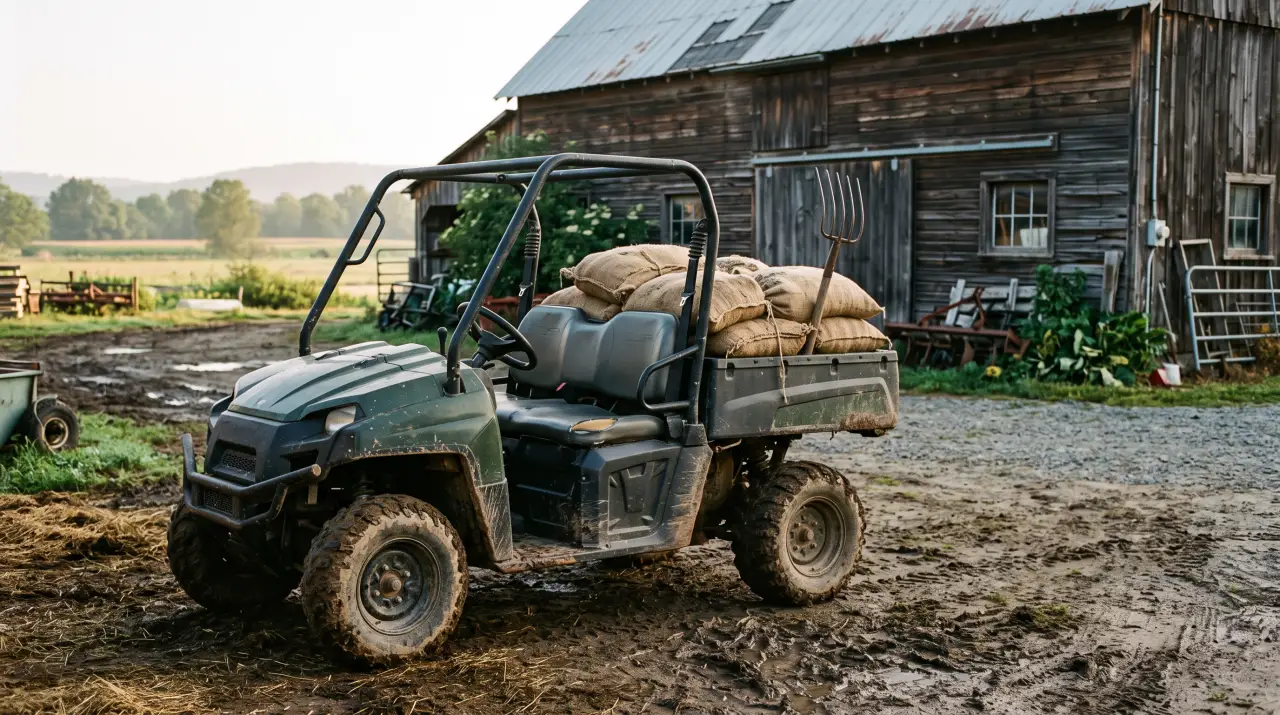
Walk into most barns and you will find one machine that does the unglamorous work all day: feeding, scraping the loafing shed, hauling people and fence posts, plowing the lot when it snows. It rarely leaves a half-mile radius, and it runs the same loop every morning whether you feel like it or not. That machine - the chore rig - is where battery power has quietly stopped being a gimmick and started paying for itself.
Notice the word "chore." The question that gets farmers into arguments online is the wrong one. "Is electric ready to replace diesel?" has no useful answer, because no single machine on a diversified operation does one job. The better question is narrower and a lot more honest: for which jobs on my place does battery power already win, and which ones should stay diesel for now? Answer that, and the hype falls away. What is left is a decision you can actually make.
This piece is a filter, not a verdict. We will keep utility vehicles and tractors in separate lanes because the math is different for each, name real machines and real numbers, and put the limits up front - cold-weather range, charging, battery replacement cost - because a working farmer will spot a glossed-over caveat from across the field.
Two things genuinely changed.
The first is torque delivery. An electric motor makes peak torque at zero RPM, so a battery UTV or tractor pulls hard from a dead stop without a clutch dump or a downshift. For low-speed work - easing a loaded trailer out of mud, nudging a round bale, plowing wet snow - that instant pull is the real advantage, not the top speed.
The second is the operating environment. No engine means no exhaust and very little noise. Inside an enclosed barn or a closed feed alley, that is not a comfort upgrade, it is an air-quality and animal-stress one. Skittish livestock settle faster around a machine that hums instead of clatters, and you are not breathing diesel fumes in a building with the doors shut in January. Some of the newer electric tractors add a third trick: exportable power, meaning the battery doubles as a mobile generator with standard outlets to run tools or a pump out in the field.
What did not change is the refuel problem. Diesel goes from empty to full in five minutes at the bulk tank. The best farm battery still needs hours on a charger, and there is no roadside fill-up for a UTV that runs flat two miles out. Range under load, on hills, in cold, drops below the brochure number every time. That gap is exactly why the chore-versus-field frame matters: short predictable loops forgive slow charging, long remote field days do not.
The benchmark is the Polaris Ranger XP Kinetic, and it is worth understanding because it sets the reference everyone else is measured against. Two trims: the Premium pairs a 14.9 kWh battery with roughly 45 miles of advertised range, and the Ultimate steps up to a 29.8 kWh battery and about 80 miles, landing near 37,500 dollars. It tows 2,500 pounds - the same as the gas XP 1000 - and makes 110 horsepower against the gas model's 82. On paper it is not a downgrade you tolerate for being green; it out-pulls the engine it replaces.
The most useful data point is not a spec, it is a field test. Field & Stream ran a Kinetic through a western Kentucky farm in March, plowing snow and towing heavy in sub-zero cold, and plugged it into a standard 110-volt outlet overnight. Charge never dropped below 75 percent across continuous daily use. The reviewer's honest caveat is the part to hold onto: the best fit is daily farm and ranch work with access to 240-volt charging. The wall outlet only kept up because the loops were short and the truck sat on the charger every night.
Below the Polaris sit mid-range and specialty options. The Hisun Sector E1 runs a 48-volt lithium system, tows around 1,500 pounds, carries roughly 800, and advertises near 40 miles of range at a noticeably lower price - reasonable for a lighter-duty chore rig if you size the towing honestly. Narrow specialty units, some around 1.2 meters wide, slip between orchard and vineyard rows a standard side-by-side cannot, towing in the 500-pound range over a 25-to-40-mile loop. Across the category, the realistic envelope is 30 to 80 miles per charge, and the instant low-RPM pull is the consistent reason owners keep them, not the range figure.
The buying filter for a UTV comes down to three questions. Does your daily loop stay comfortably inside the real-world range with a cold-weather margin? Is there a 240-volt circuit, or a plan for one, where the machine parks? Is the towing and payload you actually need at or under the rating, not right at the ceiling? Three yeses and a battery side-by-side is a serious candidate. One firm no and you are buying frustration.
Tractors change the unit of measure. Stop thinking in miles and start thinking in hours of runtime, because a chore tractor lives at the loader, the mower, and the PTO, not on a route.
The Solectrac e25 is built for exactly this reader: a 25-horsepower-class machine with about a 22 kWh battery and a real-world runtime of roughly three to six hours depending on load, charged on Level 2. It is aimed at small farms, equine and hobby operations, mowing, and light loader work near people and animals - chore duty, not field tillage. Used inside its window, the three-to-six-hour spread is the planning number that matters: a morning of feeding and scraping fits, a full day of continuous loader work does not without a charge break.
The New Holland T4 Electric Power is the first all-electric utility tractor from a major manufacturer, and it stretches the envelope. Sixty-five PTO horsepower, roughly 10,800 pounds, DC fast charging to full in about an hour, and exportable 110-volt and 220-volt power that turns the tractor into a job-site generator. North American availability is rolling out through select dealers, and pricing is not public yet - worth a dealer call rather than a guess.
The Monarch MK-V is the autonomy story. It is in commercial production, charges in roughly five to six hours on an 80-amp Level 2 unit, and offers a swappable battery to extend a shift plus driver-optional features. Monarch reports diesel savings around 5,500 to 6,500 dollars a year at 500 hours of annual use in vertically trellised crops. Treat that as the manufacturer's figure, not a neutral benchmark - it assumes high utilization in a specific cropping system, and your mileage on a livestock yard will differ.
Here is where most articles quietly sell you. The reported operating cost for electric tends to land around 2.50 to 3.75 dollars an hour against roughly 7.50 dollars an hour for diesel, with some sources pushing the diesel figure to 10 or 15. At 500 hours a year that is something like 1,875 to 2,500 dollars in annual running-cost savings. Call those reported ranges, because most of them come from vendor or affiliate sources, and they swing hard with fuel price and how you charge.
Maintenance is the cleaner part of the case. No oil changes, no filters, no fuel system, far fewer moving parts. A diesel overhaul at seven to ten years can run 15,000 to 30,000 dollars. But the honest counterweight is battery replacement: plan on 10,000 to 20,000 dollars somewhere in the five-to-eight-year window. That single trade is the crux of total cost of ownership, and any payback math that leaves it out is selling, not analyzing.
Payback periods get cited at three to five years for typical use and as short as 1.5 to 3.5 years for high-hour operations like dairy running 1,800 hours a year - often with incentives doing real work in the math. The pattern underneath all the figures is simple: payback is a function of utilization. A machine that runs hundreds of hours on a tight loop amortizes fast. A 30,000-dollar UTV that runs 80 hours a year is a comfort purchase, and that is fine, but do not let a spreadsheet dress it up as savings. Incentives, where your state and utility offer them, shorten the payback - check what is live before you bank on it, because those programs change by year.
The counter-case deserves its due. For most diversified row-crop and livestock operations, the machine that has to do everything still needs diesel range and a five-minute fill, and a battery chore rig is a second machine, not a replacement. The savings only show up if you genuinely have a high-hour, short-loop role to dedicate it to. That is the whole argument for treating this as a filter: the value is real but narrow, and it concentrates in dairy, livestock, and specialty operations with power at the barn and a predictable daily loop.
Two things will decide whether a battery machine delights you or disappoints you, and neither is in the brochure.
Cold shrinks usable range. Lithium loses roughly 15 to 20 percent in ordinary winter cold and up to 20 to 40 percent in severe cold, between higher internal resistance and the energy spent heating the battery and cab. It is temporary - capacity comes back when things warm up - but in February your usable loop is smaller than the spec sheet, and a northern farmer who plans around the summer number will run short on the worst possible morning. Size your daily loop against the cold figure, not the advertised one.
Charging is the quiet enabler. The Field & Stream test survived on a 110-volt outlet, but only because the chores were short and the machine charged all night. The real infrastructure answer is a 240-volt Level 2 circuit at the barn. With it, a UTV or compact tractor is full every morning and the runtime question mostly disappears. Without it, you are rationing. Budget the electrician into the purchase, not as an afterthought - it is the difference between a tool that is always ready and one you are always nursing.
Run your operation through this before you run it through a dealer:
Four or five yeses and battery power likely already pays on your place. A no on charging or on the short-loop test is a signal to wait, not to force it.
Electric has not won the farm, and anyone telling you it has is selling something. What it has done is win specific jobs - the quiet, repetitive, close-to-the-barn chore work where instant torque, zero fumes, and near-zero maintenance compound day after day, and where a short loop forgives slow charging. Match the machine to that job and the economics hold up. Ask it to be your one diesel-range workhorse and they fall apart.
The honest move is to know your loop before you know your machine. If you are already tracking how your equipment, water, and yard systems actually perform across the season, that decision gets easier - the farmers who measure their daily patterns are the ones who can tell a real chore role from a wish. That is the thinking we work through every week in the Manley Farms field notes; if it is useful, the free email list is where the next one lands.
Real-world range across the category runs about 30 to 80 miles. The benchmark Polaris Ranger XP Kinetic pairs a 14.9 kilowatt-hour battery with roughly 45 miles in the Premium trim, and a 29.8 kilowatt-hour battery with about 80 miles in the Ultimate. Range drops under load, on hills, and in cold, so size your daily loop against the winter figure, not the brochure number.
The Polaris Ranger XP Kinetic Ultimate lands near 37,500 dollars. For that it tows 2,500 pounds, matching the gas XP 1000, and makes 110 horsepower against the gas model's 82, so it out-pulls the engine it replaces rather than being a downgrade. Lighter-duty options like the Hisun Sector E1, towing around 1,500 pounds, come in at a noticeably lower price.
It depends on the machine and the load. The 25-horsepower Solectrac e25 carries about a 22 kilowatt-hour battery and delivers roughly three to six hours of real-world runtime on a Level 2 charge. A morning of feeding and scraping fits inside that window, but a full day of continuous loader work needs a charge break. The larger New Holland T4 Electric DC fast charges to full in about an hour.
Plan on roughly 10,000 to 20,000 dollars for battery replacement somewhere in the five-to-eight-year window, and that single figure is the crux of any total-cost math. It offsets against real savings: operating cost lands near 2.50 to 3.75 dollars an hour versus about 7.50 for diesel, plus no oil changes, filters, or fuel system to maintain. Any payback claim that omits the battery is selling.
Join our list for practical guides on farm tech, precision agriculture, and tools that work.