
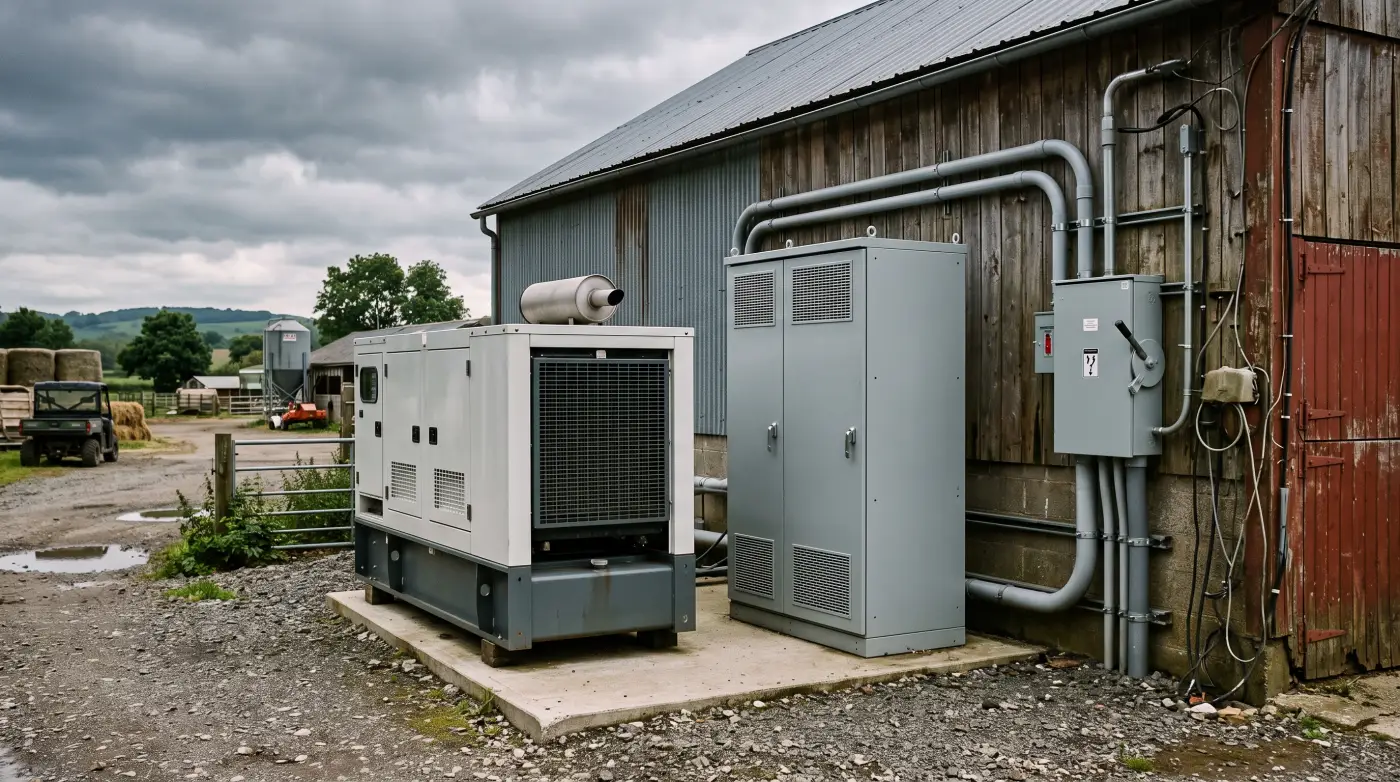
For most livestock farms, the right backup power is a standby diesel or propane generator wired to an automatic transfer switch, which restores power in about ten seconds with no one present. PTO generators fit loads that can wait a few minutes, and solar-plus-battery microgrids suit farms already adding solar.
Backup power on a working farm is not a comfort item. It is livestock insurance. The house lights coming back on is a nice side effect. The real job is keeping the fans, the compressor, the vacuum pump, and the well running when the grid quits, because those are the loads that turn an outage into a dead flock or a dumped milk tank. Get the sizing and the switching right and an outage becomes a non-event. Get it wrong and you find out how fast a barn goes bad in the dark.
Start with the clock, because the clock decides everything else.
In a poultry house, fifteen minutes is enough to lose a full flock if the conditions line up. Once the tunnel fans stop, ammonia, heat, and dust climb fast, and birds packed at production density have no way to shed it. Auburn's poultry ventilation extension work puts it bluntly: fifteen minutes is all it takes to lose an entire house of chickens if conditions are right.
In a dairy, the clock is the milk tank. Grade "A" rules require raw milk cooled to 45 F or below within two hours of the first milking and one hour after the second, with the blend temperature never allowed to top 50 F when fresh milk hits the tank. Lose the cooling compressor and the whole bulk tank is at risk of rejection. That is not a spoiled gallon. That is the day's production down the drain, and possibly a failed inspection on top of it.
So the design question is not "how do I power the farm." It is "what cannot wait." The ventilation fans, the milk-cooling compressor, the milking vacuum pump, and the well pump are the loads that must never go dark. The shop lights, the grain fan, the block heater, the yard lights - all of that can wait. Write that list down before you price a single generator, because the list is the spec.
The number that stalls an undersized generator is not the running wattage. It is the startup surge.
Electric motors run most of a farm, and a motor pulls roughly two to twelve times its running current for a few seconds every time it starts. A generator sized to the nameplate running load will brown out or trip the moment the cooling compressor kicks in or a bank of fans spins up. Size to the starting load of your largest motor plus everything already running, not to the tidy running-watt sum on a spreadsheet.
The practical move is a load audit. Walk the critical list, note the running watts, then find the single largest motor and add its starting surge on top of the base load. That peak is your minimum. If you are not comfortable estimating it, an electrician or your generator dealer can meter it during a milking or a hot-weather ventilation cycle, which is exactly when the real peak shows up. This one step separates the farms whose backup power works from the farms that bought a number off a chart.
A PTO generator borrows the tractor's engine instead of hauling its own. That makes it the cheapest serious capacity you can buy, as long as you already own a tractor big enough to spin it and can spare that tractor during an outage.
Common PTO units run from about 10 kW up through 75 kW, with big ones reaching 150 kW and beyond. Sizing is simple: budget roughly two tractor PTO horsepower per kilowatt of output, so a 20 kW generator wants about 40 PTO horsepower at the shaft. Under-power the shaft and the generator sags under load, so match it honestly to the tractor you actually have.
The catch is start time. There is no automatic anything. When the grid drops, someone has to walk or drive to the tractor, back up to the generator, couple the PTO shaft, and engage it. On a good day that is a few minutes. That is fine for a well pump, a grain fan, or shop power. It is not fine for a poultry house on a July afternoon or a dairy in the middle of milking, where the clock is measured in minutes and nobody may be home. A PTO generator is a strong second line and a genuinely economical choice for loads that can wait. It is the wrong tool for the loads that cannot.
Because seconds beat minutes, and an automatic transfer switch does not need a driver.
A standby generator sits permanently wired to the barn through an automatic transfer switch, or ATS. The ATS senses the outage, disconnects the utility so you never backfeed a line worker, starts the generator, and moves the load over. Typical transfer happens in about ten seconds, with no operator present and nobody awake. For a house of birds or a milking in progress, that ten-second gap is the whole ballgame.
This is why, for most livestock operations, the honest recommendation is a right-sized standby diesel or propane generator on an ATS as the first purchase. It is not the cheapest capacity per dollar. It is the cheapest insurance per dollar for the loads that will not wait, and that is a different equation. Buy the standby unit for the critical barn first, then layer a PTO generator or extra capacity behind it for the loads that can tolerate a few minutes.
The fuel decision is really a storage and runtime decision.
Diesel is energy dense and, on most farms, already sitting in the yard tank, so the fuel logistics are solved on day one. The downsides are cold and time: diesel gels in deep winter without treatment, and it degrades in storage, so a tank that has sat two years may not be the fuel you think it is.
Propane stores essentially forever and burns clean, which is a real advantage for a unit that might sit idle for months between outages. The tradeoff is lower energy density and the need for enough tank capacity to carry a long outage, so you plan the tank size around worst-case runtime.
Natural gas gives unlimited runtime wherever a utility line reaches, which is wonderful and also rare out in the country. If you have a gas line, it belongs in the conversation. If you do not, it is not an option, and most rural farms land on diesel or propane based on what is already in the yard.
These numbers are directional. Your load audit is the real answer. But they set expectations.
A milking parlor pulls a peaked, simultaneous load: the vacuum pump, the milk-cooling compressor, and often well and wash-water heating all firing during the milking window. Field guidance puts a 50 to 100 cow dairy somewhere around 30 to 60 kW of running power during milking, with the cooling compressor stacking a large startup surge on top. That surge is why 60 to 100 kVA gensets are common when a farm wants to run the whole operation, not just bridge the critical loads.
A poultry house is a different shape of problem. The load is more continuous - it is fans, and in hot weather it is a lot of fans - so the sizing centers on carrying full tunnel ventilation at the worst point of a summer afternoon, plus the surge as banks of fans cycle. In both cases, size to the hot day and the peak moment, not the mild afternoon. A generator that covers the average will fail you on the day the average does not matter.
For a barn's overnight backup, no. As a bridge and a bill-shaver layered on top of a generator, yes, and that combination is where farms are actually winning.
A battery gives you what a generator cannot: instant, silent, automatic switchover with no start delay and no exhaust near the animals. The problem is raw backup per dollar. Installed residential-scale storage runs roughly $700 to $1,300 per kilowatt-hour, and a single popular home battery in the 13.5 kWh class lands around $15,000 to $16,000 before incentives. That one unit is a bridge for critical loads for a while, not a barn's supply through a multi-day outage. The per-kilowatt-hour math is simply worse than a generator for pure outage insurance.
The pattern that works on real farms is a hybrid microgrid: solar, a battery, and a backup generator together. The battery covers instant switchover and short blips, the solar recharges it by day, and the generator handles the long, multi-day outages that would drain any reasonable battery. Larger operations already run exactly this shape, pairing solar and storage with a backup diesel behind it. Just keep the scale honest. The headline "farm microgrid" case studies with multiple megawatts of solar and batteries are corporate, utility-scale operations. They are the ceiling, not the template. The family-farm version is a few panels, one or two batteries, and a generator, and lithium storage typically lasts ten to fifteen years before it needs replacing.
Every figure here is a vendor or installer range. Treat them as directional and get local quotes, because amperage, brand, spec, and your specific install swing the real number hard.
A PTO generator is the cheapest capacity if you already own the tractor, since you are not paying for an engine. A standby install is the big-ticket item: air-cooled units in the 2 to 24 kW range run roughly $5,000 to $18,000 for the unit, with fully installed whole-building systems commonly landing in the $8,000 to $23,000 range once the pad, wiring, and switch are in. Larger diesel standby units into the 60 kW class run roughly $3,000 to $20,000 for the unit alone depending on brand and spec. The automatic transfer switch itself is about $600 to $1,200, and $400 to $2,500 installed depending on amperage.
Battery storage is priced by capacity at that $700 to $1,300 per kilowatt-hour installed, which is why it earns its place as a bridge and a solar companion rather than as the whole backup plan. Add it when you already want solar and a lower everyday power bill, not as a straight generator substitute.
Usually not for a bare generator, and the grant window is in flux, so this is the one place to make a phone call before you count on anything.
The Rural Energy for America Program, or REAP, is a renewable-energy and efficiency program. It has historically cost-shared up to 50 percent of an eligible project and backed guaranteed loans up to 75 percent of eligible costs, and battery storage can qualify when it is paired with a right-sized solar system that offsets farm energy use. A standby generator with no renewable component generally does not fit, because it is neither renewable nor an efficiency upgrade. If you are chasing REAP, you are chasing the solar-plus-battery path, not the genset.
The timing matters too. As of mid-2026 there are reports of USDA pausing new grant applications pending new regulations while guaranteed loans stay open, so do not assume the grant window is open. Treat REAP as worth a call to your local Rural Development office rather than a check you can bank on, and confirm the current status on the live USDA REAP page before you build a budget around it.
Because it was never exercised. This is the failure nobody plans for and almost everybody suffers.
The generator that will not start on outage night is nearly always the one that sat untouched for a year. Stale fuel, a dead starting battery, and seized transfer gear are the classic causes, and all three are preventable. Extension guidance is consistent: run the unit under load on a schedule, keep the fuel fresh and treated, and actually test the transfer switch so you know the handoff works. A backup you planned around and that then fails to start is worse than no backup at all, because you built your outage plan on a machine that let you down. Put the exercise cycle on the calendar the same day you install the thing.
Match the tier to the barn. For most livestock operations, buy a right-sized standby generator on an automatic transfer switch first, sized to the startup surge of your critical loads, not their running watts. Add a PTO generator for the loads that can wait a few minutes and the cheap capacity it brings. Reach for a solar-battery microgrid when you already want solar and a lower power bill, and let the battery bridge while the generator carries the long outages. Then exercise all of it on a schedule, because the best backup power on paper is the one that actually starts.
While you are mapping the loads that cannot wait, it is worth watching the conditions that cause the outages in the first place. The free tools at manleyfarms.com - the streamflow and irrigation watch and the spray window planner among them - pull live public weather and water data so you can see the storm or the freeze coming before it takes the grid with it. They will not start your generator, but they will tell you which nights to double-check that it is ready. Join the email list if you want those alerts to find you instead of the other way around.
For most livestock farms, a right-sized standby diesel or propane generator on an automatic transfer switch is the first purchase, because it restores power in about ten seconds with no operator present. PTO generators cover loads that can wait a few minutes, and solar-plus-battery microgrids suit farms already adding solar for a lower power bill.
About fifteen minutes, if the conditions line up. Once tunnel ventilation fans stop, ammonia, heat, and dust build fast in a house packed at production density, and the birds cannot shed it. This is why poultry ventilation is the classic case for an automatic transfer switch that restores power in seconds rather than a generator that needs someone to start it.
It depends on the load's clock. A PTO generator is cheaper capacity if you own a capable tractor, but it needs a person to couple and start it, so it fits well pumps, grain fans, and shop power. A standby generator on a transfer switch starts itself in about ten seconds, which is what poultry ventilation and dairy cooling require.
Not for overnight or multi-day outages. Installed storage runs roughly $700 to $1,300 per kilowatt-hour, so a single home-scale battery is a short bridge for critical loads, not a barn's supply. Batteries shine as instant, silent switchover paired with solar and a generator in a hybrid microgrid, where each part covers what the others cannot.
Generally not for a standalone generator, since REAP funds renewable-energy and efficiency projects, not plain backup power. Battery storage can qualify when paired with a right-sized solar system that offsets farm energy use. The grant window has also been in flux as of mid-2026, so confirm current status with your local Rural Development office before budgeting around it.
Join our list for practical guides on farm tech, precision agriculture, and tools that work.