
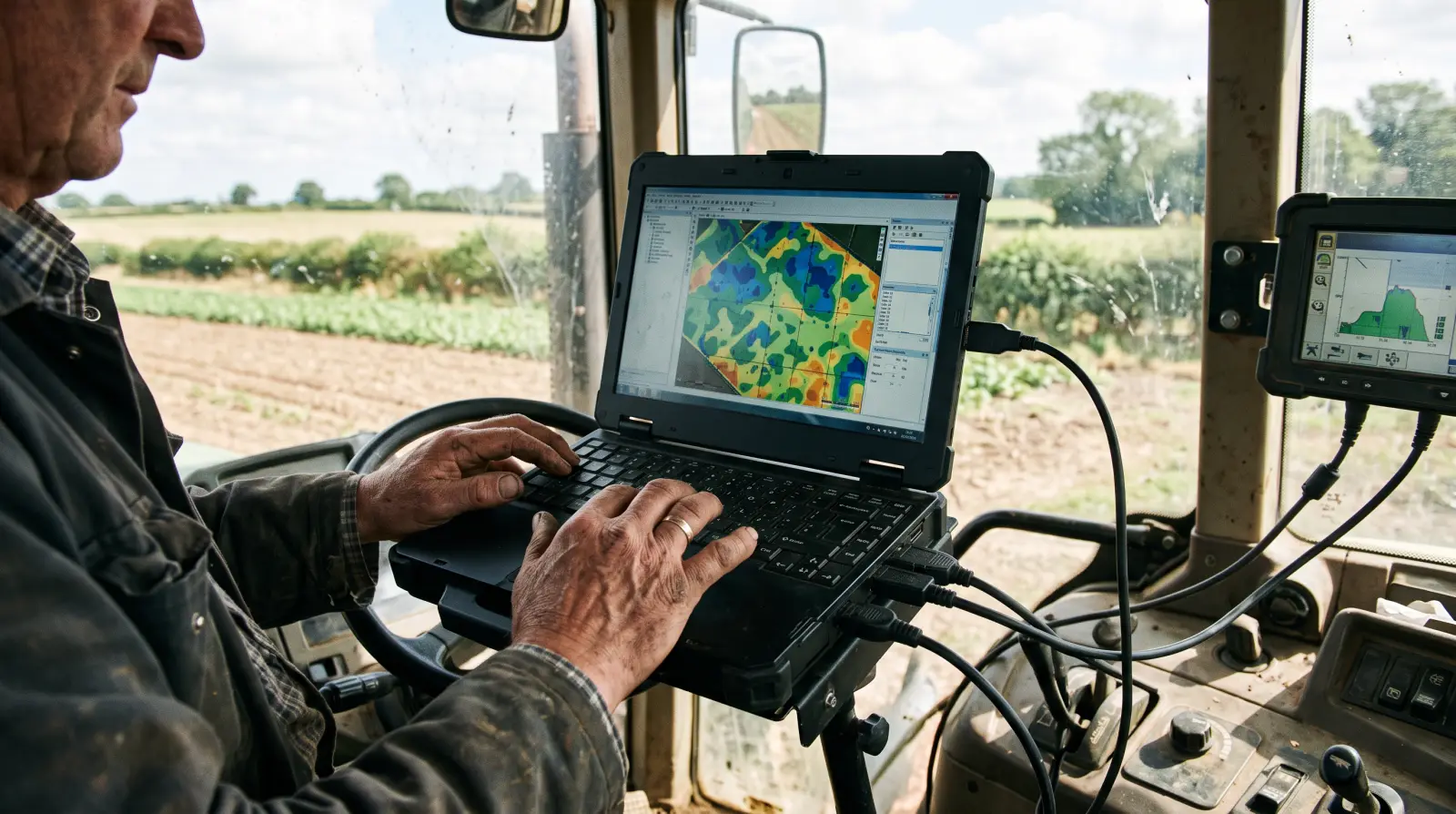
The data your operation generates is now one of the most valuable assets coming off your fields, and most farmers are giving it away without reading the contract. The 2026 picture is that every modern tractor, sprayer, combine, drone, soil probe, irrigation pivot, and milking robot is producing a continuous stream of telemetry, and the companies on the other end of that stream are aggregating, analyzing, and in many cases reselling the information to a market of seed and chemical suppliers, equipment manufacturers, commodity traders, insurers, lenders, and government agencies. The contracts you signed when you accepted the terms of service on the in-cab display or the precision ag account were, in many cases, the moment you handed over rights you did not know you had.
This is a working operator's read on where farm data sits in 2026: what is actually being collected, who has it, what they are doing with it, what your contractual position really is, what the practical leverage points are, and what specific steps an operation can take to get and keep meaningful control. The goal is not to become a data hermit, because the value of precision ag tools comes precisely from the data flow they enable, but to negotiate the relationship from a position of awareness rather than from the assumption that the equipment you bought is yours and the data it produces is yours by default. Neither of those things is automatically true.
The phrase "farm data" gets used loosely and the loose usage is part of the problem. The data coming off a working operation falls into several distinct categories with different sensitivity, different ownership questions, and different downstream uses, and the practical control conversation only works if the categories are kept separate.
Agronomic data is the layer most people are thinking about when they say farm data. It includes as-applied maps for seed, fertilizer, and chemical, yield maps from the combine, soil sampling results, scouting observations, irrigation records, and the detailed field histories that build up over years of working the same ground. This is the data that has the most direct competitive value because it tells a sophisticated buyer exactly what your land is doing, exactly what inputs are producing what outputs, and exactly where your weak spots and strong spots are.
Equipment telemetry is the second category and includes engine hours, fuel consumption, fault codes, GPS tracks, operator behavior, and the running diagnostic feed from every connected machine. The equipment manufacturers want this data for warranty enforcement, for predictive maintenance services, for fleet utilization studies, and for product development feedback. The third parties want it for benchmarking, for resale value modeling, and for the gradual construction of a national picture of how American agriculture is actually using its iron.
Financial and operational data is the third category and includes records that are sometimes generated by the same software platforms but represent a different sensitivity level. Field operations records, input cost data, lease and ownership maps, crop insurance records, and the integrated financial picture of the operation are all increasingly captured in farm management software, and the question of who has access to that data is genuinely consequential.
Personal and identification data is the fourth category and is the one most farmers give the least thought to. Your name, your operation's legal entity, your contact information, your equipment serial numbers, your insurance carrier, your input dealer relationships, and the network graph of who you do business with are all captured by the platforms you use, and the aggregation of that information is what makes the marketing and sales targeting machinery work in the background.
Each of these categories deserves a separate conversation about what is appropriate to share, with whom, and on what terms. Most of the contracts in the precision ag world treat them as a single bundle and grant the platform broad rights across all of them, which is exactly the problem.
The list of parties with active data collection on a typical commercial farming operation in 2026 is longer than most operators realize and is worth running through explicitly. The equipment manufacturer is the most obvious player. John Deere through the Operations Center, CNH through MyPLM Connect and the Climate FieldView integration, AGCO through Fuse, Kubota through KubotaNow, and the other major brands all run telemetry platforms that feed back continuously from connected machines. The default settings on most of these platforms are not the most restrictive options available.
The precision ag and farm management software platforms are the second layer. Climate FieldView, John Deere Operations Center, Granular, Trimble Ag Software, Conservis, FBN, Farmers Edge, and the dozen smaller competitors are all collecting agronomic and operational data with varying contractual terms. The relationship between these platforms and the equipment manufacturers is layered, with some of them being owned by manufacturers, some being independent but tightly integrated, and some being explicitly competitive.
The input suppliers are the third layer. Bayer, Corteva, BASF, Syngenta, and the major retail dealer networks all have data collection programs tied to their seed and chemical sales, sometimes through their own platforms and sometimes through the precision ag platforms they have stakes in. The reason the seed and chemical companies want your field-level performance data is straightforward: it lets them build hybrid and product performance maps that improve their breeding and product development decisions, and it lets them target their sales efforts more effectively against competitors.
The crop insurance and lender layer is the fourth and is increasingly using data feeds from the same platforms for underwriting and risk management. The federal crop insurance program collects substantial data through its standard reporting requirements, and the private crop insurance market is increasingly asking for data feeds that go well beyond what is mandated. Lenders, particularly the larger agricultural lenders, are starting to ask for connected platform access as part of operating loan packages.
The commodity buyer and trader layer is the fifth and is the most opaque. The major grain buyers, the ethanol plants, the food companies running supply chain sustainability programs, and the commodity trading firms all have growing interest in farm-level data, both for their own operational purposes and for the developing carbon and sustainability markets. The aggregator companies sitting between farms and these buyers are a growing category and are often invisible to the operations whose data they are buying and reselling.
The government layer is the sixth and includes USDA programs, conservation programs, state agricultural departments, environmental compliance reporting, and the various inspection and audit functions. Some of this is mandatory disclosure tied to specific programs and some is data that flows from the private platforms back to government databases through various integration arrangements.
The seventh layer is the carbon and ecosystem services market, which has expanded significantly in the past several years and is now a meaningful data buyer. The carbon credit verification process requires extensive farm-level data and the platforms running these programs are often a separate set of companies from the traditional precision ag and equipment players.
The terms of service and end user license agreements on the major precision ag platforms have been the subject of significant farmer pushback in the past several years and many of them have been substantively improved, but the operator who has not actually read the current version of the agreements they are operating under is operating on assumptions that may or may not still be true.
The general structure of these agreements typically grants the platform a broad license to use, store, analyze, and in many cases redistribute the data the platform collects. The licenses are usually framed as nonexclusive and revocable in theory, but the practical question of how data flows out of the platform when an operation leaves is often not symmetrical with how easily it flowed in. The aggregation rights are typically explicit, meaning the platform reserves the right to combine your data with data from other operations and produce derived analytics, benchmarking products, and aggregated insights that are then sold or used commercially. The de-identification provisions in these agreements are typically the legal basis for the aggregation, and the question of whether the de-identification is actually robust given modern reidentification techniques is a real one.
The major equipment manufacturers have generally moved toward language that explicitly states the farmer owns the agronomic data, but the rights granted to the manufacturer to use, analyze, and aggregate that data remain extensive. The distinction between ownership and effective control is the important one. You may technically own the data while the platform has the legal right to do almost anything with it short of selling your name attached to your specific yield numbers to your neighbor.
The Ag Data Transparent certification, which we will cover in detail in the next section, is the most useful single tool for evaluating where a particular platform actually stands. The platforms that have gone through the certification process have made specific commitments about data use, retention, sharing, and portability, and the certification gives the operator a way to compare across platforms without reading the full text of every agreement.
The Ag Data Transparent program was launched by the American Farm Bureau Federation in collaboration with the major precision ag platforms in 2016 and has become the de facto industry standard for data practice disclosure. The certification process requires platforms to answer a standardized set of questions about their data practices in plain language, and the answers are reviewed and published in a comparable format on the Ag Data Transparent website.
The questions cover the core issues an operator should understand before signing on with a platform. They include who owns the data, whether the company collects data and how, who has access to the data, whether the company uses the data for purposes other than the stated service, whether the company sells data to third parties, what the data sharing arrangements with affiliates and partners look like, how long the data is retained, how an operator can delete their data and get it back, what happens to the data if the company is sold or goes out of business, and what notification the operator gets if the data practices change.
The platforms that are certified include most of the major players including John Deere Operations Center, Climate FieldView, Trimble Ag, Granular, FBN Network, AGCO Fuse, Conservis, and several others. The certification is not a pass-fail measure of whether the practices are good or bad, but a structured disclosure that lets the operator make an informed comparison. The platforms that are not certified are not necessarily worse, but the operator has to do more work to figure out where they actually stand on each of the relevant questions.
The practical use of the certification is to read the comparison page for any platform you are considering or currently using and to specifically check the answers on data sharing with third parties, data resale, retention after account closure, and data portability. These are the four questions where the answers actually matter for an operation's leverage in the relationship.
The portability question is where the rubber meets the road on whether the data the platform claims you own is actually under your control. The right answer is that an operator can extract their data in standard, usable formats at any time and can take that data to a different platform without losing the historical context. The actual answer varies significantly across platforms.
The standard formats that matter for agronomic data are shapefiles for boundaries and zone maps, ISOXML for as-applied and as-harvested data from modern equipment, GeoTIFF for raster data like yield maps and imagery, and CSV or similar tabular formats for the underlying records. A platform that exports clean, complete data in these formats is one that has made portability a genuine commitment. A platform that exports only PDFs or only proprietary formats has effectively trapped the historical data inside the platform, regardless of what the contract says about ownership.
The practical test for portability is to actually do an export of a meaningful chunk of historical data from your current platform and try to load it into a different platform or into a free and open tool like QGIS or one of the open source farm data tools. The operations that have done this exercise once know what their leverage actually looks like. The ones that have not are operating on the assumption that they could leave if they wanted to, an assumption that may not hold up when they try.
The retention policy after account closure is the second portability question and is sometimes a separate issue. The good platforms keep your data accessible for an extended period after an account closes and provide clear procedures for export. The less good platforms retain rights to use the data while making it harder for the operator to retrieve it. Reading the specific retention and post-closure language in the current terms of service is the only way to actually know where you stand.
The third portability issue is the integration with adjacent platforms. The precision ag world has gradually developed better data exchange standards, and the major platforms can typically import and export data to and from each other to varying degrees of completeness. The detailed historical context, the calibration information, the operator notes, and the workflow state often do not transfer cleanly even when the raw data does. Plan for some loss of context if you ever migrate, and treat the historical data inside any single platform as partially platform-specific even when you technically own it.
The commercial use of aggregated farm data has matured into a real business across several distinct lines and understanding what the buyers actually pay for is useful for evaluating how much your individual data contribution is worth and what the leverage in the relationship looks like.
The agronomic and product development line is the oldest and most established. Seed companies use aggregated yield and performance data to inform their breeding programs, to identify hybrids that perform well in specific environments, and to refine their product positioning by region. Chemical companies use aggregated application and outcome data to refine their product recommendations and to identify resistance trends. The value to the seed and chemical companies is genuine and contributes to the steady improvement of the products that flow back to operators, but the value extraction is concentrated upstream.
The benchmarking and analytics line sells aggregated insights back to operations and consultants. The benchmarking products that show how your operation compares to similar operations on yield, input efficiency, financial performance, and operational metrics are built on the aggregated data contributions of the participating farms. The pricing of these products and the value they return to participating operations is variable and worth evaluating on a case-by-case basis.
The supply chain and sustainability line has grown rapidly and is driven by the food companies and consumer packaged goods buyers who need farm-level data to support sustainability claims, carbon accounting, and regulatory compliance through their supply chains. The Walmarts, the Cargills, the Unilevers, and the rest of the downstream food system are increasingly demanding farm-level data through their supply chain programs, and the aggregator and platform companies are the conduit. The compensation flowing back to farms for participating in these programs is improving but is still typically a small fraction of the value the data contributes downstream.
The carbon and ecosystem services line is an extension of the sustainability line and is now a substantial market. The carbon credit programs require farm-level practice and outcome data and the verification process involves data sharing that goes well beyond what most operators have historically been comfortable with. The economics of carbon participation are covered in our separate article on soil carbon credit programs and the data sharing implications are a meaningful component of the decision.
The financial services line is the newest and most concerning. The crop insurance and lending applications of farm data, including the use of telemetry and agronomic data for underwriting, pricing, and risk management, are expanding. The operator-level implications include the possibility of insurance pricing based on detailed operational data, lending decisions informed by year-over-year operational changes, and the gradual transformation of farm finance from a relationship business into a data-driven business. Whether this is good or bad for any particular operation depends on the operation, but the implications deserve attention.
The data brokers and aggregators sitting between the platforms and the end buyers are a category that most operators have very little visibility into. These companies acquire farm data through licensing arrangements with the precision ag platforms, through direct relationships with farms in some cases, and through the various supply chain and sustainability program flows, and then resell or relicense the data to the downstream buyers.
The transparency of this layer is poor. The platforms that disclose their third party data sharing in their terms of service typically do so in general categories rather than in specific named relationships, and the chain from the platform to the eventual end user of the data is often impossible for an operator to trace. The Ag Data Transparent certification helps with the platform layer but does not extend through the aggregator chain.
The practical implication for an operator is that data shared with a precision ag platform should be assumed to potentially flow to a wide range of downstream parties, and the question of whether the de-identification protects the operator from being identifiable in the downstream products is a real one that depends on the specific de-identification methods, the specifics of the operation, and the analytical capabilities of the buyer. Operations with distinctive sizes, locations, or crop mixes are the ones most likely to be effectively identifiable even in supposedly aggregated datasets.
The regulatory framework for farm data in 2026 is incomplete but improving. The federal level has not produced a comprehensive farm data privacy law and the state level is a patchwork. The European Union's GDPR continues to be the closest thing to a comprehensive regulatory framework that covers personal data including some farm operator data, but the agronomic data and equipment telemetry are largely outside the scope of personal data privacy regulation everywhere.
Several states have passed or are considering data privacy legislation that touches on farm data. The California, Virginia, Colorado, and Connecticut privacy laws apply to farms operating in those states for personal data of operators, and the proposed legislation in Iowa, Indiana, and several other major agricultural states includes provisions that would extend to farm operational data. The right-to-repair legislation in several states includes provisions about diagnostic data access that overlap with the farm data conversation. The patchwork is likely to continue for the next several years rather than being replaced by a comprehensive federal framework, although the federal conversation is ongoing.
The practical implication is that an operation with multistate operations or with data flowing to multistate platform companies is operating under a complex set of overlapping regulations, and the contract terms of the platforms remain the primary source of operator rights in most cases. The regulatory floor is rising slowly but is not yet at the point where it provides a meaningful backstop against problematic data practices.
The operations that are taking data ownership most seriously have moved toward maintaining their own primary copies of agronomic and operational data outside any single platform. The infrastructure for doing this has gotten substantially better in the past several years and the cost is reasonable for most commercial operations.
The basic architecture is a primary data store that you control, fed by exports from the various platforms you use, and backed up properly. The primary store can be as simple as an organized folder structure on a NAS unit at the farm shop, with regular exports from the precision ag platforms saved in standard formats and organized by year, field, and operation type. The slightly more sophisticated approach uses a free or low-cost geographic information system like QGIS as the primary tool for working with the data, with the platforms used as data acquisition and equipment control tools rather than as the system of record.
The export discipline is the operational practice that makes the architecture work. The end of every season should include a comprehensive export from each platform you use, with the data saved in standard formats, organized in a clear structure, and backed up to at least one off-site location. The end of every multi-season period should include a verification that the historical data is still readable and useful. Operations that have done this for several years have a primary record of their land that is independent of any platform they currently use.
The middleware option for operations that want a more sophisticated setup includes products like AgPython, the various open source farm data tools, and the developing class of farmer-controlled cloud storage platforms that are explicitly designed to be the primary record rather than the platform. The cost and complexity of these options have come down and the operator with technical inclination can build a substantially more sophisticated own-data setup than was practical even a few years ago.
The simpler alternative is to be deliberate about which platform you use as the primary record and to make the exports and backups against that platform consistently. The platform-as-primary-record approach is operationally simpler but leaves the operation more exposed to platform-specific risks including pricing changes, ownership changes, service degradation, and the various ways a platform relationship can go wrong over a multi-year period.
The concrete steps an operation can take to improve its data ownership position are not complicated and are worth doing in roughly this order.
Read the current terms of service for every precision ag platform, equipment manufacturer telemetry program, and farm management software you use. The current versions, not the version you signed years ago. Pay specific attention to the data sharing, third party access, retention after closure, and portability sections. Note any platforms whose terms you cannot find in plain language form, because that is itself a signal about the relationship.
Check the Ag Data Transparent certification status of every platform you use. The platforms that are certified will have a comparable answer page on the Ag Data Transparent website. The platforms that are not certified should be evaluated against the same questions through whatever direct communication you can establish with the company.
Audit the actual data flows from your operation. Make a list of every connected piece of equipment, every account, and every platform that is currently receiving data from your operation. Most operations are surprised at the length of this list when they actually compile it. The list is the prerequisite for any meaningful conversation about which data flows are worth maintaining and which are not.
Review the default sharing and visibility settings on each platform. Many platforms have configurable settings that control whether your data is included in benchmarking aggregations, whether it is shared with affiliated companies, whether it is visible to dealers and partners, and whether it is included in research and product development feeds. The default settings are not always the most restrictive options.
Establish an export and backup discipline. Set a regular schedule for exporting data from each platform in standard formats, save the exports to your own storage in an organized structure, and verify that the exports are actually readable and useful. The discipline matters more than the specific tools.
Be deliberate about new data sharing arrangements. Every new platform, every new program, every new partnership that involves data sharing should be evaluated against the same questions about ownership, sharing, retention, and portability. The accumulation of unconsidered sharing arrangements is how operations end up in the position of having lost effective control without having ever explicitly chosen to.
Talk to your input dealer, your equipment dealer, your insurance agent, and your lender about their data practices. The dealer and service relationships are sometimes the source of data flows that the operation did not specifically authorize and are sometimes negotiable in ways that the platform terms of service are not.
Document the data practices of your operation in your written farm policies. The next generation of operators will inherit the data setup along with everything else and the operations that have written down what they share, with whom, and why are the ones that will hand off cleanly. The operations that have a hundred undocumented platform relationships and a few unread terms of service are the ones where the next generation will inherit a problem.
The crop insurance and lender relationships deserve a separate paragraph because they are the relationships where data sharing pressure is most consistently present and where the operator's leverage is sometimes weakest. The federal crop insurance program has standard data requirements that are not negotiable for participating operations, but the private crop insurance market and the lender market are more variable and the specific data feeds requested are sometimes negotiable.
The operations that have had productive conversations with their insurance agent and lender about specifically what data is required, what data is requested but optional, and what is actually used for what purpose have generally come away with more nuanced arrangements than the ones that simply accepted the default data sharing requests. The lender and insurer conversation is also the place to ask explicitly about whether the data shared with them flows further into their broader analytical and benchmarking systems, because the answer is sometimes yes and is not always disclosed without specific questioning.
The realistic action list for an operator who has read this far is short and useful. Make the list of every platform and program receiving data from your operation. Pull the terms of service for the top three or four by importance and read the data sharing and retention sections. Check the Ag Data Transparent comparison page for each one that is certified. Do one full export from your most important precision ag platform and save it somewhere you control. Look at the default sharing settings on each platform and tighten the ones that are looser than you want. Have one conversation with your input dealer or equipment dealer or insurance agent about the data flows in that relationship. Write down what you learn somewhere that is going to be findable next year.
The longer-term work of moving toward an own-data infrastructure, of evaluating every new platform relationship against the data ownership questions, and of building data practices into the written policies of the operation is a multi-year project for most farms. It is also one of the few areas where the practical work an operator can do has a meaningful and lasting effect on the leverage and value of the operation. The data is one of the most valuable assets coming off the land and the operations that treat it that way are going to be in a substantially better position in five years than the ones that treat it as a free byproduct of the equipment they bought.
Most major equipment manufacturers now state in their terms that the farmer owns the agronomic data. The catch is the gap between ownership and control: the same agreement typically grants the platform a broad license to use, analyze, and aggregate that data. You can technically own your yield numbers while the platform holds the legal right to do nearly anything with them short of selling them under your name.
Ag Data Transparent is a disclosure program launched by the American Farm Bureau Federation in 2016. Certified platforms answer a standardized set of plain-language questions about who owns the data, who can access it, whether it is sold, how long it is retained, and how you get it back. Certified platforms include John Deere Operations Center, Climate FieldView, Trimble Ag, Granular, and AGCO Fuse.
Look for exports in open, usable formats: shapefiles for field boundaries and zone maps, ISOXML for as-applied and as-harvested data, GeoTIFF for yield maps and imagery, and CSV for tabular records. Test it by loading a real export into a free tool like QGIS or a competing platform. A platform that exports only PDFs or proprietary formats has effectively trapped your history regardless of the contract.
Often, yes, through aggregation. Most platform agreements reserve the right to combine your data with other operations' and resell derived analytics and benchmarking products, using de-identification as the legal basis. Data brokers then relicense it downstream to seed, chemical, insurance, and food-supply buyers. Operations with distinctive sizes, locations, or crop mixes are the ones most likely to remain effectively identifiable inside supposedly anonymous datasets.
Join our list for practical guides on farm tech, precision agriculture, and tools that work.