
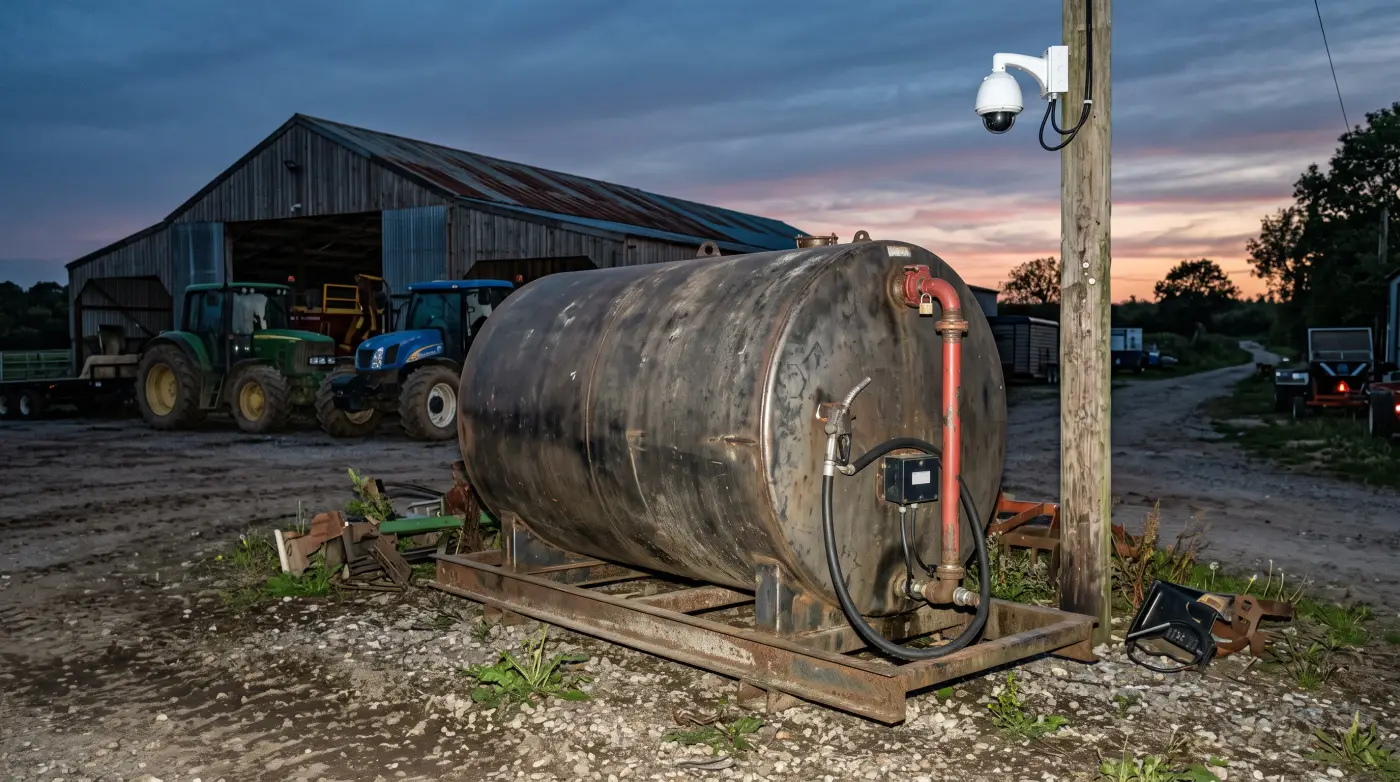
Fuel theft is one of those losses that a working operation can absorb for a long time without ever putting a number on it, because the diesel disappears in quiet increments rather than in one obvious hit. A few gallons skimmed off the bulk tank overnight, a nurse trailer drained while it sits at the edge of a leased field, a transfer tank emptied out of a parked pickup at the shop - none of these announce themselves the way a stolen implement does. The tank still has fuel in it the next morning, the equipment still runs, and the loss shows up only as a fuel bill that runs higher than the work done seems to justify. By the time a farmer notices the pattern, the theft has often been going on for months, and the question shifts from whether to do something about it to how to build a fuel security setup that actually fits a farm rather than a fuel depot.
This is a practical read on protecting on-farm diesel in 2026: where the theft actually comes from, the three layers of defense that matter, what tank locks and physical barriers do and do not stop, how fuel level sensors and remote monitoring catch the slow losses that locks miss, what it takes to run a camera at a tank with no power and no internet, and how to put it all together into a system that matches the size and layout of your operation. The goal is to spend security money where it displaces a real loss, not to fortify a farm against threats it does not face, because fuel security follows the same discipline as every other farm purchase: it has to pencil against the problem it solves.
Before buying a single lock or camera, it is worth being honest about where the diesel is going, because the defense looks very different depending on the source. Farm fuel theft comes from three broad places, and most operations have more than one of them at work.
The first is opportunistic outside theft - someone who spots an unguarded bulk tank or a fuel trailer parked at a field edge and helps themselves with a hose and a can. This is the theft people picture first, and it spikes whenever diesel prices climb, because the resale value of stolen fuel rises with the pump price. Remote storage is the prime target here, since a tank sitting at a leased field a few miles from the home place, with no house in sight and no one checking it for days at a stretch, is about as soft a target as exists. The opportunist wants speed and low risk, and a tank that is visibly locked, monitored, or watched is usually enough to send him to an easier one down the road.
The second is targeted theft, which is a different animal. This is the person who has watched the operation, knows the fill schedule, knows when equipment sits idle, and comes prepared with a transfer pump and the time to move real volume. Targeted theft often involves larger losses and sometimes involves someone with knowledge of the operation - a former employee, a neighbor who knows the layout, or someone who has done work on the place. Physical locks slow this thief but rarely stop him, and the defense that matters most against targeted theft is detection and documentation: knowing it happened quickly and having the evidence to act on it.
The third source, and the one operations are most reluctant to confront, is internal loss. Fuel that walks off through an employee filling a personal vehicle, a contractor topping off equipment that is not on the job, or simple unaccounted usage that nobody is tracking. Internal loss almost never shows up on a camera or trips a lock, because the person taking it has legitimate access to the tank. The only thing that catches it is reconciliation - matching fuel dispensed against work done and noticing when the numbers stop adding up. An operation that buys cameras and locks but never reconciles its fuel usage has armored the front door while leaving the back one open, and for a lot of farms the internal and unaccounted loss is the larger number.
A fuel security setup that works is built in layers, the same way any sensible security is, and the layers do different jobs. Skipping a layer leaves a gap that the others cannot cover, and over-investing in one layer while ignoring another is the most common way farms waste money on this.
The first layer is physical: locks, barriers, and siting that make the fuel hard to get at and slow to take. Physical security is deterrence and delay. It does not stop a determined thief with the right tools and enough time, but it turns a thirty-second job into a ten-minute one, and that difference is enough to send the opportunist elsewhere and to buy time for detection to matter.
The second layer is monitoring: fuel level sensors, telemetry, and reconciliation that tell you how much fuel you have and alert you when it moves unexpectedly. Monitoring is detection. It is what turns a loss you discover months later into an alert you get the same night, and it is the only layer that catches the slow internal and unaccounted losses that locks and cameras miss entirely. For a lot of operations, monitoring is the layer with the best return, because it works against all three theft sources at once.
The third layer is surveillance: cameras and lighting that document who is at the tank and deter the people who do not want to be recorded. Surveillance is evidence and deterrence combined. A visible camera turns away the opportunist who assumes he is unwatched, and a camera that captures a clear image gives law enforcement and insurance something to work with when theft does happen. The catch is that cameras at remote farm tanks run into power and connectivity problems that a camera on the house never faces, which is where most of the practical difficulty lives.
The right system blends all three in proportions that fit the operation. A small farm with a single bulk tank in the yard a hundred feet from the house needs very different layers than a spread-out operation with fuel cached at three leased fields. The layers are the framework; the mix is the decision.
Physical security starts at the tank fittings, and the weak points are predictable. A standard bulk tank has a fill cap, a vent, a pump or nozzle, and on gravity tanks a valve at the bottom, and each one is a way to get fuel out if it is left unprotected. The cheapest and most effective first move is a locking fill cap or a locking nozzle holster, because the nozzle and the fill point are where casual theft happens. A locking cap on the fill and a padlock through the nozzle holster or pump handle stop the person who was going to fill a can in under a minute, and they cost very little relative to what they prevent.
Beyond the fittings, the pump itself is worth locking down. Many farm fuel theft incidents are simply someone using the tank's own pump and hose, because the operation left it ready to dispense. A pump with a lockable on-off, a removable handle, or a padlocked enclosure forces the thief to bring his own transfer equipment, which raises the effort and the risk. For tanks with electric pumps, putting the pump power on a switched and locked circuit - or simply unplugging and securing it when not in use - is a near-free measure that defeats the lazy thief entirely.
Anti-siphon devices address the other common method, which is dropping a hose through the fill and siphoning. Anti-siphon screens or valves in the fill neck make siphoning slow and frustrating, and while a determined thief can sometimes work around them, they push him toward methods that take longer and leave more evidence. On larger installations, fuel cabinets and lockable tank enclosures wrap the whole assembly in a steel cage, which is the strongest physical measure and the most expensive, and it makes sense mainly where the fuel value and the exposure justify it.
The honest limit of physical security is that it is delay, not prevention. A thief with a cordless grinder and a few minutes can defeat almost any padlock, and a determined person will get into a tank he is willing to spend time on. What physical barriers do reliably is filter out the large majority of theft that is opportunistic and low-effort, and create the time window in which monitoring and surveillance can do their jobs. A farm that relies on locks alone is protected against the casual thief and exposed to the serious one, which is exactly why locks are a layer rather than a solution.
If physical security is the layer everyone thinks of first, fuel level monitoring is the layer that earns its keep the most, because it is the only one that tells you how much fuel you actually have and when it changes. A modern fuel monitoring setup puts a level sensor in the tank - usually an ultrasonic, pressure, or float-based gauge - and reports the reading to a phone app or dashboard over cellular, satellite, or a local radio link. The sensor watches the fuel level continuously, and the platform alerts you when the level drops outside of normal dispensing, when it drops at an odd hour, or when it drops while no equipment should be fueling.
The value of this is twofold. First, it catches theft fast. A bulk tank that loses a hundred gallons overnight throws an alert before breakfast rather than showing up as a vague shortage weeks later, and that speed is the difference between catching a pattern and absorbing a loss. Second, and less obviously, it catches the slow internal and unaccounted losses that no lock or camera ever sees, because the monitoring records every drop in level whether it came from legitimate fueling or not. When the recorded dispensing does not match the work the equipment did, that gap is visible in the data, and the gap is often where the real money is leaking.
Monitoring also pays for itself in ways that have nothing to do with theft, which improves the economics of the whole purchase. Knowing the real-time level across multiple tanks lets an operation schedule deliveries efficiently, avoid running a tank dry in the middle of a critical day, and buy fuel on favorable pricing rather than in a panic. A delivery supplier can sometimes manage the tanks remotely and top them on a keep-full basis. The theft detection is the headline benefit, but the inventory and logistics value is what often makes the spend easy to justify even on an operation with no theft problem at all.
The practical considerations are sensor accuracy, calibration to the specific tank shape, and the backhaul that gets the data off the tank - the same connectivity question that governs every remote farm sensor. A tank in the yard with wifi or cell coverage is simple. A tank at a remote leased field with neither is the hard case, and the answer there is usually a cellular sensor where there is any signal at all, or a satellite-linked unit where there is none, accepting a lower update frequency in exchange for coverage everywhere.
Cameras are the layer people most want and most often get wrong, because a camera at a remote fuel tank is a fundamentally different problem than a camera on a barn with power and internet. The remote tank has no outlet to plug into and frequently no wifi within range, which rules out the consumer security cameras that assume both. What works at a remote tank is a camera built for the off-grid case: solar-powered, battery-backed, and cellular-connected, designed to sit unattended for months and report on motion rather than stream continuously.
The cellular trail-camera category, originally built for hunting, has become a practical and affordable option for watching remote farm assets, and it is where a lot of operations start. These cameras run on a battery with an optional solar panel, trigger on motion, and send a still image or short clip to a phone over a cellular plan. They are inexpensive, genuinely off-grid, and good enough to tell you that someone is at the tank and to capture a usable image of a vehicle or a person. Their limits are real: they capture stills or short clips rather than continuous video, the image quality and night range vary, and a cellular trail camera in a true dead zone will not report until it is back in coverage. For documenting events at a remote tank where the alternative is no camera at all, they are a strong value.
The step up is a purpose-built solar cellular security camera, which adds continuous or on-demand video, better night vision, two-way audio on some models, and more reliable motion detection with fewer false triggers from wind and wildlife. These cost more and demand more from the solar and battery budget, but for a high-value installation or a tank that has already been hit, the better image and the live view are worth the difference. The deciding factors are the same as for any remote camera: enough solar to keep the battery up through cloudy stretches, enough cellular signal to report, and a mounting position that captures the approach and the fill point with a clean line of sight.
Two things make camera deployments succeed or fail in the field. The first is power and connectivity planning, covered in the next section, because a camera that runs its battery flat or sits in a dead zone is decoration. The second is positioning: a camera aimed to capture faces and license plates at the approach is far more useful than one staring at the tank itself, because the evidence that matters is identifying who came, not watching the fuel leave. A visible camera also deters, and there is a legitimate argument for mounting an obvious unit at the tank and a second, less obvious one positioned to catch the thief who disables the first.
The hard engineering problem in farm fuel security is not the lock or the camera or the sensor - it is keeping any of them running at a tank that has no power and no internet, which describes exactly the remote storage that is most at risk. Every electronic layer depends on solving power and backhaul, and the operations that get burned are the ones that bought the camera and the sensor without thinking through how they would stay alive in the field.
Power at a remote tank comes down to solar plus battery in almost every case, because running a line out to a leased field is rarely practical or worth it. The sizing question is whether the solar panel can keep the battery charged through the worst stretch of short, cloudy winter days while still powering the device through the long winter nights, and the common failure is a panel sized for summer that cannot keep up in December. The fix is to size the solar and battery for the worst-case season rather than the average, accept that a remote camera draws more than a remote sensor and needs more generous sizing, and choose devices with a genuine low-power sleep mode that wakes on motion rather than running full-time.
Connectivity is the other half, and it is the same coverage problem that governs every remote farm device. A tank with usable cell signal can run cellular sensors and cameras directly, which is the simplest case. A tank in a marginal signal area may need an external antenna to pull in enough signal to report reliably, which is a cheap fix that is often overlooked. A tank in a true dead zone has two honest options: a satellite-linked sensor that reports from anywhere at a lower frequency, or a local radio link back to a base station at the home place if the distance and terrain allow it. The mistake to avoid is assuming coverage that is not there - mapping the actual signal at the tank before buying is the step that prevents the most disappointment, because a cellular device in a dead zone is worse than useless since it gives a false sense of protection.
The practical upshot is that remote storage security is a systems problem, not a shopping problem. The lock, the sensor, and the camera are the easy parts; keeping them powered and connected through a Pacific Northwest winter or a remote stretch of rangeland is the part that takes planning, and it is worth doing that planning before the purchase rather than discovering the gaps after the gear is mounted and the battery has gone flat.
No camera and no lock catches the fuel that walks off through legitimate access, and on a lot of operations that quiet, unaccounted loss is the biggest number of all. The only thing that catches it is reconciliation - keeping track of how much fuel goes in, how much comes out, and whether the usage matches the work. It is the least glamorous layer and frequently the most valuable.
Reconciliation can be as simple as a log at the tank where each fueling is recorded with the date, the equipment, and the gallons, totaled against deliveries and tank readings at the end of each month. Even a paper log creates accountability, because people are far less likely to take fuel they have to write down, and the act of totaling the numbers surfaces gaps that nobody would have noticed otherwise. The discipline of the log is doing most of the work; the sophistication of the tools is secondary.
At the next level, a fuel management system ties dispensing to an individual key fob, card, or PIN, so that every gallon is attributed to a person and a piece of equipment automatically. These systems are common on larger operations and fleets, and they make reconciliation automatic and tamper-resistant: the data shows exactly who drew fuel, when, and how much, and the unaccounted gap shrinks to near zero. They cost more and make sense mainly where the fuel volume and the number of people with access justify the investment, but where internal loss is suspected, they are the tool that confirms it and stops it.
The point of reconciliation is not to treat the crew like suspects - it is to close the loop that the other layers leave open and to know the truth about where the fuel goes. An operation that locks the tank, watches it with a camera, and never reconciles its usage has spent money on the visible threats while ignoring the one that hides in plain sight. Pairing reconciliation with the level monitoring is especially powerful, because the sensor data and the dispensing log can be matched against each other, and any divergence between what the tank lost and what the log recorded is exactly the signal that something is leaking outside the system.
Some of the most effective fuel security costs almost nothing and involves no electronics at all - it is just placing and lighting the tank so that taking fuel is exposed and inconvenient rather than easy and hidden. The principles are the same ones that govern any sensible approach to securing a property: make the target visible, make the approach observed, and make the easy method hard.
Siting is the first lever. A bulk tank placed in view of the house, near a well-traveled part of the yard, and away from a road where a vehicle can pull up unseen is a far harder target than one tucked behind a shed at the edge of the property. For tanks that must sit at remote fields, even modest siting choices help: positioning the tank so that approaching it requires crossing open ground in view of a road or a neighbor, rather than backing up to it under cover, changes the risk calculation for the thief. Where a tank cannot be moved into view, that is exactly where the monitoring and camera layers earn their place.
Lighting deters because thieves prefer the dark, and a motion-activated light at a fuel tank is a cheap and effective measure for tanks within reach of power or running on a small solar light kit. The motion trigger matters: a light that snaps on when someone approaches is more startling and more useful than one that burns all night, and it pairs naturally with a motion-triggered camera so that the camera captures a lit subject rather than a dark shape. For remote tanks, a small solar motion light is inexpensive and adds a layer of deterrence that costs nothing to run.
The broader idea is to design the easy theft out of the situation before spending on the hard countermeasures. A tank that is visible, lit, locked, and known to be monitored presents a thief with a target that is exposed, slow, and likely to be recorded, and the large majority of fuel theft is opportunistic enough that this combination simply sends it elsewhere. The expensive layers are there for the determined thief and the internal loss; the cheap layers of siting and lighting handle the casual majority, and skipping them to spend everything on cameras is getting the order backward.
Fuel security spans a wide cost range, and the right spend is the one that matches the loss exposure rather than the one that buys the most gear. At the low end, locking caps, nozzle padlocks, anti-siphon devices, and a fuel log cost very little and stop the large majority of opportunistic theft, which makes them the obvious first spend for any operation regardless of size. There is almost no farm where these basic measures do not pay for themselves, because the downside is a few dollars of hardware and the upside is closing off the easiest theft entirely.
In the middle sit the fuel level monitoring sensors and the cellular cameras, which carry a per-unit hardware cost plus, in most cases, a subscription for the connectivity and the platform. These run from modest for a basic cellular trail camera or a single tank sensor up to a more meaningful figure for a purpose-built solar security camera or a multi-tank monitoring system with a service plan. This is the tier where the value is highest for most operations, because the monitoring works against all three theft sources and delivers inventory and logistics benefits on top, and the cameras provide the evidence and deterrence that physical security alone cannot.
At the high end are fuel cabinets, full lockable enclosures, and key-fob fuel management systems, which carry real cost and make sense where the fuel volume, the value at risk, or a confirmed internal loss justifies them. These are fleet and large-operation measures for the most part, and a small farm reaching for them before the basics is spending out of proportion to the problem.
Where the spend pencils is governed by the same logic as every farm technology purchase: it has to displace a real, recurring loss. An operation with remote tanks, a history of theft, or high fuel volume and many people with access has a real exposure that the layered system directly addresses, and the spend recovers itself in fuel not lost and deliveries better managed. An operation with a single tank in the yard, no theft history, and a small crew may rightly stop at the cheap physical layer and a fuel log, because the expensive layers would be armoring against a threat that is not there. The discipline is to size the security to the exposure, and the operation that is honest about its actual risk is the one that does not overspend on threats it does not face or underspend on the ones it does.
When theft does happen, what the operation can do about it afterward depends heavily on documentation, which is one more reason the monitoring and camera layers matter beyond simple deterrence. A fuel theft reported with a clear time, a recorded volume from the tank sensor, and a camera image of the vehicle or person gives law enforcement something concrete to work with, and it gives an insurance claim the evidence it needs to be taken seriously. A theft reported as a vague shortage with no documentation is far harder to act on and easy to dismiss.
Insurance coverage for stolen fuel varies, and it is worth knowing where the operation stands before a loss rather than after. Many farm policies cover fuel theft under broader theft or contents provisions, often subject to a deductible that can exceed the value of a single theft event, which means the practical recovery on a modest loss may be nothing. The documentation that the security layers produce supports a claim where one is worthwhile, and the deterrence and detection they provide are usually the better return than the insurance itself, since preventing the loss beats recovering part of it after a deductible.
On the legal side, the value of good camera evidence is in identification and prosecution, and the positioning that captures faces and plates is what makes a camera useful to a sheriff rather than just to the farmer's own peace of mind. It is also worth being aware of the basic rules around recording on and near a property, which for cameras on your own land watching your own fuel are generally straightforward, but which deserve a moment's thought where a camera's view extends onto a neighbor's ground or a public road. None of this is complicated, but it is the kind of thing worth sorting out as part of setting up the system rather than discovering after an incident that the evidence is not usable or the coverage is not there.
Putting the layers together is a matter of matching them to the operation's actual layout and exposure, and a few common shapes cover most farms. The small operation with a single bulk tank in the yard, near the house, with a small crew, should start and often stop with the cheap physical layer - locking cap, nozzle lock, anti-siphon, motion light - plus a simple fuel log for reconciliation. The exposure is low, the tank is observed, and the expensive layers would be out of proportion. If theft has occurred or fuel volume is high, adding a single tank sensor for monitoring is the next sensible step.
The spread-out operation with fuel cached at remote leased fields has the hardest problem and the highest payoff from the full stack. Each remote tank needs the physical basics, a level sensor with the right backhaul for its coverage, and a solar cellular camera sized for the worst-case season, because these tanks are the soft targets and the ones nobody is watching day to day. This is the operation where the power and connectivity planning matters most, and where skimping on the monitoring layer leaves exactly the assets most likely to be hit unprotected.
The larger operation with high fuel volume and many people with access should weight its spending toward reconciliation and monitoring, because internal and unaccounted loss tends to be the larger number at that scale. A key-fob fuel management system that attributes every gallon, combined with level monitoring on every tank and cameras on the remote ones, closes the loop that a big operation with a lot of access cannot close by trust alone. The physical and surveillance layers still matter, but the reconciliation layer is where the money is found at scale.
Across all of these, the build order is the same: start with the cheap physical and reconciliation measures that stop the easy majority, add monitoring where there is exposure to slow or remote loss, and add cameras where remote storage or a theft history justifies the power and connectivity work they require. Build the layers in proportion to the exposure, run them long enough to learn what the normal looks like so the alerts mean something, and wire the alerts and the logs into the daily routine so the system is acted on rather than installed and forgotten.
Farm diesel theft is a real and recurring loss for the operations that are exposed to it, and the good news is that the defense is well understood and scales cleanly to the size of the problem. The cheap physical measures - locking caps, nozzle locks, anti-siphon devices, lighting, and a fuel log - stop the large majority of opportunistic theft for very little money, and there is hardly a farm where they do not pay for themselves. The monitoring layer, fuel level sensors with remote alerts, is the highest-value addition for most operations because it catches theft fast, catches the slow internal losses that nothing else sees, and delivers inventory and delivery benefits on top of the security. Cameras are worth the effort at remote storage and where theft has already happened, with the understanding that the real work is keeping them powered and connected in the field rather than choosing the camera itself.
The operations that get the most out of fuel security are the ones that were honest about where their fuel was actually going before they shopped, matched the layers to the real exposure rather than the imagined one, and built reconciliation into the routine so the unaccounted loss had somewhere to show up. The operations that come away frustrated are the ones that bought a camera for a tank in a dead zone, locked the front door while internal loss walked out the back, or armored a low-risk yard tank against threats it never faced. Fuel security follows the same rule as every other tool on the place: it earns its keep when it displaces a real cost, and it wastes money when it solves a problem the operation did not have.
The trajectory of this technology points toward cheaper sensors, better solar and battery performance, more capable off-grid cameras, and monitoring platforms that tie the fuel data into the rest of the farm records. An operation that builds a sensible layered setup in 2026 is making a sound decision, and one that starts with the cheap physical basics and adds the electronic layers as the exposure justifies them is spending its money in the right order. As with every loss a working operation manages, the technology extends good practice rather than replacing it - the farm that knows its fuel usage, watches its tanks, and acts on what it sees is the one that keeps its diesel where it belongs.
With layered defenses matched to the exposure. The cheap physical layer, locking fill caps, nozzle padlocks, and anti-siphon devices, stops the large majority of opportunistic theft. Monitoring adds fuel-level sensors that alert you when fuel moves unexpectedly, and surveillance adds cameras for evidence and deterrence. Reconciliation, even a simple fuel log, closes the loop on the internal loss that locks and cameras never see.
A camera built for off-grid use: solar-powered, battery-backed, and cellular-connected. Cellular trail cameras, originally built for hunting, trigger on motion and send a still or short clip over a cell plan, making them an affordable start. Purpose-built solar security cameras add continuous video and better night vision. Position either one to capture faces and license plates at the approach, not just the tank itself.
An ultrasonic, pressure, or float sensor watches the tank level continuously and reports to a phone app over cellular or satellite. It alerts when the level drops at an odd hour or while no equipment should be fueling, so a hundred gallons lost overnight throws an alert before breakfast rather than surfacing weeks later. Matched against a dispensing log, it also exposes slow internal losses.
From three sources. Opportunistic outside theft targets unguarded tanks and spikes whenever diesel prices climb. Targeted theft comes from someone who knows the operation's fill schedule and arrives with a transfer pump. Internal loss walks off through legitimate access and never trips a lock or camera. For many operations the internal and unaccounted loss is the largest number, and only reconciliation catches it.
Join our list for practical guides on farm tech, precision agriculture, and tools that work.