
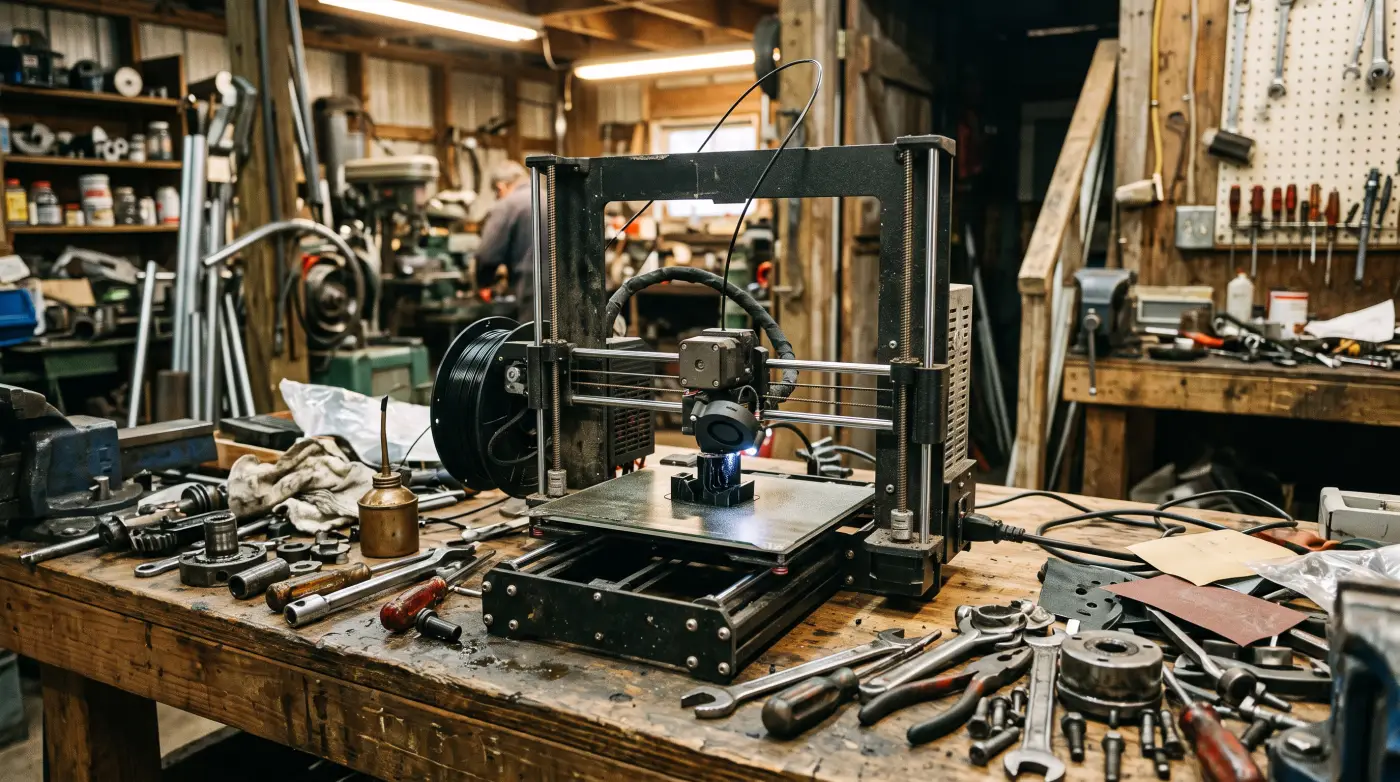
The pitch for a 3D printer in the farm shop sounds almost too good for the operation tired of waiting three days and paying dealer money for a plastic knob that snapped off in the cold. Print your own parts, the story goes, and never get held up by a backordered clip or a discontinued bushing again. There is real truth in that pitch, and a farm shop printer earns its keep on the right jobs more often than the skeptics expect. There is also a fair amount of nonsense around it, because the same machine that will save you a trip to town for a wiring clip will not print the structural casting that actually broke your planter, and a buyer who does not understand that line is going to be disappointed in one direction or the other. The honest read in 2026 is that a desktop 3D printer is a genuinely useful shop tool for a specific and surprisingly large set of small parts, that it costs little enough to be an easy buy, and that the value comes entirely from knowing which parts it can make and which ones it cannot.
This is a working farmer's guide to 3D printing in the farm shop as the technology stands in 2026: what the printer actually does and the two main types you will be choosing between, the parts that print well and pay for the machine, the parts that look printable but will fail you, what the filament choices mean when the part has to live outdoors in sun and cold and diesel, what the machine and the learning curve really cost, and how to decide whether it belongs in your shop at all. The goal is enough detail to make the call rather than enough enthusiasm to make the sale.
Before any of the buying decisions make sense, it helps to be clear about what a desktop 3D printer is and is not, because the name carries a lot of expectations that the machine does not meet. A filament 3D printer builds a part by melting a thin plastic string and laying it down in layers, one thin layer stacked on the next, until the shape is complete. It is an additive process - the part grows from nothing rather than being cut out of a block - and that single fact drives everything about what it is good and bad at.
The strength of the process is that it makes complex small shapes cheaply and without tooling. A bracket with odd angles, a knob with a specific bore, a spacer of an exact thickness, a housing that snaps around a sensor - these are jobs that would take real time on a lathe or mill or would have to be ordered, and the printer makes them overnight from a digital file while you sleep. You pay nothing for the complexity; a complicated shape prints as easily as a simple one, which is the opposite of machining where every feature is more work.
The weakness is structural, and it comes straight from the layered construction. A printed part is strong along the layers and weaker between them, because the bond between one layer and the next is the weak plane, and a load that tries to pull the layers apart will break the part there long before the plastic itself would fail. This is why a printed part can feel solid in your hand and then snap under a load that a molded part of the same plastic would shrug off. The layers are the part's grain, like grain in a piece of wood, and just as you would not trust a wooden handle loaded across a weak grain line, you cannot trust a printed part loaded across its layers. Understanding this one limitation is most of what separates a farmer who gets real value from the machine from one who prints a part that fails in the field and concludes the whole idea was a gimmick.
The other thing the printer is not is fast in human terms. A small part might print in under an hour, but a larger or more detailed one runs for many hours, and a big job can run overnight or longer. This is fine for the way a farm shop works - you start the print, walk away, and it is done in the morning - but it is not the right tool for a part you need in the next ten minutes with the planter stopped in the field. The printer is a planning tool and a never-run-out tool, not an emergency-on-the-spot tool, and matching it to that role is part of using it well.
The desktop 3D printer market splits into two technologies, and for a farm shop the choice is straightforward, but it is worth knowing why so you do not get talked into the wrong one.
The first and right type for nearly every farm is the filament printer, technically called FDM or FFF, the kind described above that melts a plastic string and lays it down in layers. This is the workhorse, the affordable machine, and the one that makes the functional parts a farm actually needs - the brackets, knobs, spacers, housings, and clips. It runs on spools of plastic filament that cost little, it makes tough functional parts in the engineering plastics that matter for outdoor use, and the machines have gotten genuinely good and genuinely cheap. If someone says farm shop 3D printer, this is the machine they mean, and it is the only type most operations should consider.
The second type is the resin printer, which builds parts by curing liquid resin with light, and it makes beautifully detailed small parts with smooth surfaces. It is the wrong tool for a farm shop in almost every case. Resin parts are typically more brittle, the resin itself is messy and requires careful handling and ventilation and a wash-and-cure step after printing, and the strengths of the technology - fine surface detail on small decorative or miniature parts - are not the strengths a farm needs. The resin printer is built for the hobbyist making figurines and the jeweler making models, not for the operation making a functional bracket that has to survive a season outdoors. Skip it.
Within the filament-printer category, the meaningful 2026 distinction is between the older-style open machines and the newer enclosed, high-speed machines that have largely taken over. The newer machines print faster, handle the tougher engineering filaments more reliably because the enclosure holds heat, run with far less fiddling thanks to automatic bed leveling and better software, and have brought the price of a genuinely capable machine down to where it is an easy shop purchase. For a farm buying its first printer, the guidance is simple: buy a current enclosed filament machine from an established maker, not the cheapest open frame you can find and not last decade's design, because the reliability and the ability to print the tougher plastics is exactly what a farm needs and is exactly what the newer machines deliver. The enclosure is not a luxury for a farm; it is what lets the machine print the durable filaments that survive outdoors.
The case for a farm shop printer lives entirely in the set of parts it makes well, and that set is larger and more useful than the skeptics expect once you learn to recognize it. The pattern is consistent: small parts, loaded lightly or in compression rather than pulled apart, where the value is in having the part now rather than waiting and paying for it.
Knobs, handles, and grips are a sweet spot. The plastic knob that controls a valve, the handle that snapped off a panel, the grip on a lever - these break constantly, the dealer wants real money and a wait for a part that is mostly air and plastic, and the printer makes a better one overnight. You can even improve on the original, making the knob bigger for gloved hands or adding a grip pattern, and the load on a knob is gentle enough that a printed part lasts.
Brackets and mounts for the electronics a modern farm hangs everywhere are another strong case. The mount for a backup camera, the bracket that holds a monitor in the cab, the housing that positions a sensor, the case for the wiring junction - these are exactly the complex small shapes the printer makes cheaply, and they carry light loads in service. As farms add cameras, screens, sensors, and antennas, the need for one-off mounts to hold them in odd places grows, and the printer turns that need from a fabrication problem into an overnight print.
Spacers, bushings, washers, and shims print well and are genuinely useful, because so often you need a spacer of an exact thickness or a bushing of an exact bore that is not a standard size, and machining one is more trouble than it is worth. Loaded in compression, which is how most spacers and bushings work, a printed part in a tough plastic holds up well, and being able to make one to an exact dimension in twenty minutes solves a class of small problems that otherwise eat an afternoon.
Clips, clamps, and fasteners for routing and holding things - the clip that keeps a wiring harness off a hot surface, the clamp that holds a hose, the bracket that organizes lines - are high-value prints because they are cheap to make, frequently broken or missing, and forever a nuisance to source. Printing a handful of clips to tidy up the wiring on a piece of equipment is the kind of small win that adds up.
Caps, plugs, covers, and guards round out the list - the cap that keeps dirt out of a port, the cover that protects a connector, the guard over a moving part, the plug for an unused hole. These protect things and carry essentially no load, so they print reliably and last, and they are exactly the small parts that go missing and are a hassle to replace.
The honest payback case is built from this kind of part. No single printed knob justifies the machine, but a shop that prints a steady stream of knobs, brackets, spacers, clips, and caps over a year - parts that would each have cost real money and a wait - finds the machine has paid for itself in saved trips, saved dealer markups, and saved downtime, and that it keeps paying every time something small breaks and the answer is a print rather than an order.
Just as important as knowing what to print is knowing what not to print, because the fastest way to sour on a farm printer is to make a part that fails in service and takes something with it. The line is structural load, and it is worth being blunt about where it falls.
Anything that carries a real mechanical load in tension or bending is off the table. The bracket that holds a heavy implement component, the arm that takes a pulling load, the mount that a real weight hangs from and swings on - these will find the weak plane between the layers and break, and they will break at the worst time under the worst load. A printed part can substitute for a lightly loaded bracket, but the moment the bracket is structural, the printer is the wrong tool and the answer is the real part in steel or the real molded component.
Anything in the drivetrain or under real rotational or impact load is off the table. Gears that transmit meaningful torque, parts that take impact or shock, components that spin at speed - the layered plastic part will not survive, and the failure can be sudden and can damage what is around it. There are printable plastics strong enough to surprise you, but no desktop-printed part belongs in a load path where its failure damages equipment or risks injury.
Anything that has to hold pressure or seal against real force will disappoint, because printed parts are slightly porous between the layers and do not seal the way a molded part does, and a part meant to contain pressure or fluid against a real load is not a job for the printer.
Anything safety-critical is an absolute no. Any part whose failure could hurt someone or cause a serious equipment failure - a part in a braking path, a part in a lifting or supporting role where a person or a load is overhead, a guard whose failure exposes someone to a hazard in a way that matters - is not a candidate for a printed substitute, full stop. The printer is a tool for convenience parts, not for parts that keep people safe.
The practical filter is a simple question asked honestly: if this part fails, what happens? If the answer is a minor inconvenience - a knob you reprint, a cap you replace - print it without worry. If the answer is damaged equipment, a field stoppage at a bad time, or any risk to a person, do not print it, and do not let the convenience of the machine talk you past that line. The farmers who get lasting value from a shop printer are the ones who keep it firmly on the right side of that question.
The same printed shape will last for years or fail in a month depending on which plastic it is made from, and for farm parts that live outdoors the filament choice matters more than almost anything else. The cheap, easy filament that beginners start with is the wrong one for a part that has to survive a farm.
The default beginner filament, PLA, is easy to print and is the wrong choice for nearly any functional farm part. It is brittle, it softens at temperatures a part can easily reach sitting in the sun or near an engine, and it breaks down under sustained sunlight. A PLA part is fine for a prototype you are checking the fit of, or for an indoor part that never sees heat or sun, but a PLA knob left on equipment in the summer will go soft and a PLA bracket outdoors will turn brittle and crack. Print your test fits in PLA if you like, then print the real part in something tougher.
The workhorse for functional farm parts is PETG, which prints almost as easily as PLA but is far tougher, holds up to sunlight and weather far better, takes more heat before it softens, and resists many chemicals. For the great majority of farm shop parts - the brackets, knobs, spacers, clips, and caps that live outdoors and need to last - PETG is the right default, and a farm that prints everything functional in PETG will rarely be wrong. It is the filament to standardize on.
For parts that need to take impact or flex without cracking, ASA and ABS are the tougher, more heat-resistant and more UV-stable engineering plastics, and ASA in particular is well suited to outdoor parts because it resists sunlight and weather very well. These print harder than PETG and are where the enclosed machine earns its keep, because they need the held heat to print without warping, but for a demanding outdoor part that has to survive sun and impact, ASA is often the best choice. There are also flexible filaments for parts that need to bend or grip or seal lightly, useful for the occasional gasket-like part or grip, though not for real pressure sealing.
The buying lesson is to ignore the cheap PLA that comes with the machine for anything that matters, standardize on PETG for general functional parts, and reach for ASA when a part faces hard sun and impact. The right plastic is what turns a printed part from a short-lived novelty into a component that quietly does its job for years, and getting the filament choice wrong is the most common reason a farm printer disappoints on parts it should have made well.
The money side of a farm shop printer is genuinely modest, which is a large part of why the tool pencils out, but the full cost includes more than the machine and it is worth laying out honestly.
The machine itself, a current enclosed filament printer capable of the tough engineering plastics from an established maker, is an affordable shop purchase in 2026, in the range of other midrange shop tools rather than a major capital item, and well within reach of any operation that buys tools at all. The filament is cheap, with a spool that makes a great many small parts costing about what a single dealer plastic part might, so the per-part material cost is close to negligible and the spool lasts a long time across the kind of small parts a farm makes.
The real cost that the machine price hides is the learning curve and the time, and being honest about it prevents disappointment. There are two skills to climb. The first is running the printer well - getting prints to stick and finish cleanly, choosing the settings for each filament, and the occasional maintenance and troubleshooting when a print fails. The newer enclosed machines have made this far easier than it used to be, with automatic leveling and better software taking most of the old fiddling away, but it is not zero, and the first weeks involve some failed prints and learning. This skill comes fairly quickly and is well within reach of anyone comfortable with shop equipment.
The second and steeper skill is getting the part you want to print in the first place, because the printer needs a digital model of the part and that model has to come from somewhere. For many common parts the model already exists - there are large free libraries of printable designs, and a great many farm-useful parts and a lot of generic knobs, brackets, and clips can simply be downloaded and printed. For a part specific to your equipment that nobody has modeled, you either learn enough CAD to design it yourself, which is a real skill that takes real time to acquire, or you adapt an existing model, or you do without. The farmers who get the most from a printer are usually the ones who climb at least partway up the CAD skill, because that is what unlocks the made-to-fit parts rather than only the generic downloads, but it is the part of the commitment that the machine price does not show and that a buyer should go in expecting.
The full honest cost, then, is an affordable machine plus cheap filament plus a real but manageable investment of time to learn to run it and a larger optional investment to learn to design for it. For an operation that enjoys the shop side of farming and likes solving small problems, that learning is part of the appeal rather than a cost. For an operation that wants parts to appear with no learning involved, the printer will underdeliver, and that is worth knowing before buying.
The decision comes down to matching the tool to how your operation actually works and to being honest about whether you will use it.
The operation that gets the most from a shop printer is the one that already does its own work, keeps its own shop, fixes its own equipment, and is regularly held up by small plastic parts that are backordered, discontinued, or overpriced for what they are. For that operation the printer is a natural fit, the payback comes steadily across a year of small wins, and the learning curve is the kind of thing it enjoys rather than resents. If you are forever waiting on a small clip or knob and muttering about what the dealer charges for it, the printer is talking directly to your pain.
The operation that should think harder is the one that does not really do its own fabrication, does not have the time or interest in the learning curve, or simply does not break enough small parts to build a payback. The printer is cheap enough that it is not a big risk, but a tool that sits unused because nobody climbed the learning curve is money spent for nothing, and that is a real outcome for the buyer who likes the idea more than the doing. Be honest about whether the machine will actually get used.
For the operation on the fence, the realistic expectation to hold is the right way in. A farm shop 3D printer is a very good tool for a specific and useful set of small, lightly loaded parts, made in the right plastic, where the value is having the part now instead of waiting and paying for it. It is not a tool for structural parts, drivetrain parts, pressure parts, or anything safety-critical, and trying to make it one is how it earns a bad reputation it does not deserve. Buy the current enclosed filament machine, standardize on PETG with ASA for the hardest outdoor parts, keep the printer firmly on the convenience-part side of the if-this-fails-what-happens question, and budget the time to learn it. Do that and the machine quietly saves trips, dealer markups, and downtime on small parts for years, paying back many times its modest cost - and the farmer who understands exactly what it can and cannot make is the one who is glad to have it.
A current enclosed filament printer, technically FDM or FFF, from an established maker. The enclosure holds heat, which is what lets it reliably print the tough engineering plastics that survive outdoors, and modern machines add automatic bed leveling that removes most of the old fiddling. Skip resin printers: they are messy, need ventilation and a wash-and-cure step, and make brittle parts suited to figurines, not functional brackets.
Standardize on PETG for functional farm parts. It prints almost as easily as PLA but is far tougher, tolerates more heat, resists many chemicals, and holds up to sun and weather. Reach for ASA when a part faces hard sunlight and impact, since it resists UV especially well. Avoid the beginner PLA that ships with the machine for anything real: it turns brittle outdoors and softens in summer heat.
Small parts that carry light loads or work in compression. Knobs, handles, and grips print well and can be sized for gloved hands. Brackets and mounts for cameras, monitors, and sensors are a strong case, as are spacers, bushings, washers, and shims made to an exact dimension. Clips, clamps, caps, plugs, and covers round out the list. A steady stream of these pays for the machine.
No. A printed part is strong along its layers but weak between them, so a load pulling in tension or bending finds that plane and breaks the part, often at the worst moment. Structural brackets, drivetrain gears, pressure or sealing parts, and anything safety-critical are all off the table. Use one honest filter: if this part fails, what happens? A minor reprint is fine; damaged equipment or injury is not.
Join our list for practical guides on farm tech, precision agriculture, and tools that work.