
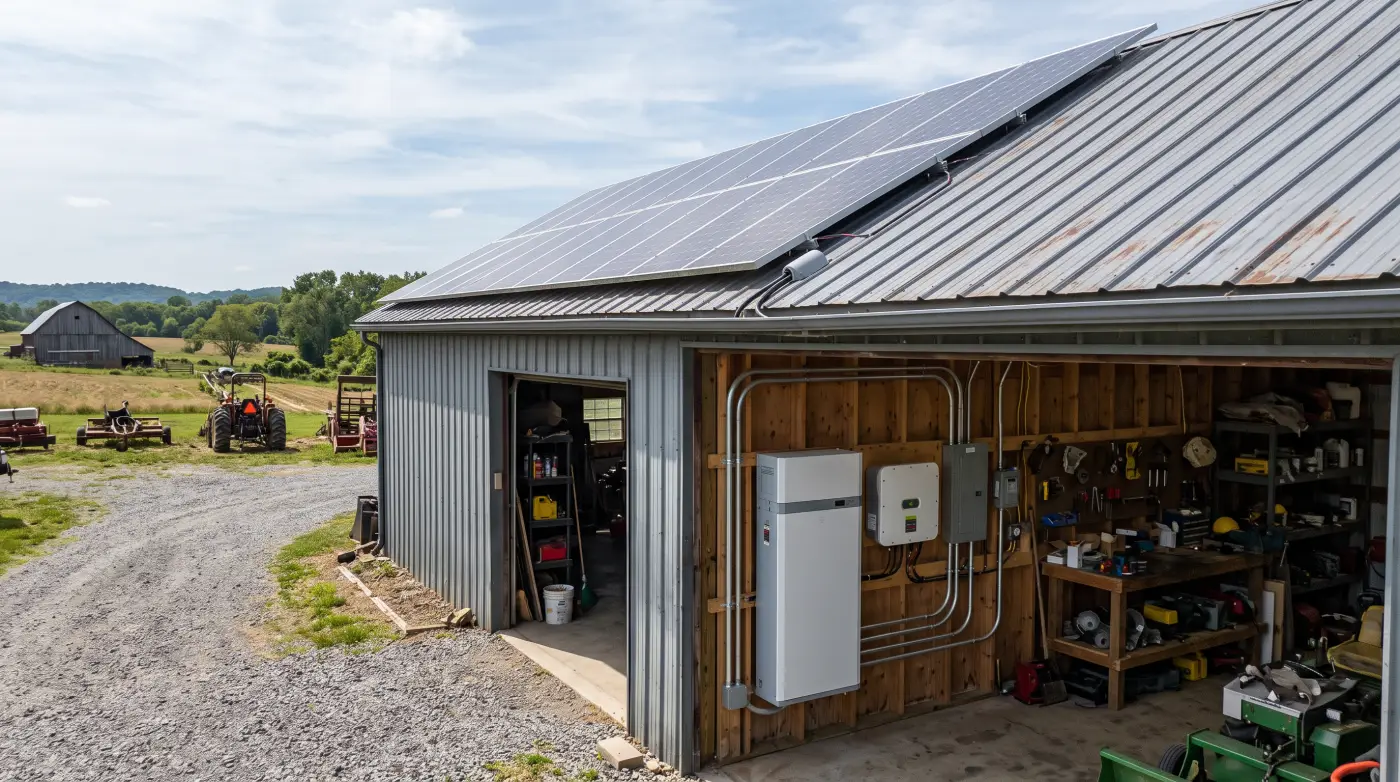
The farm shop is one of the few buildings on the operation where solar actually pencils out without anyone needing to fudge the numbers. The roof is large, oriented in whatever direction the farmstead happened to face when it was built in 1962, and the loads underneath it are predictable. Welders, air compressors, lights, a parts washer, a couple of overhead heaters in winter, and the well pump that often shares the panel. The grid that feeds it is rural, the line is long, and the outages are frequent enough that anyone who has tried to finish calving in a power outage with a borrowed generator already knows why battery backup matters.
This guide is the practical version of solar and battery backup for the farm shop in 2026. It covers what the shop actually pulls in real loads, how to size an array against those loads instead of against a sales brochure, how to size a battery bank that will run the things that matter when the line goes down, the differences between grid-tied, off-grid, and hybrid systems and which one fits which farm, the inverter decision, the real ROI math with current incentives and depreciation, the USDA REAP grant and the federal tax credit, the installation realities of mounting a 15 kW array on a steel-roofed shop, and the maintenance reality that nobody in a sales meeting wants to discuss.
The case for solar on a farm shop is built on numbers that do not apply to a typical house. The roof is bigger. The loads are heavier and more variable. The electrical service is usually 200 amps or 400 amps single-phase and sometimes three-phase. The duty cycle is mostly daytime, which lines up with solar production. The owner is the operator, which means the decision-making cycle is short and the install can happen on the operation's schedule rather than waiting for a homeowner association.
Three things follow from that. First, the ROI math is genuinely better than residential solar in most regions because the loads are larger and the time-of-use of the loads matches production. Second, the system has to be sized against a specific list of loads with specific duty cycles, not against an annual kilowatt-hour total from a utility bill, because the shop bill is often part of the house meter or part of a farm aggregate meter and the shop-only consumption is hidden in the total. Third, the federal incentive picture is different. A farm shop is a business asset. It qualifies for the federal Investment Tax Credit and for the Modified Accelerated Cost Recovery System depreciation, and it can apply for the USDA Rural Energy for America Program grant. None of that is available for a residential rooftop install on the same farm.
Operators who treat the farm shop solar decision as a residential solar decision miss most of the value. Operators who treat it as a business capital decision get the incentive stack working and the math gets a lot more interesting.
Before any sizing conversation can happen, the loads have to be measured or at least estimated honestly. A typical farm shop has a more variable load profile than almost any residential building, and the peaks matter as much as the averages.
Start with the continuous loads. Lights, ventilation fans, a refrigerator or freezer if there is one, the well pump if it is on the shop panel, a parts washer if it is plugged in, network gear, a security camera. These are the loads that run all day or all night, and they typically total 1 to 3 kilowatts of continuous draw. A reasonable shop with LED lights and a single freezer can be under a kilowatt at idle.
Then the intermittent heavy loads. An air compressor cycling on and off can pull 5 to 10 kilowatts during its run cycle and then drop to zero for forty-five minutes at a time. A welder on a 50-amp 240-volt circuit can pull 12 kilowatts when it is striking an arc and then zero between welds. A plasma cutter, a milling machine, a lift, a tire changer - each of these has a startup surge two to three times their rated draw and a duty cycle of maybe 10 percent during use. A 5-horsepower hydraulic press pulls 4 kilowatts when it is making a stroke and zero the rest of the time.
Then the seasonal heavy loads. Overhead radiant heaters or a forced-air shop heater can be 15 to 30 kilowatts when running. A water heater for a wash bay, 4.5 kilowatts. A heated floor system, variable but often 6 to 10 kilowatts at peak in cold weather. These loads often dwarf everything else and they appear in winter, when solar production is at its lowest.
The right way to capture all of this is to put a logging meter on the shop panel for at least two weeks across a representative season, and ideally for a full year if the decision is large enough to warrant it. An Emporia Vue, a Sense monitor, or a clamp-on logger from the utility will produce a 15-minute interval log that shows actual peaks, actual averages, and actual time-of-use. Most farm cooperatives and rural electric cooperatives will install one for free if asked. Without that data, sizing is guesswork, and guesswork on a $40,000 capital decision is expensive.
A reasonable medium-sized farm shop with a typical equipment set runs 12,000 to 25,000 kilowatt-hours per year, with peaks in the 30 to 60 kilowatt range during heavy use and a baseline under 1 kilowatt overnight. A larger operation with an attached crop dryer, a heated wash bay, or a full machine shop can easily double those numbers.
Once the loads are known, the array sizing follows a sequence that has a couple of decision points but is otherwise straightforward.
First, decide whether the goal is to offset most of the annual kilowatt-hours, to cover daytime loads only, or to be the primary power source with batteries handling the rest. These three goals produce three different system sizes.
To offset most of the annual kilowatt-hours on a 20,000 kWh per year shop in the central Plains, the rule of thumb is roughly 1 kilowatt of array per 1,400 to 1,600 kilowatt-hours of annual production at typical southern-facing tilt. That is a 13 to 14 kilowatt array. In the northern tier of states, expect closer to 1,200 kilowatt-hours per kilowatt, so the same shop needs 16 to 18 kilowatts. In the desert Southwest, 1,800 kilowatt-hours per kilowatt is achievable, so a 11 to 12 kilowatt array is sufficient. The PVWatts calculator from NREL gives a free, defensible number for any specific site, and any installer who cannot match their proposal to PVWatts within 10 percent is selling on hope.
To cover daytime loads only, the array can be smaller. The shop runs 8 to 10 hours of significant load on a working day, and a 10 kilowatt array produces 50 to 70 kilowatt-hours on a typical clear day, which is more than enough to cover daytime use on most days without exporting much. This sizing matches well with utilities that have eliminated full retail net metering, because the goal becomes self-consumption rather than export.
To act as the primary power source with batteries, the array has to be larger than the annual offset case, because the system has to produce enough on average days to refill the battery and run the loads. The rule of thumb is roughly 1.3 to 1.5 times the annual offset size, so the same 20,000 kWh shop needs an 18 to 22 kilowatt array if the goal is full primary supply with grid as backup, and 25 to 30 kilowatts if the goal is genuine off-grid operation with no grid connection at all.
Panel selection in 2026 is mostly a question of price per watt and form factor. The mainstream tier-one panels are 425 to 460 watt monocrystalline modules with bifacial construction, and they run roughly $0.32 to $0.40 per watt at the wholesale level for full pallets. A 15 kilowatt array is 33 to 35 modules. The roof of a 60-foot by 80-foot shop has more than enough room for that even on a single south-facing slope.
The mounting decision is between rail-on-roof and ballasted ground mount. Steel-roof shops with proper purlins are excellent rail-on-roof candidates, and the install is faster and cheaper than ground mount. Older sheet-roof shops with marginal purlin spacing or unknown roof condition are better candidates for ground mount, particularly if there is a south-facing pasture or unused yard area. A ground mount adds $0.10 to $0.20 per watt to the install cost but eliminates the roof condition risk and makes future panel cleaning and snow removal easier.
The battery sizing question is the one where most operators either over-spend by a factor of two or under-spend by a factor of three, and there is no middle ground without doing the math.
The starting point is to define what the battery actually has to do. A battery sized to ride through a one-hour grid blip is a different battery than one sized to power calving and the shop heater for three days during an ice storm.
For most farm shops, the practical battery use cases are these. Power outage backup for the well pump, lights, freezer, and basic shop loads for 12 to 48 hours. Power outage backup that includes heavy loads like overhead heaters or an air compressor for shorter durations. Time-shifting solar production to cover evening loads when the array is not producing. Off-grid operation as the primary power source.
The first use case, basic backup for 12 to 48 hours, requires roughly 10 to 30 kilowatt-hours of usable storage, depending on how much overnight load matters. A well pump that cycles on and off for stock water, a freezer, and lights together pull around 2 to 4 kilowatt-hours per day. A 13.5 kilowatt-hour battery, which is the size of a single Tesla Powerwall 3 or two stacked EG4 LiFePOWER4 racks, is enough for about three days of essential loads.
The second use case, backup that includes heavy loads, requires 20 to 60 kilowatt-hours and a high continuous power rating. A shop heater, an air compressor running periodically, and an overhead light bank can pull 6 to 8 kilowatts continuous when active, and a battery designed for this needs an inverter capable of 8 to 12 kilowatts continuous and 20 kilowatts surge.
The third use case, time-shifting solar production, is the smallest battery requirement. A 10 to 13 kilowatt-hour battery is enough to capture late-afternoon production that exceeds load and discharge it through the evening. This is the most common battery sizing for grid-tied installations where the goal is self-consumption rather than backup.
The fourth use case, off-grid operation, requires the largest battery and the most careful sizing. The rule of thumb is 2 to 3 days of average daily load, which on a 20,000 kWh per year shop is 110 to 165 kilowatt-hours of usable storage. That is a substantial bank, and it is the single most expensive component of an off-grid system. Most farm operations that look hard at off-grid conclude that a hybrid system with a small grid connection or a backup generator is dramatically cheaper than full off-grid for the same reliability.
Battery chemistry in 2026 is essentially settled on lithium iron phosphate, often abbreviated LFP or LiFePO4. LFP has displaced both lead-acid and lithium nickel-cobalt-aluminum chemistries for stationary storage because it is safer, has 6,000 to 10,000 cycle life, tolerates partial discharges well, and runs in cold weather better than other lithium chemistries. The major brands are Tesla Powerwall 3, Enphase IQ Battery 5P, Franklin aPower 2, EG4 PowerPro, and SOK SK48V100 for the rack-mount segment. Pricing runs $400 to $700 per usable kilowatt-hour installed, with rack-mount systems on the lower end and integrated wall-mount units on the higher end.
Lead-acid batteries are no longer competitive for new installations. The cycle life is a fifth of LFP, the depth of discharge is limited to 50 percent, and the maintenance is real. A lead-acid bank that looks cheaper at install costs more per delivered kilowatt-hour over a decade.
The architecture decision is where a lot of solar consultations go sideways. The three options have different costs, different rules, and very different reliability profiles.
A grid-tied system has no batteries. It produces solar power, the loads consume it, and any excess gets exported to the utility. When the grid goes down, the system shuts off automatically, both for utility worker safety and because the inverter cannot run without a grid reference. This is the cheapest configuration and it has the highest production efficiency, but it offers zero backup. When the line goes down, the shop goes dark even if the sun is shining on the array.
An off-grid system has no utility connection. The array charges the batteries, the inverter runs the loads, and a backup generator covers extended cloudy periods. This is the most expensive configuration and it requires the most careful sizing, because there is no fallback if the system runs out of energy. For a farm shop on a long rural line with chronic outages and high tap fees, off-grid can pencil out, but the all-in cost for a system that is genuinely reliable is usually 2 to 3 times the grid-tied cost.
A hybrid system has both. The array charges the batteries and runs loads, excess goes to the grid, and the grid is available as backup when batteries are depleted. When the grid goes down, the inverter switches to island mode and continues running loads from the battery and array. This is the most common configuration for farm operations that want backup, and it is the configuration that the major battery manufacturers like Tesla, Enphase, and Franklin are optimized for.
The hybrid choice within that is whether to put the entire shop on the backup-protected side of the system or to put only critical loads on a sub-panel. Whole-shop backup requires a larger inverter and battery, costs more, and provides full functionality during outages. Critical-load backup uses a smaller sub-panel that contains only the freezer, lights, well pump, network gear, and maybe a single 240-volt outlet for the welder, costs less, and provides enough functionality to keep the operation running.
For most farm shops, critical-load backup is the right answer. The cost difference is often $10,000 to $20,000, and the functional difference during an outage is small. A welder that only works during outages on the backup circuit is sufficient for most operators.
The inverter is the component that most operators underspend on, and it is the component most likely to fail first. The inverter does the work of converting DC from the panels and battery into AC for the loads, and it manages the entire system's behavior during normal operation, during grid outages, and during fault conditions.
Three inverter architectures dominate the 2026 market. String inverters, where one or two large inverters handle the entire array. Microinverters, where each panel has its own small inverter. And hybrid inverters, where a single unit handles solar input, battery input, AC output, and grid interaction.
For farm shop installations, hybrid inverters from manufacturers like Sol-Ark, Schneider XW Pro, EG4 18kPV, and Tesla Powerwall 3 are the dominant choice. They handle the solar array, the battery bank, and the AC loads in one unit, they provide seamless backup during outages, and they support generator integration for extended outages. Pricing runs $4,000 to $8,000 for capacities in the 8 to 18 kilowatt range that suit most farm shops.
The capacity decision is driven by the surge requirement of the loads. A 12 kilowatt continuous inverter with 24 kilowatt surge handles most farm shop loads including a 5-horsepower air compressor and a welder, but it will not start a 7.5-horsepower well pump on inrush. The right sizing is to add up the continuous loads, identify the largest single inrush load, and pick an inverter whose surge rating meets the inrush plus 50 percent margin.
Microinverters from Enphase have a place on installations with significant shading or with multiple roof orientations, but they are more expensive per watt and they do not pair as cleanly with battery systems for backup. For a clean south-facing shop roof, string or hybrid inverters are the better choice.
The headline numbers in 2026 for a typical 15 kilowatt shop solar plus 20 kilowatt-hour battery system look like this. Installed cost is $50,000 to $70,000 depending on region and installer. Federal Investment Tax Credit is 30 percent, which is $15,000 to $21,000. USDA REAP grant for rural agricultural producers can be up to 50 percent of project cost, capped, often $10,000 to $25,000 in practice for a system this size. State and utility incentives vary widely, from zero in some states to $5,000 to $10,000 in better-incentive states. MACRS depreciation allows the depreciable basis to be deducted over five years, which for a farm operation in a 24 percent marginal bracket is worth roughly $9,000 to $14,000 in tax savings on a $60,000 project after the ITC reduces basis.
Stack those together and a $60,000 system can have a net cost to the operation of $15,000 to $25,000 after all incentives. Annual savings on electricity, depending on local rates, run $1,800 to $3,500. Simple payback after incentives is 5 to 12 years, and the system has a useful life of 25 to 30 years.
The REAP grant is the single biggest variable in this stack and it is the one most operators do not pursue. The application is genuinely real paperwork and it requires either a USDA-approved energy audit for systems above $80,000 or simpler self-certification for smaller systems. The deadlines are quarterly, the awards are competitive, and the process from application to award typically runs 6 to 12 months. Operations that work with a regional agricultural lender or with an installer experienced in REAP applications win these grants regularly. Operations that try to file independently for the first time without help often get rejected on procedural issues even when the project is sound.
The depreciation calculation is the second most-overlooked piece. A farm operation with significant other income can take the bonus depreciation in year one and recover a meaningful share of the project cost through the tax benefit. The exact mechanics depend on the operation's tax structure - sole prop, S-corp, partnership, LLC - and a tax professional with rural and agricultural experience is worth the consultation fee.
The net effect is that a system that costs $60,000 retail can have a true cost to the operation of $15,000 to $25,000, with annual savings that pay it back in 5 to 8 years and continuing value through year 25 or beyond. Few capital projects on a farm have that profile.
The install of a 15 kilowatt array on a typical farm shop takes a competent two-person crew about three to five days. The roof work is the most time-consuming part, particularly if the shop is steel-roofed with hidden purlins that have to be located by sounding or by removing the soffit to inspect.
The penetrations matter. Every roof penetration is a potential leak, and on a 25-year-old steel roof, the gasket material on standard solar mounts has not been tested at the same end-of-life conditions as the roof itself. Quality mounts use butyl gaskets and through-bolts to the purlins rather than self-tapping screws into sheet steel. A roof replacement decision is sometimes appropriate before the install if the roof is more than 20 years old.
Wire runs from a roof-mounted array down to the inverter often involve a 50 to 150 foot conduit run, and the wire size has to be chosen for voltage drop, not just for ampacity. A long run on undersized conductors can lose 3 to 5 percent of system production, which adds up over the life of the system. Most quality installers run #6 or #4 AWG copper in conduit on these runs.
The interconnection with the utility is its own paperwork process and timeline. Most rural cooperatives have streamlined processes for systems under 25 kilowatts, but the timeline from application to permission-to-operate is typically 30 to 90 days. The system is ready to commission, sitting on the wall, and waiting for the utility's signature. Plan accordingly.
The maintenance burden of a properly installed solar plus battery system is low, but it is not zero. The realistic annual checklist is this. Visual inspection of the array for leaves, snow accumulation, bird nests, and panel damage. Cleaning of the panels if dust or pollen has accumulated significantly, which on a Plains farm shop is typically once or twice a year. Inspection of the inverter for fault codes and dust buildup, with a vacuum cleaning of any cooling vents. Inspection of the battery cabinet for proper temperature and any visible issues. Verification through the system's monitoring app that production is matching expected curves and that no panels have dropped offline.
The first failure on most systems is an inverter capacitor or fan after year 8 to 12. Inverter manufacturers offer 10 to 15 year warranties on most hybrid units, and registering the warranty at install is important because the warranty often does not transfer with property. The second-most common failure is a wire connection at a panel or at the combiner box, usually showing up as one panel offline in the monitoring app. The third is the battery management system, which on most LFP packs is a 10 to 15 year component.
Snow on the array is the maintenance question that comes up most often in the upper Midwest and the Plains. The reality is that solar production drops to zero with even an inch of snow on the array, and modules are not warranted for being walked on with a snow rake. Most operators with shop arrays find that the panels self-clear within a day or two of any sun once the angle is right, and that walking on the roof to clear them is not worth the production loss. The exception is a multi-day snow event followed by extended cloudy weather, where active clearing with a soft-bristle pole rake from the ground is sometimes warranted.
The pattern of mistakes on farm shop solar projects is consistent enough to be worth listing.
Sizing the array against a utility bill that does not separate the shop from the house. The shop loads end up under-counted, the array ends up undersized, and the system never quite covers what was expected.
Sizing the battery against the wrong use case. A battery sized for time-shifting solar will not run a shop heater during an ice storm, and a battery sized for off-grid operation is overkill for a hybrid grid-tied install.
Specifying an inverter that cannot start the largest single load. A welder, a well pump, or a heavy compressor with a high inrush current can pull two to three times the inverter's continuous rating for a fraction of a second, and an inverter without enough surge headroom will trip on the start.
Skipping the REAP grant application because the paperwork looks intimidating. The grant is real money, the program is well-funded, and operations that work with experienced installers or rural lenders win these awards routinely.
Buying based on the largest array rather than on production per dollar. A 20 kilowatt array on a partially-shaded roof can produce less than a 15 kilowatt array on a clean south-facing slope. The PVWatts model is the test.
Picking an installer based on price alone. The bottom-bid installer often skips on the mounting hardware quality, the wire sizing, and the documentation that future inspectors and warranty claims will require. The middle-market regional installer with a track record on agricultural projects is usually the right call.
Over-spending on whole-shop backup when critical-load backup is sufficient. The marginal cost of running the welder on solar during an outage is rarely worth it.
Under-spending on monitoring. A system without proper production monitoring is one that is failing silently for months at a time. Modern monitoring is included with most quality inverters, and turning it on and checking it monthly is part of the value of the system.
A typical install on a 60-foot by 80-foot steel-roof shop in central Nebraska in 2026 looks like this. A 14 kilowatt array of 32 panels at 437 watts each, ground-mounted on a south-facing pad next to the shop because the roof was 22 years old. A 12 kilowatt Sol-Ark hybrid inverter inside the shop on the cool wall. A 30 kilowatt-hour LFP battery bank on a rack next to the inverter, sized for critical-load backup of the well pump, freezer, lights, network gear, and a single 30-amp 240-volt outlet for the welder. Critical loads on a sub-panel, balance of shop on the main panel. Total install $63,000. ITC of $18,900. REAP grant of $15,000 awarded after a four-month application cycle. State incentive of $1,500. Net cost $27,600 before depreciation. Estimated annual savings of $2,400 against the local rural cooperative rate of 11.5 cents per kilowatt-hour. Simple payback after incentives of approximately 11 years, with depreciation reducing that further.
The operation now runs the shop on solar during working hours, exports the small daily surplus, charges the battery in late afternoon, and discharges it through the evening to cover the freezer and the well pump. During the November ice storm that took the cooperative line down for 38 hours, the shop kept the freezer cold, the well running for stock water, and the lights on. The neighbor with no battery system ran a generator the whole time at five gallons of diesel a day.
That is the case for the system, made in concrete numbers. Every operation will have its own version of those numbers. The work is in measuring the actual loads, sizing the system against them, stacking the incentives correctly, and picking an installer who has done it before.
Yes. Because the shop is a business asset, it qualifies for the USDA Rural Energy for America Program grant, which can cover up to 50 percent of project cost and often lands between $10,000 and $25,000 in practice for a system this size. Applications run on quarterly deadlines, the awards are competitive, and the process typically takes six to twelve months from filing to award.
It depends on target load, but a common 15 kilowatt array uses 33 to 35 modules of 425 to 460 watt bifacial monocrystalline panels. A 60-foot by 80-foot steel-roof shop has room for that on a single south-facing slope. In the northern tier of states, expect closer to 1,200 kilowatt-hours of production per installed kilowatt each year, so the same shop needs 16 to 18 kilowatts.
For basic backup of a well pump, freezer, and lights over 12 to 48 hours, plan on 10 to 30 kilowatt-hours of usable storage. A single 13.5 kilowatt-hour battery covers roughly three days of essential loads. Genuine off-grid operation on a 20,000 kilowatt-hour-per-year shop needs 110 to 165 kilowatt-hours, which is the single most expensive component of the system.
A 15 kilowatt solar plus 20 kilowatt-hour battery system installs for $50,000 to $70,000, but the 30 percent federal Investment Tax Credit, a REAP grant, and five-year MACRS depreciation can drop the true cost to $15,000 to $25,000. Simple payback after incentives typically runs five to eight years on a system that keeps producing through year 25 or beyond.
Join our list for practical guides on farm tech, precision agriculture, and tools that work.