
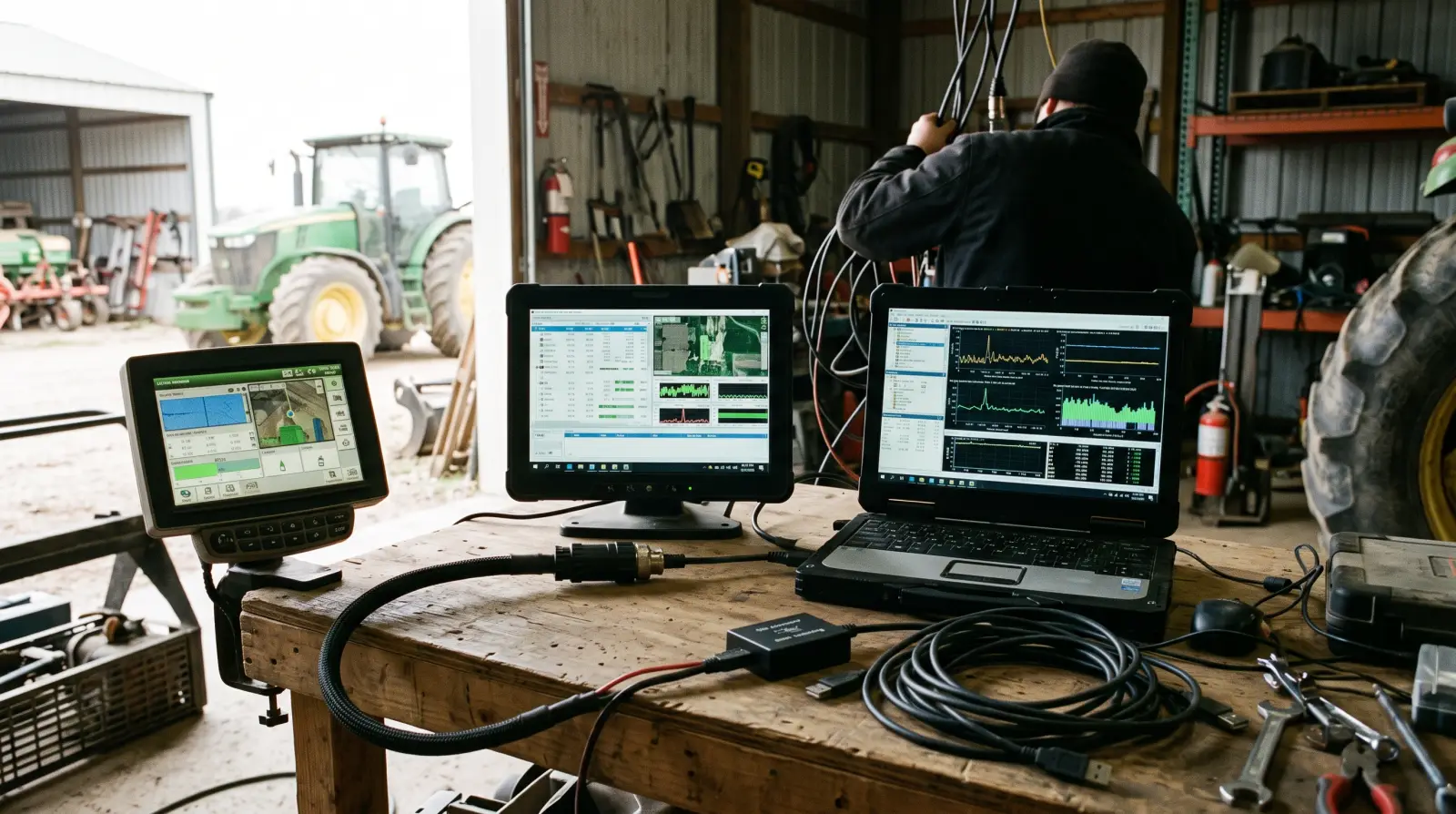
If you farm with more than one piece of technology - a guidance system, a yield monitor, an agronomy platform, a soil-sampling service - you have already run into the wall. Data lives in one brand's app, your agronomist uses another, your dealer pushes a third, and nothing talks cleanly to anything else. The result is hours of manual re-entry, prescription files that fail to load, and agronomic decisions made on partial information because pulling the full picture together is just too much work. This problem is not an accident. It is a consequence of how the ag-tech industry built itself over the past thirty years - around proprietary platforms designed to keep you inside one ecosystem. Understanding how farm software integration actually works, and where the leverage points are, lets you make better buying decisions, demand better contracts, and build a data workflow that actually serves your operation instead of the other way around.
Every major equipment and software vendor has a platform they want to be your hub. John Deere has the Operations Center. CNH (Case and New Holland) has AFS Connect and PLM Intelligence. AGCO, which covers Fendt, Massey Ferguson, and Challenger, has Fuse. Trimble has Ag Software. Climate FieldView sits across equipment brands but wants to be the agronomic layer you live in. Each of these platforms is genuinely capable. Each also has a business model that rewards keeping your data inside its walls.
The trap closes gradually. You buy a green tractor. The dealer sets you up on Operations Center because it connects to the machine telemetry natively. You buy the field computer that pairs with it. A few seasons in, you have boundary files, as-applied maps, and yield data all sitting in John Deere's cloud. When you look at buying an AGCO sprayer or a Trimble guidance upgrade, the question of what happens to your existing data becomes a real friction point. Switching platforms means migrating years of agronomic history - or starting over.
This is not unique to farm equipment. It is the classic platform lock-in pattern. But agriculture has a few features that make it worse than most industries: data formats are fragmented, standards adoption has been slow and uneven, and many smaller software vendors lack the resources to build and maintain integrations with every major platform.
The industry has known about the interoperability problem for decades, and several efforts have been made to solve it at the standards level.
ISOBUS and ISO 11783 is the hardware-level standard that lets implements communicate with tractors across brands. A Kinze planter talking to a Case tractor over ISOBUS is a genuine success story - the standard works well enough that you can plug in a third-party implement and get section control and rate control without proprietary cables or software bridges. ISOXML, which is part of the ISO 11783 standard suite, defines how task data - field boundaries, prescriptions, as-applied records - should be structured in files that travel between systems. In theory, you export an ISOXML file from one system and import it into another. In practice, every vendor's ISOXML implementation has quirks, optional fields that one platform fills in and another ignores, and unit conventions that differ just enough to cause problems.
ADAPT (Agricultural Data Application Programming Toolkit) is a more recent effort, driven largely by the Agricultural Industry Electronics Foundation (AEF) and a coalition of software vendors. ADAPT defines a common data model and a plugin architecture that lets different software systems translate their proprietary formats into a shared representation. If two platforms both have ADAPT plugins, data should flow between them without manual conversion. The toolkit is open source and available on GitHub. Adoption is real but uneven - the major platforms have engaged with it to varying degrees, and the quality of individual plugins varies.
AgGateway is the standards body doing the most consistent work on ag data interoperability. They maintain standards for everything from prescription file formats to supply chain data. Their ADAPT work, their contribution to ISOXML profiles, and their ongoing work on data exchange specifications are worth knowing about even if you never deal with AgGateway directly - their specs are what the better software vendors implement.
The honest summary: standards exist, they are better than nothing, and they are not good enough to make integration painless in 2026. You still have to do work.
When a software vendor says their platform has an API, they mean there is a programmatic interface - a set of URLs and protocols - that lets other software request or send data without a human logging into the web interface and clicking around. For farm software, APIs are how integrations between platforms get built: your precision ag software calls the equipment telematics API to pull machine hours and fault codes, or calls your agronomy platform's API to push a new variable-rate prescription.
Most modern ag platform APIs use REST over HTTPS, which is the same basic architecture as the APIs for payment processors and social media. Authentication is almost universally handled through OAuth 2.0 - you authorize a third-party app to access your account, it gets a token, and it uses that token on your behalf without ever seeing your password.
What varies enormously:
John Deere's Operations Center API is documented and accessible, but you go through an application process and Deere controls who gets access and on what terms. Climate FieldView has had developer API access available in the past, with similar application-gated access. Trimble has APIs that partners use. The pattern across the industry is: APIs exist, but they are not freely open in the way that a consumer web service's API might be. Vendors use API access as a business relationship lever.
For a working farmer, this matters because it determines what integration tools your agronomist, your custom applicator, or your grain elevator can build and maintain. If Deere restricts API access to approved partners, then only those approved partners can build clean automated integrations. Everyone else is back to exporting files and emailing them around.
Equipment telematics - the real-time and historical feed of machine location, hours, fuel use, fault codes, and operational data - has its own interoperability standard: AEMP (now formalized as ISO 15143-3). The AEMP telematics standard was originally developed by the Association of Equipment Management Professionals and defines a common data format for machine health and location data.
In theory, any telematics platform that implements ISO 15143-3 can pull data from any AEMP-compliant machine regardless of brand. In practice, the major OEMs support the standard to varying degrees and often provide richer data through their proprietary APIs than through the standard AEMP endpoint. John Deere's Operations Center, CNH's AFS Connect, and AGCO's Fuse all expose telemetry data - but the depth of that data and the terms under which you can export or redirect it differ.
Practical options for getting telematics data:
If you run a mixed fleet - which most operations over a certain size do - the realistic path is often a third-party fleet management layer that aggregates data from multiple OEM APIs, rather than trying to make the OEM platforms talk to each other directly.
Before getting further into APIs and standards, let's be direct about what most farmers are actually doing to move data between systems today: they are downloading CSVs and shapefiles and re-uploading them somewhere else.
This works. It is tedious, it introduces lag, and it creates opportunities for error - but it works, and knowing how to do it cleanly is a real skill.
Shapefile format is the oldest and most universally supported spatial format in agriculture. Field boundaries, as-applied maps, soil zones, and prescription layers almost universally export to shapefile. The gotchas are:
CSV exports from yield monitors and field computers carry similar risks: column naming conventions differ, coordinate formats vary (decimal degrees versus degrees-minutes-seconds), and missing or inconsistent null values cause import failures.
The practical discipline is: keep a simple log of what you exported from where, in what units, in what CRS, and what you did to it before importing. Future-you and your agronomist will thank you.
Between the raw file-export approach and full API integration lies a category of tools that exist specifically to bridge ag software platforms. These range from point-to-point connectors to full data aggregation layers.
Some precision ag software platforms position themselves explicitly as the neutral aggregator - they will pull data from your Deere account, your FieldView account, your soil sampling service, and your agronomist's platform into one place. Granular (now part of the AGCO/Trimble ecosystem) played this role for a period. Conservis, SST Software (now Trimble), and others have taken similar positions. The risk is that your "neutral" aggregator gets acquired by one of the branded platforms and stops being neutral.
A second category is the agronomic services platform that operates independently - companies like Proagrica or Ag Connections' SST that have built data bridges to many of the major platforms specifically to support agronomists and consultants who work across multiple equipment brands.
What to look for in any middleware layer:
The middleware category is genuinely useful but adds another vendor relationship to manage, another subscription to pay, and another potential point of lock-in.
Your agronomic data - the yield maps, the as-applied records, the soil samples tied to your specific fields - has real value. It describes the productivity and characteristics of land you may have farmed for decades. Downstream, that data has value to seed companies, ag lenders, land buyers, and commodity traders. The question of who owns it, and what they can do with it, deserves a direct answer before you sign any software agreement.
The American Farm Bureau Federation developed the Privacy and Security Principles for Farm Data in 2014, and most major platforms have signed on. The principles commit signatories to: telling farmers what data is collected, not selling data without farmer consent, and giving farmers the ability to retrieve and delete their data. But commitment to principles and contract language are different things.
What to read in any ag software contract:
Several major platforms have moved toward better language here, partly under pressure from farm bureaus and partly because it became a competitive differentiator. But the baseline varies enough that you should read before you sign, every time.
The most operationally critical integration in precision agriculture is between the prescription file you build in your agronomy software and the field computer that executes it. Getting this wrong means the wrong rates go down on the wrong zones - which is both economically costly and, for things like seed population, agronomically consequential.
The path from prescription to application typically looks like this: boundary file comes from your farm management system, variable-rate prescription is built in your agronomy software referencing soil zones and yield data, prescription is exported in a format compatible with the field computer or controller, field computer executes and records as-applied data, as-applied is exported and compared to the prescription in the agronomy platform.
Every hand-off in that chain is a potential failure point.
Common failure modes:
The fix for most of these is test and verify before you are in the field at planting. Run the prescription file through the field computer in a controlled setting, confirm the zones load correctly on top of your field boundaries, and confirm the rates look right before you move.
Before signing any new farm management system, precision ag software, or equipment telematics contract, get answers to these questions in writing - not from the sales rep verbally, but in the contract or in a written addendum.
On data ownership and portability:
On integrations and APIs:
On equipment compatibility:
On lock-in risk:
A vendor who pushes back on these questions or cannot answer them is telling you something useful about how they view your data relationship.
Given everything above, here is a realistic approach to managing farm software integration without waiting for the industry to solve interoperability for you.
Step 1: Audit what you have. List every software platform and hardware system that generates or consumes data on your operation. Note where each one stores data, what formats it exports, and whether it has an API. One page, done.
Step 2: Identify your critical data flows. Not every system needs to talk to every other system. The flows that matter most are usually: agronomic recommendations to field computers (prescriptions), field computers back to agronomy platforms (as-applied), yield monitor data to agronomy analysis, and equipment telemetry to maintenance tracking. Focus on getting those clean.
Step 3: Build a master copy discipline. Pick one platform as the authoritative record for field boundaries, and stick to it. Re-exporting boundaries from a master copy rather than letting different platforms accumulate slightly different versions of the same boundary prevents the coordinate drift and version confusion that quietly degrades data quality over seasons.
Step 4: Standardize on export formats. Where you have a choice, prefer ISOXML for task data (prescriptions and as-applied) and WGS84 shapefiles for spatial layers. These are the formats with the broadest import support across platforms.
Step 5: Document every data transfer. A simple spreadsheet or even a paper log: date, what was exported, from where, in what format, to where, and any conversions applied. When something breaks - and something will break - this log is how you diagnose it.
Step 6: Test prescriptions before fieldwork. Load every prescription file onto the field computer in a non-field environment and verify the zones display correctly before the planter or applicator is in the field.
Step 7: Renegotiate at renewal. Software renewal time is your leverage point. Ask specifically about export capabilities, API access, and data ownership language. The market is moving, slowly, toward better interoperability, and vendors respond to customers who ask pointed questions.
Farm software integration is genuinely getting better. The ADAPT framework has gained traction. AgGateway's work on standards is ongoing. Several precision ag platforms have improved their export tooling in response to farmer and agronomist demand. Equipment OEMs have incrementally opened up their APIs, partly in response to right-to-repair and data ownership pressure.
But the fundamental tension between interoperability and platform business models has not been resolved, and it will not be resolved by standards bodies alone. The practical reality for the next several years is that clean, reliable data flow between platforms will require active management on your end - knowing your formats, verifying your transfers, reading your contracts, and asking pointed questions before you sign.
The farmers who will handle this best are not necessarily the ones with the most technology. They are the ones who treat their data as an asset they manage deliberately, not as a byproduct of running software. Knowing what formats your data lives in, having the ability to export it completely, and understanding what rights you have granted over it - that is the foundation. Everything else, the APIs and the standards and the middleware, is infrastructure built on top of that foundation.
Start with the audit. Figure out what you have, where it lives, and what you can get out. The rest follows from there.
You should, but the contract decides it, not the sales rep. The American Farm Bureau Federation's 2014 Privacy and Security Principles for Farm Data commit signatory platforms to disclose what they collect, not sell data without consent, and let you retrieve and delete it. Read the ownership clause, license grant, and deletion timeline before signing, because a commitment to principles and actual contract language are different things.
The two dominant formats are ISOXML, part of the ISO 11783 standard suite, and shapefiles for spatial layers. Shapefiles carry a catch: field names are limited to 10 characters, so a column like AppliedRate_lbsPerAcre gets truncated differently between platforms and breaks imports. Prefer ISOXML for task data and WGS84 shapefiles for boundaries, since those have the broadest import support across systems.
Yes. The Operations Center API is documented and accessible, but you go through an application process and Deere controls who gets access and on what terms. For historical analysis you can also use the platform's native CSV exports and downloaded logs. Vendors across the industry treat API access as a business-relationship lever rather than an open consumer-style service.
Usually a naming or coordinate mismatch. The controller looks for a column named RATE or TARGET_RATE, and a file labeled VR_Nitrogen_lbsN gets skipped, running a flat default instead. Management zones built in a different coordinate reference system can also shift relative to the field boundaries. Load and verify every prescription on the field computer in a controlled setting before the planter is in the field.
Join our list for practical guides on farm tech, precision agriculture, and tools that work.