
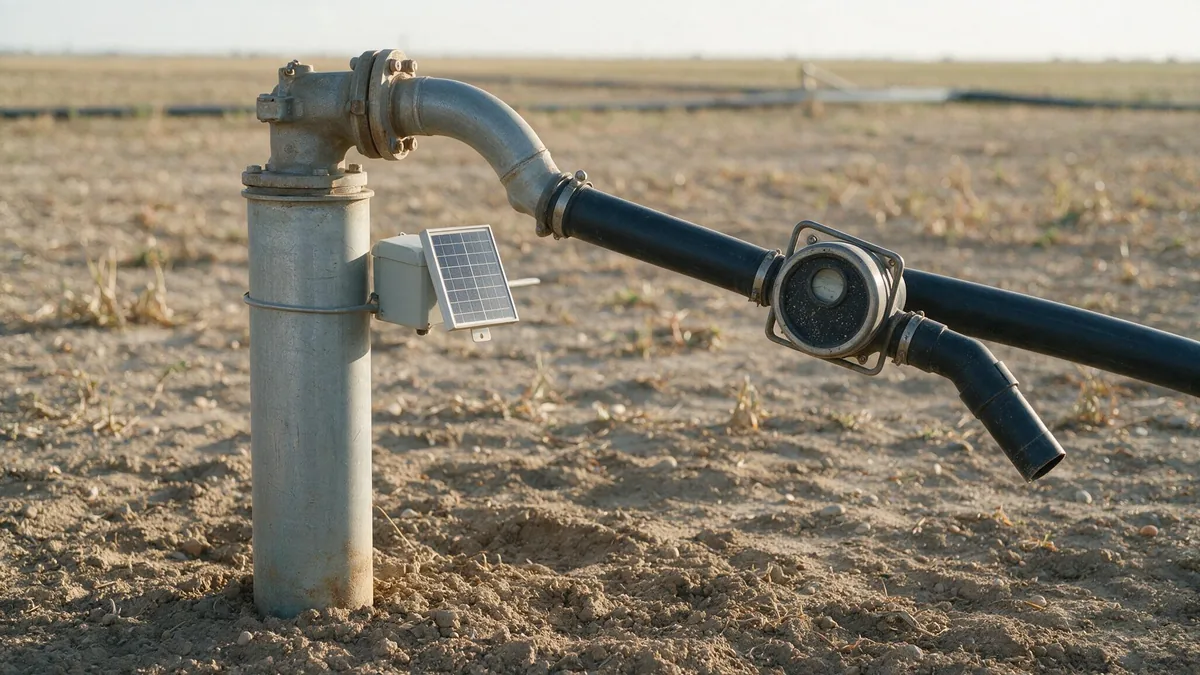
Remote well monitoring puts a pressure sensor down the borehole and a flow meter on the discharge, then reports two numbers over cellular or LoRaWAN: the water level in the well and how hard the pump works to hold it. Trended together, those two numbers warn you that a pump or an aquifer is failing weeks before an outage.
Most farmers only learn a well is in trouble the moment the tank runs dry or the pump quits. By then you are paying emergency-service rates and pull-the-pump money on the repair crew's schedule, in the middle of irrigation season, when every service truck in the county is already booked. The frustrating part is that the well was warning you the whole time. The warning just lived in two numbers nobody was watching.
This is about the water source itself, the hole in the ground, not the tank it fills. A float switch on a storage tank tells you that you are out of water. Well telemetry tells you why, and how soon. That difference is the whole argument.
To read the warnings, you need three plain-language terms. They are not complicated, and getting them straight is what separates a credible setup from a dashboard full of numbers you cannot act on.
A submersible pressure transducer sits in the well a few feet above the pump and reads the height of the water column above it. That is your water level. With the pump off, the level settles to the static water level - the natural resting level of the aquifer at that spot. Turn the pump on and the level drops as you pull water out faster than the formation refills the borehole; where it stabilizes is the pumping (dynamic) water level. The gap between those two is drawdown.
Static minus pumping is not the metric that matters. Drawdown is. A well that drops four feet to deliver 200 gallons a minute is a strong well. A well that drops forty feet to deliver the same 200 is working four times as hard for the same water, and something in that gap is telling you why.
There is a fourth term worth knowing: recovery. When you shut the pump off, the level climbs back toward static. How fast it recovers is another health signal, and a monitored well records it automatically every time the pump cycles.
Here is the number that turns a level chart into a maintenance decision. Specific capacity is pumping rate divided by drawdown - gallons per minute per foot. A well pumping 200 gpm with 40 feet of drawdown has a specific capacity of 5 gpm per foot.
On its own, that figure is just a spec. Trended over a season, it is the single best early-warning number a well produces, because it is exactly the metric a hydrogeologist uses to grade a well. Standard maintenance guidance is to measure static and pumping levels monthly and run a specific-capacity test at least twice a year. Continuous telemetry does that on its own, all day, every day, which is the entire pitch: you get the professional's metric without the professional's site visit.
Read the trend, not the snapshot. When specific capacity falls roughly 15 percent from your baseline, that is the accepted signal to schedule a cleaning or rehabilitation. Practitioners find that catching a decline early, in the 10 to 25 percent range, allows lower-cost cleaning with a high chance of success. Wait until capacity has collapsed by more than half and you are usually looking at permanent capacity loss, a new pump, or a new well.
That is why the single most valuable thing you can do is boring: baseline your best well now, before anything is wrong, so you have a real starting number to measure the decline against. A trend with no origin point is just a line.
Specific capacity flags that something is wrong. Level, flow, run time, and motor current together tell you what, and that distinction decides who you call and what it costs.
No single sensor separates those cases. Level alone cannot tell a fouling screen from a failing motor. The combination can, and that is why a useful setup measures more than just depth.
The pump and motor are the most expensive parts in the ground, and the fastest way to kill them is not drought. It is short cycling - the pump starting and stopping too often. Every start sends a heavy inrush of current through the motor, and rapid cycling wears out pressure switches, starters, relays, and capacitors while overheating the motor and stressing bearings and splines.
Submersible motors have a published maximum number of starts per 24-hour period, and that ceiling drops sharply as the motor gets bigger. A small fractional-horsepower motor tolerates far more daily starts than a large irrigation-size motor. Franklin Electric's guidance also sets a floor on the other side: a motor should run at least one full minute per start so the heat from that inrush current has time to dissipate. Monitoring starts and run time per day catches a pump that is cycling itself to death long before it fails.
Monitoring is only worth as much as what you do with it, which is where protection hardware pairs in. Controllers in the Franklin SubMonitor family protect three-phase motors against overload, underload (dry-run), overheating, and rapid cycling, and they include a well-recovery restart mode that waits for the aquifer to come back before trying the pump again instead of hammering a dry borehole. Variable-frequency drives such as the SubDrive line vary pump speed to hold pressure and soft-start the motor, which cuts the hard cycles that do the damage. Grundfos offers comparable protection and drive products. Name them as real options, then judge any specific "extends motor life by X" claim as the marketing it is.
Worth keeping straight: this article is about seeing the well. Actively controlling pump speed with a VFD is its own subject, covered in our guide to remote irrigation pump control with a VFD. Monitor first, automate second.
The stack that vendors actually field is modest and off-grid-friendly:
Established ag and water telemetry players in this space include Ranch Systems, AgriLynk, NightOwl Monitoring, and Valarm, with Franklin and Grundfos on the pump-control side. Those are starting points to evaluate against your own well, motor, and cell coverage, not endorsements.
A dashboard nobody checks is worthless, and a dashboard that pings all day trains you to ignore it. Configure a short list of alerts that each demand a decision:
Four alerts you trust beat forty you swipe away. Alert fatigue is a real failure mode; design against it from day one.
Honestly, the return is in avoided disasters, not a tidy line-item saving, so treat any vendor ROI figure with suspicion. The real payoff is straightforward: you skip the emergency call-out during irrigation season when crews are booked and rates are high; you catch a fouling screen while cleaning is cheap instead of after capacity has collapsed; you protect a five-figure pump and motor from short cycling and dry running; and you time maintenance on your calendar instead of the well's.
There is a compliance angle too. In many California basins under the Sustainable Groundwater Management Act, metering and reporting of groundwater use is now required, and the specifics vary by basin and by year. If you are already installing a flow meter to satisfy that, adding level and run-time monitoring on the same wellhead is a small step that turns a compliance cost into an operational tool.
The demand behind all of this is real but worth stating honestly. Parts of California's San Joaquin Valley sit among the world's fastest-declining aquifers, with some water tables down more than 100 feet since the 1960s, leaving wells that worked for decades suddenly failing. After the wet winter of 2023, though, 2024 groundwater storage rose and dry-well reports fell sharply from the 2022 peak. The picture is "still stressed, recently improved," not endless collapse. Which is exactly why the drought case should not be the reason you monitor. The always-true reason is reliability: a monitored well warns you of a failing pump or a fouling screen before an unplanned outage, drought or no drought.
Do not wire up the whole farm. Pick the most critical well - the one whose failure stops irrigation or empties the stock tanks - and put three signals on it: level, flow, and pump run time. Baseline its specific capacity this month so you have a real number to trend against. Watch it for a season. Once you trust the data and know which alerts matter on your operation, expand to the next well.
Monitor before you automate. Seeing the well clearly is what tells you whether automating it is even the right move.
For the water it feeds, our related guides cover wireless tank level sensors for above-ground storage, remote pond and dam monitoring for surface water, and water quality sensors for livestock and irrigation when chemistry, not quantity, is the question. If you want a hand scoping a monitoring setup for your own wells, our free farm water monitoring starter checklist walks through sensor placement and the handful of alerts worth setting up first - reach out and we will send it over.
Install a submersible pressure transducer a few feet above the pump to read water level, add a flow meter with a pulse output on the discharge line, and sense pump run time and motor current. A logger reports those over cellular or LoRaWAN to a phone app or dashboard, with threshold alerts for low level, no-flow, and excessive cycling.
Specific capacity is pumping rate divided by drawdown, measured in gallons per minute per foot. A well pumping 200 gpm with 40 feet of drawdown has a specific capacity of 5 gpm per foot. Trended over time it is the best early warning of a declining well; a drop of about 15 percent from baseline is the standard signal to schedule a cleaning.
Static water level is where the water sits when the pump is off, reflecting the aquifer's resting level. Pumping (dynamic) level is where it stabilizes while the pump runs and pulls water out. The difference between them is drawdown, and drawdown, not raw depth, is what you use to judge well performance.
Yes, when it watches level, flow, run time, and current together. Falling static level points to the aquifer. Growing drawdown while static holds points to a fouling well screen. Rising amp draw or stretching run time for the same gallons points to a wearing pump. A spinning motor with no flow means dry running.
Ongoing cost is low: a small solar panel powers an off-grid wellhead, and cellular or LoRaWAN data plans are inexpensive for the handful of readings a well sends. The harder cost to quantify is what it saves, from avoided emergency service calls to avoided pump burnout and better-timed maintenance, which is real but varies too much by operation to put a single number on.
Join our list for practical guides on farm tech, precision agriculture, and tools that work.