
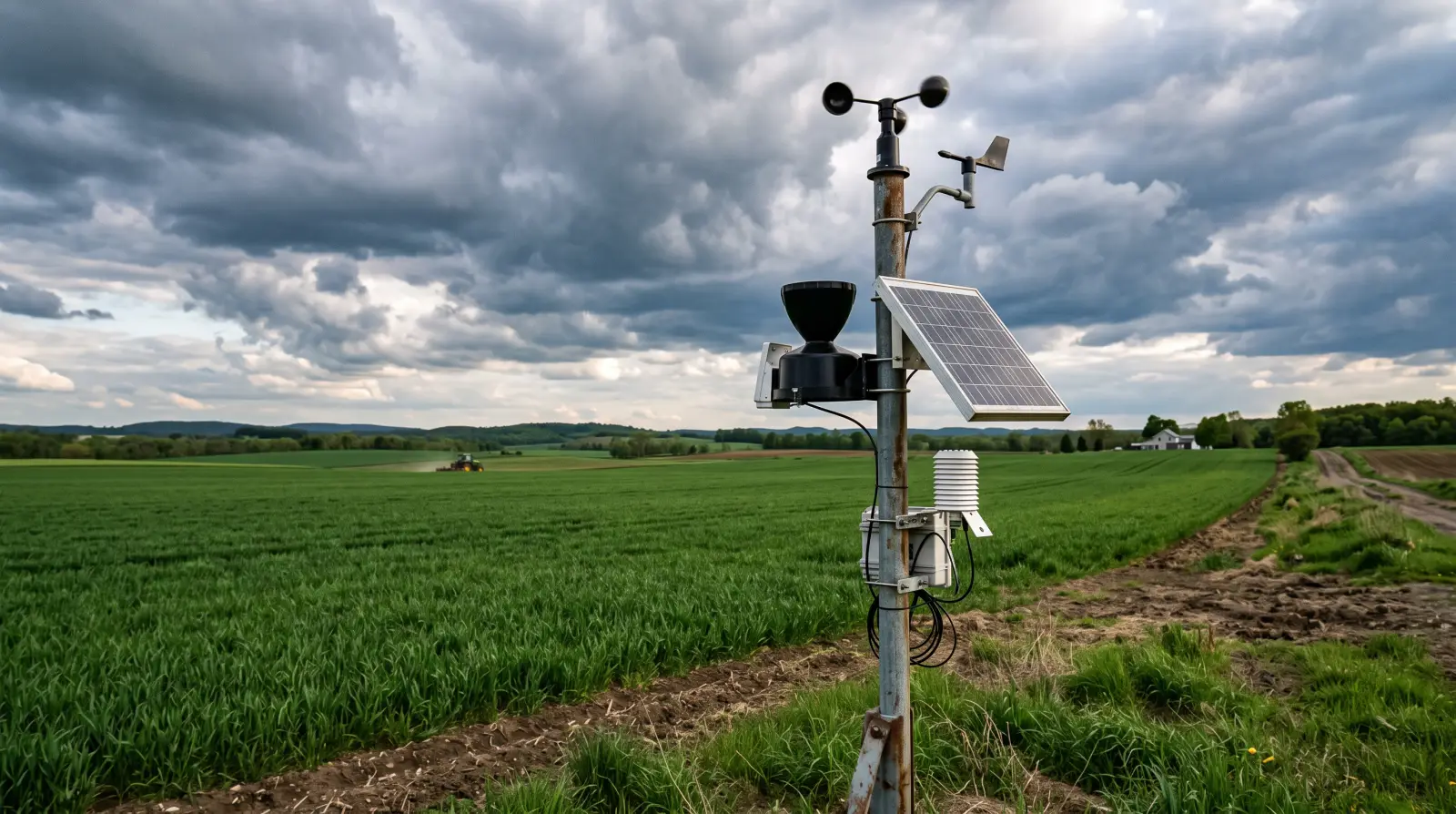
The nearest airport weather station is probably fifteen to forty miles from your fields. It sits on a mowed grass pad, surrounded by concrete, reporting conditions that have nothing to do with what is actually happening in your bottom ground, your hilltop, or your pasture on the other side of the ridge. If you have ever watched a thunderstorm track right across the radar and dump two inches on your neighbor while you got a quarter inch, you already know why farm-specific weather data matters. An on-farm weather station puts the sensor where the crop is. It tells you what the canopy felt, not what the regional station thirty miles away guessed at. Done right, it replaces a surprising amount of guesswork in spraying, irrigation, frost protection, planting windows, and record keeping. Done wrong, it becomes a $500 gadget that tells you what the sky already told you. This guide walks through what an on-farm station actually measures, which models are worth buying, where to put them, how to use the data for real decisions, and the maintenance routine that keeps the numbers honest.
The phrase "weather station" covers a huge range of hardware, from a $50 wireless thermometer to a $10,000 research-grade unit with a cellular modem. The sensors that matter for farming fall into a few clear categories, and the price of a station scales with how many of them it carries and how accurate each one is.
A good farm weather station covers the core sensors well and lets you add the specialty sensors you need. A great one makes the data easy to get into the tools you already use.
The difference between a $300 station and a $1,500 station is not marketing. It is sensor quality, radiation shielding, mounting hardware, data reliability, and how long the whole thing holds up in a field.
Cheap stations cut corners in a few predictable places. Their radiation shields are thin plastic stacks that get hot in summer and read high. Their tipping buckets are not calibrated from the factory and undercount heavy rain. Their anemometers use plastic bearings that wear out in a year. Their wireless links are short range and drop packets in bad weather, which is exactly when you need the data. Their data hosting is a consumer app that may or may not still exist in three years.
A mid-tier station - and this is the sweet spot for most farms - uses a proper aspirated or multi-plate radiation shield, a factory-calibrated rain gauge, sealed bearings on the anemometer, a data logger that stores readings locally if the uplink fails, and a published data export option so you are not locked into one vendor's app. Expect to spend $700 to $2,000 for a station in this class with a full core sensor package.
Research-grade stations, the kind that NOAA and university extension networks deploy, cost $5,000 and up, use laboratory-grade sensors, and are built for a 15-year service life. They are overkill for the average farm unless you are running precision variable-rate irrigation or feeding data into an insurance product that requires traceable accuracy.
The market has consolidated around a handful of serious vendors. The rest are either toys, research gear, or legacy hardware from companies that have moved on. Here is how the practical options shake out for farms.
The Vantage Pro2 has been the standard farm weather station for almost twenty years, and for good reason. The sensor suite is solid, the radiation shield is properly designed, the tipping bucket is accurate, and the console and software ecosystem is mature. A full Vantage Pro2 with the fan-aspirated radiation shield, a cabled solar radiation sensor, and a WeatherLink Live gateway runs around $1,400 to $1,800 depending on options. It uploads to WeatherLink.com and Weather Underground, exports to APIs, and integrates with dozens of agricultural software platforms. Parts are available for repair and the sensors are replaceable.
The Vantage Vue is the stripped-down version at around $400. It covers the core sensors with less accuracy and without any of the optional soil or solar add-ons. Good for a homestead or a backup station. Not the right choice for a farm that needs real agronomic data.
Ambient Weather has moved up the quality ladder in the last five years. The WS-5000 is their flagship and costs around $500 to $700 with a full sensor array. Accuracy is not Davis-grade but it is honest, the app is solid, the data exports are clean, and the hardware holds up. A good choice for a farm that wants real weather data without a four-figure investment and does not need specialty agricultural sensors.
Onset's HOBO line is where farms go when they outgrow consumer stations. The RX3000 is a logger platform that accepts a wide range of agricultural sensors - wind, rain, soil moisture, soil temperature, leaf wetness, PAR, and more. You build the station to match your crop. Expect $1,500 to $4,000 for a full build. The data flows into HOBOlink, which handles alerts, graphs, and exports cleanly to agronomy platforms. This is the right tool for specialty crops, vineyards, orchards, and any farm where disease modeling and irrigation scheduling drive real money decisions.
Campbell builds research-grade stations on their CR-series loggers. These are the stations that sit on ag research plots, in state mesonets, and in high-end commercial operations. Expect $3,000 to $10,000 per station and a real learning curve on the datalogger programming. You do not buy Campbell unless you need that level of accuracy, traceability, and long service life. Most farms do not. But if you are running research trials, insurance-grade data, or irrigation contracts that depend on verifiable numbers, Campbell is the standard.
Rainwise has been making farm weather stations in Maine for decades. The Mark III is a solid, hard-nosed station that holds up in coastal weather and cold climates. Not as feature-rich as Davis or Onset, but built for abuse. Around $1,200 to $1,800 depending on options.
Spectrum is squarely aimed at agriculture. Their WatchDog stations handle crop-specific needs - cumulative degree days, chill hours, leaf wetness, soil moisture, evapotranspiration - out of the box. Pricing is similar to Onset, and the SpecConnect software is built around agronomy rather than general weather. A good choice for growers who want a station that speaks their language from day one.
Sensor placement is the single biggest factor in whether the data is actually useful. Most bad weather station data comes from bad placement, not bad hardware. Here is how to get it right.
Mount the temperature sensor five feet above a short grass surface, away from buildings, paved surfaces, and large heat masses. The radiation shield should be oriented so the prevailing wind can ventilate it. Do not mount it on the side of a barn, in a tree line, or over gravel. Do not mount it in the middle of a soybean canopy either - that gives you canopy temperature, not ambient air temperature. The standard recommendation is a ten-foot clearance from any vertical obstruction at least as tall as the sensor.
If your primary use is frost warning for a specific orchard block or low ground, then place a dedicated temperature sensor in that block at canopy height. That is a secondary station, not your main one. Frost pools in low ground, so the coldest spot on the farm is often a frost pocket that can be ten degrees colder than the ridge. Track that separately.
A tipping bucket rain gauge needs a clear overhead view with no overhanging obstructions. The general rule is that any obstruction should be at least twice as far away as its height above the gauge. Mount the gauge level - out of level gauges undercount. Heated gauges need power and should be placed where they can reach an outlet or a solar panel sized for winter operation.
Wind sensors belong at least ten feet above any nearby obstruction. Most on-farm stations mount the anemometer on a pole at thirty-three feet, which is the standard reference height for weather data. Lower mounts read lower wind speeds, which matters for spray decisions. If you mount your anemometer at six feet next to a windbreak, you are not measuring the wind that matters for a boom sprayer working in open ground.
Mount the pyranometer level and with an unobstructed view of the southern sky. Shadows from trees, buildings, or even the mounting pole will wreck the numbers during part of the day. This is one sensor where bad placement makes the data actively misleading.
Place soil probes in ground that represents the field, not the edge. If your field has three main zones, you need three probes or you need to accept that you are measuring one of them. Bury the probes at the depths you care about - two inches for seed zone, four for root development, eight to twelve for water management - and mark the location with a flag so no one runs a disk over them.
The main station belongs in an open area that represents your farm climatically. That usually means a fenced-off weather pad, ten feet on a side, in open grass with nothing taller than knee high within thirty feet. It should be close enough to the house or shop that you can reach it with a ladder and a laptop, but far enough that heat from buildings does not contaminate the data. On a diversified operation, one well-placed central station plus one or two satellite temperature and soil sensors in critical blocks covers the whole farm.
Collecting weather data is pointless if you never look at it. The difference between a station that earns its keep and a station that becomes yard ornament is whether the data flows into the decisions you are already making.
Wind speed, wind direction, humidity, and delta T (the difference between air temperature and wet-bulb temperature) drive spray decisions. Delta T above 10 degrees Celsius means your spray is evaporating before it hits the target. Below 2 means the spray is hanging in the air and drifting further than you want. Most spray labels define acceptable wind limits and temperature inversions, and a weather station is the only way to actually know whether you are in bounds. Keep the last seven days of station data accessible from the sprayer seat - some apps plot it on a phone, and some stations have a dedicated console that sits in the shop.
Rainfall, evapotranspiration, solar radiation, and soil moisture drive irrigation decisions. A station with a pyranometer and temperature sensor can calculate reference ET using the standardized Penman-Monteith equation, and most weather software does this automatically. Compare ET against rainfall and soil moisture to figure out when the crop is running short. A good station plus a couple of soil moisture probes will save more water than any amount of guessing, and on a pivot or drip system it will pay for itself in the first full season.
Leaf wetness, humidity, and temperature feed directly into disease models for fire blight, late blight, apple scab, grape downy mildew, and dozens of other crop-specific problems. If you grow apples, grapes, potatoes, or tomatoes, a station with a leaf wetness sensor is not a luxury - it is the difference between spraying on a calendar and spraying when the model says the risk is real. Spraying on a calendar is almost always either too much or too late.
A frost pocket temperature sensor with text alerts at, say, 34 degrees lets you start wind machines, irrigation, or frost fans before the damage happens. A good frost alert pays for the whole station once.
Growing degree days drive planting dates, pest scouting windows, pollination timing, harvest predictions, and more. Most stations calculate GDDs automatically from daily minimum and maximum temperatures, using whatever base temperature you set. Having GDDs pulled from your own farm rather than the airport station fifteen miles away makes a real difference when you are timing a fungicide or a harvest.
Your station data is also a legal record. Crop insurance adjusters, organic certifiers, and drift complaint investigators all want to know what the weather was. Having your own records - time-stamped and exported cleanly - can save you in a dispute. Choose a station whose data you can export in a standard format, keep nightly backups, and store at least three years of history.
A weather station is a field instrument, which means it gets dirty, gets moved by wildlife, gets hit by hail, and drifts over time. A few minutes of maintenance a few times a year keeps the data honest.
Calibration drift is subtle. A sensor that reads two degrees high looks fine day to day but wrecks your GDD numbers over a season. If your station data ever starts disagreeing with the regional airport data by more than the local climate justifies, it is time to pull the sensor and check it.
A station that logs data locally but never uploads is fine if you are disciplined about pulling the data by hand. Almost no one is. The real value shows up when data streams into a cloud platform that you can check from a phone at 5 a.m. when you are trying to decide whether to spray.
Wi-Fi is cheapest and easiest if your station is within a few hundred feet of the house. Point an external antenna at it, or use a mesh extender to bridge the gap. The drawback is that Wi-Fi drops out when power blips, and Wi-Fi coverage does not extend to the back forty.
Cellular is the right choice for stations that are not near the house. Most serious ag stations offer an optional cellular modem. Pick a station that supports either LTE-M or NB-IoT, because older 3G and 2G cellular is shutting down. Data usage is tiny - maybe a few megabytes a month - so a cellular plan runs $5 to $20 a month per station.
LoRa and LoRaWAN are worth knowing about. These are low-power long-range radio networks that let a base station near the house talk to sensors miles away, on a single battery that lasts years. If you want soil moisture probes in twelve fields and a single central station at the farmstead, LoRa is the technology that makes that affordable. It is still a somewhat DIY space, but Onset, Campbell, and several smaller vendors now offer LoRa gateways for agricultural deployments.
Local-only stations with no network uplink still have a place. A datalogger that you download monthly with a laptop gives you the full dataset and does not depend on a vendor's cloud surviving. Some farms pair a connected station with a local-only backup logger for exactly this reason.
Here is the honest math on a farm weather station.
A $500 consumer station will give you basic air temperature, humidity, rain, and wind that is better than airport data but not good enough to feed into a disease model or an ET calculation. It pays for itself in better frost warnings and spray decisions, probably in the first season.
A $1,500 mid-tier station with a radiation sensor, soil temperature, and reliable data export is the minimum you should consider if you are trying to run real variable-rate irrigation or disease modeling. Payback comes from reduced spray passes, better irrigation timing, and fewer missed planting windows. On an irrigated farm, a station at this level often pays back in a single season by saving one or two unnecessary irrigation passes.
A $3,000 to $5,000 station with leaf wetness, soil moisture at multiple depths, and cellular uplink is the right choice for orchards, vineyards, and high-value specialty crops. Payback comes from spray programs that go from calendar to model-driven, which typically cuts fungicide applications by 20 to 40 percent without increasing disease risk.
Above that, you are buying research-grade instruments, which make sense only if the data has a specific use that justifies the cost - regulated agriculture, insurance contracts, or multi-farm research.
Whatever you buy, budget for a spare temperature-humidity sensor and a spare tipping bucket mechanism. These are the two components most likely to fail, and you do not want to be waiting two weeks for a replacement during the month you need the data most.
The stations that disappoint farms almost always have one or more of these problems.
A farm weather station is one of the few pieces of technology that pays back fast on almost any operation, because it replaces guessing with measuring in decisions that already happen every day. Spray timing, irrigation scheduling, frost protection, disease management, planting windows, harvest prediction - all of them get better when the data comes from your field instead of an airport thirty miles away. The key is to buy a station that matches what your farm actually needs, place it where it can read the air the crop breathes, maintain it like you maintain a planter, and integrate the data into the tools you already use to run the farm. Start with the decisions you are making blind right now and buy the sensors that turn those decisions into measured ones. Everything else is a bonus.
Wind sensors belong at least ten feet above any nearby obstruction, and most on-farm stations mount the anemometer at thirty-three feet, the standard reference height for weather data. A sensor mounted at six feet next to a windbreak reads low and misleads spray decisions, because it is not measuring the wind a boom sprayer actually meets working in open ground.
A $500 consumer station beats airport data but is not accurate enough to feed a disease model or an evapotranspiration calculation. A $1,500 mid-tier unit with a solar radiation sensor and soil temperature is the minimum for real variable-rate irrigation. Orchards and vineyards that need leaf wetness, multi-depth soil moisture, and a cellular uplink run $3,000 to $5,000.
Yes. A station with a leaf wetness sensor feeds disease models for apple scab, fire blight, late blight, and grape downy mildew, letting you spray when the modeled risk is real instead of on a calendar. Growers who move from calendar-based to model-driven programs typically cut fungicide applications by 20 to 40 percent without increasing disease risk.
Clean the radiation shield, pyranometer, and rain gauge funnel monthly, since wasp nests in the gauge are the most common cause of zero rainfall readings during the month you needed the data. Replace transmitter and console batteries every six months, calibrate the rain gauge yearly with a known water volume, and swap the humidity chip every three to five years.
Join our list for practical guides on farm tech, precision agriculture, and tools that work.