
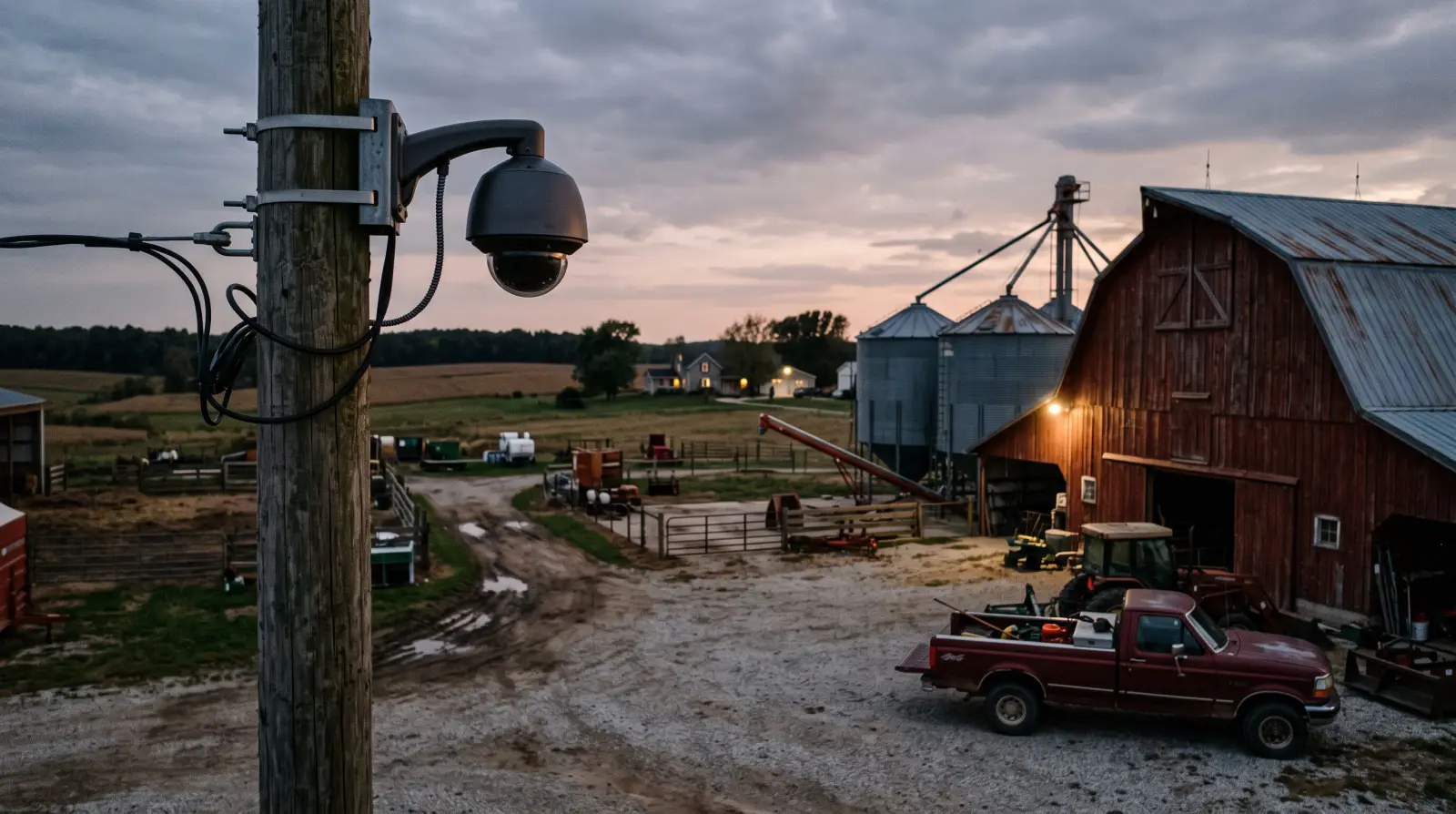
A doorbell camera works great on a porch. It has an outlet three feet away, your house Wi-Fi pours straight through the wall, and someone is usually home to hear the chime. None of that is true on a farm. The spots actually worth watching - the diesel tank by the shop, the equipment yard, the back gate, the machine shed at the far fence line - are exactly the spots with no power outlet, no Wi-Fi signal, and nobody within earshot at three in the morning.
That single fact should drive every camera decision you make. Forget picture quality for a minute. The first two questions at any spot you want to cover are: can I get power here, and can I get a signal here? Answer those, and the rest of the buyer's-guide noise sorts itself out. So let's take a walk around the yard, location by location, and answer those two questions at each stop.
Pull up a typical "best farm security camera" list and you'll get a ranking of products by megapixels and night-vision range. That's the wrong order. A 4K camera with a beautiful sensor is useless on a gate post 600 feet from the nearest outlet if you can't keep it powered and can't get the footage off it.
Walk your operation and you'll find your high-value targets cluster in the hardest places to wire: the entrance every vehicle passes through, the yard where the tractors and implements sit, the shop and sheds, the fuel tank, livestock pens, the water supply, and the private access roads. Independent buyer guides land on nearly the same list every time. They're remote, unpowered, and out of router range. So we pick the camera to fit the spot, not the spot to fit the camera.
There are three ways to keep a camera running, and the one you can manage at a given spot narrows your choices more than any spec on the box.
Power over Ethernet (PoE), wired. One Ethernet cable carries both power and video. This is the gold standard: it records 24/7, there's no battery to die in a cold snap, and it's about as reliable as cameras get. The catch is the leash. A PoE run goes roughly 100 meters, about 328 feet, before you need a switch or an extender to keep going. Great for the shop, the yard, anything within cable reach of the house or a powered building. Not an option for the back forty.
Powered Wi-Fi. Plug it into an outlet, talk to your Wi-Fi. You get 24/7 recording without pulling Ethernet, but you need both a nearby outlet and a Wi-Fi signal strong enough to hold a video stream. On most farms that combination only exists close to the house and the main shop.
Battery plus solar. This is what makes the far corners possible. A wire-free camera with a built-in battery and a small solar panel can sit on a gate post or a fuel tank with no wires at all. Most wire-free cameras only draw about 5 to 10 watts, and a modest panel keeps the battery topped up through normal weather. If you're building a dedicated off-grid IP camera setup rather than buying an all-in-one, a common recipe is something like a 50 to 100 watt panel, a 100Ah 12V LiFePO4 battery, and a charge controller for continuous running. Exact sizing depends on the camera's draw, your latitude, and how much it records, so treat those numbers as a starting point, not a guarantee.
Rule of thumb: wire it with PoE if you can reach it, and go battery-and-solar only where you genuinely can't.
Power keeps the camera alive. The connection gets the video to you. Again, three options.
Wired Ethernet is best when it's available, for the same reason PoE wins on power: nothing to drop, nothing to die.
A Wi-Fi bridge extends your existing farm network out to a pole, a shed, or a gate. Plenty of farmers run a point-to-point or mesh link with Ubiquiti-type gear, sometimes solar-powered, to push the network across the yard to a building that's just out of normal router range. If a spot is close to reach but not quite there, bridging is cheaper and more reliable than going cellular.
4G LTE cellular is for anywhere the network simply does not reach. The camera has its own SIM and sends video over the cell network. The thing to check before you buy: pick a camera that supports multiple carriers - AT&T, Verizon, T-Mobile - so you can run whichever one actually has bars at that corner of the property. Signal at the house tells you nothing about signal at the far gate.
So: wire it if you can, bridge Wi-Fi if you can almost reach it, and go cellular only where neither will.
This is where buyers get burned, so here's the honest version.
A wired PoE-to-NVR system records locally with no monthly fee. You pay once for the network video recorder and a hard drive, and that's it. Entry-level NVRs start around $500, and you'll replace the hard drive every three to five years. That's the cheapest path over time, full stop.
Many battery and Wi-Fi cameras can record to a microSD card or a local NVR with no mandatory cloud plan - but the brands push a cloud subscription hard for off-site backup, and the cheaper the camera, the harder the push. Read the box: "records to microSD, no subscription required" is the phrase you want.
Cellular cameras always need a data plan. There's no way around it; the camera is using the cell network. The market broadly sits around $5 to $15 per camera per month. Some carriers will add a camera as a connected device for around $5 a month; dedicated services like Moultrie Mobile run around $10 a month; trail-camera plans range from a couple of dollars for limited photos up to roughly $13 a month for unlimited. None of those are huge numbers on their own, but multiply by several cameras and twelve months and it adds up - so budget the recurring cost into the decision, and keep anything on a wire or a Wi-Fi bridge off the monthly meter.
Farmers conflate these two, and they're different tools for different jobs.
A cellular security camera - think Reolink Go and Go Plus, or the eufy 4G S330 - streams live video on demand. You can pull it up on your phone, talk through it, get person and vehicle detection, and on some models pan and tilt to follow movement. That's what you want on the high-value core: the yard, the shop, the fuel tank.
A cellular trail camera - Tactacam, Moultrie Mobile, Stealth Cam, Spartan, Campark - is built to hide, sip battery for months on an 8,000 to 10,000mAh pack plus solar, and fire a still photo to your phone when something moves. It's not for watching live; it's a cheap, concealed tripwire. Tuck one on a back gate or a field approach where all you need to know is "someone is here right now," and you've covered an edge of the property for very little money.
Trail cams for covert motion alerts at the edges. Security cams for live eyes on the core. Use both.
Every vehicle that comes onto the place passes through one chokepoint - the main gate or driveway. That's the one spot where it's worth spending up for a specialized camera: an ANPR or LPR unit, automatic number or license plate recognition.
A normal camera at the gate gives you a glare-blurred rectangle where the plate should be, especially at night against headlights. An ANPR camera is purpose-built to capture and read a plate, day or night, even on a moving vehicle. Many record locally to microSD, a PC, or an NVR with no per-read recognition fee. They cost more and they're fussier to mount - you need the right angle, the right distance, and the infrared tuned for headlights - but at the one gate every truck passes, a readable plate is worth more than ten pretty pictures of the wrong angle.
A camera on the diesel tank tells you who and gives you evidence. It doesn't stop the siphon. Fuel is the rural crime farmers worry about most - in NFU Mutual's reporting, 49% of farmers named fuel theft as their top concern - and a determined thief can move a lot of diesel in well under an hour. So the tank gets a layered setup, with the camera as one piece:
The camera documents it; the sensor and anti-siphon hardware flag or slow it as it happens. Pair them. (We've covered the fuel-protection side in more depth in our diesel-theft piece - this is just where the camera fits into it.)
Be clear-eyed about this, because the marketing isn't. Cameras give you four real things:
What they do not do: physically stop a determined thief, work without a power and data path you actually maintain, or replace gates, locks, lighting, and good habits. A camera is detection, evidence, and deterrence - not a force field. Anyone who sells it as theft prevention is overselling it.
You don't have to wire the whole operation in a weekend. A practical first pass:
That's eyes on your three highest-value spots and a tripwire on the edge, mostly recording locally with one small cellular plan. Scale from there as you learn where the gaps are.
One last note, lightly: aim cameras at your own ground, and check your local rules before you record audio or point anything past your fence line.
If a yard-by-yard plan for your own place would help, that's exactly the kind of thing we work through on the Manley Farms blog - tell us which corner is giving you trouble and we'll dig into it in a future piece. Wire what you can, watch the rest, and put the right eyes on every gate before you need the footage rather than after.
Not always. A wired PoE-to-NVR system records locally with no monthly fee; entry-level recorders start around $500 and you replace the hard drive every three to five years. Many battery and Wi-Fi cameras record to a microSD card with no cloud plan required. Only cellular cameras always need a data plan, which broadly runs $5 to $15 per camera each month.
A single Power over Ethernet cable carries both power and video roughly 100 meters, about 328 feet, before you need a switch or extender to keep going. That reach covers the shop and yard within cable distance of a powered building, but not the back forty. Beyond it, a battery-and-solar wire-free camera drawing 5 to 10 watts is the practical answer.
Use a wire-free camera with a built-in battery and a small solar panel. Most wire-free cameras draw only 5 to 10 watts, so a modest panel keeps the battery topped through normal weather. For a dedicated off-grid build, a common recipe is a 50 to 100 watt panel, a 100Ah 12V LiFePO4 battery, and a charge controller for continuous running.
An ANPR or LPR camera, for automatic number or license plate recognition, is purpose-built to capture and read a plate day or night, even on a moving vehicle. A normal camera at the gate usually returns a glare-blurred rectangle against headlights. Many ANPR units record locally to microSD, a PC, or an NVR with no per-read recognition fee.
Join our list for practical guides on farm tech, precision agriculture, and tools that work.