
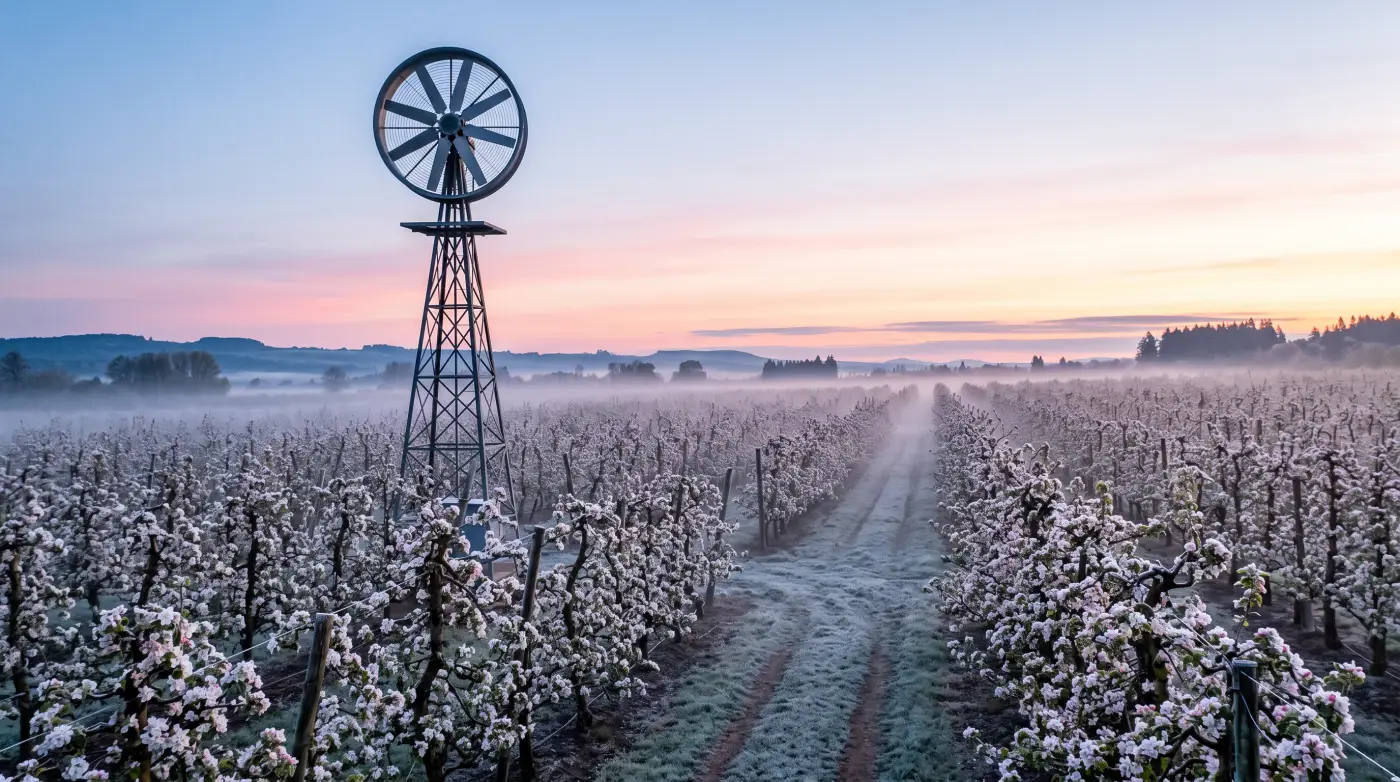
A single cold night in the wrong week can erase a year of work in an orchard, a vineyard, or a strawberry field. The blossoms that were going to be the fruit crop get killed in a few hours, the canopy survives, and the operator spends the rest of the season looking at trees and vines that grew leaves but produced almost nothing. The financial shape of a frost loss is brutal because nearly all of the year's input cost is already spent by the time bloom happens - the pruning, the fertilizer, the irrigation, the labor - and the revenue side of the year evaporates in one event. The technologies that exist to prevent that outcome have improved substantially over the past two decades, and the cost-benefit calculation has shifted in favor of active protection for a much wider set of operations than it used to make sense for. This guide is the working version of what the protection options actually do, what they cost, what they fail at, and how the forecasting and sensor side has reshaped the decision of when to turn anything on at all.
The damage from a frost event is not from cold air touching the plant. The damage is from ice forming inside the plant tissue, which ruptures cell walls and kills the affected part of the plant. This distinction matters because it determines what temperature is actually dangerous for a given crop at a given stage, and that temperature varies by an enormous range. Dormant fruit trees in winter routinely survive temperatures well below zero with no damage because the water inside the tissue is bound up in ways that resist ice formation. The same tree two months later, at full bloom, is in catastrophic trouble at 28 degrees because the open flowers have free water and no cold-hardening at all. The pattern across most fruit crops is that hardiness drops by twenty or thirty degrees over the course of bud development, with the most sensitive stage running from late bloom through small green fruit.
The published critical temperatures are well-documented for the major crops and worth keeping in front of any operator making spray decisions. For apples, the critical temperature at which ten percent of flowers are killed runs from about 25 degrees at tight cluster down to 28 degrees at full bloom and 28 degrees at petal fall, with the 90-percent-kill temperature about four degrees colder. Sweet cherries are roughly the same shape but slightly more sensitive at bloom. Pears track close to apples. Stone fruits are generally more vulnerable than apples through the bloom stages. Wine grapes that have pushed buds and shown one to three inches of new growth are damaged at 30 to 31 degrees, which is a remarkably narrow window. Blueberries during open bloom are damaged at about 28 degrees. Strawberry blossoms with open flowers are damaged at 30 degrees.
The narrowness of these windows is what makes the decision so consequential. The difference between a normal cold night that does no damage and a frost event that kills the crop is often three or four degrees of air temperature for an hour or two. An operator who is off on the timing of bloom by a week, who reads the forecast wrong, who underestimates how cold a particular block gets in a cold-air pool, or who waits too long to fire up the equipment, loses the difference. The technologies that work best are the ones that buy that three or four degrees reliably, not the ones that promise huge temperature lifts that they cannot deliver.
The second piece of the physics that the protection options depend on is the distinction between radiation frost and advection frost. A radiation frost happens on a clear, calm night when the ground and the plants lose heat to the open sky faster than they receive it, and the air immediately above the ground gets colder than the air above it - the inversion. The cold layer is typically a few feet to a few dozen feet thick, with warmer air sitting on top of it. Most spring frost events that damage orchards in temperate climates are radiation frosts. An advection frost, by contrast, happens when a mass of cold air moves into the area, often with wind, and there is no inversion - the air is cold from the ground up to the clouds, and there is no warmer layer to mix down. Advection events are much harder to protect against because most of the mainstream protection technologies depend on the inversion existing.
The wind machine is the technology that protects more orchard acres in the United States than any other single approach, and the reason is that radiation frosts produce strong inversions that wind machines exploit very efficiently. The basic design is a large propeller, typically 18 to 22 feet across, mounted on a tower 30 to 35 feet tall, driven by an engine - usually propane, sometimes natural gas, occasionally diesel or electric - and aimed at a slight downward angle to push air across the orchard floor. The propeller rotates slowly relative to a helicopter blade, around 500 to 700 rpm, and the head of the machine rotates a full circle every four to five minutes, so the airflow sweeps across the protected area on a slow cycle.
The way a wind machine actually adds heat is not by blowing warm air into the cold area from outside. The machine works because the inversion is sitting right there, with warmer air typically 30 to 60 feet above the cold layer, and the propeller mixes the two layers together. The resulting blended air at canopy height is several degrees warmer than the cold layer that was there before. The temperature lift varies with the strength of the inversion, but a typical event with a five-to-eight-degree inversion will deliver a two-to-four-degree lift to the protected area. That lift is exactly the size of what most events actually need.
Coverage per machine varies with terrain, inversion strength, and orchard layout, but a common design value is about ten acres per machine on relatively flat ground with a normal inversion. Hilly terrain, complex canopies, and weaker inversions push the per-machine coverage down. Stronger inversions and very flat terrain push it up. The machines are typically spaced on a grid pattern designed to give overlapping coverage so that no part of the orchard is unprotected when one machine is at the far point of its rotation.
The capital cost of a wind machine has come down somewhat in real terms over the past decade but is still significant. Installed cost in 2025 dollars runs from about $30,000 to $45,000 per machine depending on the engine, the tower height, and the installation complexity. The propane consumption during a protection event runs around 8 to 12 gallons per hour per machine, which at 2025 propane prices is roughly $25 to $40 per hour per machine. A typical protection event of six to eight hours on a half dozen machines is several hundred dollars in fuel plus the engine wear. The annual maintenance, mostly engine service and gearbox attention, is a few hundred dollars per machine.
The economic case is straightforward in any crop where one prevented frost loss pays for the installation. For a block of fruit that grosses $15,000 to $30,000 per acre at full production, a single event prevented on a 40-acre block pays for the four to five machines that would protect it. Operations that get hit by a frost event every three to five years and could have saved most of the crop with wind machines are usually well past the financial break-even on the equipment.
The limitations are real and worth taking seriously. Wind machines do almost nothing on an advection frost, because there is no warmer air aloft for the propeller to mix down. They do little on a clear cold night without a strong inversion, which is rarer but happens. They have a noise impact that has become a significant issue in suburbanizing fruit-growing areas, with several jurisdictions imposing limits or requiring quieter machine designs. And they are not effective protection for crops that are very low to the ground - strawberries and bush blueberries get only partial benefit because the propeller is moving air above the canopy, and the heat exchange to ground-level plants is limited.
The newer electric and hybrid wind machines have started showing up in California and Washington in the past few years, driven by air-quality regulations and by the long-run economics of avoiding propane delivery infrastructure. These run on three-phase grid power, with much lower operating cost per hour but a higher installation cost and the requirement of grid capacity at each tower site. For operations with adequate grid service, the lifetime economics often favor the electric machines now, especially in jurisdictions where propane permits have become harder to renew.
Burning fuel to heat an orchard during a frost event is the oldest active protection method and is still in use, though much less than it was fifty years ago. The classic smudge pot - a metal can full of low-grade fuel oil, lit and placed every few rows - has mostly disappeared because of air quality rules, but propane and natural gas orchard heaters are still in service in some operations. The current generation of heater is a more efficient burner mounted on a fuel line, typically distributed at one heater per quarter or third of an acre, producing a few thousand BTUs per hour each.
The way heaters add heat is direct - the combustion produces a hot exhaust plume that warms the air immediately around the heater and contributes to a general lift across the orchard. The lift varies with heater density and weather conditions, but a well-designed heater system can deliver a three-to-five-degree temperature increase over a wide area. Heaters have one important advantage over wind machines: they work in conditions where wind machines do not, including advection frosts and weak inversions, because they are adding heat to the air rather than redistributing existing heat.
The disadvantages are also large. The fuel cost is substantial - propane consumption across a fully heated orchard runs several gallons per acre per hour, which at current prices is hundreds of dollars per acre per event. The labor required to light and monitor a heater system is real, even with automated ignition systems. The air quality impact is significant enough that some jurisdictions have effectively banned the practice. And the carbon and energy intensity of the approach is at odds with where most operations are trying to go on energy management.
The current pattern in the industry is that heaters are used as supplementary protection for wind machines in marginal blocks where the inversion is sometimes too weak for the machines alone, or in microclimates that the machines cannot adequately cover. The combination of wind machines as the primary defense and a small number of heaters in the trouble spots is often more cost-effective than scaling up either approach alone.
The sprinkler approach to frost protection exploits a different piece of physics: when water freezes, it releases the heat of fusion as it transitions from liquid to ice. As long as liquid water continues to be supplied to the plant surface, the ice that forms stays at 32 degrees, and the plant tissue under the ice is held at that temperature regardless of how cold the air around it gets. The technique works remarkably well in the right circumstances and is the dominant protection approach in some industries, most notably the Florida strawberry and citrus industries.
The mechanics require continuous water application throughout the cold period. The sprinkler heads are usually impact rotors on a permanent or semi-permanent overhead system, set to deliver about a tenth of an inch per hour across the entire protected area. They cycle on a one-to-two-minute pattern so that every point on the plant is hit by water at least every two minutes throughout the event. The instant a plant surface goes from wet to dry while still below freezing, the protection is lost and the plant temperature crashes back to air temperature.
The water requirement is the main constraint and the main cost. A tenth of an inch per hour over a 40-acre block for an eight-hour event is roughly 870,000 gallons of water, or about 100 gallons per minute of continuous flow capacity for the duration. The well, the pumps, and the distribution system have to be sized for that flow, and the underlying water right or water permit has to allow it. Operations with adequate water can run sprinkler protection at a small fuel cost - just the pump energy - which is dramatically cheaper than the heater or wind machine alternatives. Operations without water capacity simply cannot use this approach regardless of how attractive the economics look.
The other constraints are real. Sprinkler protection produces a tremendous amount of ice on the trees, which can break limbs if the ice load gets too heavy. Operations using this approach typically design their training systems and pruning strategies to tolerate the ice load. The water also saturates the ground completely, which can create problems with traffic and disease in the days after the event. And the system has to start before the air temperature drops to the critical point and run continuously - any interruption during the event will produce damage as the ice transitions from a protective layer to a thermal sink.
The newer micro-sprinkler systems, with one sprinkler per tree at the trunk level, address some of the water-volume constraints by applying water more efficiently where the heat is needed most. These systems are common in some California citrus operations and have started showing up in higher-value orchard crops. The water requirement drops by a factor of two or three compared to overhead systems, which puts the approach within reach for some operations that could not run overhead protection.
The decision to fire up frost protection equipment is one of the most economically consequential decisions an orchard or vineyard operator makes during the season. The cost of running the equipment unnecessarily is several hundred dollars to several thousand dollars per event. The cost of not running it when it was needed is the entire crop on the affected blocks. The forecasting question is therefore not academic - it directly determines whether the protection program pays out.
The available forecast products have improved significantly over the past decade. The National Weather Service produces a frost outlook in many fruit-growing regions during the spring season, with detailed forecasts of minimum temperatures, wind, dew point, and cloud cover. The combination of those four numbers, plus the timing across the night, is what determines whether a given night is a damage risk and what protection approach will be effective. The state university extension services in major fruit-producing states run their own frost advisory programs, often with regional refinement that captures local cold-air drainage patterns that the national forecast misses.
The commercial weather services have built substantial business in this space. Several vendors offer subscription forecasts specifically calibrated for tree fruit operations, with point-specific predictions, alert thresholds, and decision-support tools. These services are not free, but for operations with significant frost exposure, the cost of a season subscription is small compared to the cost of one wrong decision. The accuracy of these forecasts has improved to the point where the day-ahead minimum temperature prediction is typically within two degrees, which is the resolution that matters for the spray decision.
The on-farm side of forecasting depends on local sensors that the operator deploys and reads. A weather station at the orchard, with a temperature sensor at canopy height and ideally a second sensor higher up to read the inversion, is the most useful single instrument an operator can install. The canopy-height temperature is what determines damage. The differential between canopy height and the higher sensor determines whether a wind machine will be effective. The current generation of farm weather stations, from vendors like Davis, Onset, Ambient Weather, and several specialized agricultural brands, costs a few hundred to a few thousand dollars depending on the configuration and connects to a cellular or Wi-Fi gateway for remote monitoring.
The cold-air mapping piece is worth its own attention for operations with hilly or complex terrain. Cold air drains downhill and pools in low spots, with the result that the temperature can vary by several degrees across a single property. Operations that have mapped their cold pools with temperature sensors deployed across the property during early-spring nights have a much better picture of which blocks are at risk during a given event and where the protection priority should be. The mapping exercise is one-time work that pays off across the life of the orchard, and the deployment cost is modest - a handful of sensors for one or two springs is enough to identify the consistent cold spots.
The state of the art in sensor coverage for frost protection has progressed substantially in the past five years, mostly driven by the cellular and LoRa-based wireless sensor platforms that have become economically viable for smaller operations. The basic architecture is a network of small, battery-powered temperature sensors distributed across the orchard, each reporting back to a gateway and then to a cloud dashboard that the operator can read on a phone or laptop. The granularity ranges from one sensor per block to one sensor per several rows depending on the operation's scale and budget.
The benefit over a single weather station is that the operator can see in real time which parts of the orchard are at risk and which are still above the critical threshold. The cold pool mentioned above is no longer a generality - it is a specific reading from a specific sensor that tells the operator that the lower part of block four is at 30 degrees while block six is still at 33. The protection decision becomes block-specific rather than orchard-wide, which has real economic value for operations large enough to have meaningful microclimate variation.
The alarm side is the other significant benefit. The cloud platforms that come with most of these sensor networks include configurable alerts - text messages or app notifications when temperatures cross thresholds. The operator can be asleep at midnight and get woken up at 1 AM by a message that block four has hit the trigger temperature, rather than having to set an alarm and walk the orchard with a thermometer every two hours through the night. The labor savings during the cold season are real, and the chance of catching a faster-than-expected temperature drop is much higher.
The sensor pricing has reached the point where a per-block deployment is reasonable for most orchard operations. A typical setup of ten sensors and a gateway runs $1,500 to $3,000 depending on the brand and the cellular versus LoRa choice. The annual subscription for the cloud service is typically $100 to $500 per year. The lifetime of the sensors is several years on the original batteries, with replacement batteries every two to four years.
The integration question with the protection equipment itself is starting to develop. Several wind machine vendors now offer automatic start systems that fire the engine when the canopy temperature crosses a configured threshold, integrated either with the vendor's own temperature sensor or with a third-party sensor network. The reliability of automatic start has improved to the point where some operations now run their protection on automatic during the high-risk weeks and check on it in the morning rather than staffing through the night. The labor saving is substantial and the additional sensor cost is modest. The risk to manage is making sure the automatic system actually fires when it should, which means testing it periodically through the season and not assuming it will work because it worked last year.
The helicopter approach is a niche but real protection method, particularly in higher-value blocks where the geometry is wrong for wind machines or where the wind machine coverage has a gap. A helicopter flying at low altitude through an inversion mixes the warm air above the inversion down to the orchard floor through the same physical mechanism a wind machine uses, just on a much larger scale per pass. The temperature lift can be substantial when the inversion is strong, and a single helicopter can cover dozens of acres on a single flight pattern.
The cost is high - a helicopter pilot on standby through a cold event runs $300 to $600 per hour depending on the operator and the contract, and the flight time itself adds to that. The economics work for very high-value crops, for filling in gaps in a wind machine system, or in regions where wind machines have not been installed at scale. The approach is most common in the Pacific Northwest cherry industry and in some California stone fruit operations, where the per-acre crop value is high enough to justify the per-hour cost.
The safety side is substantial enough to mention. Flying low at night through orchards in cold conditions with limited visibility is not a casual operation, and the contracted operators who do this work have specific experience and equipment. Operations that contract for helicopter protection should be running with established commercial operators with frost-protection-specific experience, not chartering a one-off flight from an operator who has not done this before.
The protection approach that actually pays out across the long run is rarely a single technology applied uniformly. Operations that have run the numbers carefully usually settle on a combination of approaches calibrated to their specific microclimate, crop mix, and water and energy availability.
The dominant pattern in the Pacific Northwest tree fruit industry is wind machines on most acres, with heaters as a supplement in low-lying blocks where the inversion is sometimes weak, and a contracted helicopter on call for unusual events. The dominant pattern in the Florida strawberry industry is overhead sprinkler protection, with backup options for the occasional event that exceeds the water system's capacity. The dominant pattern in California stone fruit varies more, but combinations of wind machines and selective sprinklers are common, with some operations running automatic-start wind machines as their primary protection.
The decision of which combination makes sense for a specific operation comes down to a few questions. How strong is the inversion in the typical frost event - which determines whether wind machines alone will be enough? How much water capacity does the operation have for sprinkler use, and what is the cost of expanding it? What is the crop value per acre, which determines how much capital investment in protection equipment is justified? What are the noise and air quality constraints in the local jurisdiction? And what is the labor situation during the high-risk weeks, which determines whether automatic systems are worth their additional cost?
The forecasting and sensor side cuts across all of these decisions. An operation with good local forecasts and a real-time sensor network running across the property is making better decisions about when to run any of the protection equipment, which means less unnecessary fuel burn, less unnecessary water use, and a much smaller chance of missing an event. The sensor and forecasting investments are smaller in dollar terms than the protection equipment itself, and they substantially improve the return on whatever protection investment the operation has already made.
The protection technology itself is mature and changing slowly. The wind machine designs in current production are not radically different from the designs of twenty years ago, with most of the improvements coming in engine efficiency, control systems, and noise reduction. The heater designs have shifted toward propane and away from oil, but the basic combustion approach is the same. The sprinkler approach is fundamentally unchanged. The helicopter approach is unchanged.
What has changed in a substantial way is the information side. The forecasting accuracy is dramatically better than it was a decade ago. The on-farm sensor networks are an order of magnitude cheaper and more accessible than they were five years ago. The integration of sensors with protection equipment for automatic operation is finally maturing into reliable products. And the cloud-based dashboards and alerting systems have moved the operational pattern from someone walking the orchard with a thermometer at 2 AM to someone checking a phone from inside the house.
The direction of further change is mostly toward more automation, more sensor coverage, and better decision support around the existing protection technologies. The fundamental physics of the protection problem has not changed, and is not going to. The improvements that show up in the next decade will be in making the existing technologies easier to operate, less labor-intensive, and better targeted at the specific events that actually threaten the crop. For an operation evaluating its protection program in 2026, the highest-leverage investments are usually on the information side - better sensors, better forecasts, automatic-start integration - and on the maintenance and readiness of the protection equipment that is already in place.
The operations that come through a bad frost year intact are the ones that have a working system, that knew when to run it, that ran it long enough, and that had backup options when conditions exceeded the primary system's capability. None of those four conditions are about having the latest equipment. All four are about having thought through the program in advance, sized it for the actual risk profile, and committed to operating it during the brief windows of the year when the entire crop depends on it.
It depends on the crop and stage. For apples, about 28 degrees kills ten percent of flowers at full bloom, while tight cluster tolerates roughly 25. Wine grapes with one to three inches of new growth are damaged at 30 to 31 degrees, strawberry blossoms at 30, and open-bloom blueberries at about 28. Hardiness drops twenty to thirty degrees over the course of bud development.
Installed cost runs about $30,000 to $45,000 per machine in 2025 dollars, depending on engine, tower height, and site complexity. One machine covers roughly ten acres of flat ground with a normal inversion. During an event a propane machine burns 8 to 12 gallons per hour, about $25 to $40 hourly, and delivers a two-to-four-degree temperature lift to the protected area.
No. A wind machine works by mixing warm air from the inversion down to the orchard floor, so it needs a radiation frost with warmer air 30 to 60 feet aloft. On an advection frost, where a cold air mass moves in from the ground up with no inversion, there is no warm layer to pull down and the machine does almost nothing.
A large amount. Overhead sprinklers apply about a tenth of an inch per hour continuously, which over a 40-acre block for an eight-hour event is roughly 870,000 gallons, or about 100 gallons per minute of sustained flow. The protection relies on the heat of fusion released as water freezes, so any interruption lets plant temperature crash back and causes damage.
Join our list for practical guides on farm tech, precision agriculture, and tools that work.