
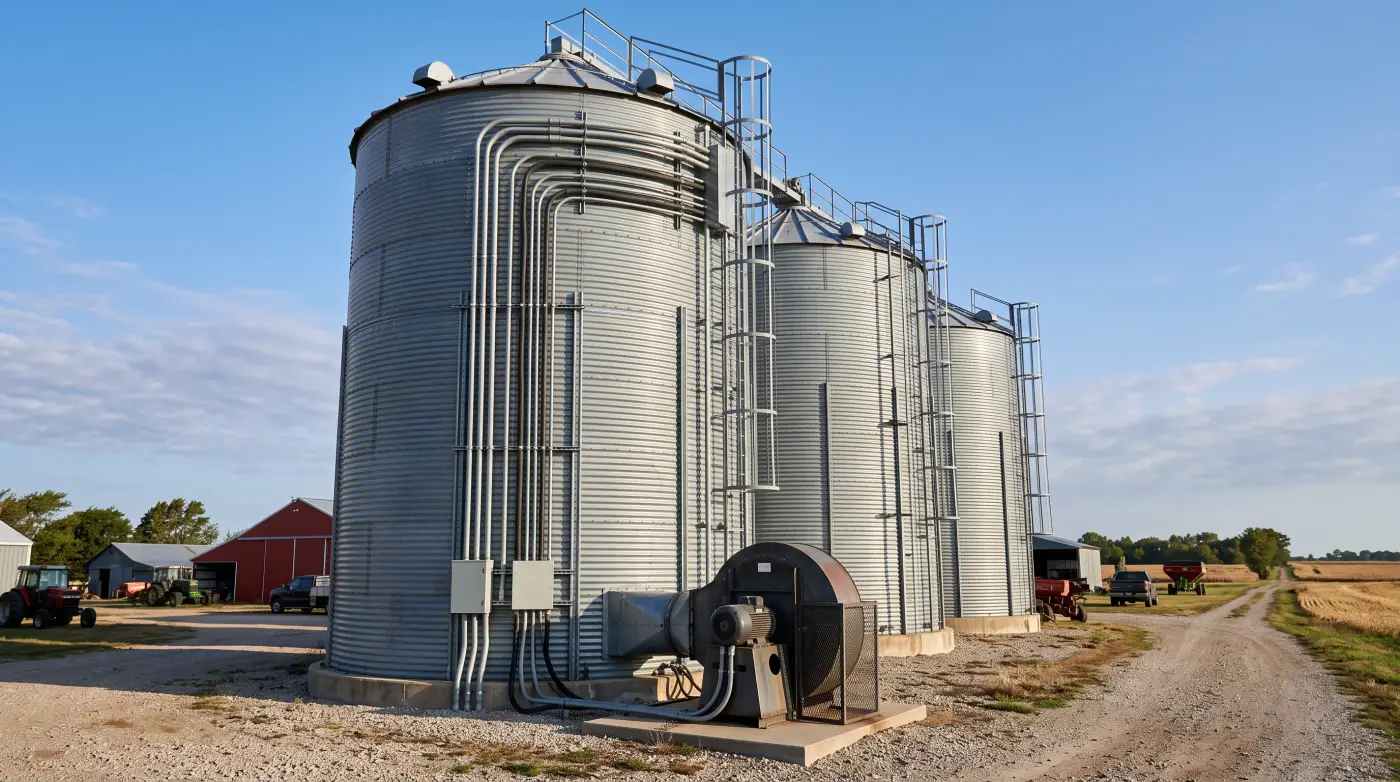
Stored grain is money sitting in a steel can, and it does not sit still. From the day you fill a bin to the day you haul it out, the grain mass is shifting moisture around, breathing, and giving insects and mold a chance to set up shop in any spot that gets warm and damp. A grain bin monitoring system is the set of sensors and controls that lets you see what is happening inside that mass without climbing the ladder, and act on it before a small hot spot turns into a crusted, spoiled core that costs you thousands of bushels. This guide walks through how these systems work, what they actually tell you, the difference between just watching temperature and actively controlling aeration, and how to decide what is worth the money on your operation.
If you understand the failure modes, the value of monitoring makes a lot more sense. Grain in storage spoils for a handful of related reasons, and most of them show up as heat before they show up as a smell or a crusted surface.
Moisture is the root of almost everything. Every grain has a safe long-term storage moisture content, and going over it is the single most common reason bins go out of condition. As a rough guide, corn keeps well at about 13 to 15 percent depending on how long you intend to hold it, soybeans want to be down around 11 to 13 percent, and wheat stores well at roughly 13 percent or below. The longer you plan to hold grain and the warmer it is, the drier you want it. Grain put away at 17 or 18 percent corn "to dry down later in the bin" is a gamble that often does not pay off, especially in a warm fall.
Moisture migration moves water even in dry grain. Here is the part that surprises people. Even a bin that went in at a safe average moisture can develop wet, spoiling zones. As outside temperatures drop in fall and winter, the grain near the bin wall cools faster than the grain in the center. Air inside the grain mass starts to move in slow convection currents - cool air sinks down the walls, warms slightly, rises up through the warm center, and when that warmer, moisture-laden air hits the cold grain near the top center, the moisture condenses. That is why so many spoilage problems start as a crusted, wet, sometimes frozen cap right in the top center of the bin. The grain did not get wet from the outside. The water moved there from inside.
Hot spots and biological activity. Wherever moisture concentrates, mold and grain respiration pick up, and both produce heat. Insects do the same. A localized warm zone feeds on itself: heat drives more moisture movement, more moisture feeds more mold and bugs, and the temperature climbs. Left alone, a hot spot can run from grain temperature into the 90s, 100s, and higher, fast enough that a bin checked monthly can be in serious trouble before the next check.
Fines and packing. When you fill a bin, the small broken pieces and chaff - the fines - tend to concentrate in the center under the spout in a column. That core of fines packs tight, holds more moisture, and resists airflow from your fan. It is both more likely to spoil and harder to cool with aeration. Coring the bin (pulling a few loads out of the center after filling) is the old-school fix, and it still matters even with good monitoring.
The takeaway: spoilage is usually a moisture-and-heat problem that begins in a specific spot, and the earlier you see the temperature rise, the cheaper the fix. That is exactly what monitoring is for.
The backbone of nearly every grain bin monitoring system is a set of temperature cables. These are flexible cables suspended from the bin roof, hanging down through the grain, with temperature sensors spaced along their length - typically every 4 to 8 feet. A bin will have several cables arranged across the diameter so you get readings from the wall, the mid-radius, and the center, at multiple depths.
A 30-foot bin might run a handful of cables; a large commercial bin can have a dozen or more. Each sensor reports the grain temperature at its point in the mass, and the system gathers all of those readings into a profile so you can see the temperature at, say, the center of the bin 12 feet down versus near the wall near the top.
Why temperature is such a good early warning. Grain is a fantastic insulator. A pocket of grain that starts heating does not warm the whole bin - it stays localized, which means a sensor near that spot will show a rising reading while the rest of the bin looks fine. A 5 to 10 degree rise in one zone, especially one that keeps climbing check after check, is the classic signal that something is going wrong there. You may not smell anything or see anything from the top yet, but the cable saw it.
The major names in cable-based monitoring include OPI (OPI Blue and the older Integris systems), Tri-State (TSGC) cables and BinManager, and systems from the big bin manufacturers - GSI, Sukup, Brock, and AGI brands all either build or integrate cable monitoring. Many of these are interchangeable enough that an aftermarket cable system can be hung in a bin from any manufacturer.
Manual readout versus connected systems. At the simple end, a temperature monitoring system gives you a handheld or panel readout: you plug in or walk up, and it shows the temperature at each sensor. At the connected end, the readings flow automatically to a controller, then to a phone app or web dashboard, on a schedule - hourly, daily, whatever you set - so you can look at every bin in the yard from the kitchen table or the cab. The connected versions are where the real labor savings and peace of mind come from, because the value of monitoring is checking often, and nobody climbs every bin every day in January.
Temperature tells you a lot, but the question every grain farmer eventually asks is whether the system can tell them moisture content directly. The honest answer is: sort of, and you need to understand the limits.
There are two broad approaches.
Moisture cables add a humidity-sensing element alongside the temperature sensor at each point on the cable. They measure the relative humidity of the air in the void spaces between grain kernels, plus the temperature, and then use a known relationship for that grain type to estimate the grain's moisture content. This works on the principle of equilibrium moisture content, or EMC: at a given temperature and grain moisture, the air between the kernels settles to a predictable relative humidity. Read the humidity and temperature, and you can back-calculate an estimated grain moisture.
This estimate is genuinely useful, but treat it as a guide, not a gospel grade. Interstitial-air moisture sensing tends to be most accurate once the grain and air have equilibrated and least accurate right after fan runs or big temperature swings, when the air and grain are not in balance. Most operators use moisture-cable readings to watch trends - is this zone trending wetter over weeks - rather than to certify a precise selling moisture. For the number that matters at the scale, you still pull a sample and run it through a bench moisture meter.
EMC-based aeration logic uses the same physics but for a different purpose: deciding when to run the fan. More on that in the aeration section, because this is where moisture sensing earns its keep on a lot of farms.
A reasonable way to think about it: temperature cables are the proven, must-have core. Moisture sensing on the cables is a valuable add-on for trend-watching and for driving smart fan control, but it does not replace a good handheld moisture meter and physical sampling for your actual marketing decisions.
Plenty of grain is still stored with no electronics at all, checked by a person climbing the bin, opening the hatch, smelling, looking at the surface, and maybe probing for temperature with a long thermometer probe or by feeling the grain coming off an unload auger. This works, and on a small operation that turns grain over quickly it can be perfectly adequate. The problems are time, consistency, and timing.
Manual checks take real labor, they are unpleasant and frankly dangerous in cold or hot weather, and the natural human tendency is to check less often exactly when grain is most stable-seeming and to discover problems only once they are advanced. Climbing into or onto bins also carries a serious safety cost - grain entrapment and falls are among the deadliest hazards on a farm, and anything that lets you assess a bin's condition without going inside or on top of it is a safety win in its own right.
Automated monitoring flips the economics. Once the cables and controller are installed, checking the whole yard costs you the time it takes to glance at an app. That means you actually check daily, you catch a 6-degree rise in a center sensor while it is still 6 degrees, and you make the decision to run a fan or move grain on data instead of on a hunch. The first time a system flags a developing hot spot that you fix with two nights of aeration instead of losing a truckload of grain to spoilage, it has often paid for a good chunk of itself.
Monitoring tells you what is happening. Aeration is what you do about it. A grain bin monitoring system reaches its full value when it is tied to the aeration fans, because the most common fix for a temperature or moisture problem is moving the right air through the grain at the right time.
What aeration does. Aeration is not high-volume drying. It is low-airflow conditioning - pushing or pulling enough air through the grain to even out and lower the grain's temperature and to hold or gently shift its moisture toward equilibrium with the air. Typical aeration airflow for cooling and holding grain runs around 0.1 to 0.2 CFM per bushel, far less than the 1 CFM per bushel or more used for in-bin drying. The goal in fall is to walk the grain temperature down in steps as the weather cools - getting the whole mass cold and uniform kills insect activity, slows mold, and stops the convection currents that cause moisture migration.
The core idea: cool and uniform wins. Cold grain is stable grain. Insects largely stop developing below about 50 degrees and go dormant in the 30s and 40s. Mold growth slows dramatically as temperature drops. And a bin that is uniformly cold has no warm center to drive moisture to the top. So the fall and early winter game is to use cool, dry nights to run the fans and pull the whole mass down to around 30 to 40 degrees, then hold it there through winter, watching the cables to confirm it stays put.
There are three levels of sophistication in how the fans get run.
Manual fan control. You decide when to flip the switch based on the weather and your reading of the cables. This is free if you already have fans, and it works if you are disciplined and you understand the rules - run when the air is cool and dry relative to the grain, do not run when the air is warm and humid (which can rewet your grain or warm it back up). The downside is that the best aeration windows often happen at 2 a.m. when you are asleep, and bad judgment about humid weather can undo a week of cooling in one night.
Thermostat control. A step up: a thermostat starts the fan when outside air drops below a set temperature, so you capture cool nights automatically without standing at the switch. Simple, cheap, and a big improvement over pure manual. The weakness is that a plain thermostat does not know about humidity, so it can run the fan on a cold but very humid night and add moisture to your grain.
Automatic EMC-based controllers. This is the smart end, and it is where monitoring and aeration fully merge. An automatic aeration controller looks at the outside air temperature and humidity, calculates the equilibrium moisture content that air would drive your grain toward, and runs the fan only when running it actually helps - cooling without rewetting, or drying toward your target without overdrying. Systems like OPI's controllers, AGI/BinManager, and the controllers from the major bin brands do exactly this. You tell the system your grain type and target moisture and temperature, and it manages the fans across the season, logging when and why it ran. Tied to temperature and moisture cables, the controller can also respond to a developing hot spot by prioritizing fan runs for that bin. For an operator with a lot of bins or a lot of grain held long-term, this automation is frequently the single biggest reason to invest in a full system.
A common and fair question: my bins are 20 or 30 years old with basic fans and no electronics - can I add monitoring, or do I need new bins? You can almost always retrofit, and it is one of the better-value upgrades on an older grain setup.
Temperature and moisture cables are hung from the roof and do not care how old the bin is, so adding a cable monitoring system to an existing bin is routine. The main considerations are roof access and structural attachment points for the cables, getting the wiring or wireless gateway from the bins to a controller, and power for the controller and any new fan contactors.
On the aeration side, retrofitting automatic fan control onto existing fans is usually a matter of adding a controller and the contactors and sensors it needs to switch the fans and read outside air. If your existing fans and aeration floor are adequate for the airflow you need, you may not have to touch them at all - you are just adding a smarter brain in front of them. If the bin was never set up with enough fan or floor for proper aeration airflow, that is a separate and bigger project, and monitoring will at least tell you honestly whether your current airflow is doing the job.
Wireless options have made retrofits much easier than they used to be. Several systems now offer wireless cable hubs and gateways so you are not trenching control cable across the yard between bins. That lowers the installation cost and disruption considerably on an existing site.
A monitoring system is only worth what you do with the numbers. Here is how to read the common situations.
A single sensor trending up. One sensor climbing while its neighbors hold steady is the classic early hot spot. The action is to run aeration to cool that zone, and to keep a close eye on whether it responds. If a center-bottom sensor near the fines core is the culprit and aeration does not bring it down, that grain may need to be moved - sometimes the only real fix for an advanced hot spot is to start unloading and break up the problem core before it spreads.
The whole top center crusting or warming. This is the moisture-migration signature. The fix is aeration to re-equalize temperatures and break the convection cycle, and often coring or pulling the top center if a crust has formed. Catching the temperature signal early, before a crust forms, is exactly the point of having cables up high in the center.
Grain not cooling down in fall despite fan runs. This points to inadequate airflow, blocked spots from packed fines, or running the fan in the wrong weather. The temperature profile across the cables will often show you where the air is and is not getting through - a wall-to-center temperature gradient that will not close usually means air is short-circuiting or the core is too tight.
Stable, cold, uniform readings all winter. This is the boring success case, and it is what you want. Cold and even, holding steady week after week, means the grain is stable and you can market it on your schedule instead of being forced to move it because a bin is going out of condition.
The discipline that makes monitoring pay is acting on trends, not just snapshots. Any single reading can be noise. A sensor that is 4 degrees warmer than last week and was 3 degrees warmer the week before that is telling you a story. Good systems make that trend obvious with history and alerts.
Prices vary a lot with bin size, number of cables, and how much automation you add, so treat these as ballpark figures to frame a conversation with a dealer rather than firm quotes.
A basic temperature-cable monitoring setup for a single farm bin - cables, a controller or handheld readout - commonly lands in the low thousands of dollars per bin, scaling up with diameter and the number of cables. Add moisture sensing on the cables and the per-bin cost rises. Full automatic aeration control with EMC logic adds the controller and fan-switching hardware, and a connected, multi-bin system with a yard-wide gateway and app access is a larger up-front number but spreads across all your bins. A large operation outfitting a whole yard with connected monitoring and automatic aeration can be looking at a five-figure project; a single older bin getting basic temperature cables is far more modest.
The return shows up in three places. First, avoided spoilage - a single saved hot spot or prevented crust-out can be worth more than the system. Second, marketing flexibility - grain you can confidently hold in good condition lets you sell on price rather than being forced to dump grain that is going out of condition. Third, reduced shrink and quality discounts - grain kept cool and at correct moisture grades better and weighs right, where over-dried grain gives away water weight you paid to remove and under-dried grain risks discounts or rejection. The labor and safety savings from not climbing bins to check them are real too, even if they are harder to put a dollar on.
A few questions sort out what you actually need.
How much grain do you hold, and how long? If you fill bins in fall and empty them by spring, basic temperature monitoring plus disciplined aeration may be plenty. If you store long-term or hold across summer into the next marketing year, full automation and moisture sensing earn their keep, because summer storage is where the hard problems live.
How many bins, and how spread out? One or two bins by the shop are easy to check and easy to wire. A dozen bins across a yard or at multiple sites is where connected, wireless, app-based monitoring transforms your day, and where automatic aeration control stops you from trying to manage a dozen fans by hand.
Do you want it tied to the fans, or just to watch? Decide whether you are buying eyes (monitoring only) or eyes and hands (monitoring plus automatic aeration control). Many operators start with monitoring, run the fans manually or on a thermostat for a season to learn their bins, and add automatic control once they trust the data.
Compatibility and support. Cable systems are fairly interchangeable across bin brands, but the controller, app, and especially the local dealer support are what you live with. Ask who installs and services it locally, how the app works, whether it needs a cell signal or wifi at the bin site, and how alerts reach you. A system that texts you a hot-spot alert at midnight is worth more than one that only shows the problem when you happen to open the app.
Connectivity at the site. Connected systems need a way to get data off the farm - cellular, wifi, or a radio link to a base. Rural sites with poor cell coverage may need a booster or a wired internet drop at the yard. Confirm this before you buy, because an app-based system you cannot reach is just an expensive cable readout.
Buying the system is the start. Getting value out of it is an ongoing, low-effort habit.
Set sensible alerts and actually respond to them. Configure temperature-rise alerts so the system tells you when a sensor climbs past a threshold or trends up over several readings. An alert you ignore is worthless; the whole point is to act while problems are small.
Walk the grain in correctly. Monitoring does not excuse you from good filling practice. Core the bin to pull the fines column out of the center, level the peak so air distributes evenly, and put grain away at a safe moisture for how long you plan to hold it. Good cables in a poorly filled bin will faithfully report a developing problem you could have avoided.
Mind the cables and sensors. Cables get stressed by the grain mass, especially on unload when grain flows past them, and sensors can drift or fail over years. Check that all sensors are reporting at fill time, and watch for a sensor that suddenly reads wildly different from its neighbors - that is often a failed sensor rather than a real grain event, but verify before you dismiss it. Most systems flag a sensor that has gone offline.
Run aeration on the right weather. Whether manual, thermostat, or automatic, the rule is to move air when it helps - cool, dry conditions for fall cooling - and to avoid running fans in warm, humid weather that warms or rewets the grain. Automatic EMC controllers handle this for you; if you are running manually, learn the equilibrium-moisture rules for your grain or you can undo your progress.
Keep records across seasons. One of the quiet benefits of a connected system is the log it builds - when bins cooled, how fast, which ones gave you trouble, how many fan hours it took. Over a few years that history makes you genuinely better at managing your storage, telling you which bins have airflow problems and which fill patterns lead to trouble.
Do not stop sampling for marketing. Use the system to keep grain in condition and to flag problems early, but pull physical samples and run a bench moisture meter for the moisture number you sell on. The cable estimate is for trend-watching and fan control; the meter is for the scale ticket.
Grain in the bin is one of the larger uninsured-against-mismanagement assets on most grain farms, and it goes out of condition quietly, from the inside, in specific spots, well before anyone smells it from the ladder. Temperature cables give you early eyes on exactly the heat that signals trouble, moisture sensing adds useful trend information and drives smarter fan control, and automatic aeration turns all that data into action while you sleep. You do not have to buy the top of the line to benefit - even basic temperature monitoring with disciplined manual aeration is a large step up from climbing bins and hoping. Match the system to how much grain you hold and how long, get the fan side dialed in, respond to the alerts, and you turn stored grain from a worry that nags at you all winter into an asset you can hold and market with confidence.
As a rough guide, corn keeps well at 13 to 15 percent, soybeans want to be down around 11 to 13 percent, and wheat stores well at roughly 13 percent or below. The longer you hold grain and the warmer it is, the drier it should be. Putting corn away at 17 or 18 percent to dry down later in the bin is a gamble that often fails in a warm fall.
It is moisture migration, not a leak. As outside temperatures drop, grain near the wall cools while the center stays warm, setting up slow convection currents. Warm, moisture-laden air rises through the center and condenses when it hits the cold grain up top, forming a crusted, sometimes frozen cap. The water moved there from inside the mass, which is why a high center cable catches it early.
EMC stands for equilibrium moisture content. An automatic controller reads outside air temperature and humidity, calculates the moisture level that air would drive the grain toward, and runs the fan only when it cools without rewetting. Aeration uses low airflow, around 0.1 to 0.2 CFM per bushel, far less than the 1 CFM per bushel or more used for in-bin drying.
Almost always. Temperature and moisture cables hang from the roof and do not care how old the bin is, so retrofitting is routine; the main considerations are roof access, structural attachment points, and power for the controller. Wireless cable hubs and gateways now avoid trenching control cable across the yard, which lowers installation cost and disruption on an existing site considerably.
Join our list for practical guides on farm tech, precision agriculture, and tools that work.