
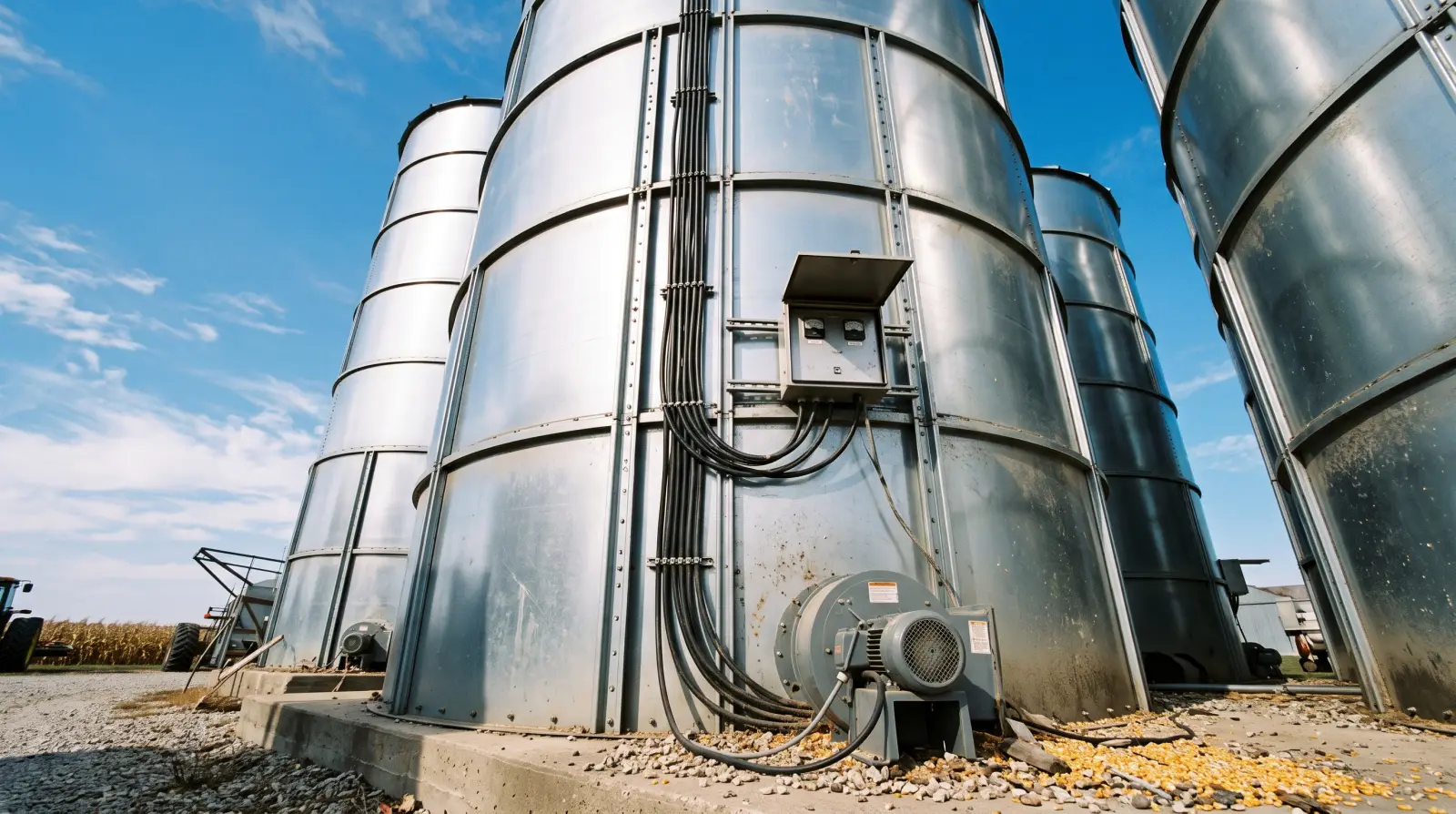
The cheapest bin fire is the one that never starts. The cheapest load of out-of-condition corn is the one that gets caught at 65 degrees and dried back down before it goes to 80. Grain bin monitoring is one of those areas of farming where a few hundred dollars of sensors and a cell signal can save a five or six figure loss, and yet plenty of operations are still running on a ladder, a long thermometer, and a guess. The reason is partly that the older probe-and-cable systems were painful to install and expensive to maintain, and partly that a lot of farmers grew up watching their fathers run bins the old way without losing any. That worked until it did not. As bin sizes climbed past 50,000 bushels and harvest moisture got more variable, the margin for error shrank, and the cost of a bad surprise went up.
This guide covers what grain bin monitoring systems actually do, the different sensor technologies available, how temperature cables and wireless sensors compare, what aeration controllers add to the mix, how to set target temperatures for each season, and how to pick a system that matches your storage size and budget. Whether you are running three 30,000 bushel bins of corn or a single 10,000 bushel bin of wheat, the underlying physics is the same and the tools have gotten a lot better in the last five years.
Grain in a bin is not dead inventory. It is a biological system with living kernels, fungi, insects, and mites, all of which respond to temperature and moisture. Left alone, a bin of corn at 16 percent moisture and 70 degrees will slowly spoil. Respiration from the kernels themselves produces heat, water, and carbon dioxide. Mold growth produces more of all three. Insect activity - grain weevils, rusty grain beetles, Indian meal moths - generates localized heat and moisture pockets that pull nearby grain out of equilibrium. The core of a large bin can climb 15 to 20 degrees above ambient in a matter of weeks if nothing is done about it, and once that temperature differential is set up, moisture migration pulls wet grain to the top and cold spots to the bottom in a slow convective loop that spoils from the inside out.
The classic failure mode is the crust. A bin of 16 percent corn that gets loaded warm in October, sits through a cold November without aeration, and then sees a warm spell in February will develop a hard crust of moldy grain on top where moisture migrated up and condensed on the cold steel roof. By spring that crust can be three feet thick, impossible to unload, and worth ten cents a bushel instead of four dollars. That entire sequence is preventable with a temperature cable, a moisture sensor, and an aeration controller that runs the fans on the right nights.
The other failure modes are rarer but more expensive. Bin fires from grain dust and hot bearings. Spontaneous heating in damp soybeans. Insect infestations that trigger an inspection hold on a whole elevator delivery. Roof collapse from a crust letting go. Each of those has a chain of warning signs, and each one is catchable with a decent monitoring system and a farmer who knows what the numbers should look like.
Grain storage is an equilibrium problem. Kernels absorb or release moisture until they match the relative humidity of the air around them. The relationship between air temperature, air humidity, and equilibrium moisture content of the grain is well-mapped for every common crop. Corn at 50 degrees and 70 percent humidity sits at about 14 percent equilibrium moisture. At 60 degrees and 70 percent humidity, about 13.5 percent. At 40 degrees and 70 percent, closer to 15 percent. Wheat runs a point lower at each condition. Soybeans behave differently because of their oil content.
What this means in practice is that you cannot control grain moisture in storage without moving air through it, and you cannot move air intelligently without knowing the temperature and humidity of both the outside air and the grain mass. An aeration fan blowing 80 degree 90 percent humidity air through 50 degree corn does not cool the grain - it warms it up and adds moisture. A fan blowing 30 degree dry air through 60 degree corn pulls temperature and moisture down together. The difference between those two fan runs is the difference between grain that stays graded and grain that grows mold.
The other piece of the physics is that heat conducts slowly through grain. A temperature change at the bin wall takes days or weeks to reach the center. This is why full-bin temperature cables - probes that run the entire height of the bin with sensors every three to five feet - are so much more useful than a single probe at the top. The problems always start in the center or along the sidewall where moisture differential is highest, and by the time a hot spot reaches the top of the grain, you have usually lost thousands of dollars of feed or market value.
The original grain bin monitoring technology, and still the gold standard for big bins, is the temperature cable. These are vertical cables with thermistors or thermocouples embedded every three to six feet along their length, suspended from the bin roof down into the grain mass. A typical 30,000 bushel bin will have three to five cables arranged in a pattern that covers the center and the sidewalls, each cable reading eight to twelve sensors top to bottom. The readings get multiplexed to a control box that displays them, logs them, and in modern systems pushes them to a web dashboard or smartphone app.
The strength of temperature cables is spatial resolution. You see not just whether the bin is heating, but where. A sensor on the south sidewall reading eight degrees above the rest of the bin on a sunny February day tells you the solar heating is pulling moisture to that wall and the bin needs a cooling run. A sensor in the center column ten degrees above the rest at any time is the classic signature of a developing hot spot from insect activity or spoilage, and it calls for immediate action - pull a core sample if you can, or move the grain to another bin.
Installation is the headache. A temperature cable has to be hung before grain goes in, because you cannot fish one down through a full bin without risk of snagging. The top anchor has to be stout enough to hold the cable against the considerable downward pull of settling grain, which can reach several hundred pounds per cable. Cables are installed using heavy-duty bin anchor assemblies rated for that load, and the cable itself is typically made with Kevlar or stainless steel reinforcement inside the jacket. Cutting corners on the anchor or the cable jacket is how you end up with a cable torn off the bin eave and lost somewhere in 40,000 bushels of corn.
Major players in cable-based systems include Rolfes@Boone, Tri-States Grain Conditioning, OPI Systems, and IntelliFarms. A full temperature cable install on a 30,000 bushel bin runs $2,500 to $5,000 for the cables, anchors, and the control box, plus labor to hang the cables. On a new-build bin it is modest money. Retrofitting an existing full bin means waiting until the next time it empties, which can be a factor in decision timing.
The control box ranges from a simple wall-mounted display with a rotary selector, at the low end, to a cellular-connected multi-bin controller with a web dashboard at the high end. For anything over about 20,000 bushels per bin, the cellular version is worth the extra $500 to $1,000. Being able to check bin temperatures from a phone on a Sunday evening without driving to the farm is the feature that actually changes behavior and prevents losses.
The last few years have seen a new generation of wireless grain sensors that can be retrofitted into existing bins without pulling cables through the roof or emptying the grain. Products like the OPI Blue, BinSentry, Telesense, and Centaur work by dropping or inserting one or more sensor nodes into the grain through an existing fill or unload hatch. The nodes communicate wirelessly to a gateway at the bin or at a central farm hub.
The appeal is obvious. No hanging heavy cables. No waiting for the bin to empty. You can instrument a full bin tomorrow for a fraction of the cost of a cable install. Most of these systems also measure humidity and CO2 in addition to temperature, which opens up some monitoring capabilities that cable systems lack. CO2 in particular is a very early indicator of grain spoilage - mold and insect respiration spikes CO2 in the bin headspace days or weeks before temperature climbs noticeably.
The tradeoffs are worth understanding. Wireless sensors in a grain mass face a hard radio environment. Grain attenuates radio signals, and metal bin walls make reflections unpredictable. Most wireless systems use low-frequency radios - 900 MHz ISM band in North America, or sub-GHz proprietary bands - to get through the grain, and they typically rely on the sensor nodes being near the top of the grain mass or at known positions along the bin wall. This means the spatial coverage is usually coarser than a full cable install. You get a few sensor locations instead of dozens.
Battery life is another consideration. Wireless nodes run on lithium batteries that have to last a full storage season or more. This puts a hard limit on how often they can transmit readings - typically once an hour or once every few hours rather than continuous. For most storage monitoring that is plenty. For a bin that is actively being dried or aerated, more frequent readings are nice to have.
Cost is where wireless systems shine for small-to-medium operations. A single-bin Telesense system, for example, runs in the $800 to $1,500 range including the cellular gateway and one season of service. Compare that to $3,000 to $5,000 for a full cable install and it is an easy decision for a 10,000 bushel bin that is going to store corn for eight months. For a 50,000 bushel commercial bin running a continuous flow operation with multiple unload cycles per year, the full cable system still makes more sense.
The other retrofit option is the portable probe. Units like the AgSense AgriLogger or the Vortex Wireless grain probe are handheld or wand-style devices that get pushed down through the top of the grain to read temperature and sometimes moisture at different depths. These are great for occasional checks on a small bin or a grain bag, but they are not continuous monitoring and they do not replace fixed instrumentation for anything you are storing long term.
Sensors tell you what is happening. Aeration controllers do something about it. The modern grain bin runs one or more aeration fans mounted at the base or the ring foundation, pulling or pushing air through the grain mass. Those fans can move a lot of air - a typical 1 CFM/bu fan on a 30,000 bushel bin moves 30,000 cubic feet of air per minute - and they use real electricity, often 5 to 15 horsepower per fan. Running them at the wrong time is wasteful. Running them at the right time is how you keep grain in condition all winter.
The right times are the nights when outdoor air is cooler and drier than the grain, specifically when the equilibrium moisture content of the outside air is at or below the target moisture of the grain. That math is not something most people want to do by hand every evening. An aeration controller does it automatically. It reads outside temperature and humidity, calculates the equivalent moisture content of that air, compares to the stored grain condition, and runs the fan when conditions are favorable and shuts it off when they are not.
The most widely used aeration controllers in North America include the OPI Integris, the Rolfes Grain Guard, the Tri-States BinManager, and the IntelliFarms BinManager. They all do essentially the same core job - automatic fan cycling based on EMC calculations - with different user interfaces, cellular connectivity, and integration with temperature cable systems. A basic aeration controller runs $500 to $1,000 installed. A full-featured unit with cellular, multi-fan control, and integration with a temperature cable or wireless sensor system runs $1,500 to $3,000.
The value they deliver is not just automation. It is running the fans fewer hours with better results. A well-tuned aeration controller will typically cut fan runtime by 30 to 50 percent compared to manual operation, while holding grain temperature closer to target. On a 15 horsepower fan at 12 cents per kWh, cutting 200 hours of runtime per season saves about $270 in electricity alone. Across three or four bins, the controller pays for itself in a season or two. And that is before accounting for the avoided losses from grain that stays in condition instead of heating up.
The standard playbook for aeration in the northern corn belt is a three-stage cooling strategy. When the grain goes in warm at harvest - say 70 to 80 degrees - the first stage is to pull it down to 50 to 60 degrees using the first cool fall nights. The second stage, in late November and December, takes it to 30 to 40 degrees. The third stage, if you are going to hold grain into the summer, holds it as cold as you can get it through the winter, typically 20 to 30 degrees.
Each stage has a different target EMC and a different set of favorable fan conditions. Trying to go from 80 to 30 in one run is inefficient and can cause condensation problems at the top of the bin where cold grain meets warm humid air. A controller that understands this sequence and stages the cooling automatically is worth a lot more than one that just runs fans when outside temp is below grain temp.
Less well known, but just as important, is spring warming. Grain held at 25 degrees into April will start to see condensation on the warm bin roof as outside temperatures climb into the 70s and 80s. The cure is to warm the grain mass gradually as the season changes, keeping the grain-to-air temperature differential within 15 to 20 degrees. An aeration controller handles this in reverse - running fans in the afternoons when outside air is warmer than the grain - and prevents the spring crust that catches a lot of operations off guard.
Temperature is the easy measurement. Moisture is harder. Direct moisture sensors that go into the grain mass are available - they work by measuring dielectric constant, similar to a handheld grain moisture tester - but the practical problem is getting a representative reading. Grain moisture in a bin is never uniform. It varies by height, by proximity to the wall, by time since loading, and by how well the bin was cored when it filled. A single moisture sensor in the middle of the bin gives one number that may or may not represent the whole.
For this reason, most stored grain monitoring infers moisture changes from temperature changes plus bin air humidity, rather than trying to measure grain moisture directly. A sensor in the headspace of the bin measures air temperature and relative humidity, and the system calculates what that corresponds to for grain equilibrium moisture. If the headspace EMC is climbing, something in the grain mass is releasing moisture - a sign of respiration or early heating.
Some systems add CO2 sensors in the headspace as well, which as noted is a very early spoilage indicator. Centaur and BinSentry both emphasize CO2 sensing as a core feature. In studies from University of Kentucky and University of Manitoba, CO2 rise preceded detectable temperature rise in spoiling corn by seven to 21 days. That is a lot of lead time to act.
For a direct in-bin moisture check, most operations rely on periodic coring. A long grain probe - a hollow tube with a sliding inner handle, sized to pull a sample from six or eight feet deep - gets pushed down through the top of the grain at different points, and the samples get tested on a bench moisture meter. Brands like Seedburo and Gehl's probes run $50 to $200 depending on length. A bench meter like the Dickey-John GAC runs $1,500 to $4,000 but pays for itself in elevator dockage avoided.
There is a side benefit to a good grain monitoring system that often gets overlooked. Accurate, continuous records of bin temperature and inferred moisture become part of your case when you are negotiating with an elevator about grading, or proving condition for a forward contract delivery. A buyer who knows the grain has been monitored and aerated to 30 degrees all winter is more likely to accept the delivery on a thin day than one who sees a load pulled from an unmonitored bin and has to guess.
Some grain buyers, particularly specialty and food-grade buyers, are starting to require documented storage conditions. Organic corn going to a food processor, white corn for tortilla production, non-GMO soybeans going to a tofu plant - all of these buyers increasingly want to see the storage log. A bin monitor that exports a clean time-temperature record to PDF is a sales tool as much as a loss prevention tool.
The right grain monitoring system depends on how much grain you store, how long you hold it, and how much you are willing to spend to prevent a bad year. For a rough framework:
The smartest money for most family farms in the mid tier is spent on one good aeration controller per bin and one wireless sensor node for monitoring, rather than trying to install cables in an existing bin. The controller captures most of the loss-prevention value. The sensor captures the early warning value. Adding cables becomes worth it when you are building a new bin and the incremental cost is a few thousand dollars on top of a quarter-million-dollar structure.
Before writing a check to any grain monitoring vendor, get clear answers on a few points:
Vendors who answer these clearly and in writing are worth dealing with. Vendors who get evasive on data ownership or ongoing fees are telling you something about how they plan to treat you as a customer.
Once the hardware is picked, the install is half the battle. A few things worth insisting on for any grain monitoring install:
A few patterns come up over and over when monitoring systems fail to deliver the value they should:
If you are running bins today without monitoring, the lowest-regret first step is to buy one wireless bin sensor - a BinSentry, Telesense, or OPI Blue unit - and instrument your largest or longest-held bin. Live with it for one storage season. Watch what normal looks like. Watch what the early days of a problem look like, if you are unlucky enough to see one. A season of data will teach you more about what your bins actually do than a decade of opening the roof and sticking in a thermometer ever will.
From there, add an aeration controller on that same bin, then expand the monitoring to the other bins as budget and install windows allow. Within two or three years you will have a complete, boring, well-instrumented grain storage operation where nothing goes wrong because you catch everything early. That is the goal. Boring is good. Boring is grain that sells at the bid price, in full, with no dockage, because it went in at the right moisture, stayed cold all winter, and came out the same way.
Grain bin monitoring is not about chasing the latest farm tech. It is about applying a few well-understood measurements - temperature, humidity, CO2 - to a biological process that rewards attention and punishes neglect. The tools are mature, the prices are reasonable, and the payback is measurable. The operations that figure this out sleep better in the winter than the ones that do not, and their grain bills prove it at the elevator every spring.
Cool it in stages. Corn that goes in at 70 to 80 degrees at harvest should come down to 50 to 60 on the first cool fall nights, then to 30 to 40 in late November and December, and finally to 20 to 30 degrees if you are holding into summer. Trying to jump from 80 to 30 in one fan run causes condensation at the top of the bin.
Yes, often days ahead of any heat. Mold and insect respiration spikes carbon dioxide in the bin headspace before temperature climbs noticeably. In studies from the University of Kentucky and University of Manitoba, a CO2 rise preceded detectable temperature rise in spoiling corn by seven to twenty-one days. Systems like Centaur and BinSentry build CO2 sensing in as a core feature.
A full temperature cable install on a 30,000 bushel bin runs $2,500 to $5,000 for the cables, anchors, and control box, plus labor to hang them, and the cables must go in before grain is loaded. For bins over about 20,000 bushels, a cellular-connected controller is worth the extra $500 to $1,000 so you can read temperatures from a phone.
Yes. A well-tuned controller runs the fans only when outside air will cool grain without adding moisture, cutting fan runtime by 30 to 50 percent versus manual operation. On a 15 horsepower fan at 12 cents per kWh, trimming 200 hours a season saves about $270 in electricity, before counting the grain that stays in condition instead of heating up.
Join our list for practical guides on farm tech, precision agriculture, and tools that work.