
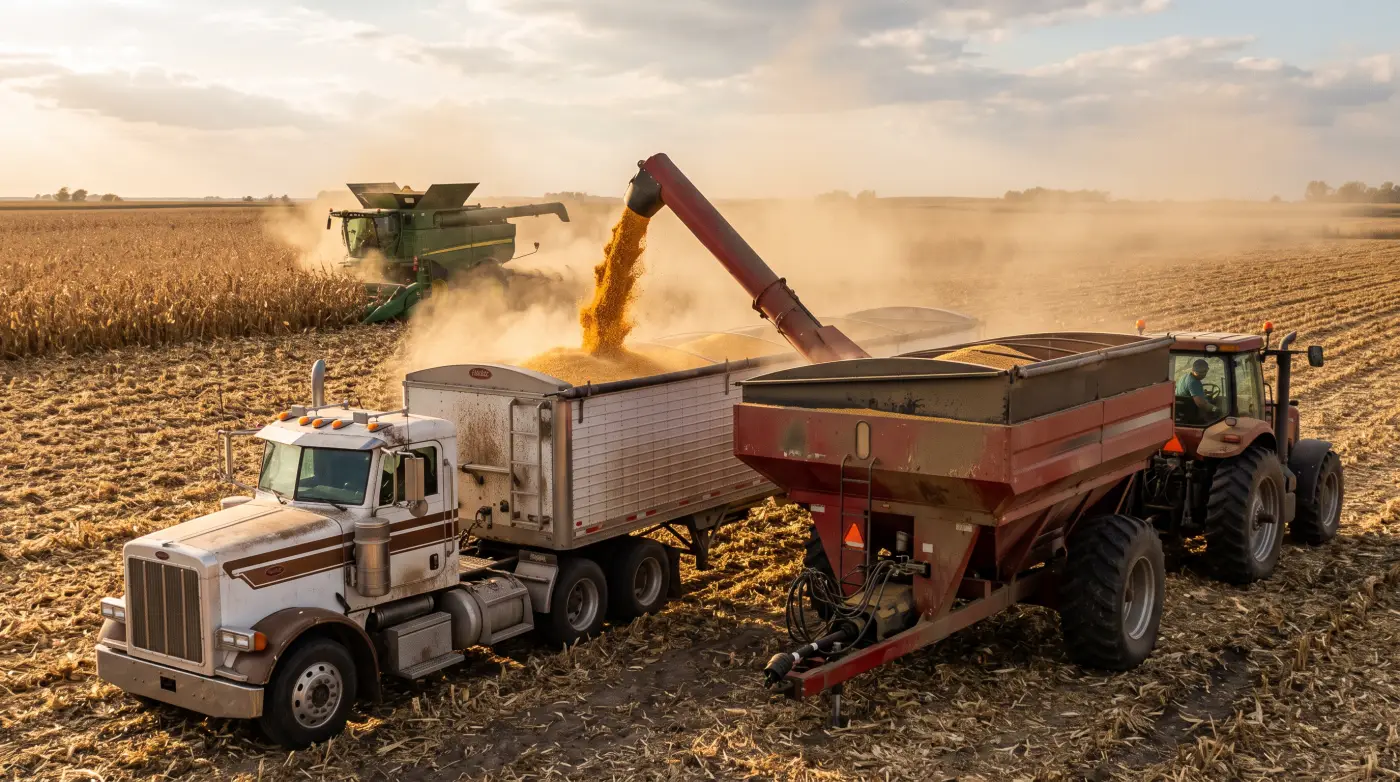
The grain cart is the most overlooked machine in the harvest train. The combine gets the attention because it is the expensive, complicated one. The trucks get the attention because they are what stand between the field and the elevator. The grain cart just runs back and forth, swallowing combine tanks and spitting them into semis, and most of the time nobody thinks about it until it breaks down. But the grain cart is sitting in exactly the right spot to do something no other machine in the operation can do as cheaply or as accurately: weigh every bushel that comes off the field, the moment it comes off, before a single load goes down the road. Put a scale on the cart and you turn a dumb hauling tool into the measurement hub of the entire harvest.
This guide covers what grain cart weigh systems actually do, how the load cell technology works, how cart scales compare to the combine yield monitor and the certified scale at the elevator, how to calibrate a cart scale so the numbers are trustworthy, what the real time data does for harvest logistics and trucking, and how to think about cost and payback. Whether you are running a 600 bushel cart behind one combine on a family corn operation or a 1,500 bushel tracked cart feeding a fleet, the principles are the same and the value is more about decisions than about any single number on a display.
At its simplest, a grain cart scale weighs the grain in the cart. Load cells under the cart frame or in the running gear measure the downward force of the loaded cart, the system subtracts the known empty weight, and an indicator in the cab reads out the net weight of grain on board. Dump that weight into a truck, hit the button, and the system logs the load. That is the whole mechanical story.
The reason it matters is that this single measurement, taken at the right place in the harvest chain, does several jobs at once. It tells the cart operator exactly how full the truck is so it can be loaded to legal weight without a trip across a certified scale. It records yield by field, by load, and by combine. It gives the operation a running tally of total bushels harvested in real time, which is the number every other harvest decision keys off of. And it produces a record that can be checked against the elevator scale ticket to catch shrink, theft, or a miscalibrated scale before it costs real money.
A combine yield monitor measures yield too, but it does it by inference. It estimates mass flow through the clean grain elevator using an impact plate or an optical sensor, multiplies by ground speed and header width to get bushels per acre, and integrates over the field. It is a genuinely useful tool for making yield maps, but it is an estimate built on several sensors that all drift, and it needs frequent calibration to stay within a few percent. The grain cart scale, by contrast, measures actual weight with load cells. It does not care about ground speed, header width, moisture, or mass flow. It just weighs what is in the cart. That makes it the natural ground truth for checking and calibrating the yield monitor, and the natural source for the bushel totals that actually go in the books.
Almost every modern grain cart scale uses strain gauge load cells. A load cell is a precisely machined block of steel with strain gauges bonded to it. When the cell carries a load, the steel deflects a tiny amount, the strain gauges change resistance in proportion to that deflection, and a small voltage change comes out that maps to a weight. Four load cells, one near each corner of the cart, carry the full weight of the cart and grain, and the system sums their readings to get the gross weight.
The placement of the load cells is where cart scale designs differ. The most common arrangement puts the cells between the cart frame and the axle or running gear, so everything above the cells - the tub, the auger, the grain - is weighed, and everything below - the axle, wheels, and tracks - is not. Some systems use a single-axle weigh bar arrangement, others use a four-point full-frame system, and the four-point designs are generally more accurate because they are less sensitive to where the grain sits in the tub and how the cart is tilted.
The indicator in the cab is the brains. It powers the load cells, reads their combined signal, applies the calibration, subtracts the tare weight, and shows net grain weight. Modern indicators do a lot more than show a number. They log each load with a timestamp, assign loads to fields and trucks, track moisture if a moisture sensor is wired in, total bushels for the day and the season, and push the data over Bluetooth or cellular to a phone app or a farm management platform. The well-known indicator and scale brands in North America include Scale-Tec, Avery Weigh-Tronix, Digi-Star (now part of Topcon under the Digi-Star and TAP lineup), Cabela's and CountyLine private-label units at the low end, and the scale packages that Brent, Kinze, Unverferth, and J&M build into their carts from the factory.
A factory-integrated scale from the cart maker is generally the cleanest install because the load cells are designed into the frame and the wiring is routed and protected from new. A retrofit scale kit is entirely workable on an existing cart, but it means jacking up the cart, installing weigh bars or load cell mounts under the frame, and running cable to the cab. A good retrofit on a typical cart runs most of a day in the shop and costs $3,500 to $7,000 depending on the indicator and whether you add moisture and connectivity.
A well-installed, well-calibrated grain cart scale will read within about 1 percent of a certified scale, and the better installs hold closer to half a percent. That is good enough for almost every on-farm decision and good enough to catch most problems at the elevator. It is not, however, legal-for-trade accuracy. The cart scale is not certified by weights and measures, so you cannot use it to sell grain by. The elevator's certified platform scale remains the number of record for any transaction. The cart scale is for your own management, and within that role its accuracy is plenty.
A few things degrade cart scale accuracy in the field, and understanding them is the difference between trusting your numbers and chasing ghosts:
None of these are dealbreakers. They are just the reasons a cart scale needs an occasional check against a certified scale and a sensible weighing routine, the same way any field instrument needs care to stay honest.
Calibration is what separates a cart scale you trust from a number you ignore. There are two distinct things people call calibration, and it helps to keep them separate.
The first is the tare, or zero. This is the empty weight of the cart, and it has to be set with the cart genuinely empty, clean, on level ground, with no operator in any attached seat and the auger in its normal travel position. Re-zero the tare at the start of each day and any time you suspect drift, mud accumulation, or after washing the cart. A wrong tare puts a fixed error on every single load, so this is the cheapest accuracy you can buy and it takes thirty seconds.
The second is the span calibration, which sets how the load cell voltage maps to actual weight. This is done once at install and checked once or twice a season, and it requires a known reference weight. The right way to do it is to fill the cart, weigh it on a certified scale, drive back, and adjust the indicator's calibration factor until it matches the certified weight. Some operations do a multi-point calibration with a partial load and a full load to make sure the scale is linear across its range, which is worth doing on a new install. Once the span is set, it does not move unless something mechanical changes.
The practical seasonal routine looks like this. Early in harvest, take the first full cart of the year across a certified scale - the elevator, a co-op, a feed mill, anywhere with a legal platform - and compare. If the cart reads within a percent, you are good. If it is off, adjust the span and check again on the next load. Through the rest of harvest, do a spot check every week or two, and pay attention to any load where the elevator scale ticket differs from your cart total by more than the usual amount, because a sudden divergence is a signal something changed - a load cell going bad, a mud bridge, a loose mount.
One more calibration discipline pays off all season: weigh the same way every time. Same spot if you can, same routine of stop, let it settle, record. Consistency in how you weigh matters as much as the absolute calibration, because most of the value of the data comes from comparing loads and fields to each other, and that comparison only holds up if the measurement conditions are the same.
One of the highest-value uses of a grain cart scale has nothing to do with logistics. It is using the cart's accurate weights to calibrate and correct the combine yield monitor, which turns a rough yield map into a trustworthy one.
The yield monitor estimates mass flow and needs calibration loads to learn the relationship between its sensor signal and actual grain mass. The standard procedure asks for several calibration loads at different flow rates - a slow pass, a fast pass, a partial-width pass, a normal pass - each weighed accurately so the monitor can build a calibration curve. The grain cart scale is the obvious source for those weights. Run the combine until its tank is full, dump into the cart, read the cart weight, enter it into the yield monitor, and repeat at different ground speeds. A few calibration loads at the start of each crop, in each crop, and the yield monitor sharpens up dramatically.
Beyond the initial calibration, the cart scale gives you a per-field reality check on the yield map. If the yield monitor says a field made 180 bushels per acre but the cart-weighed total over the field's acres works out to 168, you know the map is running about 7 percent high and you can mentally discount it or apply a correction in your mapping software. Some farm management platforms will do this automatically - they take the cart-scale load weights, match them to the fields and the combine passes, and rescale the yield map to match the weighed totals. That gives you a yield map with the spatial detail of the monitor and the absolute accuracy of the scale, which is the best of both and the foundation for any serious variable rate or field-profitability work.
Accurate yield data is nice. Faster, smarter harvest logistics is where a cart scale pays for itself in a single season. Harvest is a logistics problem with a short clock, expensive iron, and a weather window that does not negotiate. The grain cart scale, by giving the operation a live, accurate weight on every load, removes guesswork from several decisions that otherwise cost time and money.
Start with truck loading. Without a scale, loading a semi to legal weight is a guessing game - operators eyeball the trailer, maybe count cart dumps, and either underload, leaving capacity and money on the road, or overload and risk a DOT fine, a ticket, or an axle out of compliance. With a cart scale, the operator watches the running total as grain goes in and stops at the target. A typical hopper bottom semi in most states tops out around 50,000 pounds of grain, and hitting that number within a few hundred pounds, load after load, means every truck runs at maximum legal payload. Over a harvest of hundreds of loads, that is real money in reduced trips and real risk avoided in overweight fines. One overweight ticket and the lost time of pulling off to a scale to redistribute a load can cost more than a season of the scale's purchase price amortized.
Then there is the running bushel total. Knowing in real time how many bushels have come off and how many are sitting in the field is the number that drives the whole harvest dance. It tells you how many trucks you need running today, whether the bin at home is going to be full by mid-afternoon, whether you can finish this field before the truck driver's hours run out, and whether you should call for another truck or send one home. An operation flying blind makes these calls on feel and often gets them wrong - trucks sitting idle waiting for grain, or the combine and cart sitting full waiting for a truck. Both are expensive. The cart scale, especially one that pushes load data to a phone, lets the person managing logistics see the harvest as a flow of measured bushels and stage trucks to match.
For operations hauling to multiple destinations - some grain to the elevator on a cash sale, some to the home bins, some to a feedlot, some to a contracted delivery - the load logging keeps the accounting straight in real time. Each load gets tagged with its destination, the indicator totals bushels by destination, and at the end of the day you know exactly how many bushels went where without reconstructing it from a pile of scale tickets. That matters at settlement, it matters for contract fulfillment, and it matters for splitting grain on shares or between partners.
A grain cart scale is also an audit tool, and this is a use that quietly pays for itself on operations that move a lot of grain through third parties. Every load that leaves the field with a known cart weight and arrives at the elevator with a certified scale ticket creates a matched pair of numbers. Compare them load by load, or in daily totals, and the differences tell a story.
Some difference is normal and expected. Moisture shrink, foreign material dockage, and the simple fact that the cart scale is not certified all produce a small, consistent gap. What you are watching for is the gap that is too big or that suddenly changes. A load that loses far more weight than moisture and dockage explain is worth a phone call to the elevator to check their scale and their grading. A pattern of the home-stored grain coming up short when it is later hauled out can be the first sign of a calibration problem in a bin unload, a leak, or in the worst case theft. None of this is visible without an accurate weight at the field end, and the cart scale is the only practical place to get one before the grain leaves your control.
For custom harvesters and operations that pay landlords or partners by the bushel, the cart scale's record is also the basis for an honest, documented split. A landlord on a crop-share lease is far more comfortable with bushel totals that come off a logged, calibrated cart scale and reconcile against elevator tickets than with numbers reconstructed after the fact. The data turns a potential argument into a printout.
Many cart scale indicators can take input from a moisture sensor, either one built into the cart's unload auger or a sample-based unit. Adding moisture to the weight data unlocks the ability to report dry bushels, not just wet weight, in real time, and that matters because dry bushels are what actually get paid for and what actually go in the bin at a storable moisture.
The catch is that in-line auger moisture sensors on a grain cart are convenient but not as accurate as a bench moisture meter on a clean sample, because they read fast-moving grain at a single point in the flow. They are good enough to flag a field coming off wetter than expected, to estimate drying cost and shrink, and to track moisture trends through the day as the crop dries down. For anything that has to be exact - matching the elevator's moisture for a settlement dispute, or deciding precisely how long to run the dryer - a sample on a good bench meter still wins. Treat the cart's moisture reading as a real-time management number and the bench meter as the number of record, the same division of labor as weight between the cart scale and the certified platform.
The newest generation of cart scale indicators is less a scale display and more a data node. Bluetooth and cellular links push every logged load to a phone app and, increasingly, straight into a farm management platform. Topcon's TAP, Climate FieldView through partner integrations, John Deere Operations Center, and several independent platforms can ingest cart-scale load data and tie it to fields, machines, and operators.
The payoff of integration is that the cart weights stop living on the indicator screen and start feeding the yield maps, the bushel accounting, the contract tracking, and the field-profitability analysis automatically. The cart-weighed totals rescale the yield monitor's maps. The per-field bushels feed straight into your cost-per-bushel and margin-per-acre numbers. The destination tagging feeds delivery and contract records. Done well, this means the work of harvest record-keeping largely happens by itself as grain moves, instead of as a winter project reconstructing the season from scale tickets and memory.
The cautions here are the same ones that apply to any farm data system, and worth the same skepticism. Ask who owns the data, whether you can export it in a usable format if you leave the platform, and what the ongoing subscription costs are. A cart scale is a one-time purchase that works forever. A data platform that holds your harvest records hostage behind an annual fee is a different kind of commitment, and the scale should be useful with or without it.
A grain cart scale is one of the better-justified pieces of precision ag spending because the payback shows up in a single harvest in ways you can point to. The hardware costs break down roughly like this:
Against that, the returns stack up from several directions at once. Maximizing legal truck payload across a season of loads reduces trucking trips and the per-mile cost that goes with them. Avoiding even one overweight fine and the associated downtime covers a meaningful chunk of the cost. Better harvest logistics keeps the combine and trucks from sitting idle, and combine idle time during a tight weather window is expensive in ways that do not show up on any invoice but absolutely show up in how much crop comes in before the weather turns. Accurate yield data sharpens every downstream decision from variable rate inputs to marketing. And the audit value against elevator tickets quietly protects against shrink and grading losses that otherwise go unnoticed. For most operations moving more than a few tens of thousands of bushels a year, the scale pays for itself the first fall and then keeps paying every year after.
The right cart scale depends mostly on how much grain you move and how much you want the data to do beyond the basic weight. A rough framework:
Whatever tier you land in, prioritize a four-point full-frame load cell design over a single weigh-bar setup if accuracy matters to you, insist on a clean, protected wiring install, and commit to the calibration discipline. A four-thousand-dollar scale that nobody calibrates and nobody trusts is worse than no scale, because it generates numbers people half-believe. A scale that gets zeroed every morning, span-checked against a certified platform a couple of times a season, and weighed in a consistent routine becomes the single most trusted number in the whole harvest, and everything else - the yield maps, the trucking, the accounting, the elevator reconciliation - gets built on top of it.
The grain cart scale is a small piece of hardware that sits at a uniquely powerful spot in the harvest. It measures actual weight, not an estimate, at the moment grain comes off the field and before any of it goes down the road or through a third party's scale. That single accurate measurement, taken consistently and calibrated honestly, becomes the ground truth that calibrates the yield monitor, the live number that drives harvest logistics and truck loading, the audit trail that protects against shrink and grading losses, and the foundation of trustworthy harvest records. None of that is exotic technology. Load cells and a good indicator have been mature for years. What has improved is the connectivity and the integration, which now let the cart's numbers flow automatically into the rest of the operation instead of dying on a display in the cab. The farms that treat the grain cart as a measurement tool rather than just a hauling tool run tighter, more profitable harvests, and they know within a percent how much crop they made before the combine pulls out of the last field.
A well-installed, well-calibrated cart scale reads within about 1 percent of a certified scale, and the better installs hold closer to half a percent. That is plenty for truck loading, yield checks, and elevator reconciliation. It is not legal-for-trade, though, so the elevator's certified platform scale stays the number of record for any actual grain sale.
Two steps. Set the tare, or zero, with the cart empty, clean, and on level ground, and re-zero it at the start of each day. Then set the span once at install by filling the cart, weighing it on a certified scale, and adjusting the calibration factor to match. Spot-check the span against a certified platform every week or two through harvest.
A factory scale package on a new cart adds about $4,000 to $8,000 depending on the indicator and connectivity level. A retrofit load cell and indicator kit on an existing cart runs $3,500 to $7,000 installed, with a good install taking most of a day in the shop. Adding cellular connectivity and a farm-platform subscription runs a few hundred dollars a year.
Yes, and it is one of its highest-value uses. Fill the combine tank, dump into the cart, read the accurate weight, and enter it into the monitor at several ground speeds to build a calibration curve. The cart weights also give a per-field reality check, letting mapping software rescale a yield map that runs, say, 7 percent high to match the weighed total.
Join our list for practical guides on farm tech, precision agriculture, and tools that work.