
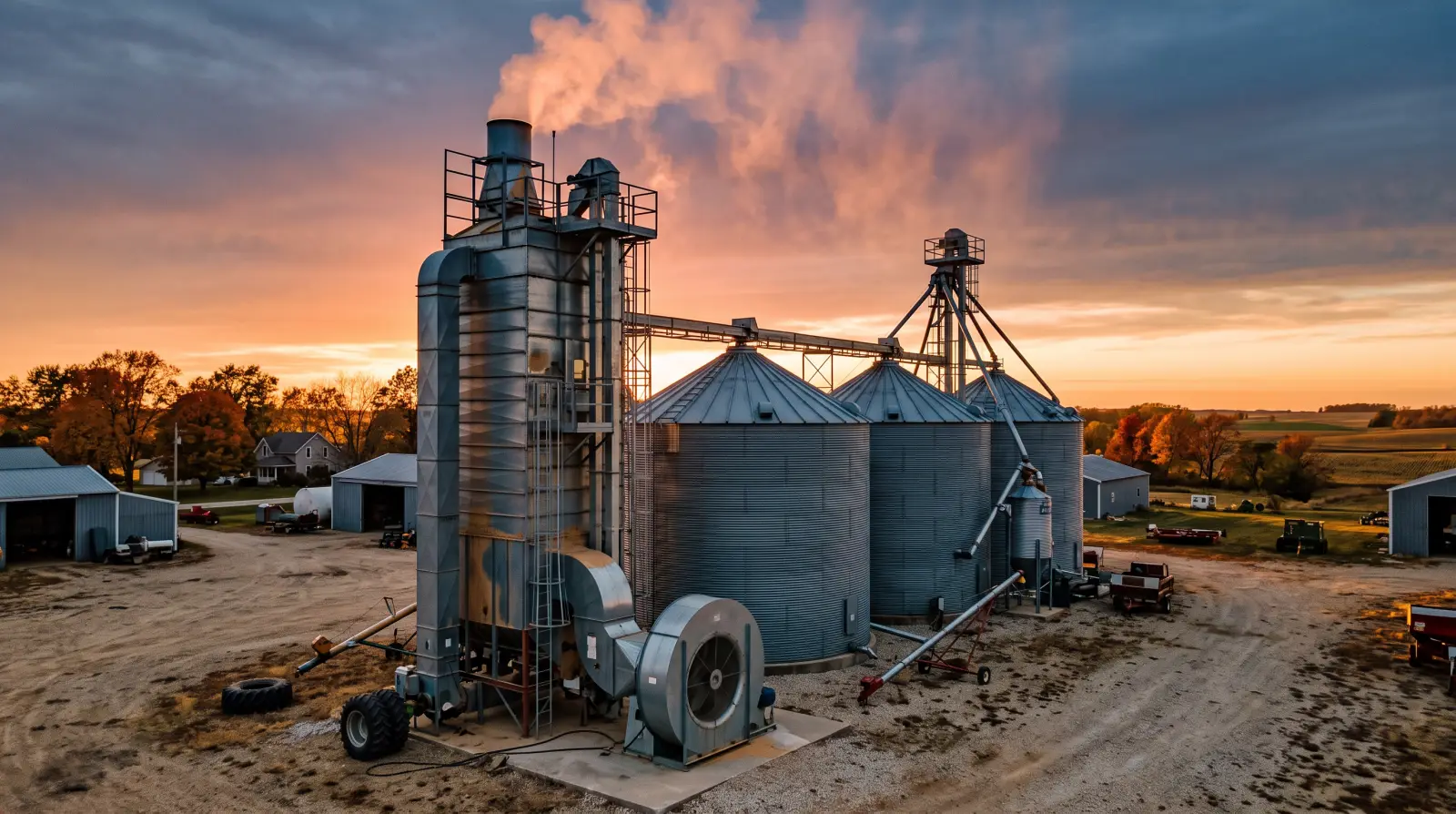
Grain drying is one of the most energy-intensive operations on a corn or soybean farm, and the propane bill at the end of a wet harvest can run into six figures for operations that move significant volume through the dryer. The economics of drying have always been straightforward in principle - take wet grain, add heat and airflow, remove moisture, store dry grain - but the cost structure has gotten more difficult as propane prices have risen, electricity rates have crept up, and the moisture content of grain coming out of the field has trended wetter with the shift toward fuller-season hybrids and the compressed harvest windows that follow late springs. The result is that an operation drying down corn from 22 percent to 15 percent moisture can spend $0.20 to $0.45 per bushel on energy alone, and on a 200,000 bushel operation that single line item is the difference between a comfortable year and a stretched one.
The good news is that the technology for cutting drying energy costs has gotten substantially better in the last decade, and the payback periods on the better upgrades have shortened to the point where they pencil out for operations that would not have considered them five years ago. Heat recovery systems that capture and reuse the warm exhaust air from a dryer can cut fuel consumption by 20 to 35 percent on the right setup. Variable speed drives on dryer fans cut electricity use and can also improve drying uniformity. Smart control systems that modulate burner output, fan speed, and grain flow rate based on real-time moisture sensing reduce overdrying and the wasted fuel that comes with it. None of these are silver bullets and the savings depend heavily on the specific operation, but for the right setup the math has gotten compelling.
This article walks through what is actually happening with grain drying energy in 2026, what the major energy reduction technologies do, what they cost, and how an operation should think about whether and when to invest. It is written for the working operator who runs the dryer themselves or who is making the equipment decisions for their operation, not for the engineers who design dryers or the consultants who optimize them.
Before talking about how to reduce drying energy costs, it helps to understand where the energy goes in a typical drying operation. The major loads are the burner, the fans, and the unloading and handling equipment.
The burner is by far the biggest energy consumer in dollar terms on a propane or natural gas dryer. Removing one point of moisture from a bushel of corn requires roughly 1,500 to 2,000 BTUs of heat at the grain depending on the dryer efficiency, the ambient air conditions, and how much overdrying is happening. Translated to propane, that is roughly 0.018 to 0.022 gallons per bushel per point of moisture removed. Drying down from 22 percent to 15 percent on a single bushel - seven points of moisture - takes 0.13 to 0.15 gallons of propane on a typical setup. At $1.80 per gallon for propane, that is $0.23 to $0.27 per bushel just in fuel. Multiply by 200,000 bushels and the propane bill is $46,000 to $54,000 for a single harvest.
The fans are a smaller dollar cost but a larger percentage cost than they used to be. A typical continuous flow dryer has axial fans pushing or pulling air through the grain column. Total fan motor power on a modern medium-sized dryer is in the range of 50 to 150 horsepower depending on the dryer capacity. Running these fans for the duration of harvest plus dryeration cooldown adds up to thousands of kilowatt-hours per harvest. At commercial electricity rates of $0.10 to $0.16 per kilowatt-hour, the fan electricity cost on a typical operation is $3,000 to $8,000 per harvest, which is significant but not the main event.
The handling equipment - the wet bin auger, the dry bin auger, the dryer fill auger, the unload auger, and any conveyors moving grain between bins - adds another layer of electricity cost that is usually smaller but worth mentioning because the inefficient handling systems waste both electricity and grain quality. Older flighting that is worn out, undersized motors that struggle under load, and chain drives that are worn enough to slip all add up to higher electricity bills and slower grain movement that bottlenecks the rest of the operation.
The total energy bill on a corn drying operation typically breaks down as roughly 80 to 90 percent fuel for the burner, 7 to 12 percent electricity for the fans, and 3 to 8 percent electricity for handling. The dollar savings opportunities follow the same rough proportions, which is why most of the focus on reducing drying energy costs lands on the burner side rather than the electrical side.
Before getting into the energy reduction technologies, it is worth a brief look at the underlying dryer designs because the efficiency numbers vary substantially.
Continuous flow column dryers are the most common design on commercial farm operations of any size. Wet grain enters at the top, passes downward through a heated section and then a cooling section, and exits at the bottom. The heated air passes horizontally through the grain column. These dryers are reasonably efficient on the heated stage but they lose substantial heat to the cooling section because the cooling air carries warm air out of the dryer to ambient. Energy consumption on a typical continuous flow dryer with no heat recovery is in the range of 1,800 to 2,200 BTUs per pound of water removed.
Mixed flow dryers, which use baffle plates to mix the grain as it descends, tend to be slightly more efficient than column dryers because the grain mixing produces more uniform drying and reduces the overdrying that happens to grain on the hot side of a column. The efficiency advantage is typically 5 to 15 percent depending on the operating conditions.
Cross flow dryers, which include some of the older designs still in service, are generally less efficient than current continuous flow designs because the heated air passes through a relatively shallow grain bed and a higher percentage of the heat exits the dryer without being absorbed by the grain. Operations still running older cross flow dryers from the 1980s and earlier are often paying 25 to 40 percent more in fuel per bushel than they would with a current generation continuous flow dryer.
In-bin drying systems use the storage bin as the drying chamber. Air heated by a relatively small burner, or in some cases just ambient air, is pushed through the grain mass over a longer period of time. In-bin systems can be very efficient in dollar terms when ambient conditions allow natural-air drying, but they require more time and more bin capacity than continuous flow systems and they do not work as well for high-moisture grain or compressed harvest windows.
The choice of dryer design is usually a longer-term decision than the operating decisions covered in the rest of this article, but it is the foundation that the operating decisions sit on top of. An operation running an old cross flow dryer that wants to substantially reduce drying energy costs may find that the largest single savings come from replacing the dryer rather than from any of the upgrades discussed below.
Heat recovery is the single biggest opportunity for energy reduction on a continuous flow dryer that does not already have it. The basic idea is straightforward - the warm air leaving the cooling section of the dryer still contains substantial useful heat, and that heat can be captured and used to preheat either the incoming combustion air for the burner or the incoming drying air going into the heated section. Either way, the burner has to do less work to bring the system up to drying temperature.
The savings from heat recovery on a continuous flow dryer are typically in the range of 20 to 35 percent of fuel consumption, with the higher end of the range achievable on dryers with good heat exchanger sizing and on operations that run the dryer at high capacity for long periods. On a 200,000 bushel operation paying $50,000 in propane per harvest, a 25 percent reduction is $12,500 per year. That is the kind of number that pencils out the system in two to four years on most installations.
The hardware is a heat exchanger that sits between the dryer cooling exhaust and the dryer combustion air intake or burner air supply. The exchanger has to handle dusty, moist air on the exhaust side without fouling, which has been the practical limitation on older heat recovery designs. Current generation heat exchangers use designs that are easier to clean and that resist fouling better than the earlier generations, but they still require periodic cleaning to maintain their efficiency. An operation considering heat recovery should plan on adding a maintenance task to the post-harvest checklist.
The major dryer manufacturers all offer heat recovery as an option on new dryers and as a retrofit on existing dryers. The retrofit options vary in how well they integrate with older dryers - some retrofits are clean factory-supported installations and some are awkward bolt-on systems that work but look like an afterthought. The cost of a heat recovery system runs from around $25,000 for a basic retrofit on a small to medium dryer to over $80,000 for a full integrated system on a high-capacity dryer.
The payback calculation depends on the volume going through the dryer, the moisture removed, the fuel cost, and the specific heat recovery efficiency. A reasonable rule of thumb is that operations drying more than 100,000 bushels of corn per year have payback periods of three to five years on heat recovery, while smaller operations have longer paybacks that may not justify the investment. Operations with very high moisture corn, with cold ambient temperatures during drying, and with high fuel costs have shorter paybacks than the average.
A specific consideration that has been getting more attention is the interaction between heat recovery and dryer capacity. Operations that have been running their dryer at capacity during harvest sometimes find that adding heat recovery effectively increases their dryer capacity because the system can dry more grain per unit of fuel input. The capacity increase can be substantial on a fuel-limited operation and can shorten harvest by enough hours to justify the heat recovery system independent of the fuel savings.
The second major opportunity for drying energy reduction is on the electrical side, specifically through variable frequency drives on the dryer fans. Traditional dryer fans run at a single speed determined by the motor and the pulley setup, and the airflow through the dryer is whatever that fan delivers regardless of the actual airflow needs at any given moment.
Variable frequency drives let the fan speed adjust based on the actual operating conditions. During heavy load periods with very wet grain, the fan can run at full speed for maximum airflow. During lighter periods or when the drying conditions are good, the fan can run at lower speeds, using less electricity and often producing better drying uniformity because the air has more contact time with the grain.
The electricity savings from variable speed drives are typically 20 to 40 percent of the dryer fan electricity cost, which on the $3,000 to $8,000 per harvest baseline translates to $600 to $3,200 per harvest in electricity savings. That is not a huge number compared to the fuel savings from heat recovery, but the cost of variable speed drives is also lower - $5,000 to $20,000 depending on the motor sizes and the existing electrical infrastructure - so the payback period is often comparable.
The secondary benefits of variable speed drives are often more valuable than the direct electricity savings. The ability to modulate airflow improves drying uniformity, which reduces the moisture variation between bushels coming out of the dryer. Lower moisture variation reduces the risk of hot spots in storage and reduces the overdrying that happens when the dryer is set for the wettest grain in the column. Better drying uniformity can also let the operator run the dryer at a slightly higher average moisture target without compromising storage stability, which directly reduces fuel consumption.
Variable speed drives also reduce mechanical stress on the fan motors and the supporting equipment. Soft starts and slow ramps replace the hard starts that older direct-on-line motors do, and the reduction in mechanical stress translates to longer motor life and lower maintenance costs. These benefits are hard to put a precise dollar value on but they are real and they accumulate over the life of the equipment.
The installation of variable speed drives requires some electrical work that varies in complexity depending on the existing setup. Most current generation dryers have wiring that is compatible with variable speed drive installation. Older dryers may require additional electrical work, and operations with limited electrical capacity at the dryer location may need service upgrades to support the variable speed drive installation. An operation considering this upgrade should have a qualified industrial electrician evaluate the existing setup before committing to the project.
The third major area of grain drying energy improvement is smart control systems that use real-time moisture sensing and active modulation of dryer operation to reduce overdrying and improve overall efficiency. This is where a lot of the recent technology development has been concentrated.
The fundamental problem these systems solve is that traditional dryer operation depends on operator-set parameters that get adjusted based on periodic moisture testing of the grain coming out of the dryer. Between adjustments, the dryer runs the same setup regardless of what is happening with the grain. Variations in incoming moisture, ambient air conditions, and grain flow rate produce variations in outgoing moisture that the operator addresses by tweaking the setpoint. The result is that some grain gets overdried to compensate for variations in conditions that the operator cannot continuously track.
Smart control systems address this by continuously monitoring moisture content with in-line sensors at the dryer inlet, throughout the drying column, and at the dryer outlet. Based on the real-time readings, the control system modulates the burner output, the grain flow rate, and the fan speed to keep the outgoing moisture as close to target as possible. The reduction in overdrying directly reduces fuel consumption because every point of unnecessary moisture removal costs fuel and bushel weight.
The fuel savings from smart controls are typically in the range of 10 to 25 percent of the baseline fuel consumption, depending on how much overdrying was happening before the upgrade. Operations that ran their dryers conservatively to ensure dry grain at any cost see larger savings than operations that were already running close to their target moisture. The savings stack with heat recovery and variable speed drives - an operation that adds all three can typically reduce drying fuel consumption by 40 to 60 percent compared to the baseline of an unupgraded dryer.
The hardware for smart control includes the moisture sensors, the control system, and the integration with the existing dryer controls. The moisture sensors are typically capacitance-based or microwave-based devices that read moisture in flowing grain. The accuracy and stability of these sensors has improved substantially in the last few years, with current generation sensors maintaining calibration across temperature variations and grain types better than the earlier generations. The control system runs on a dedicated controller that integrates with the dryer manufacturer's existing controls. The integration is usually straightforward on current generation dryers and more involved on older dryers that may need control system updates as part of the smart control installation.
The cost of a full smart control retrofit runs from $15,000 to $50,000 depending on the dryer size and the existing control infrastructure. The payback period on operations drying significant volumes of corn is typically two to four years, which is comparable to the payback on heat recovery. Smart controls also provide operational benefits beyond fuel savings, including reduced operator workload, better drying uniformity, and the ability to capture detailed records of drying operations for later analysis or quality assurance documentation.
A specific consideration with smart control installation is the maintenance and calibration of the moisture sensors over time. The sensors need periodic cleaning and calibration to maintain accuracy. Operations that install smart controls and then neglect the sensor maintenance often find that the system produces less savings than the initial commissioning suggested because the sensors have drifted out of calibration. A well-maintained smart control system delivers consistent fuel savings year after year. A neglected one degrades over time.
A different approach to reducing drying energy cost is to change the drying process itself rather than just optimizing a continuous flow dryer. Dryeration and combination drying have been around for decades but have been getting renewed attention as fuel costs have made the energy efficiency advantages more valuable.
Dryeration involves drying the grain to a moisture level slightly above the target storage moisture - typically two points above the eventual storage target - then transferring the still-warm grain to a holding bin where it is allowed to temper for several hours before being cooled with ambient air. The tempering period allows the moisture to redistribute through the kernel, and the slow cooling phase removes the remaining moisture using ambient air rather than heated air from the dryer. The result is that more of the moisture removal happens at low energy cost.
The fuel savings from dryeration are typically 15 to 25 percent compared to continuous flow drying all the way to storage moisture. The savings depend heavily on the ambient air conditions during the cooling phase and on the size of the dryeration bin relative to the dryer capacity. Operations that can run dryeration effectively often combine it with heat recovery and smart controls for cumulative fuel savings of 50 percent or more.
Combination drying is a related approach that uses the continuous flow dryer for the higher-moisture portion of the drying process and transitions to in-bin natural-air or low-temperature drying for the final moisture removal. This approach works well for operations that have multiple bins available and that have a longer overall drying window. The energy savings can be substantial because the in-bin phase uses much less fuel per point of moisture removed than the continuous flow phase. The trade-off is that the in-bin drying takes longer, requires more bin space, and is more weather-dependent than continuous flow drying.
The choice between continuous flow drying, dryeration, and combination drying depends on the operation's bin capacity, harvest window, average grain moisture, and labor availability. There is no single right answer that applies to all operations. The general principle is that operations with more bin capacity and more flexible harvest timing have more options for using lower-energy drying approaches, while operations with limited bin space and tight harvest windows are usually constrained to higher-energy continuous flow drying.
Before investing in any of the major upgrades discussed above, operations should evaluate whether their current operating practices are getting the most out of their existing equipment. Several common operational improvements can reduce drying energy use by 5 to 15 percent without any capital investment.
Maintaining the burner at proper combustion efficiency is the first item on the list. A burner that has drifted out of its optimal air-to-fuel ratio is wasting fuel even if it appears to be working normally. Annual burner servicing by a qualified technician usually pays for itself in fuel savings several times over. The same applies to the gas pressure regulators, the fuel filters, and the burner nozzles - these components affect combustion efficiency and degrade over time.
Sealing air leaks in the dryer and the surrounding ductwork prevents the burner from heating air that does not pass through the grain. Older dryers in particular often have substantial air leaks at panel seams, around the doors, and at duct connections that can be sealed with appropriate gaskets and sealants. The fuel savings from sealing air leaks vary from negligible on a tight current generation dryer to 5 percent or more on an older dryer that has not been sealed in years.
Operating the dryer at the right capacity for the conditions matters more than many operators realize. A dryer that is running below its design capacity has a higher fixed energy overhead per bushel than one running at capacity. A dryer running above its design capacity may not achieve the target moisture, which forces a slower second pass that wastes more fuel than running at capacity in the first place. The right operating capacity depends on the specific dryer and the incoming grain moisture, but the general principle is to keep the dryer at or near its rated capacity when it is running.
Setting the target moisture appropriately for the storage situation also matters. Drying grain to 14 percent when the storage target is 15 percent costs an extra point of moisture removal that has no benefit. The amount of overdrying that happens out of conservative habit is often substantial. A careful review of actual storage performance and shrinkage can often justify a slightly higher target moisture that reduces fuel consumption without compromising storage stability.
Preheating the grain in cold weather using bin aeration before introducing it to the dryer reduces the burner load. The energy to warm the grain is the same whether it comes from the dryer burner or from ambient air pushed through the bin, but ambient air costs less. This works best when the harvest extends into cold weather and when the operation has bin aeration capacity that can be used for grain warming before drying.
The economics of grain drying energy upgrades depend heavily on the size of the operation and the volume passing through the dryer. The major upgrades have substantial fixed costs that need to be spread over enough bushels to justify the investment.
For operations drying less than 50,000 bushels of corn per year, most of the major upgrades have payback periods that stretch beyond seven years even at current fuel prices. The economics typically favor focusing on operational improvements - burner servicing, air leak sealing, target moisture optimization - rather than major capital investments. Smaller operations often benefit more from sharing dryer capacity with neighboring operations or from using a commercial drying service for the heaviest moisture removal than from upgrading their own dryer.
For operations drying 50,000 to 150,000 bushels per year, the economics start to favor variable speed drives and smart controls but heat recovery is still marginal. The total capital outlay for variable speed drives plus smart controls runs $20,000 to $70,000 with payback periods of three to five years on most operations in this size range. Heat recovery becomes attractive at the upper end of this range, particularly for operations with high-moisture grain or cold drying conditions.
For operations drying 150,000 to 500,000 bushels per year, the full set of upgrades - heat recovery, variable speed drives, and smart controls - typically has payback periods of two to four years and produces substantial total savings. The total capital outlay is $50,000 to $150,000 depending on the specific equipment, and the annual fuel and electricity savings are typically $15,000 to $50,000. Operations in this size range that have not upgraded their dryers in the last decade are usually leaving substantial money on the table.
For operations drying more than 500,000 bushels per year, the upgrades pay back even faster and the total savings can run into six figures annually. Operations at this scale should also be evaluating their dryer capacity relative to their harvest volume, because capacity constraints during harvest produce their own costs through field losses, quality reductions, and harvest extension that can outweigh the direct dryer energy costs.
For operations planning their 2026 harvest preparation, the practical questions are which upgrades to make this season and which to defer.
The lowest-cost, highest-immediate-return action is a thorough pre-harvest dryer service that addresses burner combustion, air leaks, and any deferred maintenance that has accumulated. This work should happen on every operation regardless of whether larger upgrades are in the plan. The cost is typically $1,500 to $5,000 depending on the dryer and the scope of the service, and the fuel savings often exceed the service cost in a single harvest.
For operations that have not upgraded in five or more years, an evaluation of heat recovery, variable speed drives, and smart controls should be on the agenda for 2026 even if the actual installation does not happen until the off-season after harvest. The evaluation involves quotes from the dryer manufacturer or a qualified retrofit installer, a review of the operation's actual fuel and electricity usage records, and a payback calculation based on realistic assumptions about future fuel prices. Operations that complete this evaluation before harvest are positioned to make decisions during the off-season window when installers are most available.
For operations that have already upgraded major components, the focus should be on operational optimization. This includes reviewing target moisture settings, evaluating actual versus theoretical fuel consumption per point of moisture removal, calibrating moisture sensors, and identifying any deviations from optimal operation that have crept in over recent harvests. Operations that already have current generation equipment can often find another 5 to 10 percent in efficiency through operational refinement alone.
For operations contemplating dryer replacement, the 2026 model year offerings from the major manufacturers all include heat recovery, smart controls, and variable speed capability as standard or near-standard features. The capital cost of a new dryer is substantial, but for operations with older equipment that needs replacement anyway, the energy efficiency of the current generation equipment is much better than the equipment from a decade ago and the operating cost reduction can offset a meaningful portion of the capital cost over the life of the equipment.
The bottom line is that grain drying energy is no longer a fixed cost that has to be accepted at whatever the propane bill comes to. The technology and the operational practices for reducing it are available, the economics work for most operations of meaningful size, and the operations that are willing to invest in the upgrades and operate them properly are seeing real and durable savings. The harvest is coming whether the operation is ready or not, and the planning that happens in the spring and summer is what determines how much of that fuel bill is necessary and how much is avoidable waste.
Drying corn from 22 percent down to 15 percent runs about $0.20 to $0.45 per bushel in energy alone. Removing one point of moisture takes roughly 1,500 to 2,000 BTUs at the grain, or about 0.018 to 0.022 gallons of propane per bushel per point. On a 200,000 bushel operation, that single line item can reach $46,000 to $54,000 in a single harvest.
Heat recovery captures warm exhaust from the dryer's cooling section to preheat combustion or drying air, cutting fuel consumption by 20 to 35 percent on a continuous flow dryer. Systems run from about $25,000 for a basic retrofit up to over $80,000 for a full high-capacity install. Operations drying more than 100,000 bushels of corn a year typically see payback in three to five years.
Dryeration means drying grain to about two points above the storage target, then moving the still-warm grain to a holding bin to temper for several hours before cooling it with ambient air. Shifting the final moisture removal to ambient air instead of the burner cuts fuel use by 15 to 25 percent compared with drying all the way down in a continuous flow dryer.
Several operating changes save 5 to 15 percent with no capital outlay. Service the burner annually so its air-to-fuel ratio stays optimal, seal air leaks at panel seams and duct connections, keep the dryer at its rated capacity, and stop overdrying by matching the target moisture to your actual storage need instead of drying to 14 percent when 15 is fine.
Join our list for practical guides on farm tech, precision agriculture, and tools that work.