
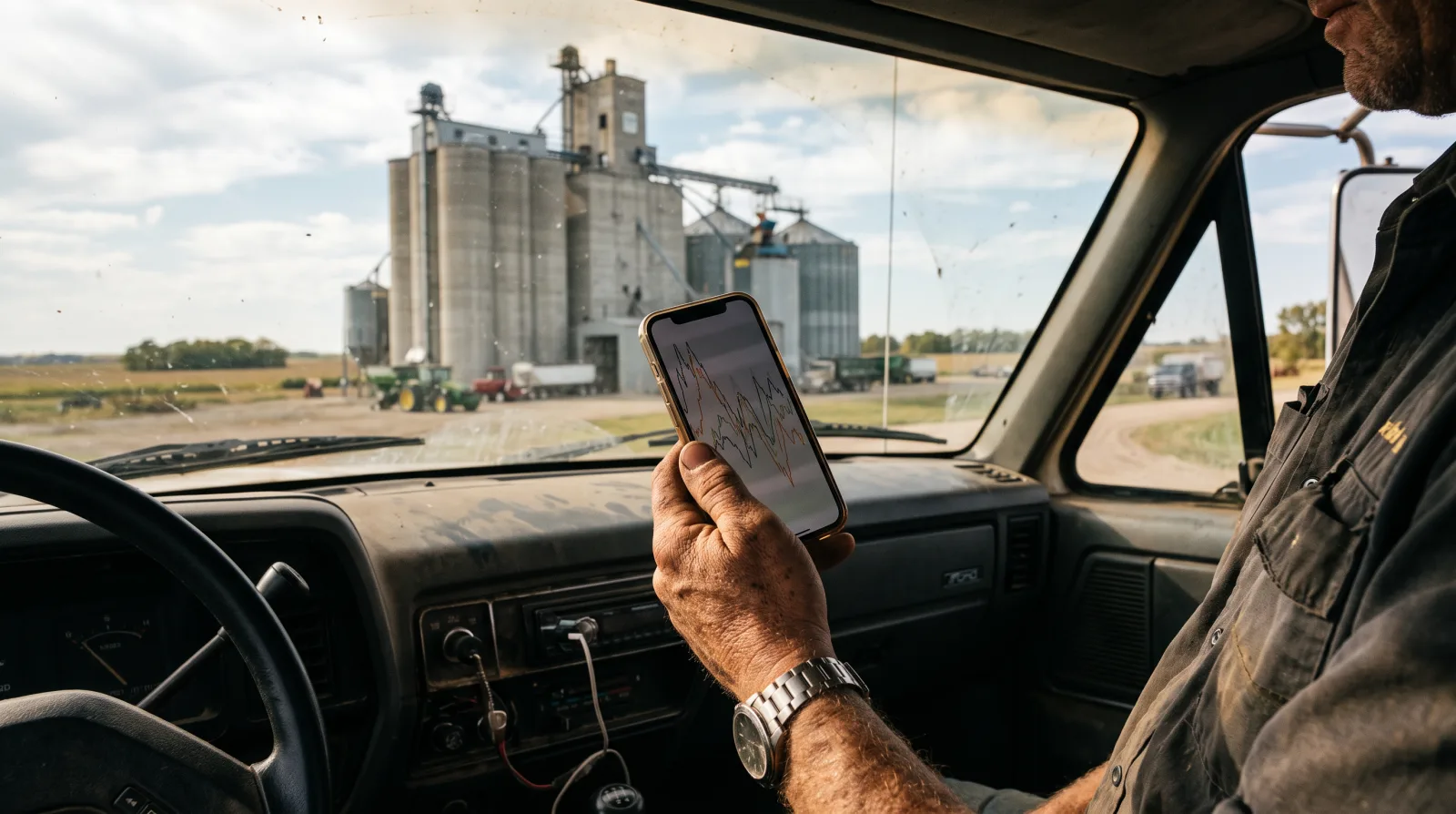
The most useful thing a grain marketing app does is small and unglamorous: it lets a farmer accept a cash bid at nine at night, from the combine cab, the instant the local price hits a number that was decided on weeks earlier. No phone call to the elevator, no waiting for the merchandiser to pick up, no talking yourself into or out of the sale while the market moves. The app pulls the trigger. That is the whole value, and it is worth being clear about it up front, because the apps are very good at the two things a disciplined marketer actually needs - seeing the local basis and acting the moment a target is hit - and they are useless, sometimes worse than useless, in the hands of someone using them to chase prices on emotion. The phone does not make the marketing decision. A written plan does. The app just executes it faster and with less friction than any farmer could on their own.
That distinction matters more in a year like this one. As of the early-2026 USDA outlook, projected marketing-year average prices sit near $4.20 corn, $10.30 soybeans, and $5.00 wheat, while estimated national break-evens run closer to $5.00 corn, $12.27 soybeans, and $7.96 wheat. Read those two rows together and the picture is plain: projected prices below break-even for the major row crops, margins narrow to negative, and a marketing year where catching a brief rally above cost and selling into it immediately is the difference between a profitable season and a loss. Those numbers are projections and they will move with weather and policy, so do not treat them as locked. The durable point is the relationship. When margins are this thin, the farmer who can recognize a short window above break-even and execute on it without hesitation is the one who comes out ahead, and that is precisely the job an offer app with a pre-set target does.
A price target means nothing without a cost of production behind it. A farmer who sets a target of $6.00 corn because it sounds like a good number, with no idea whether the break-even is $4.50 or $5.50, is not marketing - he is guessing. The first move in any marketing plan, and the first thing any of these tools should be wired to, is a hard break-even per bushel and a profit-per-acre figure that includes seed, fertilizer, chemicals, fuel, equipment, land, and labor.
This is where the profit-aware planning tools earn their keep. Programs like Harvest Profit and Bushel Farm pull together input costs, agronomic data, and existing contracts so a farmer sees break-even and profit per acre as a live number, then builds a marketing plan against it and tracks unsold bushels as prices move. The point is not the software for its own sake. The point is that a price target only has meaning relative to your cost of production, and a farmer who knows that number cold can look at a rally and instantly tell whether it is an opportunity or just noise. The ones who lose money in a thin-margin year are often the ones who never pinned down the break-even and so could not recognize a profitable price when it showed up.
The number on the market channel is the futures price, and the futures price is global. The number in your bank account is the cash price, and the cash price is local. The gap between them is basis, and basis is the single most important thing these apps put in a farmer's pocket that a national price quote never could.
Basis is simply the local cash price minus the futures price. If the local elevator is bidding $4.05 and the futures are at $4.40, the basis is minus $0.35, or "35 under." Futures move with the whole world's supply and demand. Basis moves with what is happening within hauling distance of your farm - whether the local elevator is hungry for bushels or already full. At harvest, when every farmer in the county is hauling at once and supply peaks, basis is typically at its widest and weakest, because buyers know that anyone without storage has to sell out of the field. Weeks later, when the harvest rush clears and processors and exporters still need to run, basis tends to narrow. Watching your basis tells you whether today is a day the local market is paying up or paying down, and that is information the futures screen cannot give you.
This is the part the apps do genuinely well. Cash-bid apps give a farmer 24/7 local cash bids and futures, scale tickets, contracts, and the ability to submit and track offers from any device. They are free to the farmer because the grain buyer provides them - the cost lands on the elevator, not on you. The dominant network is Bushel, which by the company's own reporting is used by more than 100,000 farmers and powers 3,500-plus grain and ag-retail facilities, somewhere north of half of U.S. and Canadian grain origination. Those figures are vendor-reported, so take them as the company's count rather than an independent audit, but the scale is real: ADM, CHS through MyCHS, Cargill, and most large originators now expose digital cash bids and offers through this kind of app.
Two other categories round out the picture. Basis-comparison tools, like DTN's local grain bids map, let a farmer compare cash bids across elevators within hauling distance, so you can see who is paying the best basis before you decide where the trucks go. And historical basis tools, like K-State's free Interactive Crop Basis Tool on AgManager.info, show weekly nearby basis going back years for corn, sorghum, soybeans, and wheat by location. That history is what turns today's basis number into a judgment: is minus 35 strong or weak for your area, this time of year? Without the history it is just a number. With it, it is a signal.
If there is one feature that justifies putting these apps on the phone, it is offer management. Instead of calling the elevator and hoping to catch the merchandiser when the price is right, a farmer sets a target price in the app. If the local bid reaches it, the sale executes or queues for the buyer to accept - including after hours, including from the field. It is a standing order on cash grain.
This is the mechanism that turns a written price target into an actual sale, and it is the part that takes the emotion out of the moment. The hardest thing in grain marketing is not knowing what price to sell at. It is selling when the price arrives, because by then the market feels like it is going higher and every instinct says wait. A standing offer removes that moment of doubt entirely. The decision was made when the head was clear; the app just carries it out when the number shows up. ADM, CHS, Cargill, and the rest now expose these digital offers as a standard feature, and for most farmers this is where the real discipline lives.
The app is the trigger. The plan is the gun, and it has to be built deliberately. The standard extension method is straightforward and it works: set an average target above your cost of production, split the crop into equal lots, and set a ladder of price targets around that average. Five lots priced at $5.50, $5.75, $6.00, $6.25, and $6.50 around a $6.00 average is a typical shape. You are not trying to hit the top tick. You are trying to sell consistently into profitable ground and let the ladder catch the range the market actually trades.
Two things make the ladder hold. Put it in writing early, before the season's emotion sets in, and share it with someone - a spouse, a partner, the merchandiser, the banker. Emotions are difficult to suppress without a written plan, and a plan nobody else has seen is easy to quietly abandon. Once the ladder exists, each rung becomes a standing offer in the app. The plan decides; the app executes. That is the entire workflow, and it is why the tools and the discipline are two halves of one thing rather than substitutes for each other.
This is also the point where knowing your acreage precisely starts to pay off, because a laddered plan is built on bushels. If you do not know how many acres are really in each field, you cannot know how many total bushels you are marketing, and you cannot size each lot in the ladder. Manley Farms' free Field Boundary and Input Calculator is built for exactly that first step - accurate acreage that feeds a real production estimate, so each "lot" in the plan represents a number you can stand behind rather than a guess.
Here is where a lot of "best grain app" lists mislead beginners, because they lump two very different things under one word. Everything above is cash marketing - free apps, no margin, no liquidity risk. Hedging with futures and options is a different animal, and it carries a cost the cash apps do not.
Hedging means opening a margin account with a brokerage and taking a futures position that offsets your physical grain. That account is marked to market every day. When the market moves against the position, you get a margin call - a request for more cash to bring the account back up to maintenance margin. A margin call is not a loss. It is the cash-flow cost of the insurance you bought against a price drop, and if the cash grain moves the way you were protecting against, the gain on the grain offsets it. But it is real money that has to be available on short notice, and in a volatile market margin calls can get expensive fast. Farms with thin cash reserves are exactly the ones that struggle to meet them. A futures hedge can absolutely be the right tool, but it needs a funded margin account and a banker who already knows the plan, not a surprise phone call in February. The important thing for a beginner to understand is that the cash-bid app on your phone does not expose you to any of this. The brokerage account does. Keep the two categories separate in your head or you will scare yourself off a free, no-risk tool by confusing it with a margin account.
Hedging does not erase risk; it trades one kind for another. When you lock the futures price with a hedge, you are still exposed to basis - the gap between futures and your local cash price can move between the day you place the hedge and the day you lift it. Your final price ends up being the futures level you locked, plus or minus wherever basis lands. That is why the basis-watching tools matter even more once you start hedging, not less: basis is the one piece you cannot hedge away, so you had better be watching it.
For farmers who want to split the decision without opening a personal margin account, hedge-to-arrive and basis contracts are the middle ground, and the apps increasingly let you initiate them as offer types. A hedge-to-arrive contract locks the futures price now and leaves the basis open to set later. A basis contract does the reverse - locks the basis, leaves the futures open. Both let you price the half of the equation that looks good today through the elevator, with the elevator carrying the margin account instead of you. They are useful, but they are not free of strings. They carry roll fees, service charges, and delivery obligations, and the terms vary by elevator. Read the contract before you sign it, and ask specifically what happens if you cannot deliver.
None of these tools make money on their own, and none of them beat the market. What they do is remove friction and remove emotion, so a farmer can execute a plan instantly instead of fighting the phone and his own second-guessing at the worst possible moment. The marketer who wins is not the one who hits the top. It is the one who consistently locks in profitable returns and avoids decisions made on feeling, and the way you stay disciplined is a written plan with pre-set targets you refuse to move.
Put against the 2026 backdrop, that is not a soft conclusion - it is the year's whole game. With projected prices flirting with break-even, the rallies above cost may be short and they may not come often. The farmer who knows his break-even, watches his local basis, and has each rung of a laddered plan loaded as a standing offer is the one who catches those windows and executes before they close. The technology takes the friction and the emotion out of that moment. It does not supply the judgment, and it never will.
A practical first move costs nothing: nail down your acreage and your real production with the free Field Boundary and Input Calculator, write down a break-even and a laddered target plan against it, and load the first rung as a standing offer the next time you are in the cab. If you want the next of these ag-tech write-ups as it posts, the email signup at the bottom of the page is the place to grab it.
Basis is the local cash price minus the futures price. If the elevator bids $4.05 while futures sit at $4.40, the basis is minus $0.35, or 35 under. Futures move with global supply and demand; basis moves with the local elevator's appetite for bushels. It is typically widest and weakest at harvest, when everyone hauls at once, and narrows as the rush clears.
Yes. Cash-bid apps are free to the farmer because the grain buyer provides them, so the cost lands on the elevator, not on you. The dominant network is Bushel, which by the company's own reporting serves more than 100,000 farmers and powers over 3,500 grain and ag-retail facilities. Those figures are vendor-reported, but the scale across major originators is real.
A hedge-to-arrive contract locks in the futures price now and leaves the basis open to set later; a basis contract does the reverse, locking the basis and leaving the futures open. Both let you price the half that looks good today through the elevator, which carries the margin account instead of you. They carry roll fees, service charges, and delivery obligations, so read the terms first.
Start from your cost of production, then set an average target above break-even and split the crop into equal lots on a price ladder. A typical shape is five lots at $5.50, $5.75, $6.00, $6.25, and $6.50 around a $6.00 average. Load each rung as a standing offer in a cash-bid app so the sale executes the moment the local bid reaches it.
Join our list for practical guides on farm tech, precision agriculture, and tools that work.