
Every summer, barns burn down that did not have to. Fire investigators find the same pattern over and over: hay baled a little too wet, stacked tight, left alone through a hot week, and a few weeks later the middle of the stack is at 180 degrees and starting to smolder. By the time anyone notices the smell, the loss is in the six figures. All of it traces back to one number, the moisture content of the hay when it went in the bale. Hay moisture testing is not a precision agriculture talking point. It is the difference between a safe winter feed supply and a fire call on a Friday night. It is also the difference between hay that grades well and hay that gets docked or rejected. This guide covers what moisture in hay actually means, the methods and tools used to measure it, how to test bales and windrows correctly, what the numbers should be at each stage from cutting to storage, and the practical habits that keep hay fires from happening in the first place.
Hay is alive when it goes in the bale. The plant cells are still respiring, the microbes on the surface are still active, and water is the fuel that keeps both processes running. Dry hay - below about 15 percent moisture - does not have enough water to support much microbial activity, and the bale is stable. Wet hay is a different story. Above about 20 percent moisture, microbes start working hard, heat builds up inside the bale, and the feed value of the hay starts to drop. At 25 to 30 percent, dry matter losses can run 10 percent or more in storage, and the risk of serious heating is real. Above 30 percent, fermentation, mold, and the risk of spontaneous combustion all climb fast.
The exact thresholds depend on bale size and density. A 40-pound small square can tolerate higher moisture than a 1,500-pound round bale, because the square bale can shed heat. A tight big square packed into a shed has almost no way to lose heat from its core, so the same moisture that would be fine in a small bale can cook the inside of a big one. This is why the general rule of thumb of "20 percent is the cutoff" is not one rule but three, depending on what you are baling into.
Miss these numbers by a few points and the hay gets moldy and loses feed value. Miss them by a lot and the bale self-heats into a fire hazard.
Knowing why hay heats helps in spotting problems early. When wet hay goes into a bale, the plant respiration and the microbial activity both produce heat. As the temperature climbs into the 120 to 140 degree Fahrenheit range, mesophilic microbes start to die off, but thermophilic microbes take over and keep producing heat up to around 170 degrees. Above that, biological activity slows. But a new process kicks in: chemical oxidation. The hay itself, especially the nonstructural carbohydrates and certain proteins, starts oxidizing and generating heat without any microbes involved. That chemical heating can push temperatures from 180 to 250 degrees. Somewhere in that range, hot spots can ignite. The exact ignition point depends on the hay, the bale density, and the availability of oxygen, but fires in stored hay that reached 200 degrees internal temperature and were not disturbed have been documented many times.
The sequence matters. Hay does not just get hot and catch fire. It goes through biological heating first, then chemical heating, and each phase takes time. A bale that hits 150 degrees on day five and does not come down is on a trajectory to ignite in the next two to four weeks. That is why daily temperature checks during the first three weeks of storage are the single best fire prevention habit a hay operation can have.
There is no single "right" way to test hay moisture. There are several methods, and each one trades off accuracy, speed, cost, and where in the workflow it fits. The operations that avoid hay fires use two or three methods together, because any one of them can give a misleading reading on its own.
The gold standard for hay moisture is oven drying. You take a known weight of hay, dry it in an oven at a controlled temperature for a known time, weigh it again, and calculate the moisture from the weight loss. Laboratory methods specify 100 to 105 degrees Celsius for 24 hours, or a Koster tester at higher heat for about 30 minutes.
This is the method every other method is calibrated against. It is also too slow for real-time baling decisions. Nobody puts the baler on hold for 24 hours to find out if the windrow was ready. What oven drying is good for is calibrating the meters and sensors you rely on, and for verifying moisture when grading or pricing hay. A Koster tester - a small countertop unit with a heating element, a fan, and a scale - gives oven-grade accuracy in about 30 minutes and is worth having on any commercial hay operation. Expect $400 to $700 for a new Koster or equivalent.
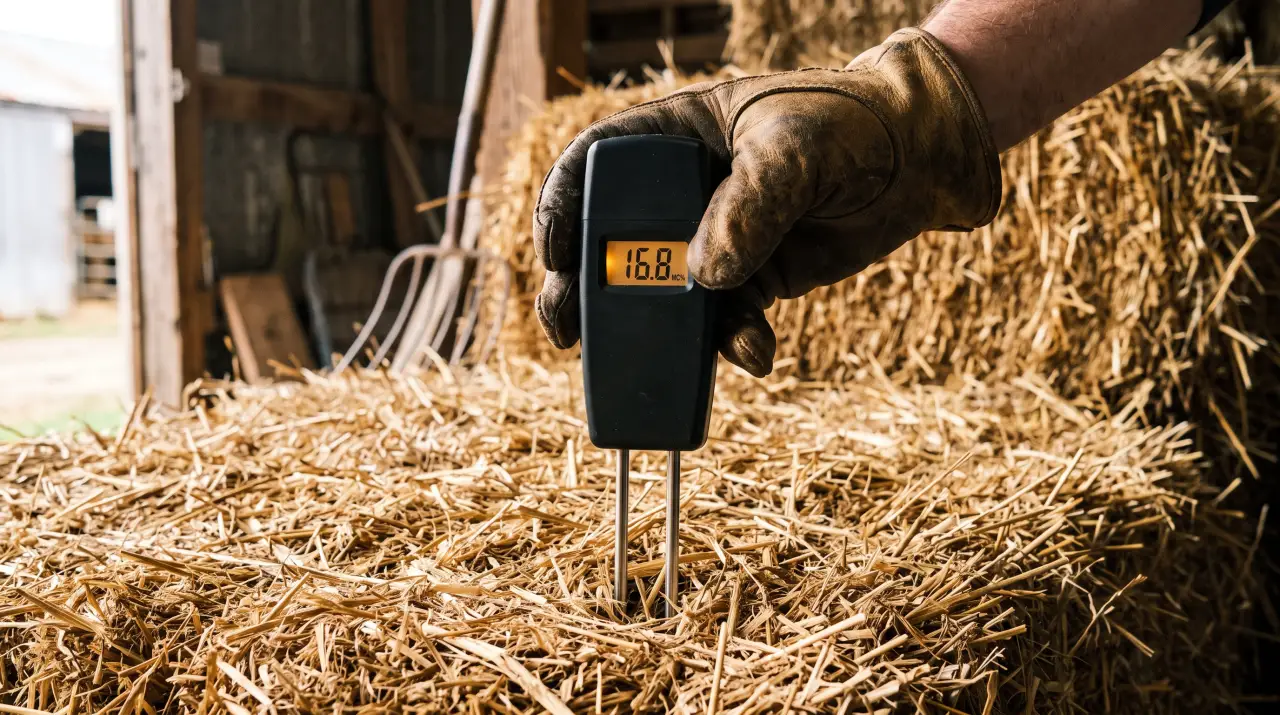
Handheld probes are the workhorses of in-field and in-storage hay testing. They work by measuring the electrical resistance or capacitance of the hay between two probe tips or along a single long probe. More water means lower resistance, and the meter translates the reading into a moisture percentage.
Handheld probes come in two main styles:
The practical accuracy of a quality handheld probe is plus or minus 1 to 2 percentage points in the 12 to 25 percent range, which is exactly the range that matters. Below 10 percent and above 30 percent, handheld probes get noticeably less reliable. This is not a problem for most hay decisions, because those extremes are either safely dry or obviously too wet.
Popular brands worth looking at:
The next step up is a moisture sensor built into the baler itself. Most major baler manufacturers - John Deere, New Holland, Case IH, Vermeer, Krone - offer factory or aftermarket moisture sensors that read the hay as it flows through the bale chamber. The reading is displayed in the tractor cab in real time, updated every few seconds, and can be logged to a bale-by-bale record.
The advantage is obvious: you see moisture trending too high before you have made ten thousand dollars of wet bales. You can shut the baler down, wait for the windrow to dry another hour, or swath around a damp low spot in the field.
The limitation is that the sensor sees the hay only at the moment it passes through the chamber, which is not exactly the core moisture of the finished bale. A windrow that was raked damp ten minutes before baling can have pockets of wetter material that the sensor reads through briefly and averages out. For this reason, baler-mounted sensors should be paired with a handheld probe check on the first few finished bales from a field. If the two readings agree within a point or two, the baler sensor is trustworthy for the rest of the field.
Baler-mounted sensors with bale-by-bale logging also let you flag individual wet bales for separate storage, which is a powerful practice. Wet bales get set aside, fed first, or sold locally for quick consumption rather than buried in the middle of a stack that will sit for six months.
On large commercial hay operations, the baler is often coupled with a hay preservative applicator. These systems inject a buffered propionic acid solution onto the hay as it enters the bale chamber, inhibiting mold growth and allowing hay to be baled at moisture levels several points higher than otherwise safe. Propionic acid applicators typically target bale moisture in the 18 to 25 percent range and apply more product as moisture rises.
The moisture sensor that controls the applicator is doing the same job as the sensor mentioned above, but it is now driving a pump instead of just displaying a number. The accuracy requirement is correspondingly higher. Calibrate these systems against a known reference, like a Koster test, at the start of every season and any time the sensor is replaced.
Preservatives are not a substitute for drying hay. They are a tool for squeezing out of a difficult weather window, for getting ahead of a storm, or for maintaining schedule on a big commercial operation. Used correctly, they prevent mold and heating in hay that would otherwise spoil. Used as a crutch for lazy drydown practices, they cost more than they save.
Once hay is in the stack, a different tool comes out. A bale core sampler is a hollow steel tube, usually 18 to 36 inches long, that you drill into the side of a bale with a cordless drill or a brace. It pulls a core sample of hay from the interior. That sample can be tested on the spot with a handheld probe, packed in a bag for lab testing, or used for feed quality analysis.
Core sampling is essential for hay that is being bought, sold, or fed to high-value livestock. Surface moisture and core moisture are often several points apart, and a surface-only reading can badly misrepresent the true state of a bale. A proper core sample, taken from multiple sides of multiple bales in a lot, gives a representative picture.
Common cores include the Penn State forage sampler, the Colorado, and the Best Harvest corer. Expect $150 to $350 for the tube, plus a decent cordless drill to run it. For large operations, a battery-powered sampler dedicated to the job is worth the investment.
Moisture is not a single reading. It is a moving number from the moment the hay is cut until the moment it is fed. Each stage has its own target.
Fresh alfalfa is 75 to 80 percent moisture on the stem. Grass hay runs 65 to 75 percent. That much water has to leave the plant before the hay is safe to bale. The testing at this stage is not moisture measurement but observation: check the maturity of the crop, check the weather window, and estimate how long the drydown will take. In hot, dry weather with good wind, alfalfa can go from standing to bale-ready in 48 to 60 hours. In cool, humid weather, the same crop can take five or six days and may need rain protection in between.
After cutting, the crop loses water fast for the first day, then the rate slows as the remaining water is bound up tighter in the plant tissues. Conditioning the crop - running it through a mower-conditioner that cracks the stems - speeds up the drydown significantly. Tedding or raking a day or two after cutting turns the windrow over and exposes wetter material to the sun and wind.
Moisture testing at this stage is primarily done by hand feel and by experience. The hay feels dry when crumpled, the stems snap cleanly rather than bending, and the color has shifted from green to the dull olive-gray of properly cured hay. A handheld probe pushed into the windrow gives a rough number, and "rough" is the right word - windrow moisture varies dramatically between the top of the row and the bottom, where the hay is still pressed against the ground. The windrow number is best treated as a go/no-go screen, not a precise measurement.
The target depends on bale type:
Test the windrow in several places before pulling the baler into the field. A dozen spot checks with a long handheld probe take five minutes and can save you from a whole field of ruined bales. Pay attention to low spots, shady edges, and anywhere the windrow is doubled up, because those will read higher than the open field.
Bale a few dozen test bales, then stop and check the first ones with a handheld probe in the core. If the baler has a moisture sensor, compare its reading to the probe reading. Adjust as needed before committing the whole field.
The most critical testing window is right after baling. Bales lose surface moisture quickly in the open air, but the core can go the other way. In a fresh small square, the core may start at the baler reading and stay there or drift slightly up over the first day as internal moisture equalizes. In a big round or a large square, the core can spend the first three to five days equilibrating, and sometimes heating in the process.
Check core temperatures and moisture in a representative sample of bales every day for the first week. The cheapest way is an electronic probe thermometer, a three or four foot stainless steel probe with a digital readout, inserted into the core of several bales in the stack. Check the same bales each day and write down the temperatures. The pattern tells you what is happening inside.
Normal pattern: core temperature rises from ambient to 100 to 120 degrees Fahrenheit over the first two to four days, then stabilizes and starts to drop. This is routine respiration heating.
Warning pattern: core temperature rises past 130 degrees, stays there, or keeps climbing. This is biological heating that is not self-limiting. At 140 degrees, the hay has lost meaningful feed value. At 150 degrees and climbing, you have a potential fire.
Danger pattern: core temperature above 160 degrees. At this point, move the hay immediately - outside, away from buildings, with fire equipment on standby. Pulling a smoldering bale apart exposes fresh hot material to oxygen and can trigger active flame. Never pull apart a bale hotter than 175 degrees without the fire department present.
Once a stack has cooled and settled through the first three to four weeks, the risk of heating drops sharply. Routine temperature checks can stretch to once a week, then once a month. But moisture should still be tested on any bale that is suspect - showing discoloration, a sour or sweet fermented smell, visible mold, or condensation on the outside. These are signs that either the original bale moisture was too high or that water has gotten into the bale from a leaky roof, ground contact, or condensation under a tarp.
Hay that has been in storage for more than three months and shows no heating is generally safe. The remaining risks at that point are mold damage from residual moisture and physical damage from rodents, roof leaks, or a badly stacked pile shifting.
A practical hay operation follows a repeatable moisture testing workflow. Here is what one looks like.
The test equipment budget to run this workflow properly is not large. A handheld probe, a Koster tester, a long thermometer probe, and a bale core sampler together run about $1,000 to $1,500. For an operation putting up a thousand tons of hay a year, that equipment pays for itself the first time it catches a wet stack before it catches fire.
Moisture testing is the input. Storage is what protects the investment.
Hay on bare ground wicks moisture up from the soil. A tarp or a layer of gravel is not enough. Use pallets, a layer of old tires, treated lumber runners, or a raised concrete pad. The bottom layer of any stack should never touch the ground.
A real roof with airflow beats a tarp almost every time. Tarps trap condensation against the hay, and the top bale of a tarped stack can rot even when the rest of the stack is fine. If tarps are the only option, use breathable hay tarps designed for the job, tie them loosely to allow air movement, and check them after every storm.
A stack in an enclosed shed with no airflow can heat and trap moisture. A stack under a roof with open sides and airflow through the stack can shed heat and moisture even when bales are at the high end of the moisture range. Build stacks with gaps for air movement, and site hay sheds so prevailing winds can pass through.
Any bale that tested high at baling, any bale that got rained on in the windrow, or any bale with visible mold or off-smell goes in a separate stack. These are the bales to watch and the bales to feed first. Burying a wet bale in the middle of a clean stack is how one suspect bale becomes an insurance claim.
For commercial operations with large indoor stacks, install permanent thermometer probes in the core of strategic bales, or use a wireless hay temperature monitoring system. Several companies now make wireless temperature probes designed for hay stacks, with alerts when temperatures climb past setpoints. The systems run a few hundred dollars for a basic multi-bale setup to a few thousand for a large barn with many probes. On a barn full of big squares worth $100,000 in feed value, the math is not close.
Every operation that stores hay should have a written plan for hot hay. The Penn State Extension and most university extension services publish clear temperature-action tables. At 130 degrees, check more often. At 150 degrees, start moving hay out of the stack. At 175, call the fire department before you disturb anything. Hay fires in storage are not like structure fires. They start in the core of a stack, and exposing them to air often makes them flare up violently. Fire departments trained in hay fires bring in heavy equipment to pull bales apart outdoors with water standing by.
A few patterns show up over and over in hay fires and hay losses. Avoiding them is cheap.
Hay moisture testing is not expensive and it is not hard. A handheld probe and a little discipline will catch the problems that matter. A Koster tester and a core sampler turn a hay operation from reactive to professional. The payoff is not glamorous - there is no trophy for the hay that did not catch fire and the feed value that did not degrade. But the operations that take moisture seriously year after year sell more hay at better prices, feed better hay through the winter, and do not have the conversation with the insurance adjuster on the day after the barn burned. That is the business case. The equipment is cheap. The habits are simple. The alternative is one of the most preventable disasters in agriculture, and it still happens every summer because somebody thought the hay was close enough.
It depends on the bale. Small squares bale safely between 16 and 20 percent, round bales between 14 and 18 percent, and large squares between 12 and 16 percent because their density sheds heat the worst. Test the windrow in ten to twelve spots before baling, and probe the core of the first finished bales to confirm before committing the whole field.
Hay heats in stages. Biological activity drives the core to around 170 degrees, then chemical oxidation can push it from 180 to 250 degrees, where hot spots ignite. Check core temperatures daily for the first three weeks; at 150 and climbing you have a potential fire, and above 175 degrees never pull a bale apart without the fire department present.
A quality handheld probe reads within plus or minus 1 to 2 percentage points across the 12 to 25 percent range that matters most for baling decisions. It gets noticeably less reliable below 10 and above 30 percent. For a reference-grade number, a Koster tester gives oven-grade accuracy in about 30 minutes and is worth $400 to $700 on a commercial operation.
Somewhat. Buffered propionic acid applicators inhibit mold and let hay be baled in the 18 to 25 percent moisture range, but the product buys about four or five points, not ten. A stack of 28 percent hay with preservative on it is still a fire risk. Preservatives beat a tight weather window; they do not replace proper drydown.
Join our list for practical guides on farm tech, precision agriculture, and tools that work.