
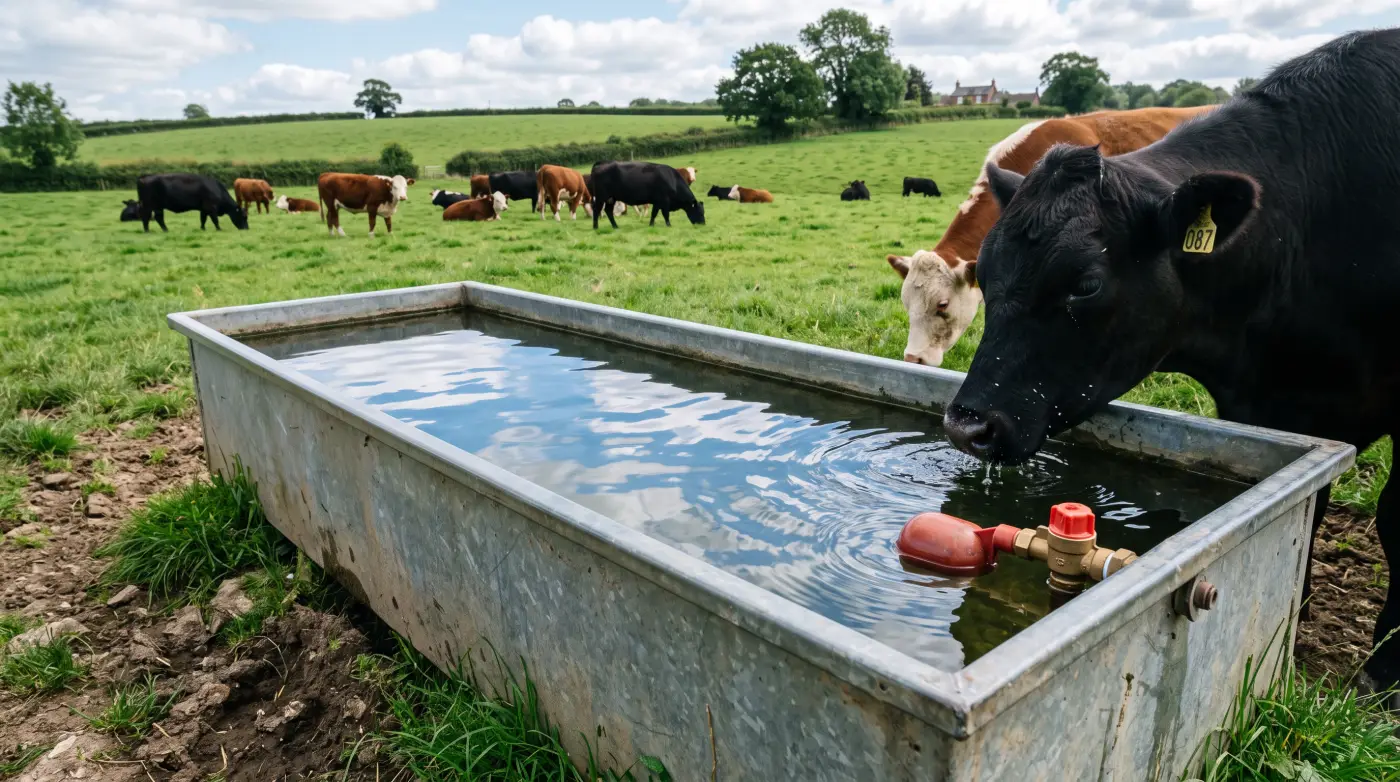
Water is the single largest daily intake of any livestock operation, and the one input that a healthy animal cannot skip for even a day. A dry lactating cow will produce twenty gallons of milk a day and drink thirty. A beef steer will drink ten to fifteen gallons in summer heat. A thousand head of cattle on a hot August afternoon can pull twelve thousand gallons before sundown. When the water stops, the herd stops gaining, stops producing, and within a day or two starts breaking fences looking for a creek. A well-designed livestock water system is not a luxury. It is the spine of the operation. This guide walks through how to size a system for real demand, how to choose between gravity, pressure, and pumped layouts, how to automate the parts that matter, how to keep water flowing through a hard freeze, and how to maintain the whole thing on a working farm budget.
Before you size anything, you need honest numbers on daily demand. The university charts are a starting point, but they underestimate peak summer intake and they almost always assume clean, cool water with unrestricted access. Real herds on real pastures drink more than the charts say, especially when the only water is warm, dirty, or far from where they graze.
Multiply by your herd or flock count and you have a rough daily total. Then multiply by 1.5. That is your summer peak day. Systems sized for average consumption fail on the days that matter most.
The number that actually drives system design is not the gallons per day. It is the gallons per minute the system must deliver when the whole herd decides to drink at once. Cattle are social drinkers. When one cow walks to the tank, the rest of the herd follows. A group of fifty cows can empty a 100-gallon tank in under ten minutes. If the refill rate is only 5 gallons per minute, the second half of the herd walks up to a mud puddle, drinks what they can, and leaves dehydrated.
A good rule of thumb for cattle is one drinking space for every 15 to 20 head, and a refill rate that can keep the tank full during a ten-minute peak event. For a 60-cow herd that means at least three drinking spaces and a delivery rate of 8 to 12 gallons per minute into the tank. Undersizing peak flow is the number one mistake on new water systems. The pipe looks big enough on paper until you watch the tank go dry at 4 pm on a hot Saturday.
Every livestock water system starts with a source. The source dictates pressure, volume, quality, and cost of every piece downstream.
A dedicated livestock well is the most common setup on row-crop country and mixed farms. Sizing the well is a conversation with your driller, but the number you care about is sustained yield, not peak yield. A well that pumps 10 gallons per minute for five minutes and then drops to 3 is not a 10 GPM well for a livestock system. It is a 3 GPM well with a bucket at the top. Ask for a four-hour pump test result and design around the sustained number. If sustained yield is below your peak demand, you need a storage tank to bridge the gap.
If a rural water line runs past the farm, tapping in is often cheaper than drilling, and the water is already treated. The catch is meter rates and peak flow limits. Some rural districts cap flow at 5 or 10 GPM per tap, which is fine for a house but too slow for a cattle tank that serves a hundred head. Verify the meter's maximum flow and plan storage accordingly. Also verify the pressure. Rural districts often run 35 to 50 PSI, which is enough for most surface systems but may not reach the hilltop pasture without a booster pump.
A developed spring is the cheapest water on the farm. A spring box with an overflow pipe can gravity-feed a tank all year with zero energy cost, zero maintenance after the install, and zero meter bill. The work is in the development. A properly developed spring has a collection box set into the hillside above the spring head, a sealed lid, an overflow, and a fenced protection zone to keep livestock from trampling the source. Sloppy spring developments silt up, get contaminated, and freeze in winter. A good one runs for fifty years.
Creek and pond water can water livestock legally in most states, but direct access destroys banks, contaminates the water, and increases parasite load. A pump-to-tank system with fenced banks solves all three problems. Solar pumps, ram pumps, and small gasoline pumps all have a place depending on elevation and cost tolerance.
On farms without reliable groundwater, catchment from barn and shed roofs is a real option. A 2,000 square foot metal roof catches about 1,200 gallons per inch of rain. With proper gutters, a first-flush diverter, and a 5,000 to 10,000 gallon storage tank, a catchment system can water a small herd through most of a normal year. The failure mode is drought. Always have a backup source.
Once you have a source, you need to move the water to where the animals are. The three basic system types are gravity, pressure, and pumped, and most real farms combine them.
If your source is higher than your tanks, gravity does the work for free. A spring on a ridge above a valley pasture can feed half a dozen tanks with no pump, no pressure switch, and no electricity. The rules are simple. You need about one PSI for every 2.3 feet of elevation drop. A tank 50 feet below the source sees about 22 PSI at the inlet, which is plenty for a float valve. Undersized pipe kills a gravity system fast. Use one-inch minimum pipe for any run over 200 feet, and step up to 1.25 or 1.5 inch for long runs or multiple tanks. Air locks are the other gravity killer. Install air relief valves at every high point.
Pressure systems use a pump and a pressure tank to maintain steady PSI at the tank. The standard setup is a submersible well pump, a 20 to 40 gallon pressure tank, a pressure switch set around 30/50 PSI, and a distribution line out to the tanks. This is the most common setup on modern farms because it handles hills, multiple tanks, and varying demand without any thought from the operator.
The common mistake is undersizing the pressure tank for a herd that drinks in waves. A 20-gallon pressure tank cycles the pump every time two cows drink. A cycling pump burns out in a year. Oversize the pressure tank to 40 or 80 gallons for livestock duty, or better, add a large atmospheric storage tank after the pressure tank so the pump runs long cycles to refill storage instead of short cycles to refill tanks.
The best system on most working farms is a pump-to-storage-to-gravity layout. Pump from the well or source into a large elevated or hilltop storage tank, usually 2,500 to 10,000 gallons, then gravity-feed from storage to the drinkers. The pump runs full cycles for an hour or two at a time, which is far easier on the motor than short cycling. Storage buffers against pump failure and power outages. Gravity distribution has no pressure fluctuation, no water hammer, and no pressure tank to worry about.
Solar pumping fits this layout perfectly. A solar submersible pump with no battery bank can fill a storage tank during daylight and the storage feeds the drinkers 24 hours a day. A 1 HP solar pump with a 400 watt panel array will move 500 to 1,500 gallons a day into storage at shallow lifts, which covers most small to medium herds. No grid connection, no diesel, no fuel bill.
The drinker - the actual vessel the animals put their mouths in - is where most daily operational headaches live. Tank choice depends on species, climate, herd size, and how much automation you are willing to buy.
The simple open tank is still the workhorse of most beef operations. A 100 to 300 gallon poly or steel tank with a float valve is cheap, durable, and easy to clean. The float valve is the weak link. Cheap brass float valves stick, leak, and freeze. Spend $25 to $40 on a Jobe or Hudson valve with a stainless steel needle and a full-flow design rated for at least 10 GPM, and buy two so you always have a spare in the shop.
Open tanks have two problems. They grow algae in summer and they freeze in winter. Shading the tank, adding a biological scrub brush, and cleaning weekly in hot weather keeps algae under control. Freeze protection is a bigger topic covered below.
Ball-valve and paddle-style automatic waterers cover the water surface with a float ball or a hinged cover that the animal pushes down to drink. The cover cuts evaporation, slows freezing, and reduces contamination from manure and feed. Models from Ritchie, Miraco, Franklin, and Drinking Post range from $400 to $1,500 depending on capacity and heating options.
For beef cattle the Ritchie OmniFount and Miraco Pro models are the standard. Capacity runs from 5 to 35 gallons, with a refill rate matched to typical herd sizes. The covered design almost eliminates algae, and most models accept a thermostatically controlled heating element for winter.
Energy-free waterers use ground heat and insulation to keep water flowing in winter without electricity or a heating element. Brands like Drinking Post, Bar Bar A, and Cobett Water Systems use a geothermal loop that pulls enough heat from the ground below frost line to keep a small drinking opening ice-free. They work well down to roughly minus 20 degrees on a protected site with steady daily use, and they save the operating cost of a heated waterer. The catch is installation. The water line has to come up from below frost line inside an insulated column, and the unit needs steady daily animal traffic to keep the drinking opening active. An energy-free waterer in a pasture that sees use once a week will freeze.
Nipple drinkers are the standard for pigs and poultry because they waste almost no water and stay clean. A pig nipple drinker delivers water on demand when the animal bites the nipple, with no standing water to contaminate. Poultry drinker lines run across the length of the barn with a nipple every few feet. Both require regulated low-pressure water, typically 5 to 15 PSI, so a pressure regulator on the supply line is mandatory. Too much pressure and the drinkers leak. Too little and the animals cannot get enough flow.
Automation in livestock water systems is not about fancy gadgets. It is about eliminating the morning and evening trips to check float valves, break ice, and refill tanks. Every chore the system handles on its own is fifteen minutes of your day back.
The first automation is a reliable float valve. A good float valve with the right orifice size, installed correctly and protected from the animals, runs for years without attention. Mount it in a baffled compartment at one end of the tank so animals cannot push it, snag it on a horn, or break the arm. Use a brass stem with a stainless steel seat and a plastic float. Brass floats corrode. Plastic with a brass arm is the right combination.
For about $150 you can add an ultrasonic level sensor and a cellular gateway that texts you when a tank drops below a threshold or stops refilling. Brands like Valley Irrigation, FarmBot, and Monnit sell purpose-built livestock tank monitors that run on small solar panels and cellular modems. The monitor catches a stuck float valve, a burst pipe, or a dry well before the herd stands at an empty tank. On a farm where the far pasture is twenty minutes away, this is one of the highest-return pieces of hardware on the place.
A simple inline flow meter on the main supply line shows daily water use for the whole operation. Dairy and feedlot operations have used flow meters for decades to track herd health - a drop in water intake is often the first sign of an outbreak. On a smaller beef or mixed operation a flow meter is still useful for catching leaks. Water that leaves the meter but never arrives at a tank is a pipe problem somewhere in between.
Solenoid valves on the supply lines to individual tanks let you shut off pastures remotely. This matters in rotational grazing where you want a tank dry when the herd is not on that paddock. It matters more in winter, when shutting off a line and letting it drain prevents freeze damage. Rachio and OpenSprinkler zones, sold for lawn irrigation, work fine for cattle water zones with a little wiring work.
Cold weather is where livestock water systems earn their keep or fail catastrophically. A frozen line on a minus 10 morning is not an inconvenience. It is a crisis that pulls you out of bed at 5 am with a propane torch and a pair of frostbit fingers.
The rule is to bury supply lines at least one foot below the local frost line. In the northern plains that is four feet. In the mid-South it is 30 to 36 inches. In the deep South and desert Southwest two feet is often enough. The cost of going deeper than you think you need is measured in inches. The cost of going too shallow is measured in split pipes every February. Trench deep, backfill with sand or screened soil, and mark the line with an electronic tracer wire or buried warning tape so you can find it again.
The riser - the vertical pipe that brings water from below frost line up to the tank - is where most freeze failures happen. Insulate it inside a foam column and surround that column with a protective sleeve. Pre-built livestock hydrants like the Woodford Y34 and the Merrill C-1000 use a self-draining design that empties the riser every time the valve closes, so there is no water sitting in the vertical section to freeze. Installed deep enough and shut off properly, they run for decades in any climate.
A slow trickle of water keeps a tank from freezing. Overflow drains set up to keep water moving through the tank use the arriving water's thermal mass to resist ice. In a climate with mild winters this is the cheapest freeze protection available, and the overflow can be routed to a stock pond or subsurface drain so water is not wasted. In colder climates, you need a real heat source or an energy-free geothermal design.
Electric tank heaters range from $30 sink-style elements to $200 thermostatically controlled heated tanks. A 1,500 watt heater on a 100 gallon tank keeps water liquid down to about 10 below. Watch the amperage draw - a long extension cord on a cheap heater is a fire risk and a voltage drop problem both. Hard-wire the heater on its own circuit with a GFCI breaker. Check the cord daily in winter. Cattle chew them, mice nest in them, and a damaged cord in a wet environment is how barns burn down.
Propane tank heaters exist and work well in remote pastures without power, but they are fussier than electric units and the propane bottle needs watching.
Any supply line that sees winter needs a manual drain valve at the low point so the line can be emptied before a hard freeze or before the pasture is abandoned for the season. A frozen dead-end is a guaranteed split. An empty pipe cannot freeze.
The ideal water system layout connects every paddock and loafing area with a buried main line, puts drinkers where the animals already want to be, and leaves room to expand. Here is how to think about it.
Start with a map of the property with gates, fencelines, waterers, and elevation. A free tool like Google Earth is enough for most farms. Mark the source, the proposed main line route, and every planned drinker location. Then walk the line with a tape measure and a level to verify distances and elevation changes. Maps lie about elevation. Walk it.
For most farm mains, 1.25 or 1.5 inch polyethylene pipe is the sweet spot. It is cheap, tough, and handles flow for up to 5,000 feet without significant pressure loss at typical livestock demand. Go bigger if you are running a high-demand system like a dairy or feedlot with sustained flow over 20 GPM. Go smaller only for short branch lines of under 200 feet. Pipe is cheap. Trenching is not. Never save money on pipe size when the trench is already open.
If budget allows, loop the main line so every drinker can be fed from two directions. A looped system handles a broken pipe gracefully - shut a valve and run on the other leg while you dig up the break. A dead-end system loses every downstream tank when the pipe splits. Loops add maybe 20 percent to the pipe cost and cut your fire drills in half.
Every 500 feet along the main line, install a tee and a curb stop. A tee with a plug costs almost nothing when the trench is open. Digging a new tee into a buried live line later costs a day of labor and a backhoe rental. You will add a paddock in five years. Plan for it now.
A few practical lessons that separate a system that works from one that does not.
Real numbers for a small to mid-sized beef operation, using 2026 material and regional labor costs.
A complete water system for a 60-head cow/calf operation with three pastures and full automation typically runs $12,000 to $25,000 if the source is already developed. Half that if you phase it in over three seasons. Twice that if you are starting from bare dirt with a new well and miles of main line.
A working livestock water system needs a short, consistent maintenance routine. Skipping maintenance is how systems fail on the worst possible day.
A well-built system, maintained on this schedule, runs quietly for twenty years. Water arrives when the animals want it, at the flow they need, at a temperature they will drink, in a tank that is not full of algae or ice or mud. That is what good livestock water infrastructure looks like. It does not draw attention to itself. It just works, day in and day out, so the herd can drink and you can get on with the rest of the farm.
A dry beef cow drinks 8 to 12 gallons per day in mild weather and 15 to 20 gallons once temperatures climb above 80 degrees. A lactating cow needs 11 to 18 gallons in mild weather and up to 25 in heat. Size the system for the summer peak by multiplying average daily demand by 1.5, since systems built for average consumption fail on the hottest days.
Bury supply lines at least one foot below the local frost line. In the northern plains that means about four feet down; in the mid-South, 30 to 36 inches; and in the deep South or desert Southwest, two feet is often enough. Backfill with sand or screened soil and mark the run with tracer wire, because going too shallow splits pipes every February.
For most farm mains, 1.25 or 1.5 inch polyethylene pipe is the sweet spot. It is cheap, tough, and carries typical livestock demand up to 5,000 feet without significant pressure loss. Step up only for high-demand dairy or feedlot systems running sustained flow over 20 gallons per minute, and drop to smaller pipe only for short branch lines under 200 feet.
Energy-free waterers use a geothermal loop that pulls heat from the ground below the frost line, combined with heavy insulation, to keep a small drinking opening ice-free without electricity. Brands like Bar Bar A and Cobett work down to roughly minus 20 degrees on a protected site, but they need steady daily animal traffic; a unit used only once a week will freeze.
Join our list for practical guides on farm tech, precision agriculture, and tools that work.