
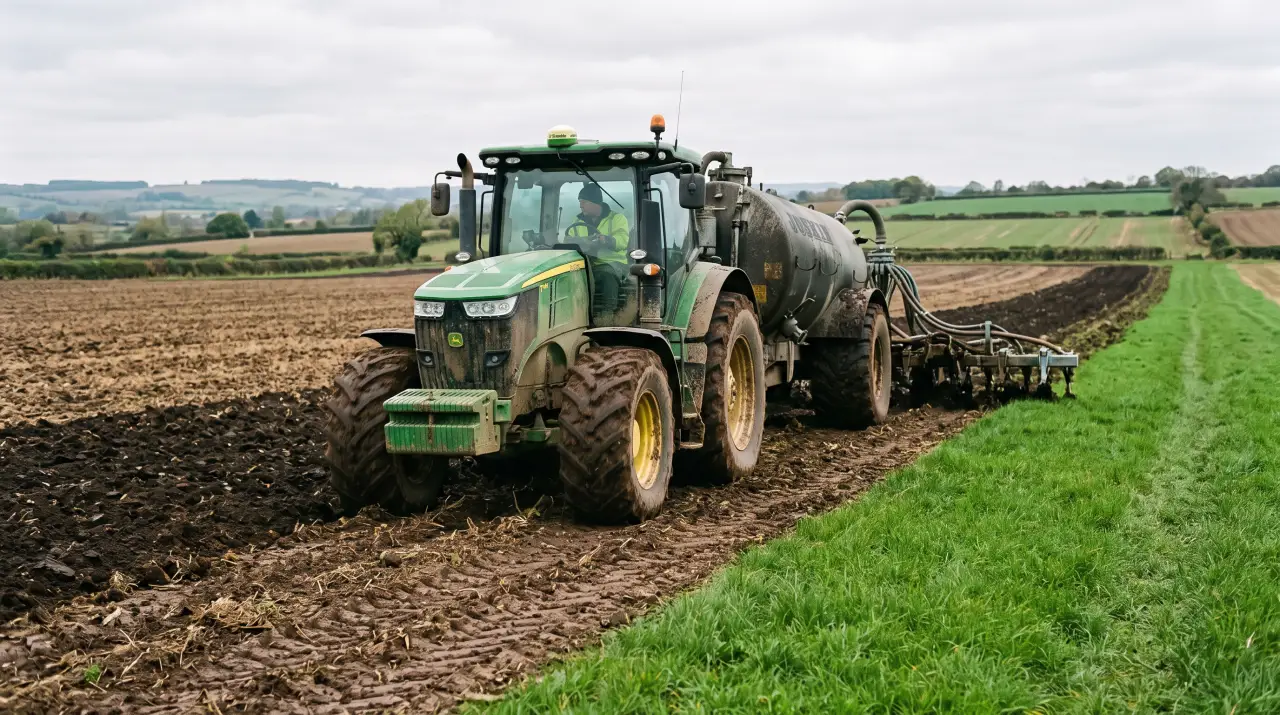
Manure has gone from a nuisance the livestock side of an operation had to deal with to a measurable input that the cropping side of the same operation increasingly tracks like commercial fertilizer. The shift has been driven by three things happening at once - rising commercial fertilizer prices that have made the nutrients in manure genuinely valuable, tightening state and federal nutrient management regulations that require documentation of what gets applied where, and a generation of sensors and software that finally make the documentation practical without doubling the labor on the spreader. The result is that operations that used to dump manure on the closest field at whatever rate the spreader happened to be set for now run application maps, log per-acre rates, and treat the manure pit or pile like a commodity inventory.
This article walks through what is actually working in 2026 for operations of different sizes, what the major sensor and software categories do, what they cost, and where the genuine value is versus where the marketing has gotten ahead of the technology. It is written for the operator who handles manure on a working livestock or mixed operation, not for the consultants who write nutrient management plans for a living. The focus is on practical decisions about what to install, what to skip, and how to make the regulatory paperwork easier without the technology costing more than it saves.
Three forces have made manure management substantially more complex over the last decade, and understanding them is the starting point for understanding why the sensor and software market exists the way it does today.
The first is commercial fertilizer pricing. Anhydrous ammonia, urea, MAP, DAP, and potash have all moved through wider price swings in the last few years than at any point in the previous two decades. The nitrogen, phosphorus, and potassium content of manure that used to be valued at maybe ten to twenty dollars per ton on dairy slurry or thirty to forty dollars per ton on dry poultry litter has at times been worth two to three times that. Operations that used to treat manure as a disposal problem have started treating it as a fertilizer asset. Once it is an asset, knowing the actual nutrient content and the application rate matters in the same way it would for purchased fertilizer.
The second is regulation. The federal CAFO rules and the state-level nutrient management plan requirements that flow from them have become more specific about what operations of different sizes must document. The thresholds vary by state and by livestock species, but the general direction is toward more documentation, more frequent soil and manure testing, and more granular records of what was applied where and when. Operations that used to file a one-page annual summary now file detailed application records and field-by-field nutrient balances. The paperwork has gotten heavy enough that handling it manually is genuinely impractical for operations above a certain size.
The third is the rural neighbor problem. Operations that used to be surrounded by other working farms now often have residential development encroaching on their boundaries, and complaints about odor, runoff, and traffic have become a routine part of operating. Documentation of best management practices is the operator's primary defense when complaints turn into investigations or lawsuits. Being able to produce records showing the application rate, the timing relative to weather forecasts, the setbacks from waterways, and the soil test calls for the fields receiving manure is the difference between a quick resolution and an expensive one.
The intersection of these three forces is what has driven the manure management technology market forward. Operators want the nutrient value of their manure quantified so they can reduce purchased fertilizer. Regulators want documentation showing the operation is following its plan. Neighbors want assurance the operation is being managed responsibly. The same set of sensors and software addresses all three, which is why even operations that started installing the technology for one of those reasons usually end up benefiting from it across all three.
The most common entry point into manure management technology for dairy and swine operations is storage sensors on the manure pit, lagoon, or above-ground tank. The basic problem these sensors solve is knowing how much liquid manure is in storage at any given time, which matters for application planning, for emergency overflow prevention, and for documenting that storage capacity has not been exceeded.
Float-based level sensors are the simplest and oldest approach. A float sits on the surface of the liquid, connected by a cable or rod to a sensor that reads the position. These work reasonably well on tanks but tend to have problems on lagoons because the surface crust can interfere with the float and because debris and stratification can produce false readings. Float sensors cost a few hundred dollars each and require minimal infrastructure. They are still the right choice for many small to medium operations.
Ultrasonic level sensors mounted above the liquid surface bounce sound waves off the surface to measure the distance from the sensor to the liquid. These avoid the float issues but they have their own problems with foam, with the surface crust on lagoons, and with cold weather operation. Current generation ultrasonic sensors handle these conditions better than the earlier ones did, but a sensor mounted above an active lagoon still requires periodic checking to confirm it is reading correctly. Cost is in the range of $500 to $2,000 per sensor depending on the range and the environmental ratings.
Hydrostatic pressure sensors, mounted at the bottom of the tank or pit, measure the pressure of the liquid column above them and convert that to a depth reading. These tend to be the most reliable for liquid manure because they are not affected by surface conditions, but they require installation through the tank wall or through a sample port and they need protection against the corrosive and abrasive nature of manure. Industrial pressure transducers rated for slurry service cost $1,000 to $4,000 per sensor and the installation typically adds another $500 to $1,500 depending on the access points available.
Radar level sensors are the newer option that combines some of the advantages of ultrasonic with better performance through foam, dust, and crust. These have come down in price significantly in the last few years and are now in the same general range as good ultrasonic sensors. For new installations on lagoons or open-top tanks, radar is increasingly the default choice.
The data from any of these sensors is most useful when it feeds into a monitoring system that can provide alerts, log historical levels, and integrate with other operational data. Cellular gateways that read the sensors and push data to a cloud platform have become the standard approach. Monthly subscription costs for the cellular service and the platform are typically $20 to $80 per month per site. Operations with reliable on-farm internet can use Wi-Fi or wired connections instead, but cellular is often more reliable for outdoor sensor installations far from the farm office.
The practical value of storage level monitoring shows up in three ways. First, it eliminates the surprise of a pit or lagoon being closer to capacity than expected, which matters most in fall before winter when application options narrow. Second, it provides a baseline for the volume calculations that go into nutrient management planning, which tends to make the plan more accurate. Third, it provides the documentation that the storage is being managed within capacity, which is exactly what regulators and inspectors look for.
Knowing the volume of manure in storage is only useful for nutrient management if the nutrient content of that manure is also known. Traditional manure testing involves pulling samples, sending them to a lab, and getting back results several days later showing nitrogen, phosphorus, potassium, dry matter, and other parameters. Lab testing remains the gold standard and the basis for most nutrient management planning, but it has limitations - the samples have to be representative, the results lag the actual application by days, and the cost of frequent testing adds up.
Real-time manure composition sensors that mount on the spreader or the application equipment have moved from research curiosity to commercial reality over the last few years, though they remain expensive enough that they are still mostly seen on larger operations. The two main approaches are near-infrared spectroscopy, which uses light absorption patterns to estimate composition, and electrical conductivity combined with temperature and density measurements, which uses the relationships between those parameters to estimate nitrogen and dry matter content.
NIR sensors for manure applications cost in the range of $20,000 to $50,000 depending on the configuration and the integration with the spreader controls. They produce continuous readings of nitrogen, phosphorus, potassium, and dry matter as the manure flows through the application system. The accuracy varies with calibration and with the type of manure, but well-calibrated NIR systems can provide composition readings that are within ten to fifteen percent of lab values for the major nutrients. That accuracy is good enough for variable-rate application and for documentation purposes, though it is still recommended to do periodic lab testing as a check on the sensor calibration.
Conductivity-based sensors are less expensive, in the range of $5,000 to $15,000, and they primarily measure ammonium nitrogen content with reasonable accuracy. They are less precise than NIR for the other nutrients but they are more rugged and easier to maintain, which makes them a reasonable choice for operations that primarily care about nitrogen tracking and that do not need the full nutrient profile in real time.
The decision about whether to invest in real-time composition sensing depends on the size of the operation and on how the manure is being used. Operations applying large volumes of manure across many fields with variable nutrient targets benefit from the real-time information because it lets them calibrate application rates to actual composition rather than assumed composition. Operations applying smaller volumes to fewer fields can usually get most of the benefit from periodic lab testing combined with documented spreader calibration, at much lower cost.
The technology that has had the largest practical impact on manure management for cropping operations is application mapping combined with variable-rate spreader control. The basic idea parallels what variable-rate fertilizer and seed applications have been doing for years - using GPS positioning combined with a prescription map to vary the application rate across a field based on the specific needs of each zone.
For manure applications, the prescription maps are typically built from soil test results showing nutrient levels across the field, combined with yield maps showing productive and less productive zones, and with any restricted areas like setbacks from waterways or wells. The result is a map that calls for different application rates in different parts of the field, with the goal of matching the manure nutrients to the actual nutrient needs and avoiding both under-application in nutrient-deficient zones and over-application in zones that are already adequately supplied.
The hardware for variable-rate manure application includes a GPS receiver, a controller that compares the current field position against the prescription map, and a spreader with the actuators needed to vary the application rate in response to controller commands. On a slurry tanker, the rate is varied by changing the pump speed and the ground speed in coordinated fashion. On a dry manure spreader, the rate is varied by changing the apron speed, the beater speed, and the gate position.
The cost of retrofit variable-rate systems on existing manure equipment varies widely depending on the equipment and the desired functionality. Simple rate control systems that work from a single rate target start around $5,000 to $10,000. Full variable-rate systems with prescription map support and detailed application logging run $15,000 to $35,000 for the controllers and software, plus whatever modifications are needed on the spreader itself. New high-end manure equipment from the major manufacturers comes with variable-rate capability built in, which has moved the practical price point down considerably for operations that are buying equipment anyway.
The value of variable-rate application has two main components. The agronomic value is the better matching of nutrients to crop needs, which improves yield consistency and reduces the risk of either nutrient deficiency in some zones or over-application that pushes nutrients beyond what the crop can use. The regulatory and stewardship value is the documentation that the application followed the prescription, which directly addresses the nutrient management plan requirements that operations of any significant size now operate under.
The honest assessment is that variable-rate manure application provides significant value on operations with substantial within-field nutrient variability and significant manure volumes to apply, and provides modest value on operations with relatively uniform fields or limited manure volumes. Operations that have been doing grid soil sampling and seeing meaningful zone-to-zone variation in their fields are the natural fit. Operations that have not done detailed soil sampling should usually start there before investing in variable-rate equipment.
The administrative side of manure management has been transformed by software that handles the calculations, documentation, and reporting that nutrient management plans require. What used to be a paper-and-spreadsheet process maintained by a consultant or an extension office is now handled by purpose-built software that integrates with the field operations data and produces the required reports automatically.
The main features of nutrient management software include field-by-field nutrient budget calculations that compare available nutrients against crop needs, manure application planning that allocates available manure inventory across fields based on the budget calculations, application logging that records what was actually applied where and when, soil and manure test management that tracks the test results that feed into the calculations, and reporting tools that produce the documentation required by state and federal regulations.
The software market includes a mix of standalone nutrient management products, modules that bolt onto larger farm management software platforms, and consultant-operated services where the operator provides data and the consultant runs the software. Pricing varies widely - standalone software subscriptions run $300 to $2,000 per year depending on operation size and feature set, modules within larger platforms add to whatever the base platform costs, and consultant services typically charge per hour or per acre for plan development and updates.
The integration with field operations data is where the value differs the most between options. Software that can pull application records directly from a tractor or spreader controller, soil test results directly from the lab's data feed, and weather records directly from a nearby weather station produces records that are largely automatic and usually accurate. Software that requires manual data entry for each application, each soil test, and each weather event produces records that are technically functional but that depend entirely on the operator remembering to enter the data correctly and consistently.
The decision about which software to use is largely a decision about how much of the operation's other systems are already in a particular ecosystem. An operation that already uses a particular tractor manufacturer's data platform for cropping decisions usually benefits from using that manufacturer's nutrient management module. An operation that uses an independent farm management platform for cropping decisions usually benefits from using the nutrient management module within that platform. An operation that does not use any farm management platform usually benefits from a standalone nutrient management product or from a consultant-operated service.
A specific consideration is the data ownership and portability question. Operations should understand what happens to their nutrient management records if they switch software platforms - whether the records can be exported in usable form, whether historical records remain accessible, and whether the software vendor can use the data for purposes beyond running the operation's plan. The major platforms have different positions on these questions and the differences matter for operations planning to be on the same platform for many years.
A specific area where technology has improved dramatically is the management of setbacks and restricted areas where manure cannot be applied. State and federal rules typically specify minimum distances from waterways, wells, sinkholes, drinking water sources, residential properties, and other sensitive features. The rules also typically restrict applications during certain weather conditions, on frozen or snow-covered ground, and within certain time windows before and after expected precipitation.
Traditional management of these restrictions depended on the operator knowing where the restricted areas were on each field and judging the weather conditions on application day. The result was reasonably good compliance on operations with experienced operators and conscientious management, and meaningful violations on operations where the operators did not know exactly where the boundaries were or did not have the time to adjust application plans for changing weather conditions.
Current systems use GPS-defined restriction zones loaded into the application controller, which automatically shuts off the spreader when it crosses into a restricted area. The same systems can integrate with weather data feeds to provide alerts about forecast precipitation that would trigger an application restriction, or to log the weather conditions at the time of each application. The combination of automated boundary management and integrated weather data substantially reduces the risk of accidental violations and produces detailed records of compliance for documentation purposes.
The practical implementation requires the restricted areas to be mapped accurately, which usually means walking the boundaries with a survey-grade GPS unit or having a consultant produce the maps. Once the maps exist, they can be loaded into the application controller and used across all operations that touch those fields. The mapping cost is typically $500 to $2,000 per operation depending on the field count and complexity, which is a one-time cost that pays for itself the first time it prevents a violation.
A consideration that often gets overlooked is the interaction between restriction maps and equipment width. A spreader that shuts off based on the controller position may still be applying manure into the restricted area if the application width is wide enough that the edges of the application zone extend past the controller position. Properly configured systems account for the application width and shut off the spreader far enough before the restriction boundary that the actual application stops at the right place. Configuring this correctly requires attention during the system setup, and it is worth verifying through a controlled test before relying on the system in production.
Operations that move manure off-farm to neighboring cropland, to commercial buyers, or to custom applicators face a coordination problem that is more complex than the on-farm application case. The manure leaves the operation's records when it leaves the property, but the regulatory and contractual obligations often follow it to the application site. Tracking what went where, in what quantity, with what nutrient content, becomes essential for both operational planning and regulatory compliance.
Hauling and custom application software addresses this with tools for managing the relationships between the manure source operation, the trucking and application contractors, and the receiving fields and operations. The features include load tracking that records each truckload from the source through to the application field, contract management that handles the agreements between the source operation and the receiving operations, application records that document the rate and location of each application, and billing and settlement that handles the financial side of the relationships.
The technology stack typically includes truck-mounted GPS and telemetry that records hauling routes and timing, electronic scales or volumetric measurement at the loading and unloading points, and the same kind of variable-rate application equipment that on-farm operations use. The data from all of these sources flows into a central platform that produces the records and reports needed by all the parties involved.
The value of these systems shows up most clearly on operations that move significant volumes of manure off-farm or that operate as custom applicators serving multiple source operations. The administrative complexity of tracking dozens or hundreds of loads per week through manual processes is high enough that the labor savings alone often justify the technology investment. The improved documentation also addresses the regulatory exposure that follows manure from the source operation to the application site, which is increasingly a focus area for state environmental agencies.
A consideration specific to custom application is the relationship management with the receiving operations. Custom applicators that can provide their customers with detailed application records, including the manure composition, the application rate, the field-by-field maps, and the weather conditions at the time of application, deliver more value than ones that just show up and apply manure. The technology that produces these records is also the technology that justifies higher pricing for the application service, which is part of the business case on the custom application side.
The right manure management technology for a specific operation depends heavily on the size, the manure volume, and the regulatory environment the operation works in. A few rough guidelines based on what is actually working in 2026.
Small to medium dairy and swine operations with under 500 animal units typically benefit most from basic storage level monitoring and from nutrient management software that handles the documentation requirements. The investment is modest, often under $5,000 in hardware plus a software subscription, and the value is clear in both labor savings and regulatory compliance. Variable-rate application equipment usually does not pencil out at this scale unless the operation is buying new application equipment anyway.
Medium to large dairy and swine operations with 500 to 2,000 animal units typically benefit from the storage monitoring and software plus selective investment in application mapping and variable-rate capability. The hardware investment is in the $20,000 to $60,000 range plus software, and the payback period is typically three to seven years on a combination of fertilizer savings, regulatory compliance value, and operational efficiency gains. Real-time composition sensors are still usually optional at this scale.
Large operations with over 2,000 animal units typically benefit from the full technology stack including storage monitoring, real-time composition sensing, full variable-rate application, integrated weather data, and comprehensive software. The investment runs $75,000 to $200,000 or more depending on the equipment, and the payback period is typically two to five years on a combination of factors. At this scale, the technology is often required for practical operation rather than a discretionary improvement.
Beef cattle operations have a different set of considerations because the manure is typically dry rather than liquid and because the application timing is more flexible. The storage monitoring is less relevant because the storage is open piles rather than tanks or lagoons, but the application mapping, variable-rate capability, and software are all valuable. The technology investment is typically lower than the equivalent dairy or swine operation, but the agronomic and regulatory value is comparable.
Poultry operations face their own specific considerations because of the high nutrient density of the manure and the substantial off-farm hauling that most poultry operations rely on. The hauling and custom application coordination software is often the most important technology investment for poultry operations, along with storage management for the litter handling facilities and detailed composition tracking because of the variability in poultry litter nutrient content.
Not every piece of manure management technology delivers value, and operations should be selective about what they invest in.
Real-time GPS tracking of every spreader load is overkill for most operations. The data volume is high, the value is limited beyond the regulatory documentation that simpler systems already provide, and the equipment cost is significant. Operations that need this level of tracking usually know they need it because of specific contractual or regulatory requirements.
Drone-based manure pile measurement has been promoted as a way to track dry manure inventory, and it works technically, but the practical value is limited compared to the cost. Periodic estimation through other means is usually adequate for inventory purposes, and drone surveys add operational complexity without providing much actionable information.
Continuous lagoon water quality monitoring with multiple sensor parameters has been pushed by some technology vendors as a way to manage lagoon biology and prevent issues. The reality is that experienced operators manage their lagoons effectively without the sensor data, and the sensor systems require enough maintenance that they often produce more false alarms than useful information. Operations that have specific lagoon management problems should address those problems directly rather than expecting sensor data to solve them.
Predictive analytics dashboards that promise to forecast manure inventory, application opportunities, and nutrient dynamics have proliferated in the last few years. The underlying calculations are usually reasonable but the predictions are only as good as the input data, and in most operations the input data is sparse enough that the predictions are not significantly better than what an experienced operator already knows. The value of these dashboards is real for the largest operations with extensive sensor networks, but it is limited for operations that do not have the data infrastructure to feed them properly.
The general principle is that manure management technology pays off most when it solves a specific problem the operation actually has, and pays off least when it provides general information that does not change any specific decision. Operations should start by identifying the specific decisions where better information would meaningfully improve outcomes, and then invest in the technology that produces that specific information rather than trying to instrument everything.
The shift from manure as a disposal problem to manure as a measured input has been one of the more substantive changes in the way livestock operations work in the last decade. The technology that supports this shift has matured from a collection of expensive and finicky tools into a reasonably reliable set of options that work for operations of various sizes and types. The economics have improved as commercial fertilizer prices have made the nutrients in manure more valuable, and the regulatory environment has made the documentation more important.
For an operator deciding where to start, the highest-leverage investment for most operations is software for nutrient management planning combined with whatever storage monitoring fits the specific operation's manure handling system. These two together address the regulatory paperwork burden, provide a foundation for everything else that gets added later, and pay back the investment within a year or two on most operations. From there, the next step is usually field setback and restriction management followed by application mapping and variable-rate capability when the operation is ready for that level of investment.
The operations that get the most value from this technology are the ones that integrate it into how they actually work rather than treating it as a separate system that gets attended to only when paperwork is due. Daily attention to the storage levels, regular review of the nutrient budgets, prompt logging of applications, and consistent maintenance of the sensors and equipment all add up to a system that actually delivers the savings and compliance value it promises. Operations that install the technology and then neglect it usually get a fraction of the potential value, and sometimes get worse outcomes than they would have with simpler manual processes that they actually maintained.
The good news for operators considering where to start is that the technology has gotten reliable enough, the software has gotten capable enough, and the data integration has gotten smooth enough that the implementation effort is much lower than it was even five years ago. The remaining work is mostly operator decisions about which problems to solve first and which systems to standardize on, rather than fundamental technical risk about whether the equipment will work as advertised.
The nitrogen, phosphorus, and potassium in dairy slurry has typically been valued around $10 to $20 per ton, and dry poultry litter around $30 to $40 per ton. When commercial fertilizer prices spiked in recent years, that content was at times worth two to three times as much, which is what turned manure from a disposal problem into a fertilizer asset worth measuring and tracking.
Four types are common. Float sensors cost a few hundred dollars but struggle with lagoon crust. Ultrasonic sensors run $500 to $2,000 and can be fooled by foam. Hydrostatic pressure sensors, at $1,000 to $4,000 plus installation, ignore surface conditions and are the most reliable for liquid manure. Radar sensors handle foam and crust well and have recently dropped into the ultrasonic price range.
Well-calibrated near-infrared sensors read nitrogen, phosphorus, potassium, and dry matter within about ten to fifteen percent of lab values, at a cost of $20,000 to $50,000. Cheaper conductivity-based sensors, running $5,000 to $15,000, mainly track ammonium nitrogen with reasonable accuracy. Periodic lab testing is still recommended as a check on the sensor calibration.
It pays off on operations with substantial within-field nutrient variability and large manure volumes, and offers only modest value on uniform fields or small volumes. Full retrofit systems with prescription-map support and application logging run $15,000 to $35,000, plus spreader modifications. Operations that have not done grid soil sampling should usually start there before buying variable-rate equipment.
Join our list for practical guides on farm tech, precision agriculture, and tools that work.