
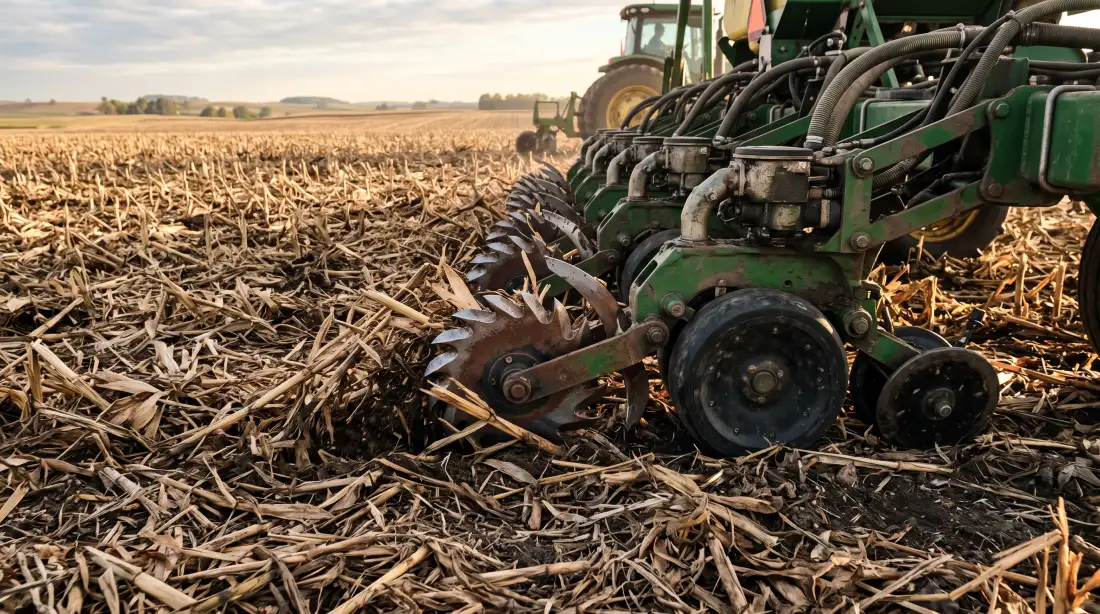
No-till is not a philosophy, it is a production system. It trades tillage passes for residue management, seed placement accuracy, and a different approach to weed and fertility programs. Done well, it cuts fuel, saves time, reduces erosion, and builds resilient soils that handle weather extremes better than tilled ground. Done poorly, it creates compaction, weed escapes, and poor emergence that can set a farm back two or three seasons. This guide walks through what actually changes when you go no-till - the equipment you need, the economics to expect, and how to plan a transition that does not blow up your rotation.
No-till, in the strict sense, means planting a cash crop directly into undisturbed soil and residue from the previous crop. No pre-plant tillage. No field cultivator, no disk, no chisel. The seed is placed into a narrow slot opened by a coulter or disk opener, closed by a press wheel, and left to emerge through surface residue.
Strict no-till is one end of a spectrum. Most farms that describe themselves as no-till are somewhere on the conservation tillage scale, which runs from full tillage at one end to continuous no-till with cover crops at the other. In between you find:
The reason this matters is because the label means less than the practice. You can run a no-till planter into cold, wet, compacted ground and get a bad stand. You can run a vertical tillage tool into heavy residue and get a great stand. The system that works is the one that balances residue, soil conditions, and seed placement for the crop you are planting.
Most farmers who switch to no-till do it for a mix of three reasons: cost, soil, and time.
Tillage burns fuel and wears iron. A full tillage pass with a chisel plow or field cultivator can run anywhere from 0.5 to 1.5 gallons of diesel per acre per pass, and most tilled systems involve three to six passes per year before planting. At fuel prices anywhere above $3.00 per gallon, that stacks up fast. Add labor, equipment depreciation, and repair costs, and a typical conventional tillage program costs $30 to $70 per acre per year before seed ever goes in the ground. A mature no-till program can cut that by 60 to 80 percent on machinery and fuel alone, though some of those savings get spent on residue management, better planters, and sometimes an extra herbicide pass.
Tillage breaks down soil structure. It buries residue, speeds organic matter loss, and leaves the surface exposed to rain and wind. Over time, aggressive tillage can create compaction layers, reduce infiltration, and lower water-holding capacity. No-till reverses much of that. Leaving residue on the surface protects the soil from raindrops, keeps aggregates intact, and lets organic matter accumulate in the top few inches. Farms that stay in continuous no-till for a decade or more often see measurable gains in soil organic matter, infiltration rate, and spring soil trafficability.
Tillage is a time sink. A field that needs three pre-plant passes needs three tractor hours per 10 to 15 acres, plus setup, travel, and repairs. In a wet spring, those passes can stack on top of each other and push planting back by a week or more. No-till lets you drive straight to planting when soil conditions are right, which can be the difference between hitting your planting window and missing it.
No-till is hard on equipment because you are asking the planter or drill to do a job that tillage used to do. The seed must be placed at uniform depth, in firm contact with moist soil, through a layer of residue that can vary from clean stubble to a heavy cover crop mat. The equipment you run is the single largest factor in whether no-till succeeds on your farm.
Any planter can technically plant into untilled ground. The question is whether it will give you a uniform stand. The key features for no-till planting are:
For small grains and cover crops, a no-till drill gives you better residue handling and seed spacing in heavy trash than a converted grain drill or air seeder. Drills designed for no-till use higher down force and sharper openers as standard.
Row cleaners are small rotating or floating wheels that push residue to the side ahead of the opener. They are not optional in heavy residue systems. They let you plant earlier into cool soil by clearing residue so the row warms up, and they reduce hairpinning. Floating row cleaners track ground contour and adjust to variable residue levels.
The best no-till equipment in the world cannot fix a combine that leaves uneven residue. Residue management starts in the fall, with:
Uneven residue creates a patchy seedbed. Patches of heavy residue stay cold and wet. Patches of bare soil dry out. You plant in both and get uneven emergence, which becomes uneven stands, which becomes a yield drag.
No-till does not demand a specific tractor, but it rewards planters and drills that can handle heavy residue without bogging down. If you run a planter that is marginal on down force and horsepower, the first expensive year of no-till can convince you to upgrade. Wide, properly inflated tires reduce compaction, which becomes much more important when you are not tilling to relieve it.
Compaction is the problem no-till raises more than any other. Without tillage to loosen the soil, how do you relieve hard pans, wheel tracks, and traffic compaction? The answer has three parts.
Aggressive tillage shatters the surface but rarely reaches below 8 to 10 inches. Below the tilled layer, compaction accumulates over years of wheel traffic and tillage itself. Continuous no-till, on the other hand, lets soil biology rebuild structure. Earthworm channels, root channels, and aggregate stability all increase over time. A well-managed no-till field often has better infiltration and deeper root exploration than a tilled field, even without mechanical loosening.
The biggest compaction risk in any system is heavy axles on wet ground. If you can control traffic to a limited set of lanes, keep axle loads reasonable, and avoid field operations when soils are saturated, compaction stays manageable. Tire inflation is free. Running correct inflation for the load, instead of the maximum, reduces ground pressure significantly.
When you do have a compaction problem, you have options that do not require ripping up the whole field:
Tillage controls weeds. Remove tillage and you lose a tool. The question is whether your herbicide and cover crop program can cover the gap.
For most commodity crop systems, the answer is yes, but it requires a real plan. A no-till weed program usually includes:
The biggest weed management risk in no-till is herbicide-resistant weeds. Without tillage, any escape becomes a seed source. The answer is not more tillage - it is a robust residual program, multiple modes of action, and attention to problem areas. Cover crops help by suppressing early-season weeds and reducing the amount of herbicide work needed in some systems.
For organic no-till or reduced-chemistry systems, roller-crimping a mature cover crop like cereal rye can provide short-term weed suppression. Timing is critical. Roll too early and the rye regrows. Roll too late and it complicates planting. Done well, a rolled rye mat can carry a crop through early-season weed pressure without herbicide.
In a tilled system, broadcast fertilizer gets incorporated into the soil. In no-till, surface-applied fertilizer stays on the surface until rain moves it in. That shifts how you think about placement.
Key adjustments:
A good no-till fertility program uses split applications, in-row placement, and targeted nitrogen stabilizers where needed. Most farms see fertilizer efficiency hold steady or improve once they adjust placement.
The economics of no-till depend on where you start, what you pay for fuel and labor, and how quickly you adjust your program. Here is a realistic picture of the first five years.
Year one is when most farms struggle. The soil is still structured like a tilled field. Compaction from previous years is still there. Residue levels are new. Planter settings that worked in tilled ground may not work in no-till. Expect:
This is where many farms give up. The fix is to plan for it. Start on your best-drained field, use a good planter, and hit the planting window. Do not try to convert every field at once.
By year two, you start to see which practices are working. Residue is accumulating. Soil structure begins to shift. You adjust planter settings and develop a feel for when soils are ready to plant. Fuel and labor savings start to show up in the budget. Yields are usually back to conventional levels, sometimes higher on well-drained ground and sometimes still a bit lower on heavier soils.
Most farms reach a new equilibrium somewhere between year four and year seven. By this point:
Farms with cover crops integrated into the rotation tend to reach stability faster and see larger long-term gains in soil function.
These are general numbers that vary by region, crop, and equipment, but they give a rough sense of the budget differences.
Conventional tillage program per acre per year: - Tillage fuel and labor: $18 to $40 - Equipment depreciation and repair tied to tillage: $12 to $30 - Typical total tillage-related cost: $30 to $70
No-till program per acre per year: - Planter maintenance and residue tools: $4 to $12 - Extra herbicide or burndown cost: $8 to $20 - Cover crop program where used: $25 to $60 - Typical total no-till-related cost: $40 to $90
At first glance that looks like a wash or worse for no-till, but the no-till budget buys more: improved soil, better water management, and fuel savings that compound over time. Farms that do not run cover crops often see a clear cost advantage in year three or four. Farms with covers may see less short-term savings but larger long-term gains in soil and resilience.
A good transition plan treats no-till like a project, not a switch. Here is a practical framework.
A handful of mistakes cause most no-till failures. They are preventable if you know what to watch for.
Residue cover keeps soil cool and wet longer in the spring. Planting on the same calendar date as conventional tillage fields is a common source of poor emergence in the first year of no-till. Use soil temperature, not the calendar. Target the same soil temperature thresholds you would in tilled ground, and be patient.
If your planter cannot cut residue cleanly and maintain depth, you will chase stand problems every year. Address planter condition before you start, not after three bad years.
Uneven residue equals uneven stands. A combine that windrows residue unevenly will cause no-till problems for months. Get the spreader set right and replace worn parts.
When year one goes sideways, the temptation is to bring out the field cultivator. That erases all the progress. A better answer is to improve planter setup, tune residue management, and stick with the system for another year on the fields that are most likely to succeed.
Losing tillage means you depend more on residual herbicides. Skipping or cutting rates to save money is one of the fastest ways to end up with escape problems that take years to correct.
No-till is not equally at home on every soil and in every rotation.
Works best: - Well-drained loams, silt loams, and sandy loams. - Rotations with residue that breaks down in a reasonable time, like corn and soybeans in the Midwest or small grains and legumes in the Plains. - Farms with the planter and combine to handle residue properly.
Struggles more: - Poorly drained heavy clays where spring soils are cold and slow to dry. - Short-season systems where cool soil delays planting and hurts yield. - High-residue crops like continuous corn without careful residue and fertility management.
On problem soils, strip-till can bridge the gap. It gives you a warm, worked strip for the seed without disturbing the rest of the field. Many farms that cannot make strict no-till work on heavy ground can run strip-till successfully.
No-till rewards patience. The first two years are the hardest, and the biggest gains come after year five. By the time a farm has been in continuous no-till for a decade, soils usually look different - darker in the top few inches, better structured, and more forgiving in wet and dry years. Fuel and labor savings compound. Erosion drops to near zero on most fields.
That does not mean no-till is the right answer for every field or every farm. Some soils and some rotations work better with strip-till or occasional tillage. The goal is not purity, it is a system that matches your ground, your equipment, and your management style. A farm that runs a smart mix of no-till, strip-till, and occasional targeted tillage is almost always ahead of one that tills everything every year.
No-till is a tool for farms that want to reduce costs, protect soil, and build long-term resilience. It is also a tool that punishes sloppy execution. Get the planter right, manage residue from the combine forward, build a realistic weed program, and plan the transition field by field. Measure what matters - stands, yields, fuel, and soil - and use that data to guide adjustments. Done patiently, no-till can reshape the economics and the condition of your farm without reshaping the crops you already know how to grow.
A conventional tillage program runs about $30 to $70 per acre per year in fuel, labor, depreciation, and repairs. A mature no-till program can cut the machinery and fuel share by 60 to 80 percent, though some of that gets spent on residue tools and herbicide. By year four, machinery costs typically settle $20 to $50 per acre below a conventional program.
Often, yes, on some fields. Year one can bring a yield drag of 5 to 15 percent, especially in corn, because residue keeps soils cold and wet and produces uneven emergence. Yields usually return to conventional levels by year two or three as soil structure shifts and planter settings are tuned. Starting on well-drained fields limits the first-year hit.
A no-till weed program leans on herbicides instead of steel: a fall or early-spring burndown to start clean, a residual applied at or before planting to catch early flushes, and one or two post-emergence passes. The biggest risk is herbicide-resistant escapes, so use multiple modes of action. Cover crops like roller-crimped cereal rye can add short-term suppression.
Surface-applied urea sitting on no-till residue can lose 15 to 30 percent of its nitrogen to volatilization if it is not incorporated or treated with a urease inhibitor. That is why no-till fertility programs lean on banded or in-row placement at planting, split applications, and nitrogen stabilizers, which keep more of the applied nutrient available to the crop.
Join our list for practical guides on farm tech, precision agriculture, and tools that work.