
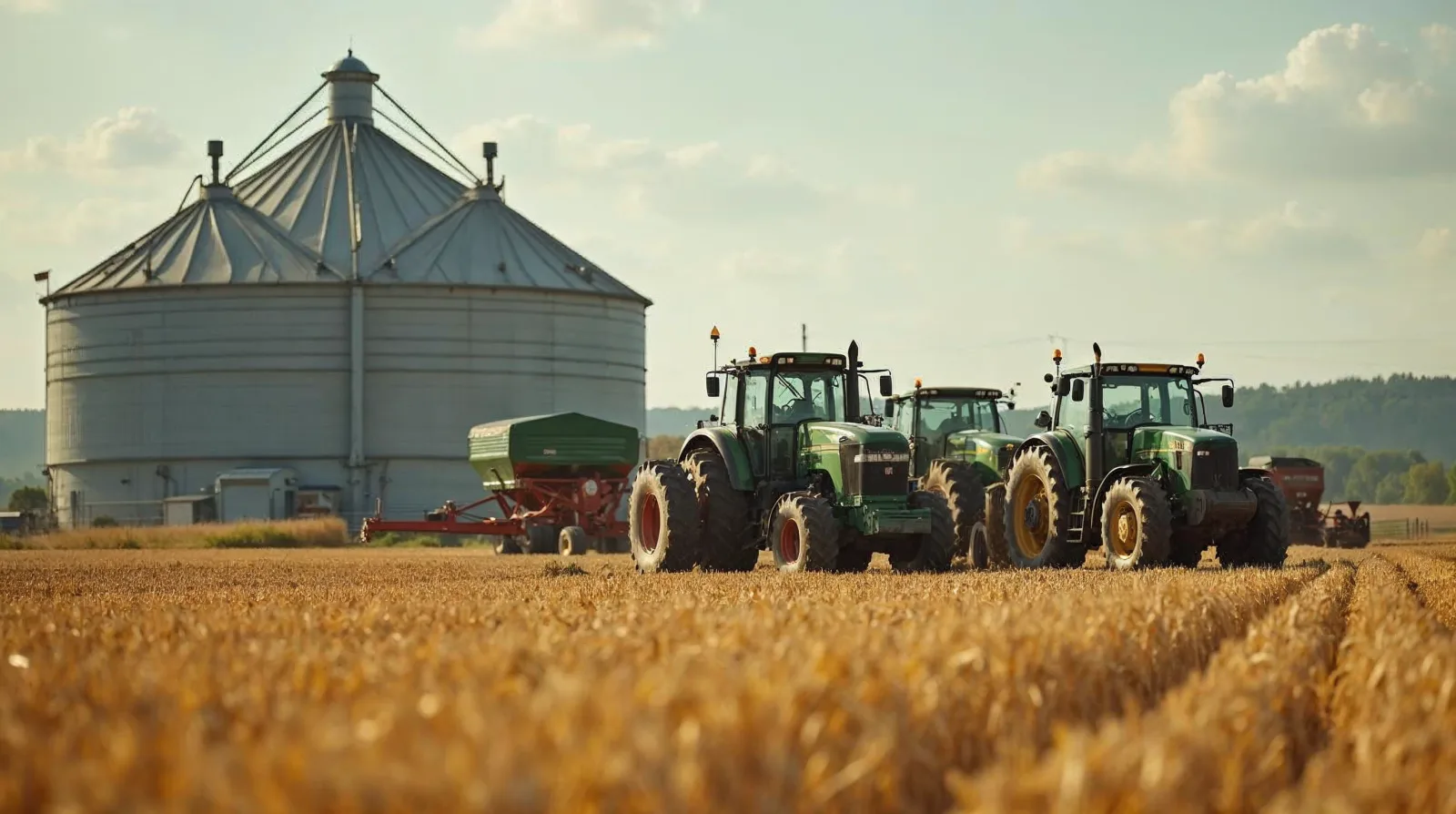
A grain bin is the only piece of equipment on most farms that makes money by doing nothing. The combine, the planter, and the sprayer all earn their keep through work in the field, but a bin earns its keep by holding grain still long enough for the market to come up to meet it. That is the whole proposition, and it is worth being honest about from the start, because a bin is a large fixed cost that pays back only if it is used as a marketing tool rather than as a place to put grain that should have been sold. This guide walks through how on-farm storage actually pays - how basis works, how to size a bin to the operation, what aeration and drying really do, how temperature monitoring keeps stored grain from turning into a loss, and how to run the numbers on storing versus selling at harvest so the decision is made with a calculator instead of a hunch.
The mistake that sinks the economics of on-farm storage is treating the bin as a convenience - a way to keep the combine running when the elevator line is long, or a way to avoid hauling on a busy day. Those are real benefits, and they have value, but they are not what pays for the steel. What pays for the steel is the spread: the difference between the price a farmer can get for grain at harvest, when everyone is selling at once, and the price that same grain will bring weeks or months later when the harvest pressure has cleared and the market has had time to recover.
That spread has two parts, and a farmer who wants storage to pay needs to understand both. The first part is the futures carry - the market's own price for time, visible in the difference between the nearby contract and the deferred contracts. The second part, and usually the bigger one for an on-farm operation, is basis. Basis is the gap between the local cash price and the futures price, and it is the part of the grain price that responds most directly to whether the local market is flooded or hungry. At harvest the country is full of grain, every farmer is hauling, and the elevators widen their basis - they pay less relative to futures - because they can. They do not need to bid hard for grain when it is pouring in the door. Weeks later, when the harvest rush is over and the elevators and processors still need to keep running, basis narrows, and that narrowing is money that flows to whoever still has grain to sell. On-farm storage is, at its core, a way to be that person.
Basis improvement is the quiet engine of on-farm storage economics, and it is worth slowing down on, because farmers who only watch the futures board miss half the picture. A farmer can be completely right about the direction of the futures market and still leave money on the table by selling into a wide harvest basis, and a farmer can be wrong about futures direction and still come out ahead by capturing a basis swing.
The pattern repeats most years, though never identically. Local basis is at its widest - its weakest, from the seller's point of view - during and just after harvest, because supply is overwhelming local demand. Through the winter and into spring, basis tends to narrow as that supply gets drawn down and as processors, feeders, and exporters compete for what is left. A farmer who stores grain and sells it during a basis-narrowing window is capturing real money that has nothing to do with whether corn or beans went up or down on the board. The size of that swing varies by region and by year, but a basis improvement of fifteen to forty cents a bushel from harvest lows to a late-winter or spring window is a common range in many areas, and that improvement is the clearest, most reliable return that on-farm storage produces.
The practical discipline this requires is keeping a basis record. A farmer who writes down the local cash bid and the futures price every week, year after year, builds a picture of when basis is historically strong and when it is weak for their specific delivery points. That record turns basis from a vague feeling into a number that can be acted on. When the local basis hits a level that the history says is strong, that is a signal to sell stored grain, regardless of where a farmer thinks futures are headed. Storage rewards the farmer who sells on basis strength, not the farmer who waits for a top.
The temptation when building storage is to either undersize it, because steel is expensive, or to oversize it, because the next size up always seems like a small additional cost. Both mistakes hurt. The right amount of storage is enough to hold the share of the crop that the operation actually intends to market through stored sales, plus a working margin.
Start with the real number: total annual production in bushels, averaged over several years rather than taken from one big crop. A farmer who grows, say, sixty thousand bushels of corn in an average year does not necessarily need sixty thousand bushels of bins. The question is how much of that crop will be sold off the combine - contracted ahead, delivered at harvest, or sold to cover cash flow - and how much will be stored for later marketing. Many operations land on storing somewhere between half and all of the crop, and the right figure depends on cash flow needs, on contract commitments, and on how much marketing risk the operation wants to carry.
There is also a strong argument for total on-farm storage that exceeds a single year's planned stored bushels, because storage capacity does more than hold grain for marketing. It buys harvest speed. When the combine can dump into a bin instead of waiting on trucks and elevator lines, the harvest moves faster, the crop comes in closer to the ideal moisture window, and there is less risk of leaving grain in the field through a weather event. Storage that lets a farmer harvest on their own schedule rather than the elevator's schedule has value that does not show up in the basis math but is real all the same.
Bin sizing also interacts with the drying and handling system. A single very large bin is cheaper per bushel of capacity than several small ones, but it offers no flexibility - a farmer cannot segregate grain by quality, by crop, or by moisture, and cannot empty and clean one bin while another stays full. Several medium bins cost more per bushel but allow segregation, staged drying, and easier management. Most working grain operations end up with a mix: one or two large bins for the bulk commodity crop and smaller bins for grain that needs to be kept separate.
Aeration is the most misunderstood part of on-farm storage, and getting it right is the difference between grain that comes out in spring the same quality it went in and grain that quietly spoils in the center of the bin. Aeration is not drying. Aeration is the practice of moving a relatively small volume of air through the grain mass to keep the temperature uniform and to hold the grain at a stable, safe condition. It is the single cheapest thing a farmer can do to protect stored grain, and it is routinely neglected.
Stored grain is alive. The kernels respire, any mold present respires, and insects, if there are any, generate heat. Without aeration, the grain mass develops temperature differences - the grain near the bin wall cools with the outside air while the core stays warm, and those differences drive moisture migration. Warm, moist air rises through the center of the grain, hits the cold grain or the cold bin roof at the top, and condenses. That condensation is what produces the crusted, moldy, spoiled layer that farmers find at the top center of a bin in spring. It is not a moisture problem in the sense that the grain went in too wet - it is a temperature management problem, and aeration is the fix.
The job of an aeration fan is to push enough air through the grain to equalize its temperature and to walk the whole grain mass down to a cool, stable storage temperature as the seasons cool. The standard practice is to run the fan to cool the grain in stages through the fall - bringing it down to follow the falling outside air temperature - and to aim for a cool storage temperature, often in the range of thirty-five to forty degrees Fahrenheit in colder climates, where insect activity nearly stops and mold growth is extremely slow. Cold grain is stable grain. The fan is sized for this job in cubic feet of air per minute per bushel, and aeration airflow rates are modest - typically a tenth to a fifth of a cubic foot per minute per bushel - which is far less air than drying requires. That is why aeration fans are relatively small and cheap to run.
The discipline aeration requires is running the fan at the right times and tracking how far a cooling cycle has progressed. Air moves through a grain mass as a front - a zone of changed temperature that travels slowly from the inlet toward the outlet. A cooling cycle is not finished until that front has pushed all the way through the grain and the air coming out the other side matches the air going in. Stopping the fan partway leaves a band of warm grain in the bin, and that band is where trouble starts. Knowing the airflow rate and the bin size lets a farmer estimate how many hours of fan run time a complete cycle takes, and the cycle should be finished before the fan is shut off.
A farmer needs to be clear at all times about whether the system is drying grain or aerating it, because they are different jobs with different equipment and different rules. Grain has to be stored at a moisture content low enough to be safe for the length of time it will be held - corn in the range of fourteen to fifteen percent for sale within the marketing year, lower for longer holds, with similar logic for other crops. If grain comes off the field above that safe level, it has to be dried before it can be stored, and aeration alone will not do it.
Drying moves large volumes of air, often heated, through the grain to actually remove water, and it happens with a high-temperature dryer, a high-airflow drying bin, or a natural-air drying system that uses a large fan and ambient air over a longer period. High-temperature drying is fast and gives the most control but burns the most fuel and, if pushed too hard, can stress-crack the grain and hurt its quality and test weight. Natural-air and low-temperature drying is gentler on the grain and cheaper in fuel but slower, and it depends on the weather cooperating - it works in a window of moderate temperature and moderate humidity and stalls when the air is cold and damp.
The mistake to avoid is asking an aeration system to do a drying job. A small aeration fan moving a fraction of a cubic foot per minute per bushel cannot dry a binful of wet corn before that corn spoils. If grain is going into a bin too wet, it needs a real drying plan - either run it through a dryer first, or commit to a properly sized natural-air drying setup with a fan large enough for the job and a willingness to manage it daily. Knowing which job the system is built for, and not overestimating it, is one of the most important judgment calls in grain storage.
The hardest thing about stored grain is that the trouble starts in the center of the mass where no one can see it. By the time a problem is visible or smellable from the bin door, it has usually been developing for weeks and a significant volume of grain may already be damaged. Temperature monitoring is how a farmer sees inside the grain, and on a working operation it is no longer an optional luxury.
A grain temperature cable is a cable hung down through the grain mass with temperature sensors spaced along its length, so it reads the grain temperature at several depths from the top of the bin to near the floor. A larger bin uses several cables spread across its diameter. The reason this works as an early-warning system is simple: grain that is starting to spoil generates heat. Mold respiration and insect activity both produce heat, and a developing hot spot shows up as a sensor reading that is climbing, or that is out of line with the sensors around it, well before anything is visible. A farmer watching the cable data sees a spot warming and can act - run the aeration fan to cool and dry that zone, or, if it has gone too far, move the grain out - while the problem is still small.
Modern monitoring systems take this further by logging the readings automatically and sending them to a phone or computer, so a farmer can check every bin from the house or the truck without climbing anything. The better systems combine temperature cables with moisture sensing and with automated fan control, so the system itself can decide when outside conditions are right to run the fan for cooling or for holding the grain at a target moisture, and run it without the farmer having to be there. That automation matters because the most common reason aeration fails is not bad equipment - it is a farmer who is too busy to manage the fan by hand and either runs it at the wrong times or forgets it entirely.
The practical value of monitoring is highest exactly when grain is held longest and the stakes are largest. A bin of corn being carried from harvest into the following summer is carrying a lot of value and a lot of risk, and the cost of a temperature cable system is small against the cost of finding a spoiled core in July. For a farmer storing grain to capture basis, monitoring is part of the cost of doing it safely, and it should be in the budget from the start.
Storage is not free, and the farmer who treats stored grain as if it costs nothing to hold will make bad marketing decisions. To know whether storing pays, a farmer has to put a real number on the cost of carry, and there are several pieces.
The first is the ownership cost of the bin itself - the construction cost spread over its useful life as an annual depreciation figure, plus interest on the money tied up in it, plus the foundation, the wiring, the fans, the handling equipment, and ongoing maintenance and insurance. Spread over the bushels the bin holds each year, this is a fixed cost per bushel of storage, and it is incurred whether the bin is full or empty.
The second is the cost of carrying the grain itself once it is in the bin. The largest piece is usually the opportunity cost or interest cost of the money: grain sitting in a bin is capital that is not in the bank account, and at any meaningful interest rate that carrying cost adds up over a multi-month hold. Then there is the cost of running aeration fans, the cost of any drying done to get the grain to a safe moisture, and an allowance for shrink and quality loss - grain loses a little weight as it dries and settles, and even well-managed grain carries some risk of quality slippage.
Added together, the cost of holding grain on-farm commonly works out to something on the order of a few cents per bushel per month, varying widely with interest rates, drying needs, and how the bin cost is accounted for. The exact figure matters less than the habit of calculating it for the specific operation, because that number is the hurdle. Storage only pays when the expected gain - the basis improvement plus any futures carry the farmer chooses to capture with hedges - is larger than the total cost of carry over the holding period. A farmer who knows their carry cost can look at the market and answer the storing-versus-selling question with arithmetic.
With a carry cost in hand, the harvest decision becomes a comparison rather than a guess. The question is never simply "will the price go up." The question is "is the price I can lock in for later delivery, net of my cost to carry the grain there, better than the price I can get today."
Several outcomes are worth naming. When the market is showing a strong carry - the deferred futures meaningfully above the nearby - and the local basis is wide at harvest, storage looks attractive, because a farmer can store the grain, sell a deferred futures contract or a deferred cash contract to capture the carry, and additionally collect the basis improvement as the local market firms. This is the textbook case for on-farm storage paying well, and it happens often enough to justify the bins. When the market is inverted - nearby futures above the deferred, which the market does in tight-supply years - it is paying a farmer to sell now, and storing grain unhedged is a bet against the market's own signal.
The basis-only play stands on its own even when futures carry is thin. If a farmer's basis records say the local market is at a seasonal low at harvest and historically firms by a known amount, storing to capture that basis can clear the carry cost by itself. The cleanest version of this is to store the grain, sell it forward when basis hits a strong level, and use a hedge to remove the futures price guess from the equation, so the trade is purely the basis gain against the carry cost.
The honest caution is that storage also carries risk. A market can fall faster than basis improves, and unhedged stored grain can be worth less in spring than it was at harvest. The farmer who stores grain and refuses to sell it, waiting for a top that never comes, can turn a storage advantage into a loss. The discipline that makes storage pay is the same discipline that makes any marketing plan pay: decide in advance what price and what basis will trigger a sale, write it down, and act on it when the market gets there.
Even grain that is sold at a good price loses money if it has slipped a grade on the way there, and quality loss in storage is preventable. The defenses are the same fundamentals running through this whole guide: get the grain to a safe moisture before storing it, cool it down with aeration and keep it cold, and monitor it so problems are caught early.
Insects are a temperature problem as much as anything. Stored-grain insects become inactive and stop reproducing once the grain is cold, which is one more reason the aeration goal is to walk the grain down to a cold, stable temperature and hold it there through the winter. Starting with a clean bin matters too - empty bins should be cleaned out and the old grain residue removed before new grain goes in, because that residue is where carryover infestations live. Mold is a moisture and temperature problem, controlled by storing at a safe moisture content and by keeping the grain cool so any mold present grows too slowly to matter. None of this is exotic. It is housekeeping, and it is the housekeeping that protects the value the marketing plan is built on.
Not every farm needs to build new steel to add storage. A used bin, bought at a farm sale and moved, can add capacity at a fraction of new-construction cost, with the trade-offs that moving a bin is real work, that an older bin may lack a good aeration floor or modern fan, and that condition has to be inspected carefully before money changes hands. For a farm that is unsure how much permanent storage it wants, a good used bin is a reasonable way to add capacity without overcommitting.
Grain bags - long polyethylene tubes that grain is augered into in the field - are the other option, and they fill a specific niche. A grain bag adds a large block of temporary storage cheaply and quickly, with no construction, which makes it useful for handling a big crop year or for segregating a load without dedicating a bin. The trade-off is that bagged grain cannot be aerated or cooled, so it has to go in at a safe moisture and be monitored for damage and for wildlife, and it is best thought of as shorter-term storage rather than a place to carry grain deep into a hot summer. For the right job - extra harvest-season capacity, a short hold of dry grain - bags are a sensible tool. For long-term storage of grain a farmer intends to baby through to a summer basis peak, a proper aerated bin is still the right home.
On-farm grain storage rewards the farmer who runs it as a system and punishes the one who treats it as a parking lot. The pieces fit together in a clear order.
A grain bin will not make a marketing decision for a farmer, and it will not turn a bad year into a good one. What it will do, run as a disciplined system, is hand the farmer control over when grain is sold, and that control - the ability to wait out a wide harvest basis and sell into a firm market weeks later - is a real and repeatable edge. The steel is only the start of it. The return comes from the management.
Basis typically widens, or weakens, at harvest when supply floods the local market, then narrows into winter and spring as that supply is drawn down. A basis improvement of roughly fifteen to forty cents per bushel from harvest lows to a late-winter or spring window is common in many areas. Capturing that swing is the clearest, most reliable return on-farm storage produces.
Aeration moves a small volume of air, typically a tenth to a fifth of a cubic foot per minute per bushel, to equalize temperature and hold grain cold and stable. It does not remove significant water. Drying pushes large volumes of often heated air through the grain to actually pull moisture out. Asking a small aeration fan to dry wet grain is a common and costly mistake.
In colder climates, aim to walk grain down to a cool storage temperature around thirty-five to forty degrees Fahrenheit and hold it there through winter. At that temperature, stored-grain insects go inactive and stop reproducing and mold growth slows to a crawl. Cooling the grain in stages as outside air falls, and finishing each cooling cycle so no warm band remains, keeps the mass stable.
The total cost of carry, including interest on the capital tied up in the grain, aeration and drying, bin ownership, and an allowance for shrink and quality loss, commonly works out to a few cents per bushel per month. The exact figure varies with interest rates and drying needs. That carry cost is the hurdle any storage decision must clear before storing beats selling at harvest.
Join our list for practical guides on farm tech, precision agriculture, and tools that work.