
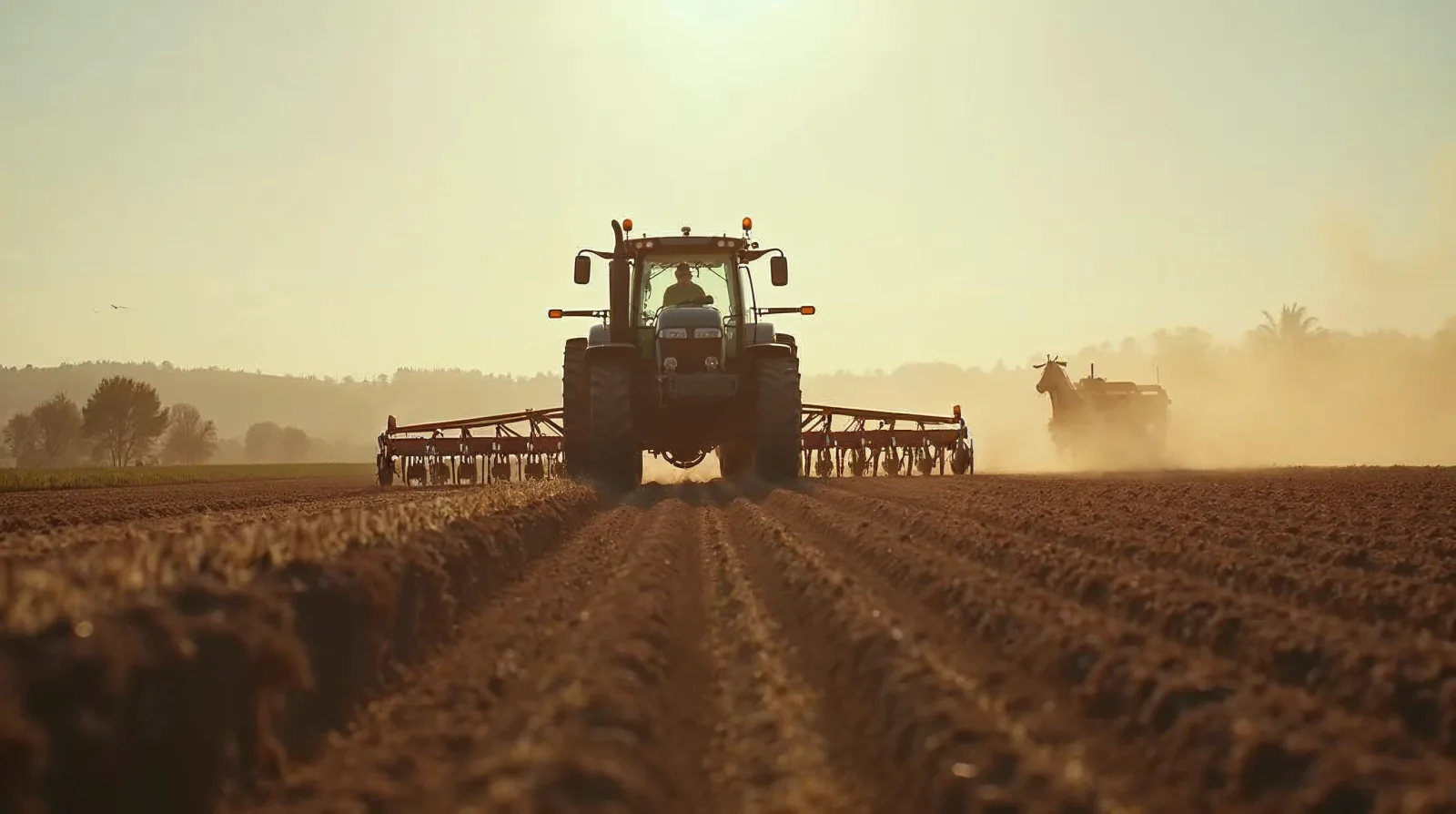
Stop a planter at the end of the first pass, walk back into the field, and dig up a row by hand. If the season is going to give you trouble, you can usually see it right there in the trench. Some seeds sitting at two inches, some barely covered, a few mashed into a hard, glazed sidewall that a root is going to fight all summer. That unevenness is rarely a problem with the seed or the meter. Most of the time it is a downforce problem, and downforce is the part of the planter that gets the least attention for how much it decides.
Here is the single sentence the brochures bury, and the one this whole article is built on: downforce does not plant the seed deeper. It keeps the gauge wheels pressed firmly on the ground so the depth you dialed in is the depth you actually get, row by row, foot by foot, as the soil changes underneath you. That is the entire job. Get it right and emergence is even, the stand comes up in one window, and every plant starts the race at the same time. Get it wrong in either direction and you pay for it at harvest.
So let us walk through what downforce really controls, the one number worth watching, the two ways to get it wrong, the free check every planter owner can do this spring, and an honest look at whether the expensive automatic systems are worth the money on your ground.
A planter row unit has to do two opposite things at once. The opener has to cut a clean trench at a set depth, and the gauge wheels riding alongside it have to hold that depth steady. The thing that keeps the gauge wheels in firm contact with the soil is weight - the weight of the row unit itself, plus whatever extra load you add with springs, airbags, or hydraulic cylinders. That total load is downforce.
When there is enough weight on the gauge wheels, they ride the surface, the opener stays at its set depth, and seed after seed lands at the same place in the ground. When there is not enough weight, the gauge wheels start to skip and lift, the opener rides up out of the soil, and depth wanders. The seed depth you carefully set on the headland quietly stops being the depth you are planting.
What downforce does not do is push the seed deeper than your depth setting. The depth stop is mechanical. Downforce just decides whether you actually reach that stop and hold it. This matters because once you understand it, the goal stops being "more pressure" and becomes "the right pressure for the ground I am on right now." And the ground is never the same for long.
This is also a different job from singulation, spacing, and population - those are the meter's department, not the downforce system's. If your spacing is ragged, that is a separate fix. Downforce is strictly about getting every seed to the same depth in firm soil. Keep the two problems separate or you will spend money on the wrong one.
The useful number is not total downforce. It is margin - the weight left on the gauge wheels after the opener has taken what it needs to hold depth. Think of it as the cushion. Too little margin and the furrow can collapse or the depth starts to wander. Too much margin and you are mashing the sidewall harder than the soil needs.
A common starting point is around 100 pounds of margin on the gauge wheels, and you adjust up or down from there based on what the field tells you. That is not a magic number that works everywhere, but it is a far better place to begin than guessing or running whatever the previous owner left the springs set to.
Two things move that number constantly. The first is moisture - wet soil firms with less weight and smears easily, dry soil needs more weight to firm at all. The second is speed. The faster you plant, the more the row unit bounces, and the more downforce it takes to keep the gauge wheels in steady contact. If you sped your planter up over the last few seasons and never touched the downforce, your old setting is almost certainly wrong now. That alone is worth a look before next spring.
Downforce has a failure mode in each direction, and they look completely different in the trench.
Too much downforce, especially in wet soil or when you are planting shallow, smears and compacts the sidewall of the furrow. The classic result is a glazed slot that dries into a hard wall, and roots that hit it turn sideways instead of going down. Agronomists call the shape it produces a hatchet root or tomahawk root - the root system flattens out in the seed slot instead of spreading down and out. Those plants struggle to reach water and nutrients later in the season, which is exactly when you need them to. The damage is done at planting and you do not see the bill until July.
Too little downforce is the opposite picture. The gauge wheels lose contact, the opener rides up, the trench can collapse, and seeds end up at inconsistent depths. That is the direct enemy of uniform emergence - a field that comes up over two weeks instead of two days, with late plants that act like weeds against their bigger neighbors.
The target sits between those two: enough weight to firm the sidewall and hold depth, and not one pound more. The hard part is that the right answer changes across a single field, which is the whole reason the automatic systems exist.
Before you spend a dollar on a new system, do the check that costs nothing. The guidance from Iowa State extension is refreshingly low-tech, and it works no matter what planter you run.
Plant at least 50 feet, then stop, get out, and inspect the seed trench by hand. Look at whether the seeds are at a consistent depth and whether loose soil is sloughing back into the trench. If excess loose soil is falling in and depth is shallow or uneven, add downforce. Keep nudging it up until the trench looks right, then settle on the lowest setting that still gave you the improvement. You want the least weight that does the job, not the most.
Two cautions come with this. In extremely dry, sandy soils, more downforce may not help at all - you can be adding weight against a problem weight cannot solve. And the big one: downforce needs to be re-checked as conditions change across the field. The setting that was right in the wet end is wrong by the time you reach the dry knoll. A fixed spring setting cannot follow that. You can, by stopping and digging again, but only so many times in a day. That limitation is the doorway to the rest of this article.
There are three levels of downforce control, and the honest way to think about them is as a ladder matched to how variable your ground is - not as old versus new, where new automatically wins.
Mechanical springs are the bottom rung and the cheapest. You set a fixed load and it stays put regardless of what the soil does. On uniform, well-prepared ground, a properly set spring system can plant a very good stand. Its weakness is simple: it cannot change while you drive, so it is only ever right for the average of the field.
Pneumatic, or airbag, systems are the middle rung. A planter-wide air system lets you adjust downforce from the cab on the go, which is a real step up from springs. The catch is that it is one setting across the whole planter, and how fast it can react is limited by how quickly the bags fill and vent. It follows broad changes in the field well, but it cannot give one row a different load than the row next to it.
Hydraulic row-by-row systems are the top rung. Each row gets its own hydraulic cylinder and a load cell that reads the weight actually carried on that row's gauge wheels, and the system adjusts each row independently and continuously. In rough terms, hydraulic systems hold the target downforce something like 95 percent of the time or better, while pneumatic sits in the high 80s - present that as a direction, not a guarantee, since the exact figures come from system makers. The point is that responsiveness climbs as you go up the ladder, and so does the price.
The decision is not "which is best." It is "how much does my ground vary, and which rung does that variability justify."
It is worth understanding what you are paying for at the top of the ladder, because it is genuinely clever.
On a row-by-row hydraulic system - Precision Planting's DeltaForce is the best-known example - the springs and airbags are replaced by a hydraulic cylinder and a load cell on every row. The load cell reads how much weight is sitting on that row's gauge wheels. The system samples that reading hundreds of times per second and adjusts the force several times per second, independently on each row. You do not manage pressure. You just set the target gauge-wheel weight you want, and the system holds it through the variability while you drive.
That is the difference in a sentence: a spring is set for the field's average, a planter-wide air system is set for the field's current average, and a row-by-row hydraulic system holds your target on every individual row through every change in the ground.
Here is the feature that actually separates the good row-by-row systems, and it is the one the sales pitch underplays. The best systems do not just push down. They can lift the row unit - take weight off - when a row is carrying too much.
Think about where a planter carries too much weight: crossing an old wheel track, an end row, a hard headland, a compacted turn-strip. A fixed-pressure system pushing 200 pounds down does not get any lighter when it rolls onto already-firm ground - it just mashes the sidewall there. A system with uplift, like Ag Leader's SureForce, can remove weight on the gauge wheels in those spots to keep from compacting the furrow where the soil does not need the load.
This is the real agronomic argument against the old habit of "just crank the springs up until it holds everywhere." If you set the springs heavy enough to hold depth in the soft spots, you are over-compacting every firm spot in the field. A static system cannot get lighter when the ground needs it to. The ability to lift, not just push, is what lets a system give every part of the field the right weight instead of one heavy compromise.
This is where most articles overpromise, so here is the balanced version.
One widely cited on-farm dataset, from Beck's Hybrids' Practical Farm Research, has reported an average corn yield increase on the order of 9 to 10 bushels per acre with row-by-row hydraulic downforce. That is a real multi-year dataset and worth knowing. It is also run by an outfit that sells and partners on the gear, and the results vary a lot by field, so treat it as a credible example and not a number you can bank on your acres.
Set against that, a 2022 peer-reviewed soybean study in the Coastal Plain of South Carolina found that downforce rate did not affect soybean grain yield, and that high downforce rates actually increased soil compaction. And a 2025 study of corn and cotton found that dynamic, active downforce produced more accurate and consistent load than static settings, which often overshot the target - with the value of active control rising as the soil got more variable.
Put those together and the picture is clear and honest. The payoff from stepping up the ladder is biggest in variable, residue-heavy, no-till, and compaction-prone ground, and it shows up more reliably in corn than in some soybean situations. In uniform, well-prepared soil, a well-set spring or air system can capture most of the benefit for a fraction of the cost. Anyone promising you a guaranteed yield bump on every field from a downforce upgrade is selling, not measuring.
Pricing on this gear is almost entirely dealer-quoted and it moves, so treat the following as order-of-magnitude, not a sticker.
Springs are cheap - often already on your planter. Pneumatic sits in the middle. Row-by-row hydraulic is the premium tier, historically on the order of a couple thousand dollars per row just for the downforce piece, and a full precision-planter package that bundles downforce with new meters, drives, and a monitor can climb well into the tens of thousands for a big planter. Because almost every current listing is "call for price," the only honest move is to get a per-row quote for your specific planter and row count rather than trust any number you read online, including the ranges here.
The brand menu, kept neutral, looks like this. Row-by-row hydraulic: Precision Planting DeltaForce, John Deere's Individual Row Hydraulic Downforce, and Ag Leader SureForce, all of which read each row and can lift as well as push. Planter-wide pneumatic: Precision Planting AirForce and the OEM airbag systems. Kinze and other planter makers offer their own spring, air, and hydraulic options. Most of the hydraulic systems retrofit onto planters of various colors, so an older planter is often a candidate, the same way an older tractor can be brought up to date - see our guide on retrofitting auto-steer to older tractors for the same make-an-older-machine-smart idea.
Downforce is not about pushing harder. It is about putting the right amount of weight on the gauge wheels so the depth you set survives the variable ground - and being able to take weight off where the soil is already firm. Start by understanding margin and the rough 100-pound starting point. Do the free plant-50-feet-and-dig check this spring no matter what system you own, and re-check it as the field changes. Climb the springs-to-air-to-hydraulic ladder only as far as your ground's variability actually justifies, and remember that the quiet magic of row-by-row is the upforce, not just the down. Then judge the payoff honestly: big in variable, no-till, corn ground, possibly thin in uniform soil.
And measure it on your own acres rather than trusting a brochure. Downforce decisions live right next to the other planter-and-precision upgrades worth weighing - section control on the planter and sprayer, and the yield-monitor calibration that tells you whether any of it actually paid. If you want the next of these field-tested breakdowns when it goes up, the Manley Farms newsletter is the place to catch it - we keep these practical, ad-free, and built for people who still get out and dig the trench themselves.
Margin is the weight left on the gauge wheels after the opener has taken what it needs to hold depth, essentially the cushion that keeps the furrow from collapsing. A common starting point is around 100 pounds of margin, adjusted up or down based on what the field shows. Too little lets depth wander; too much mashes the sidewall harder than the soil needs.
Not directly. The depth stop is mechanical, so downforce never pushes a seed deeper than your setting. Its only job is keeping enough weight on the gauge wheels that they stay pressed to the ground and the opener actually reaches and holds the depth you dialed in. When weight runs short, the gauge wheels skip, the opener rides up, and depth quietly wanders.
Pneumatic airbag systems apply one adjustable setting across the whole planter and react as fast as the bags fill and vent, holding target roughly in the high 80 percent range. Hydraulic row-by-row systems give each row its own cylinder and load cell, adjusting several times a second and holding target around 95 percent or better. Responsiveness and price both climb as you move up.
Sometimes. Beck's Hybrids Practical Farm Research has reported an average corn increase around 9 to 10 bushels per acre with row-by-row hydraulic downforce, though it varies widely by field. A 2022 South Carolina soybean study found no yield effect and more compaction at high downforce. The payoff is biggest in variable, residue-heavy, no-till, compaction-prone ground and in corn.
Join our list for practical guides on farm tech, precision agriculture, and tools that work.