
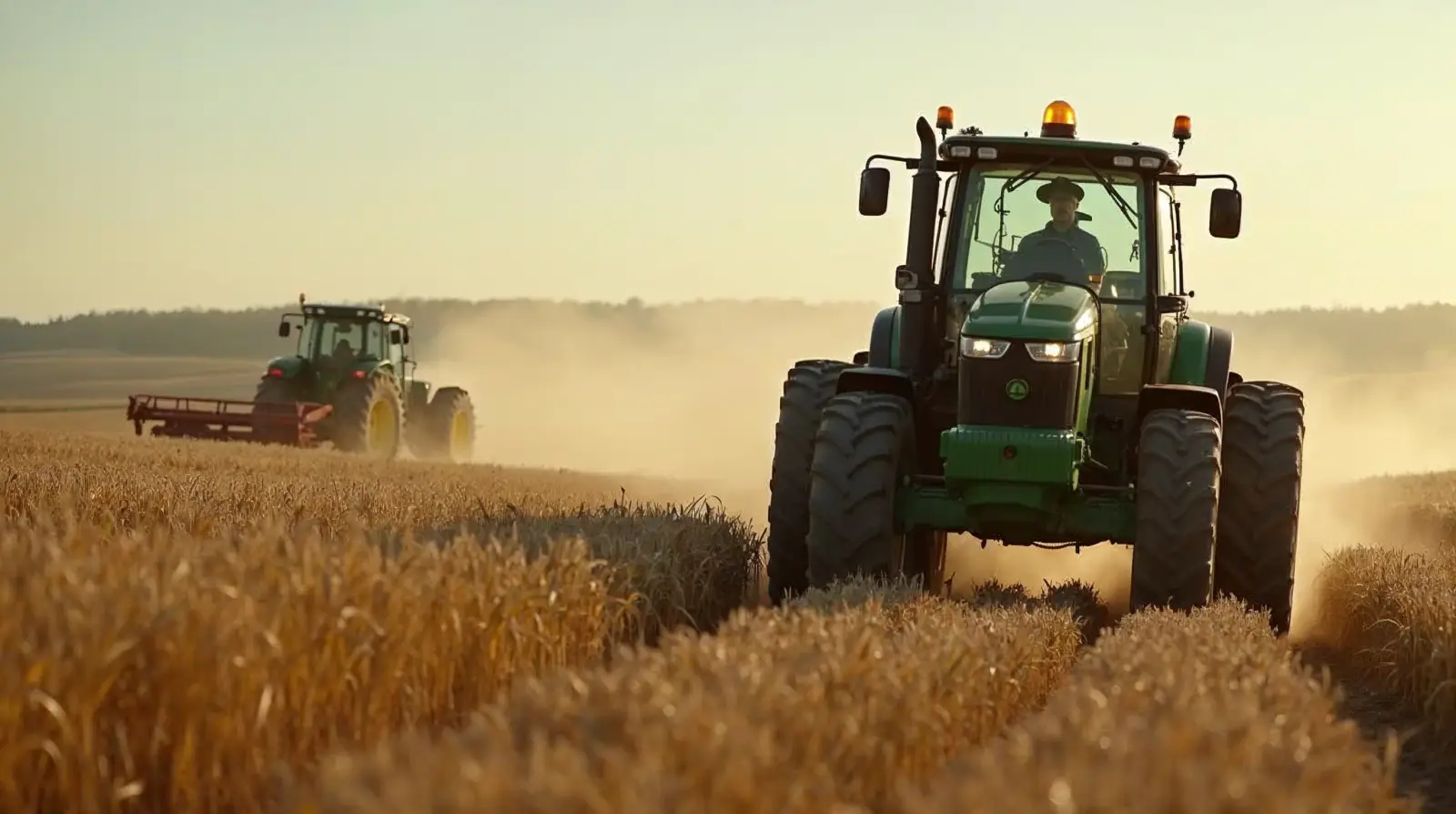
GPS guidance is no longer a novelty in row crop farming. It is a work tool that touches every pass - tillage, planting, spraying, sidedress, and harvest. The core idea is simple: put the implement where you intended, every time, and record where you have been. The hard part is making the system accurate, repeatable, and easy enough that it does not slow down real field work. When guidance is done right, it reduces overlap, lowers fatigue, and makes data more reliable. When it is done wrong, it becomes one more screen in the cab that nobody trusts.
This article focuses on what actually matters to farmers and operators - accuracy, repeatability, data flow, and return on investment. It also names the limits. GPS guidance is not a yield guarantee and it is not a replacement for good agronomy. It is a way to execute the agronomy you already believe in, with fewer mistakes and less stress.
Row crop work is a game of straight lines, repeat passes, and narrow windows. Fatigue, dust, and darkness all push overlap and skips. Guidance systems reduce that drift, hold a consistent path on long days, and let operators focus on the implement. Most of the value shows up in three places. First is input savings - every percent of overlap you remove is money you do not spend on seed, fertilizer, or chemical. Second is consistency - the pass you made at planting is the same pass you can follow at sidedress or harvest. Third is time - if the operator can trust the line, you can run at night, you can finish before a weather window closes, and you can avoid rework.
A practical way to see the benefit is to think in inches. A 12 row planter at 30 inch spacing covers 30 feet. If you are off by 6 inches, you are either overlapping or missing a band on every pass. That is the difference between 2 percent and 5 percent overlap, depending on headland turns and point rows. On 1,000 acres with $120 per acre in seed and fertilizer, a 2 percent overlap is roughly $2,400. That is before you count chemical, fuel, and time.
Guidance also reduces mental load. A tired operator in a dusty field is more likely to drift. With guidance, the operator can focus on planter depth, downforce, or spray pressure instead of constantly correcting the line. That is real value that is hard to quantify but easy to feel at the end of a long day.
Accuracy is a mix of pass to pass performance and long term repeatability. Pass to pass accuracy tells you how close you can steer to a line in the same field session. Repeatability tells you whether a line will be in the same place next week or next season.
Free correction services like WAAS are a starting point. Dealers often describe this level in the 6 to 8 inch range. John Deere lists SF1 at around 15 cm pass to pass, while SF-RTK and Radio RTK are listed at about 2.5 cm pass to pass for StarFire receivers. That difference is not small - it is the difference between a 10 inch drift and a 1 inch drift on a 30 inch row.
If you are planting, sidedressing, or strip tilling, you want sub inch accuracy and repeatability. That is RTK or an RTK like service, whether from a local base station, a dealer network, or a satellite delivered correction like SF-RTK. For row crops, the practical takeaway is this: if you need to come back to the same row later in the season, you need the highest correction level you can afford and keep year to year.
Accuracy also has a time component. Some systems drift over hours, not minutes. If you are doing a multi day planting run, you want the line to stay locked. Ask how long it takes to converge to full accuracy and how the system behaves if you lose corrections for a few minutes.
It is worth testing accuracy on your own farm. Lay out a line, plant or spray, and then come back a week later to follow the same line. Measure the offset at a few points. That real world test tells you whether the system is good enough for your operations and whether the corrections in your area are stable.
RTK is about correction data, not a specific brand. There are two ways to get it.
A local base station is a radio that broadcasts correction data to your machines. It is a one time capital cost, and you control it. The upside is independence and fast pull in time. The downside is range - a single base typically covers a few miles, and terrain or tree lines can reduce that. If your operation is compact and you want control, a base station makes sense.
A network RTK or satellite delivered service uses a network of bases and sends corrections to your cab through cellular or satellite. You pay an annual subscription, but you gain flexibility and coverage across a larger area. If you are custom farming or you have fields spread across the county, network RTK is usually the more practical fit.
The choice is not only technical. It is also about uptime. If your RTK signal drops for an hour when you are planting, you lose time and you may lose the line. Ask about service coverage, signal resiliency, and what happens during solar disturbances. Then plan for a fallback level, like SF1, so the cab does not go dead if RTK drops.
Another practical detail is convergence time. Some correction services take a few minutes to fully lock, especially after a machine has been off overnight. If you are moving between fields, that can matter. Operators should know whether they can start a pass right away or if they need to wait for the accuracy indicator to settle.
Auto-steer is a control system, not just a GPS receiver. It includes the receiver, a controller, a steering valve or motor, and an interface in the cab. Hydraulic auto-steer tied into the steering system is typically smoother and more accurate than a steering wheel motor, but it costs more and takes more installation time. Steering wheel motors can be a good entry point for older machines, but they can introduce small oscillations on rough ground.
Implement guidance is the next step. Even with perfect tractor guidance, a heavy pull type implement can drift on a slope. That matters in strip till, planting, and sidedress. Systems like John Deere AutoTrac Implement Guidance use a second receiver on the implement to account for drift. If you farm rolling ground, this can reduce sideways error by several inches.
The practical test is simple. Watch the implement, not the tractor. If the implement is walking, guidance that only controls the tractor is not enough. You can also see this in post pass maps - the tractor line might be straight, but the planted rows will show a consistent offset on side hills.
Once guidance is in place, section control turns the line into savings. On a 90 foot sprayer with automatic boom control, the system turns sections on and off as you cross a boundary or overlap a previous pass. On planters, row shutoff does the same for seed and sometimes starter fertilizer.
Even a 3 percent reduction in overlap is real money on high input crops. At 500 acres of corn, 3 percent overlap on seed and fertilizer adds up to more than a few bags of seed and a few tons of fertilizer. Section control pays back quickly when field shapes are irregular, terraces are common, or there are waterways and turn rows that create short passes.
There is also a quality benefit. Over applied nitrogen can lodge corn, and overlaps in herbicide can lead to crop injury. Section control reduces those risks. The system is only as good as the boundary data, so take the time to clean up field edges and waterways before relying on automation.
Section control also reduces operator stress on headlands. Instead of watching individual switches while turning, the operator can focus on making a clean turn and lining up on the next pass. That matters on long days, and it is one reason many operators quickly decide they do not want to go back to manual control once they have experienced automated shutoff.
Variable rate only works if the guidance and data chain are consistent. The typical workflow is soil sampling or yield data, a prescription map, and a controller that can read it. Most systems accept shapefiles or ISOXML prescriptions. The biggest failure point is not the technology - it is poor calibration or stale data.
If you want variable rate to work in practice, keep it simple at first. Start with a two zone map - high and low - rather than a 12 zone map. Use a spreader or planter that can actually hit the rates you prescribe. Then check the field and see if the rate changes are visible in the cab logs. It is easier to refine a simple map than to fix a complex one.
Rate response time matters. A dry fertilizer spreader can take a few seconds to change rate, which means your transition zones need to be wide enough for the equipment to respond. If your zones are smaller than your machine can react to, the prescription is not doing what you think it is doing.
Another practical detail is product handling. Variable rate nitrogen is easier with liquid systems than with some dry systems, while variable rate seeding depends on how quickly the meter can respond to commands. Ask your dealer or agronomist what the response curve looks like for your equipment. If it is slow, design your map with larger zones and fewer transitions.
Yield maps are the backbone of precision work, but only if the data are clean. That means calibrating the yield monitor for each crop and each season. It also means checking moisture sensors, lag time, and header cut width. If the yield map is off by 5 to 10 percent, you will make the wrong decision next year.
A good habit is to collect a few weigh wagon or cart scale weights early, then adjust the monitor. Most systems let you do multi point calibration across a yield range. That gives you a map you can trust for variable rate, drainage planning, or hybrid comparison.
Clean data also depend on operator habits. If the monitor is turned on late at the start of a pass or left on during a turn, the map will show false streaks. A two minute training session can prevent hours of confusion later.
Yield mapping is also a long game. A single year map can be misleading because weather often dominates. Three years of calibrated maps are much more useful for stable zone creation. If a low area is low every year, it is likely a soil or drainage issue. If it swings up and down, it is more likely a weather response or management issue.
There is no single price tag. A basic lightbar with WAAS might be $1,500 to $3,000. An integrated display with assisted steering can run $6,000 to $12,000. Full auto-steer with RTK commonly lands in the $15,000 to $35,000 range per machine once you include receiver, display, steering hardware, and install. RTK subscriptions are often in the $600 to $1,500 per year range, while a base station can be $3,000 to $10,000 plus radio licensing or setup.
Return on investment is real, but it is not magical. The fastest payback usually comes from overlap reduction on chemicals and fertilizer, and from avoiding rework. A planter with accurate guidance and row shutoff can pay for itself faster than a tillage tractor because it directly affects input cost and yield. If you are unsure, put guidance first on the machine that puts the most dollars on the ground.
A simple ROI example helps. If guidance and section control reduce overlap by 3 percent on 1,000 acres of corn with $180 per acre in combined seed, fertilizer, and chemical, the input savings are roughly $5,400 per year. That does not include labor savings or the value of finishing on time. At that rate, a $25,000 guidance system can pay back in about five seasons. Many farms see faster payback when they move guidance to the planter and sprayer first.
The big decision is not just brand, it is ecosystem. John Deere StarFire receivers with AutoTrac integrate well with Deere equipment and data platforms. Trimble offers open compatibility and strong steering options, often through dealer installed systems. Ag Leader has a reputation for mixed fleet support and strong displays.
A practical way to decide is to list your machines and your comfort level with data movement. If most of your fleet is Deere and you want a single support channel, Deere integration is simple. If you run multiple brands, Trimble or Ag Leader might give you more flexibility. Also consider whether you want data to move automatically to a cloud platform, or if you prefer to pull cards and control it yourself.
Whatever you choose, prioritize support. A good local dealer who can troubleshoot during planting is more valuable than a feature list you never use. Ask who will install the system, who will answer the phone on a Saturday, and what the normal turnaround time is for a service call.
Think about data ownership and export. If you ever want to switch platforms, you will need clean, portable files. Ask whether the system supports common formats like shapefiles, ISOXML, or simple CSV exports. That protects your investment and keeps you in control of your data.
The quality of guidance depends on the quality of your boundaries and lines. If a field boundary is drawn inside the actual fence line, section control will shut off too early and you will leave product off the edge. If a boundary is drawn outside the actual field, you will apply product where you did not intend. That is money lost either way.
A good practice is to drive the boundary with high accuracy corrections and recheck it every few years. If you have ditches or waterways that change, update the boundary. Clean boundaries also make planting and spraying more efficient because the system can manage headlands and short passes correctly.
The same is true for guidance lines. A clean AB line should be created when the implement is in the ground and stable. If you bump the line after it is set, the whole field will be off. Many farms keep a master set of lines for each field and treat them like a permanent asset. Back them up, label them clearly, and avoid creating a new set every year unless there is a good reason.
Start with the machine that creates the most value per acre - usually the planter or sprayer. Choose a correction level that matches the job. For planting and strip till, aim for RTK or an RTK like service. For tillage or spreading, WAAS or SF1 may be fine.
Then build a short checklist.
Add features only after the core is solid. Auto-steer without good boundaries and calibration will frustrate operators. A clean foundation makes every future feature worth more.
GPS guidance is not about chasing tech. It is about making each pass count, reducing overlap, and building a repeatable system that respects the way farmers actually work. When accuracy and repeatability are matched to the job, guidance becomes a quiet part of the operation - the kind of tool you notice only when it is missing. If you start with clear goals, realistic accuracy needs, and a support plan, the return is real and the stress level is lower when the weather window gets tight.
A basic lightbar with WAAS runs $1,500 to $3,000, and an integrated display with assisted steering runs $6,000 to $12,000. Full auto-steer with RTK commonly lands in the $15,000 to $35,000 range per machine once you include the receiver, display, steering hardware, and install. RTK subscriptions add $600 to $1,500 a year, and a base station adds $3,000 to $10,000 plus radio setup.
Yes. On a 90 foot sprayer with automatic boom control, the system shuts sections off as you cross a boundary or overlap a previous pass, and even a 3 percent overlap cut is real money. On 500 acres of corn that adds up to several bags of seed and tons of fertilizer, and it also prevents the over-applied nitrogen that lodges corn and the herbicide overlaps that injure the crop.
Pass-to-pass accuracy tells you how close you can steer to a line within the same field session, while repeatability tells you whether that line will be in the same place next week or next season. Free WAAS sits around 6 to 8 inches and drifts year over year, while SF-RTK is listed near 2.5 cm pass-to-pass, so coming back to the same row for sidedress needs the highest correction level.
On rolling ground, yes. Even with perfect tractor guidance, a heavy pull-type implement drifts sideways on a slope, which shows up as an offset in the planted rows on side hills. A second receiver on the implement, such as AutoTrac Implement Guidance, accounts for that drift and can reduce sideways error by several inches during strip till, planting, and sidedress.
Join our list for practical guides on farm tech, precision agriculture, and tools that work.