
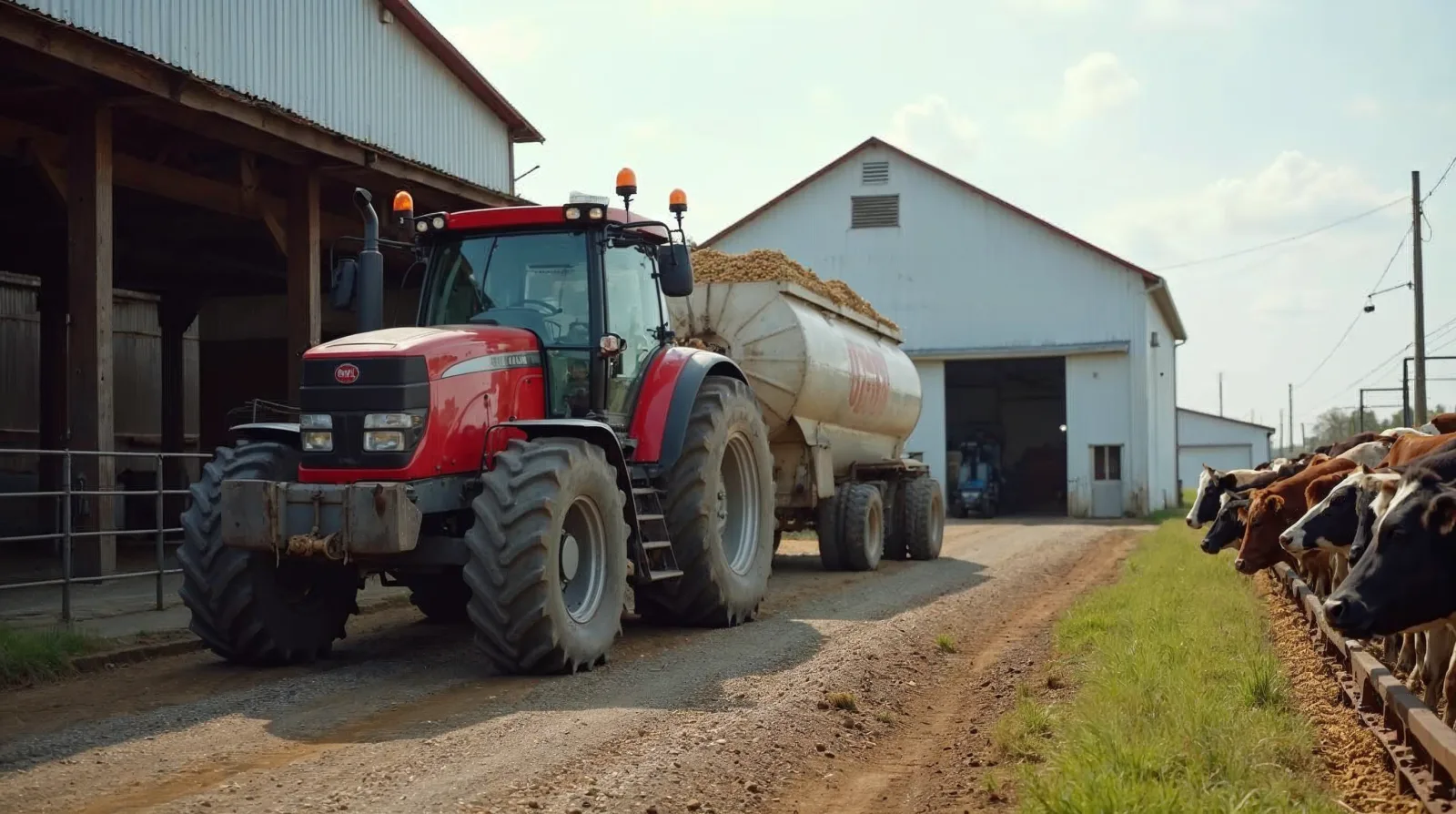
Feed is the largest cost on almost every livestock operation, usually somewhere between half and two-thirds of the total cost of producing milk or gain, which means the feed bunk is the most expensive piece of ground on the farm. Everything that happens at that bunk - how accurately the ration is mixed, how consistently it is delivered, how much the animals can actually reach, and how much gets pushed out of reach and wasted - shows up directly in the milk tank or on the scale at market. Precision feed bunk management is the practice of treating feeding as a measured, repeatable process rather than a daily chore done by feel, and the tools that make it possible - mixer wagon scales, particle separators, feed push robots like the Lely Juno, bunk cameras, and the software that ties them together - have moved from dairy showpieces to practical equipment that pencils out on working operations. This guide walks through how each piece fits, what it actually does for feed efficiency, and how to run a bunk so that the ration the nutritionist designed is the ration the animals actually eat.
A ration is a document until it reaches the bunk. The nutritionist balances energy, protein, fiber, minerals, and additives on paper or in software, and that balanced ration is what the milk check or the rate of gain is built on. But between the balance sheet and the animal sit a dozen places where the ration can drift - a forage that loaded heavy, a grain that loaded light, a mix that ran too long and pulverized the fiber, feed that the cows sorted through and left the stems behind, feed that got pushed out of reach and dried out, feed that blew away or spoiled. Every one of those drifts moves the ration the animal eats away from the ration that was designed, and the animal responds to what it eats, not to what was planned.
The reason precision matters so much here is that the errors are not random noise that averages out. They are systematic. A scale that reads two percent light on the protein supplement underfeeds protein every single load, every day, for as long as it stays out of calibration. A mixer that always loads the same operator's way leaves the ration slightly off in the same direction every time. Sorting happens in the same direction every day - cows eat the grain and fines first and leave the long fiber - so the cows that come to the bunk last get a different, higher-fiber ration than the boss cows that came first. These are not occasional mistakes; they are biases baked into the daily routine, and they cost money quietly and continuously. The whole point of measuring the bunk is to find and remove those biases.
The total mixed ration, or TMR, is the foundation of modern bunk management. The idea is simple and powerful: blend every ingredient - long forage, silage, grain, protein, minerals, additives, and often water - into a single uniform feed so that every mouthful the animal takes has the same nutrient profile. A well-made TMR keeps the rumen working steadily, removes the animal's ability to sort out the parts it likes and leave the parts it needs, and lets a nutritionist control intake precisely. A poorly made one undoes all of that.
The mixer wagon is where the TMR is built, and its scale system is the single most important measuring instrument on the feeding side of the operation. A mixer rides on load cells - typically three or four pressure sensors mounted between the box and the frame - and the scale head reads the total weight on those cells. As the operator loads each ingredient, the scale shows the running weight, and the operator adds each component until the target weight for that ingredient is reached. The accuracy of the whole ration depends on those load cells reading true and on the operator hitting the targets.
This is where precision feeding starts to earn its name, because load cell accuracy is not something to take on faith. Cells drift, they get damaged by impact and vibration, wiring corrodes, and a mixer that was dead-on a year ago can be reading several percent off today without anyone noticing, because the scale still shows confident, precise-looking numbers. The discipline is to check the scale against a known weight periodically and to watch for the warning signs - readings that jump erratically, that do not return to zero after the box empties, or that disagree with what the ration software expects the load to weigh. A mixer scale that has quietly gone out of calibration is feeding the wrong ration to every animal it serves, and the only way to know is to verify it on a schedule rather than trusting it indefinitely.
Hitting the target weights is only half of making a good TMR. The other half is the mechanical job of mixing - getting the ingredients blended uniformly without destroying the physical structure of the forage in the process. This is a balance, and both ends of it cause problems.
Loading sequence matters because the mixer is also doing processing work as it runs. In a vertical mixer, long dry hay and baleage usually go in early so the augers have time to chop and blend them, with silages, then grains and concentrates, and finally minerals and liquids added in an order the manufacturer and nutritionist recommend for the specific machine. The goal is a sequence that gives the tough forages enough mixing to break down while not over-working the whole batch. Getting the sequence wrong - dumping everything in at once, or adding the long hay last - produces a mix that is either non-uniform or unevenly processed.
Mix time is the part operators most often get wrong, and they err in the direction of mixing too long. It feels careful to run the mixer an extra few minutes to be sure everything is blended, but over-mixing grinds the forage particles too fine and strips the ration of its physically effective fiber - the long, coarse material that the rumen needs to function, that drives cud-chewing and saliva production and keeps rumen pH stable. A ration that mixes out too fine looks beautiful and uniform in the bunk and quietly causes sub-acute rumen acidosis, depressed butterfat, and health problems downstream. Under-mixing leaves clumps and lets animals sort. The right mix time is the shortest time that produces a uniform ration with the forage structure intact, and it is specific to the machine, the load size, and the ingredients. The way to find it is to mix to a target and then check the result, which is what the particle separator is for.
A mixer scale tells an operator the ration has the right weight of each ingredient. It says nothing about whether the ration has the right physical structure, and structure is what determines whether the animal can sort it and whether the fiber will do its job in the rumen. The tool for checking structure is the particle separator - most commonly the Penn State Particle Separator, a simple stack of sieve boxes with progressively smaller holes and a solid pan at the bottom.
Using it is straightforward: a representative scoop of the mixed ration goes in the top, the stack is shaken in a set pattern, and the feed sorts itself by particle size across the sieves. Weighing or estimating the fraction caught on each screen gives a particle size distribution, and that distribution is compared against the target ranges a nutritionist sets for the type of ration. Too much material on the top screen means the ration is coarse and the animals will be able to sort out the long stuff and leave it. Too much in the bottom pan means the ration is over-processed and short on effective fiber. The separator turns the vague question "is this mix right" into a measurement that can be tracked over time and used to dial in mix time and loading.
Running the separator on the fresh mix tells you what you made. Running it again on the refusals - the feed the animals left behind - tells you what they did to it, and the comparison between the two is one of the most useful diagnostics in feeding. If the leftover feed is much coarser than the fresh feed, the animals are sorting, eating the fines and rejecting the long fiber, and the ration that looked correct in the bunk is not the ration going down. That finding points to fixes - adjusting moisture, adding water, changing particle size, or improving feed push-up so the animals are not picking through a static pile all day.
One of the simplest and most overlooked truths of bunk management is that animals can only eat feed they can reach. Cattle eat with a sweeping motion of the head and tongue, and in the process they push feed away from themselves, out across the feed table beyond the reach of the next animal. Within an hour or two of feeding, a fresh delivery has been shoved into a windrow down the middle of the alley, and the feed at the rail - the only feed the animals can actually get to - is gone. From that point until the next push-up or the next feeding, animals come to the bunk, find nothing within reach, and walk away. Intake suffers, the timid animals suffer most, and feed sits in the middle of the alley drying out and going stale.
The traditional answer is to push feed up by hand or with a tractor and blade, several times a day, which works but is labor that has to happen on a schedule no one enjoys keeping, especially overnight. The Lely Juno and similar feed push robots automate it. The Juno is an autonomous, battery-powered unit shaped like a heavy cone that travels along the feed fence on a programmed route, following the edge of the feed table, and noses the windrowed feed back against the rail where the animals can reach it. It runs as often as it is set to - many operations run it a dozen or more times in twenty-four hours - returning to a charging station between rounds, and it does the overnight pushes that a person would skip.
The payoff is more consistent feed access, which raises dry matter intake and, just as importantly, evens out intake across the day and across the group. Animals eat in smaller, more frequent meals when feed is always available, which is easier on the rumen than gorging on a fresh delivery and then fasting. Frequent push-up also reduces sorting, because feed that is regularly stirred and pushed back is harder to pick through than a pile that sits untouched. The robot does not replace getting the ration right, but it makes sure the ration that was delivered stays available to be eaten, which is the difference between feed that is fed and feed that is merely delivered.
A step beyond the push robot is the fully automated feeding system, which takes over the mixing and delivery as well. Systems built around feed kitchens and automated mixers - the Lely Vector is the best-known, with comparable systems from other manufacturers - store ingredients in a staging area, mix small batches automatically to programmed recipes, and deliver fresh feed to the bunk multiple times a day without a person driving a mixer. Many of these systems also handle the push-up function, sensing when feed at the rail is low and topping it off.
The case for automated feeding is partly labor and partly biology. On the labor side, mixing and feeding is a daily, non-negotiable job that ties someone to a schedule seven days a week, and automating it frees that labor and removes the operator-to-operator variation that creeps into hand feeding. On the biology side, feeding many small fresh batches a day rather than one or two large ones keeps fresh feed in front of the animals continuously and encourages the frequent small meals that suit the rumen. These systems carry a substantial capital cost and a real complexity cost - they have to be commissioned, maintained, and managed, and they are most at home in operations with consistent ingredients and the scale to justify them - but where they fit, they bring a level of consistency and feed freshness that is hard to match by hand.
Reading the bunk - looking at how much feed is left before the next feeding and judging whether to feed more, less, or the same - is one of the oldest skills in cattle feeding, and it is still one of the most important. The amount and condition of leftover feed tells the feeder whether yesterday's call was right. The trouble is that reading the bunk well requires being at the bunk at the right time, which on a spread-out operation or in bad weather is not always practical.
Bunk cameras solve part of this. A camera aimed down the feed alley lets a feeder or manager check the bunk from a phone, from the office, or from another part of the operation, at any hour, without driving out to look. For a feedlot running slick bunk management - where the goal is to have the bunk just clean before the next feeding, so feed is fresh and intake is maximized without waste - being able to glance at the bunk an hour before feeding to fine-tune the call is genuinely useful. Cameras also document overnight behavior, show whether the push robot or the automated feeder is doing its job, and let a manager spot a bunk that has gone empty too early or a delivery that did not happen.
The honest limit of a camera is that it shows the bunk but does not measure it - a screen cannot weigh the refusals or run a shaker box. The strongest setups pair the visual check of a camera with the hard numbers from mixer scales and weigh-backs, using the camera for the quick, frequent look and the scale data for the precise accounting.
The most direct measurement in bunk management is also one of the most underused: weighing the feed that comes back. Refusals, orts, weigh-backs - the leftover feed cleaned out before the next feeding - are the difference between what was delivered and what was eaten, and weighing them turns intake from an estimate into a number. A feeder who delivers a known weight of TMR and weighs back the refusal knows exactly how much that group consumed, and tracking that figure day over day reveals trends an eyeball never would: a group going off feed, an intake that is climbing or falling, a delivery that was consistently too generous.
Operations differ on how much refusal to target. Many dairies aim for a small consistent refusal - on the order of a couple of percent of feed delivered - to guarantee that no cow ever comes to an empty bunk and that intake is never limited by running short. Feedlots running slick bunk management aim for near-zero leftover, accepting the tighter management that requires in exchange for less waste and fresher feed. Either approach works, but only if the refusal is actually measured. The failure mode is feeding to a vague sense of "looks about right," which drifts toward overfeeding - because overfeeding never causes an obvious problem the way running out does - and overfed refusal is feed that was paid for, mixed, delivered, and then hauled to the compost pile.
Weighing refusals also feeds the single most important number in feeding economics: feed efficiency. On a dairy that is pounds of milk per pound of dry matter intake, and the related income-over-feed-cost figure that compares the value of the milk to the cost of the feed that produced it. In the feedlot it is feed conversion - pounds of feed per pound of gain. These ratios are what tell an operation whether the whole feeding system is working, and they cannot be calculated honestly without knowing actual intake, which means knowing the refusals.
Feed shrink is the feed that is bought and paid for but never makes it into an animal - lost to wind, to spoilage in the pile, to rodents and birds, to mixing and loading errors, to overfeeding, and to material left in the mixer or spilled in the alley. Shrink is easy to ignore because it happens a little at a time and never shows up as a single dramatic loss, but across a year it can run to a meaningful fraction of the feed bill, and it is the kind of cost that good bunk management directly attacks. Accurate mixer scales reduce loading errors. Push-up keeps delivered feed from drying out and being refused. Measured refusals catch chronic overfeeding. Good face management and storage keep the silage from spoiling before it reaches the mixer.
Feed management software is what turns all of this measurement into something a manager can act on. Modern systems connect to the mixer scale and log every load: which ingredients went in, the target weight versus the actual weight for each, the deviation, the operator, and the time. That record exposes the systematic biases that hand feeding hides. It shows which ingredients are routinely loaded heavy or light, which operators are accurate and which are sloppy, whether load accuracy is drifting over time, and where the ration the animals are getting differs from the ration the nutritionist designed. The same software tracks ingredient inventory and cost, so feed shrink shows up as a gap between what the records say should have been fed and what the bin or pile says was actually consumed.
The value of the data is in the loop it closes. The nutritionist designs a ration, the software pushes it to the mixer, the mixer reports back how accurately it was made, the refusals report how much was eaten, and the efficiency numbers report what that feed produced. Each pass tightens the gap between the ration on paper and the ration in the rumen. The most useful step many operations can take is also the least glamorous: actually reviewing the load-accuracy reports the software is already collecting, because the data only pays if someone looks at it and fixes what it reveals.
Precision feed bunk management is not one purchase; it is a set of habits supported by the right tools. The pieces reinforce each other, and they work in a clear order.
The animals at the bunk respond to what they eat, and what they eat is the product of every decision between the ration sheet and the rail. A mixer scale that reads true, a mix made with its fiber intact, feed kept within reach all day, and refusals weighed and watched - none of these is exotic, and none of them replaces good nutrition. What they do is make sure the careful ration a nutritionist designed is the ration the animals actually receive, load after load, day after day. That consistency is where feed efficiency comes from, and on an operation where feed is the largest cost there is, consistency at the bunk is one of the most reliable returns a farmer can manage for.
Feed is the largest cost on almost every livestock operation, usually somewhere between half and two-thirds of the total cost of producing milk or gain, which is why the bunk is treated as the most expensive ground on the farm. That share is also why loading accuracy and refusals get measured: a scale reading two percent light underfeeds that ingredient every load, every day, until it is caught.
Running the mixer too long grinds the forage particles too fine and strips the ration of physically effective fiber, the long coarse material the rumen needs to keep cud-chewing and pH stable. An over-processed ration looks beautifully uniform in the bunk yet quietly causes sub-acute rumen acidosis and depressed butterfat. The right mix time is the shortest that produces a uniform ration with the forage structure still intact.
Many dairies target a small consistent refusal, on the order of a couple of percent of feed delivered, so no cow ever meets an empty bunk. Feedlots running slick bunk management aim for near-zero leftover in exchange for less waste and fresher feed. Either approach works only if the refusal is actually weighed, because feeding to a vague sense of about right drifts steadily toward overfeeding.
The Penn State Particle Separator sorts a scoop of feed across a stack of sieves to give a particle size distribution. Too much material on the top screen means the ration is coarse and the animals can sort out the long fiber; too much in the bottom pan means it is over-processed and short on effective fiber. Running it again on the refusals reveals whether cows are sorting the mix.
Join our list for practical guides on farm tech, precision agriculture, and tools that work.