
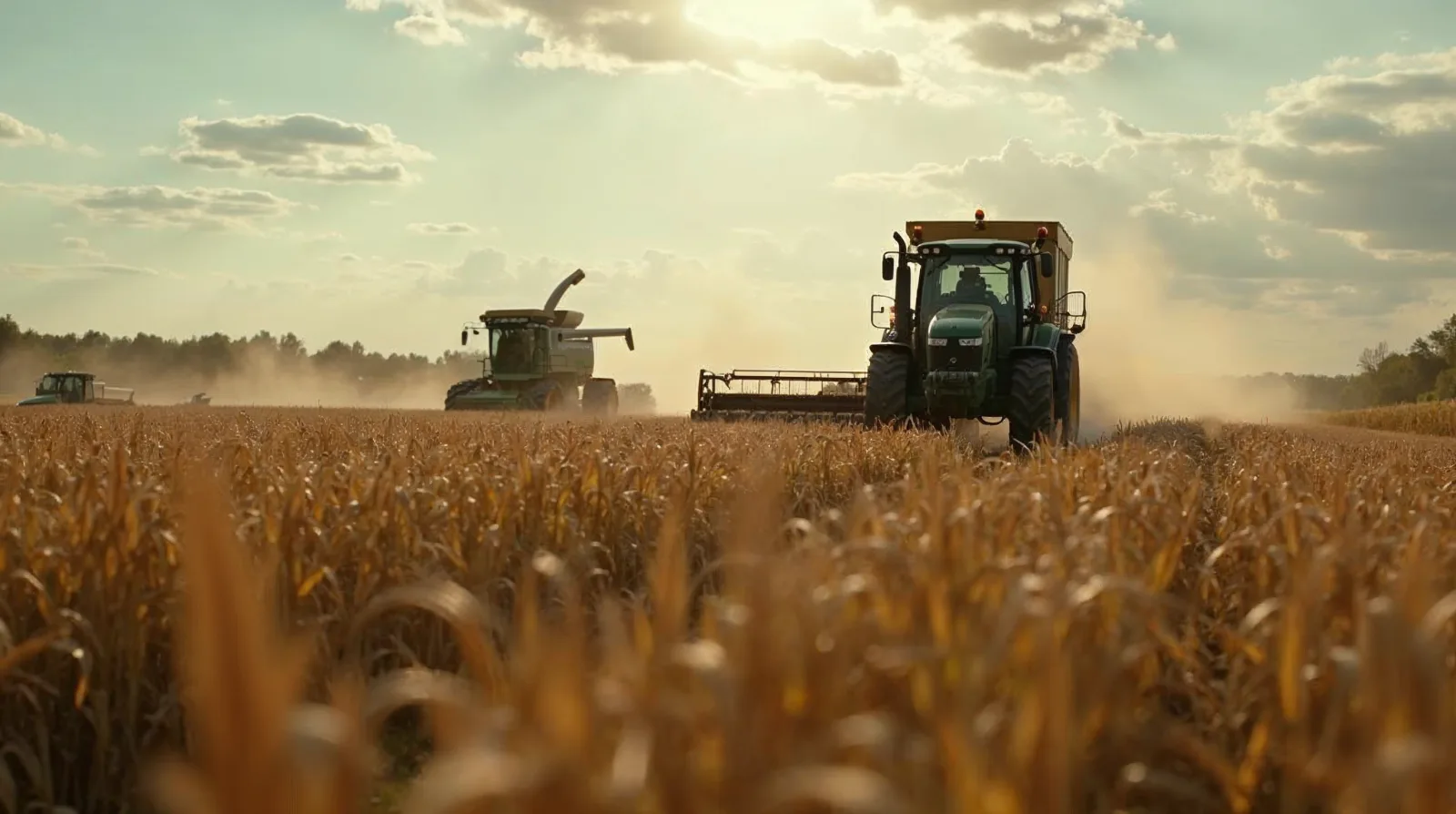
The most expensive breakdown on a farm is not the one that happens in the shop in February. It is the one that happens in the field at the front end of a good weather window, with a crop ready to come off and a parts counter three hours away. A combine bearing that lets go on the second day of harvest costs the price of the bearing plus the price of every hour the machine sits, the price of the corn that drops on the ground while the operator waits, and the price of the calls to the neighbors and the local mechanic to scramble through it. The same bearing replaced quietly in the shop on a rainy Tuesday in August would have cost the price of the bearing and an afternoon's work. Predictive maintenance is the difference between those two outcomes, and it is no longer the province of the airline fleet or the open pit mine. The same tools - oil sampling, vibration monitoring, telematics fault codes, and disciplined record-keeping - have come down in price and complexity to where a working farm can use them and get a real return on the time spent.
This is a practical guide to predictive maintenance as it actually works on farm machinery in 2026: what the techniques do, what they cost in money and time, where they pay off most clearly, and how to build the small routines that turn raw data into decisions a farmer can act on. The goal is not to chase every reading or to instrument every machine, but to find the few high-leverage indicators that catch the expensive failures before they break loose in the field, and to do so with a discipline that survives the rush of planting and harvest rather than collapsing the first week it gets busy.
There are three loosely defined ways to maintain a piece of equipment, and they sit on a spectrum from worst to best in terms of money spent per hour of useful service. The first is run-to-failure: use the machine until something breaks, then fix it. This is the default on a lot of farms by inertia, not by choice, and it is the most expensive way to operate over the long run because failures rarely happen at convenient times and the collateral damage from a small part letting go tends to be much larger than the part itself. A bearing that seizes can take out a shaft, a housing, and a day of harvest; a belt that snaps can throw a pulley and damage what surrounds it; a hydraulic line that bursts can dump fluid across a hot manifold and start a fire. Run-to-failure looks cheap on the maintenance line of the budget and expensive everywhere else.
The second approach is preventive or scheduled maintenance: change the oil every X hours, replace the filters every Y, swap the belts every Z. This is what most operator manuals prescribe and what most farmers actually do, and it is a real improvement over run-to-failure. The weakness is that it is calendar-driven or hours-driven rather than condition-driven, which means parts get replaced whether they need it or not - and just as often, parts that are wearing fast on a particular machine in particular service get missed because their scheduled interval has not arrived. Scheduled maintenance treats every machine like the average machine, and no machine on a working farm is exactly average. Some bearings see more dust, some hydraulic pumps work harder, some engines run hotter, and the schedule has no way to know.
Predictive maintenance is the third approach: use measurements - oil chemistry, vibration, temperature, fault codes, pressures, current draw, and so on - to know the actual condition of components and to act before failure rather than on a schedule. The point is to find the machines and the parts that are wearing fastest and address them, while leaving the parts that are wearing slowly alone until the data says otherwise. Done well, this catches the expensive failures before they happen, stretches the useful life of parts that have more life in them, and concentrates the maintenance time and money where it actually does the most good. Done poorly, it generates a lot of data that nobody reads and changes nothing, which is why the technique matters less than the discipline of acting on what it tells you.
The practical reality on most farms is a hybrid. The scheduled maintenance still happens - oil and filter changes on the recommended interval, the obvious wear items addressed at the obvious times. But layered over that schedule are the predictive techniques that catch the things the schedule misses: the bearing that started to make noise three hundred hours before it would have failed, the hydraulic pump whose oil suddenly shows brass particles, the combine engine whose coolant temperature has been creeping up for two weeks, the planter row unit drawing more current than the others. The hybrid is what actually works in the field, and the rest of this article is about the specific tools that make it work.
Oil analysis is the highest-value predictive tool available to most farms by a wide margin, because it costs almost nothing per sample, takes ten minutes to do, and tells you more about the internal condition of an engine, a hydraulic system, or a final drive than any other single test. A small bottle of used oil sent to a lab comes back as a report listing the concentration of wear metals - iron, copper, aluminum, chromium, lead, tin - along with contamination indicators like silicon (dirt), fuel dilution, water, and coolant, plus the condition of the oil itself in terms of viscosity, oxidation, and additive levels. Read in the context of a baseline and a trend, those numbers point straight at problems that have not yet shown up as noise, smoke, or a fault code.
The lab fee is modest, often in the range of what a half-tank of fuel costs, and the sample itself is a few minutes of work: pull a sample from the hot oil before draining, label it with the machine and hours, and ship it. Most labs return results within a week, with the report flagging any abnormal readings and, on the better services, a written interpretation that says in plain language what the numbers suggest. For an engine, rising iron usually means cylinder, ring, or cam wear; rising copper points at bearings or bushings or, in some systems, the oil cooler; aluminum can mean piston or bearing wear; silicon means dirt is getting past the air filtration, which is one of the most common findings and one of the most quickly fixed by addressing the intake side; fuel dilution past a threshold means injector or pump trouble; coolant in the oil means a head gasket or a cracked sleeve, and that one demands attention immediately.
The trick with oil analysis is that single readings tell you less than trends. A new engine and a worn engine both show iron in the oil; what matters is whether the iron is rising sample over sample, and how fast. The first sample on a given machine is the baseline, the second establishes whether the readings are stable, and from there each sample either confirms the trend or flags a change. A farm that samples its main tractors, combine, and key implements at every oil change builds up that trend within a season and starts catching the changes that point at developing wear. Many manufacturers and dealers offer sampling programs that integrate the analysis with their service records, and several of the major labs sell prepaid kits that include the bottle, the postage, and the analysis in a single package - the friction of doing it is genuinely low, and the return is genuinely high. Hydraulic and transmission oils are worth sampling too, especially on combines, where final drives and hydrostatic transmissions are expensive to repair and slow to diagnose by other means.
A practical sampling routine is simple: a sample at every engine oil change on the main tractors and the combine, an annual sample on the hydraulic and transmission oils of the same machines, and an opportunistic sample any time a machine starts acting odd or has been working in unusually hard conditions. The samples cost a little money each, but they catch problems that cost thousands when they let go in the field, and the routine pays for itself the first time it flags something real. It is the easiest place for a farm to start with predictive maintenance and the technique with the broadest return.
Bearings, gears, pulleys, and chains all make noise when they wear, and that noise carries useful information long before a human ear or a casual inspection would catch it. Vibration monitoring is the discipline of listening to that noise systematically and pulling the signal out of it that points at a developing failure. On a combine, a baler, a feed mixer, or any machine with a lot of rotating parts, vibration is often the first place a problem shows up - the bearing race develops a small spall, the gear tooth loses a chip, the chain stretches and starts slapping, and each of those produces a vibration signature that an instrument can read and a trained eye can interpret.
The entry-level tool is a handheld vibration meter, a device the size of a flashlight that an operator presses against a bearing housing or a gearbox and reads a vibration level in some standard unit. Used as a periodic check at known points around a machine - mark the spots once and check them on a routine - it builds a baseline for each location and flags any reading that rises substantially over time. The meters cost a few hundred dollars, take a minute per reading, and on a combine can save a transmission or a header drive that would have cost ten times the meter's price had it failed in the field. The skill is in the consistency: same spot, same machine attitude, same RPM if possible, same time interval. A reading that doubles month over month is the kind of finding that justifies tearing down the suspect component before harvest rather than after.
The next step up is wireless vibration sensors that attach permanently to high-value components - the combine engine, the gearbox, the cleaning shoe drive, the threshing rotor bearings - and log readings continuously, uploading to a phone app or a base station. These are more expensive, both in hardware and in setup time, but they capture trends a periodic handheld check might miss and they catch the rare sudden change - a bearing that goes from quiet to rough in a few hours - that the monthly walkaround would never see. Whether they pencil out depends on the value of the component and the cost of failure in service. For the threshing rotor and feeder house drive of a high-acreage combine, the case is easy. For a small feed mixer, the handheld meter is plenty.
Acoustic monitoring is closely related and sometimes complementary. An ultrasonic listener - a directional microphone tuned to frequencies above human hearing - can catch the high-frequency sound that bearings, valves, and steam traps make when they begin to fail, often hours or days before the audible noise that an operator would notice. The same instruments are useful for finding compressed air and hydraulic leaks, which on a busy shop or a high-pressure system are often the source of wasted energy and the early warning of a fitting that is about to let go. The ultrasonic listeners are pricier than vibration meters and the learning curve is real, but for an operation that runs a lot of high-pressure hydraulics or shop air, the payback is fast.
The thing to understand about vibration and acoustic monitoring is that neither tool replaces the operator's eye and ear. A farmer who knows his combine and pays attention to it will hear and feel a lot of the changes the instruments would also catch. The instruments add value where the operator is busy doing something else, where the change is too gradual to notice day over day, or where the noise is masked by the general loudness of the machine. Used to complement the operator's awareness rather than to replace it, vibration monitoring catches the things attention alone would miss and provides the documentation that justifies pulling a part before failure.
Most modern farm equipment - any combine, sprayer, or tractor built in the last decade or so by a major manufacturer - is generating diagnostic data continuously, whether anyone is reading it or not. The engine's electronic control unit logs fault codes, the transmission tracks temperatures and pressures, the implement records its operating parameters, and on connected machines all of this is uploaded to the manufacturer's portal where the dealer can see it and the owner can see it if he logs in and looks. The single biggest predictive maintenance win available on most farms is to actually look at this data, on a routine, and to take its warnings seriously rather than dismissing them as nuisance codes to be cleared.
Fault codes are not all created equal. Many of them are informational, intermittent, or driven by a sensor or a connector rather than a real failure, and an experienced operator learns which codes mean something and which are noise. But the codes that matter - rising injector trim values, a coolant temperature trending higher than peers, a hydraulic pressure that is slightly outside the normal band, a regen frequency that is climbing - are exactly the kind of early warnings that predictive maintenance is built around. The portal lets you compare machines, look at trends over weeks and seasons, and spot the outliers before they fail. The portal is also where the dealer's service department often sees a developing problem first, sometimes before the operator notices anything, and a service relationship that includes routine portal review is one of the cheapest forms of predictive monitoring available.
The discipline is to make portal review a habit rather than something done only after a breakdown. A short Friday-morning routine of logging in, scanning the active codes on each major machine, and looking at the engine and transmission trends takes ten or fifteen minutes and catches a lot of developing trouble. The codes that have been logging quietly for weeks are the ones most likely to be hiding a real problem; the codes that just appeared after a particular operation point at what changed. For an operation that owns more than two or three machines, that habit alone justifies the time it takes.
The data ownership question is real and worth being clear about. The fault codes and operating data are generated by your machine and arguably about your work, and the terms under which the manufacturer holds and shares them vary by brand and region. The practical answer is to know what your portal access actually gives you, to make sure your account is set up so you can see your own data without going through the dealer, and to keep a local record of the important findings rather than relying entirely on the manufacturer's cloud. Several third-party telematics services and aftermarket loggers can pull data off the machine's diagnostic port and store it independently, which is useful both for cross-brand consistency and for keeping a record that survives any change in the dealer relationship.
None of these techniques pay off if their output is not recorded, compared over time, and acted on. The maintenance log is the spine of predictive maintenance, and it is the part where a lot of farms struggle, because the log either does not exist, exists only in the head of the operator, or exists in a notebook that gets lost between seasons. The practical bar is low: a usable log captures what was done, when, on which machine, at what hour reading, and what was found. Anything beyond that is gravy; anything less than that is missing the point.
The simplest form is a paper logbook in the shop with a page per machine. Every service entry gets a line: date, hour reading, what was done, oil sample results if any, any abnormal findings, parts replaced. The advantage of paper is that it does not depend on a computer being available in the shop or a phone being charged in the field; the disadvantage is that it is hard to query, easy to lose, and impossible to share across multiple people. For a one-person operation that is in the shop daily, paper still works well and is what a lot of farms actually use.
The next step is a simple spreadsheet, with one tab per machine and the same columns as the paper log. The spreadsheet is queryable - you can see how often a given component has been replaced, how the oil sample iron readings have trended, how the hours between filters compare across machines - and it can be backed up, shared, and accessed from a phone in the field. Many farms run their maintenance entirely in a spreadsheet and never need anything more sophisticated. The discipline that makes the spreadsheet work is making the entry at the time of the work, not after, and keeping the columns standard enough that searches and sorts actually work.
Beyond the spreadsheet are dedicated farm maintenance apps, some standalone, some integrated with the manufacturer's telematics portal. These can pull hour readings automatically from connected machines, flag overdue services, store oil sample reports as attachments, generate reminders, and produce summaries that show where time and money are going. They cost a modest subscription, the better ones earn it for a multi-machine operation, and they are particularly valuable when more than one person is doing the maintenance, because the shared record removes the "did anyone change the filter" question. The trap with any software is to choose one that demands more entry effort than the value it returns; the test is whether the person doing the wrenching is willing to make the entries, and if not, a simpler tool will outperform a fancier one every time.
What the log enables is the move from anecdotes to data. Without a log, "this combine seems to use a lot of oil" is a feeling; with a log, it is "this combine used six gallons more this season than last, and the iron readings climbed forty parts per million between the spring and fall samples." That kind of statement is actionable in a way the feeling is not, and the actions that follow it are what predictive maintenance pays off.
Predictive maintenance is not free, and one of the most useful habits is to size the monitoring effort to the value of the machine and the cost of its failure. The combine, the main tractor, and the big sprayer are the high-stakes machines: they cost the most, they fail the hardest, and they fail at the worst possible times because they are most heavily used during the narrowest weather windows. For these machines, the full kit makes sense - oil sampling every interval, vibration checks on the key bearings, religious portal review, attentive operator awareness, and a maintenance log that captures all of it. The cost of the monitoring is small compared to the cost of a harvest delayed by a major failure, and the math is straightforward.
The middle tier is the workhorse tractors, the grain cart, the planter, and the disk - machines that are essential during their season but less catastrophic when they go down because the season is longer or the redundancy is greater. For these, oil sampling on the engine and major drives, a quarterly vibration check on the key bearings, and a routine portal review are usually enough. The maintenance log captures the work, but the monitoring intensity does not need to match what the combine gets.
The smallest tier is the chore tractors, the utility implements, and the older equipment kept around for occasional use. For these, scheduled maintenance and operator attention are usually adequate, with oil sampling reserved for any machine that starts behaving oddly. Putting full vibration monitoring on a chore tractor that runs a hundred hours a year is not where the money pays off; making sure the engine oil is changed on schedule and the air filter is clean is. The principle is to put the monitoring where the failure cost is highest, not to spread it evenly across the fleet for the sake of consistency.
A useful exercise is to list every machine, estimate the dollar cost of an in-season failure, and rank the list. The top three or four machines are the ones to monitor closely; the rest of the list gets a lighter touch and the time saved goes back into the high-value work. The same exercise also clarifies which spares to keep on hand, because the predictive maintenance findings will tell you which parts are likeliest to fail next, and stocking those spares before the season is the natural complement to the monitoring itself.
The window where predictive maintenance returns the most is the off-season, when the data from the previous run is fresh, the parts counter is open, and the machine can come apart without a clock running on it. A combine that finished the season with rising iron in the oil and a vibration reading climbing on the rotor bearing is a combine that needs work in the shop, and the time to do that work is in the months between harvest and the next season, not when the corn is ready to come off. The discipline is to take the predictive data from the prior season as the starting point for the winter shop list, and to use the off-season hours to address the findings methodically.
A useful winter routine is to pull every machine's record, review the oil samples, vibration readings, and fault codes from the previous season, and write a prioritized shop list per machine: items the data says need attention now, items it says should be watched, and items that look fine and need no work beyond scheduled service. The shop list drives the off-season work, the parts orders, and the spares stocking, and it ensures that the winter time is spent on what the data identified rather than on what felt like the next job. The machines come out of the shop in the spring with their known weaknesses addressed and the season ahead with fewer surprises in it.
This routine is also where the maintenance log earns its keep, because the only way to do the off-season review is to have the data from the season just finished, and the only way to have that data is to have logged it as the season went. A combine that finished harvest with a long list of operator observations, three oil samples, two vibration readings, and a clean record of every fault code that lit up during the run is a combine the winter work plan can address directly. One that finished with no record beyond the operator's memory is a machine that has to be inspected from scratch in the spring, and the things the data would have caught will be found only by tearing things down or by waiting for them to break.
The off-season is also when supplier relationships, parts availability, and shop time are easiest to arrange. Calling the dealer in February about a rotor bearing the vibration data flagged in October is a different conversation than calling in September with a combine sitting at the edge of a field. The first call ends with the part on the shelf and the work scheduled; the second ends with a scramble and a harvest delay. Predictive maintenance does not eliminate the in-season scramble entirely, but it converts most of what would have been scrambles into winter shop work, and that conversion is where the dollars actually show up on the books.
Predictive maintenance on a working farm is not glamorous and it is not free, but it is one of the highest-return habits a farm can build, because the cost of the monitoring is small and the cost of the failures it prevents is large and concentrated in the worst possible times. The techniques themselves are mature and accessible: oil sampling has been a heavy-industry standard for half a century and is now available to any farm with a phone and a postage-paid kit; vibration meters and sensors have come down in price to where the handheld units are tool-counter purchases; telematics and fault code data are already being generated by the machinery and the only question is whether anyone reads them; and the maintenance log can be a notebook, a spreadsheet, or an app, depending on what the operator will actually use. None of this is exotic, and none of it is out of reach.
The reason most farms underuse predictive maintenance is not the cost or the complexity but the discipline. The data has to be collected on a routine, reviewed on a routine, and acted on when it shows something. The off-season has to be used to address the findings while there is still time. The shop list has to be driven by what the data shows, not by what feels next. Those habits are the work, and they are also the difference between a maintenance program that pencils out and one that just generates paperwork. An operation that builds the habits gets the failures caught before they break loose, the harvest windows protected, and the equipment lifetime stretched. One that does not gets the bearing that lets go on the second day of harvest, and the bill that comes with it.
The starting point is small and concrete: sample the oil at the next change on the most expensive machine, write down what the lab says, and put it in a log. Add the next machine, and the next, and the vibration meter when the routine is steady, and the portal review on Fridays. Within a season the routine is established and the data is starting to talk, and the winter shop list writes itself from what the data says rather than from guesswork. The combine that comes out of that shop in the spring is the one that finishes the harvest on time, and the operation that built the routine is the one that quietly saves the money it would otherwise have spent on the failures that never happened.
Oil analysis, by a wide margin. A small bottle of used oil sent to a lab costs about what a half-tank of fuel costs, takes ten minutes to pull, and comes back within a week listing wear metals like iron and copper plus contaminants like silicon, fuel, and coolant. Read against a baseline and a trend, those numbers point at internal wear long before it shows up as noise, smoke, or a fault code.
In an engine, rising iron usually means cylinder, ring, or cam wear; rising copper points at bearings, bushings, or the oil cooler; aluminum can mean piston or bearing wear; and silicon means dirt is getting past the air filtration. Fuel dilution past a threshold means injector or pump trouble, and coolant in the oil signals a head gasket or cracked sleeve, which demands attention immediately.
Scheduled maintenance replaces parts on a calendar or hours interval whether they need it or not, treating every machine like the average machine. Predictive maintenance uses measurements, oil chemistry, vibration, temperature, and fault codes, to act on a component's actual condition, catching the parts wearing fastest while leaving the slow-wearing ones alone until the data says otherwise.
It depends on the value of the component. A handheld vibration meter costs a few hundred dollars and is plenty for a small feed mixer, checked at marked points on a routine. Permanent wireless sensors that log continuously cost more but justify themselves on high-value parts, like a high-acreage combine's threshing rotor or feeder-house drive, where a sudden bearing failure in the field is catastrophic.
Join our list for practical guides on farm tech, precision agriculture, and tools that work.