
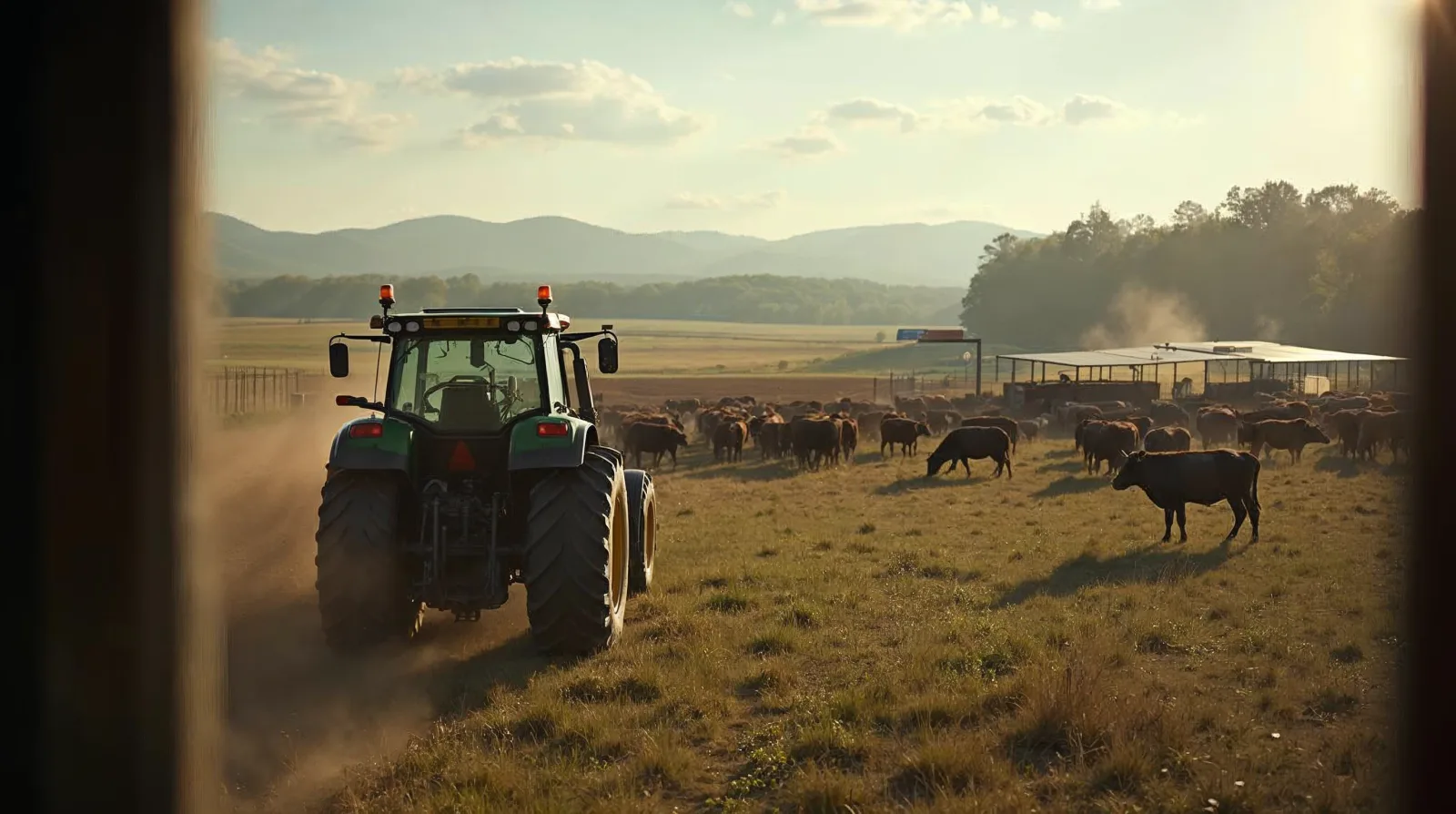
Few things cost a cattleman more sleep than calving season. Heifers calve in the worst weather, at the worst hour, and a calf that comes backward or a heifer that has been pushing for two hours without progress can turn into a dead calf, a dead cow, or both in the time it takes to pull on your boots and drive to the far pen. For generations the answer was simple and brutal: get up every two or three hours through the night, walk or drive out to the calving lot, shine a light around, and go back to bed if everything looked quiet. That routine works, but it wears a person down over a six week stretch, and it has a blind spot built into it - the trouble that starts ten minutes after you walk back to the house. Remote livestock monitoring cameras close that gap. A camera over the calving pen, a screen by the bed or an app on your phone, and you can check the heifers from under the covers as often as you want without ever opening the door. This guide walks through what these systems actually are, how they get power and signal out to a barn or a pasture pen, what separates a camera that works at 3 a.m. in a snowstorm from one that does not, and the honest economics of whether the setup pays for the calf it saves.
The case for a calving camera is not really about technology, it is about the math of checking. Every trip to the calving lot has a cost in time, sleep, fuel, and the simple friction of getting dressed and going out in the cold. Because each trip costs something, people naturally space them out, and the wider the spacing the bigger the window for something to go wrong unobserved. A heifer that started calving five minutes after your last walk-through might not be checked again for two or three hours, and in a hard pull that delay is the difference between a live calf and a dead one.
A camera drops the cost of a single check almost to zero. Instead of getting up and going out, you open your eyes, look at a screen, and decide. Because the check is nearly free, you check far more often - every time you stir in the night, you glance at the pen. The practical result is that trouble gets caught early, while there is still time to intervene calmly rather than discovering a problem that has been building for hours. You still have to go out and pull the calf when a heifer needs help, but now you go out when she actually needs you instead of going out four times to find her resting and missing the one time she did not.
There is a second, quieter payoff that experienced operators talk about: you sleep better and you make better decisions. A person running on six weeks of broken sleep, dragging out into the cold every couple of hours, is not at their sharpest when a real dystocia finally shows up at four in the morning. Cutting out the unnecessary trips means you are more rested and more capable when the night you actually have to act arrives. The camera does not replace good stockmanship - it protects it, by saving your energy for the calls that matter and giving you more lead time to make them.
Before shopping for hardware it is worth being clear about which problem you are solving, because the answer drives almost every other decision. A camera that watches a calving barn or a small lot fifty yards from the house is a fundamentally easier installation than one watching a pen a half mile out with no power and no buildings. Lumping them together is how people end up buying the wrong thing.
The close-in calving barn or yard is the common starting point and the easiest win. There is usually a building with power, a roof to mount under, and the house is close enough that home internet can reach the barn with a little help. This is where a first camera almost always goes, because the cost and complexity are lowest and the payoff during calving is highest.
The remote pasture pen, the bull lot across the creek, the watering point a mile from the yard - these are a different animal. There is no power, no roof, often no usable signal from the house, and the camera has to survive on its own through whatever the weather does. Solving the remote case means solving power and connectivity from scratch, and the cost climbs accordingly. Plenty of operations run the easy barn camera for years before they ever tackle a truly remote location, and that is a reasonable order to do it in. Know which job you are buying for before you spend a dollar.
A camera is only as good as the connection feeding its picture back to you, and on a farm the connection is usually the hard part. There are three broad ways to get a camera talking to your screen, and the right one depends entirely on the distance and the obstacles between the camera and your house.
The simplest is a wired connection. Running a cable - increasingly a single network cable that carries both data and power over Ethernet - from the house or shop out to a nearby barn gives you the most reliable picture there is, with no signal to drop and no monthly fee. For a barn within a few hundred feet of an existing network, a buried or strung cable is hard to beat for reliability, and the per-camera cost is low. The limit is distance and the work of trenching or stringing the run, which is why wired makes sense for close, fixed locations and stops making sense as the distance grows.
For locations too far to easily wire but still within reach of your home network, a wireless bridge does the job. A pair of small directional antennas - one at the house pointed at the barn, one at the barn pointed back - creates a point to point link that carries the camera's signal across the gap without a cable in the ground. With clear line of sight these links reach well over a mile, and they extend your existing internet out to the barn so the camera behaves as if it were plugged in at the house. The catch is line of sight: trees, hills, and buildings between the two antennas degrade or block the link, so the geography of your place decides whether this works.
The third option, and the only one that works when the camera is genuinely out of reach of your network, is cellular. A camera or a small cellular router with its own data plan sends the picture over the cell network the same way your phone does, so the only requirement is enough cell signal at the camera location. This is what makes a truly remote pasture pen possible, and it is also what introduces a monthly cost and a hard dependency on coverage. Where you have a couple of bars, a cellular camera can watch a pen miles from the nearest building. Where you have no signal, no amount of equipment fixes it, and you are back to wired or a wireless bridge. Check the actual signal at the exact spot the camera will sit, not at the house, before you commit to cellular.
Signal is half the remote problem and power is the other half. In a barn with an outlet this is a non-issue - plug it in. Out in a pasture it is the whole game, and the answer is almost always solar.
A solar powered camera pairs a small panel with a rechargeable battery, sized so the panel banks enough charge on sunny days to carry the camera through the nights and the cloudy stretches. Done right, it runs for years with no wire and no attention. Done wrong - undersized panel, undersized battery, mounted where it spends half the day in shade - it dies every cloudy week in the dead of winter, which is exactly when you need it for calving. The trap with solar is that winter is the worst case on every axis at once: the shortest days, the weakest sun angle, the most cloud cover, and panels that can be buried under snow. Calving season often lands squarely in that worst case.
That makes sizing the difference between a system that works and a frustration that does not. The panel and battery need to be sized for your darkest, shortest, cloudiest winter weeks, not for a sunny day in May, which means buying more panel and more battery than the spec sheet's rosy numbers suggest. Mounting matters as much as sizing: the panel needs a clear southern exposure with no tree or building shadow crossing it during the short winter day, and tilting it steep helps both winter sun angle and snow shedding. A panel laid too flat collects snow and stops charging until someone wipes it off, which defeats the purpose of a hands-off remote camera. Plan for the worst week of winter and the rest of the year takes care of itself.
Once power and signal are handled, the camera itself has to do its job in conditions that would defeat a cheap indoor unit. A few features genuinely matter for livestock work, and a lot of marketing does not.
Night vision is the first, because most calving trouble happens in the dark. Standard infrared night vision works, lighting the scene with infrared the camera can see but the animals cannot, giving a clear black and white picture out to a useful distance. The thing to check is range - a camera rated for good night vision at fifteen feet is useless watching a pen forty feet across. For watching animals at night specifically, infrared that does not throw a visible light is preferable, since you are not lighting up the pen and disturbing a heifer that is trying to settle.
Pan, tilt, and zoom - a PTZ camera that you can swivel and zoom from your phone - is the single most useful feature for a calving pen, and worth paying for. A fixed camera shows one frame, and a heifer who walks into the corner or behind a round bale is simply gone from view. With PTZ you can pan across the whole pen, zoom in on a cow you are unsure about, and actually read whether she is pushing, whether feet are showing, and whether they are coming right. That ability to look closer is what turns a camera from a motion detector into a real set of eyes. For a single fixed barn stall a fixed camera is fine, but for an open lot, PTZ earns its higher price the first night you use it to check feet without getting out of bed.
Weatherproofing is non-negotiable for anything mounted outside. Look for a genuine outdoor rating, and remember that farm conditions are harder than a suburban porch - dust, manure, ammonia in a closed barn, spiders building nests over the lens, and temperatures well below what consumer gear is tested for. Cold is the quiet killer here: many cameras and especially their batteries lose function in hard cold, so for a northern calving operation, confirm the camera and any battery are rated for the actual low temperatures you see, not just a mild "outdoor" claim.
Resolution gets the marketing attention but matters less than people think for this job. You are not reading a license plate, you are deciding whether a cow is calving. A clear, reliable, smooth picture you can pan and zoom beats a razor sharp image that stutters or drops out. Reliability and the ability to look where you need to look matter more than megapixels.
A camera is only useful if checking it is genuinely easier than walking out, so how you view it matters. Most modern systems put the picture on a smartphone app, which is the right answer for the common case - you can check from the bedroom, from the shop, from town, or from the tractor seat, and more than one family member can watch the same pen from their own phones. Being able to check the heifers from anywhere, and to share that watch among everyone who helps, is a real part of the value.
Some operations also like a dedicated screen - a monitor or tablet mounted by the bed or in the kitchen that stays on the calving pen around the clock. There is something to the always-on screen that an app cannot match: a glance across the room with no phone to unlock and no app to open lowers the friction of checking to almost nothing, so you check even more often. Plenty of setups run both, a wall screen at the house and the app for when someone is away.
Motion alerts are the feature people want most and trust least, and for good reason. A camera that pings your phone when a cow lies down and gets up sounds perfect until it has woken you forty times in a night over nothing, at which point you turn it off and it has done you no good. In an open lot full of moving cattle, motion alerts generate so much noise they often get ignored. They work best in a tightly framed single calving stall where genuine activity is rare. For most open-pen calving, the camera's real value is the cheap manual check, not the automated alert - the alert is a bonus that works in some setups and becomes useless clutter in others. Set expectations accordingly and do not buy a system on the strength of its alerts alone.
Calving is the reason most people buy the first camera, but it tends not to be the only job the camera ends up doing, and those extra uses help justify a system that otherwise sits idle ten months of the year.
A camera on the waterer or stock tank lets you confirm water is flowing and not frozen without a drive out, which in a hard freeze can save a tank from going dry or a pump from running on empty. A camera covering a gate, the fuel tank, the shop, or the equipment yard doubles as security, and rural theft of diesel, tools, and equipment is common enough that a watched yard has real value on its own. A camera over a feed bunk or a sick pen lets you check whether animals are eating and behaving normally without disturbing them by walking in. None of these alone might justify the purchase, but together they turn a seasonal calving tool into a year round set of remote eyes on the operation, and that broader usefulness is worth weighing when you size the first system.
The honest economics depend heavily on which problem you are solving. A simple wired or wireless camera on a barn near the house, running on existing power and internet, can be a modest one time cost with no ongoing fee - a few hundred dollars for a decent PTZ camera and a wireless bridge if needed, and you are watching the pen. A fully remote solar and cellular setup for a far pasture is a different order of expense: the camera, an adequately sized solar and battery system, a cellular plan with a monthly fee, and mounting hardware tough enough to survive out there, which together climbs well into four figures and carries a recurring data cost.
Against those costs sits a simple and powerful number: the value of one calf. A live calf is worth a meaningful amount of money, and a heifer saved is worth far more. If a camera lets you catch one hard calving in time over a season that you would otherwise have lost, a barn system has very likely paid for itself, and a remote system is at least in the conversation. The catch is that the saved calf is uncertain - you cannot know in advance how many you will catch that you would otherwise have lost - while the cost is certain. That is why the close-in barn camera, with its low cost and high calving-season payoff, is nearly always the right first purchase, and the expensive remote setup is a decision to make only once the easy win has proven its worth and a specific remote pen justifies the added expense.
The non-dollar value is real too and harder to put a number on. Sleep through calving season, less time spent dragging out into the cold for nothing, and the steadier nerves that come from catching trouble early instead of discovering it late are worth something to anyone who has lived through six weeks of two-hour checks. For many operations that quality-of-life return is what actually closes the sale, and it is a legitimate part of the math.
The lowest-risk way in is the same as with most farm technology: start small, on the easy problem, and learn before you scale. Put the first camera on the calving barn or the lot nearest the house, where power and internet are within reach and the calving payoff is highest. Buy a PTZ camera so you can actually look at feet and assess progress rather than just confirm a cow exists, get genuine outdoor weatherproofing rated for your real winter cold, and confirm the night vision range covers the whole pen and not just the near corner. Get that one camera working through a full calving season and you will know exactly what you want from a second.
If a remote pen is the goal, solve power and signal honestly before buying the camera. Stand at the exact spot the camera will mount and check the cell signal there, not at the house. Look at where the sun actually falls in December, not June, and size the solar panel and battery for the darkest, snowiest week of the year with margin to spare. Make sure the panel can be mounted with clear southern exposure and tilted steep enough to shed snow. Get those two problems solved and the camera is the easy part. Skip them and you will own an expensive box that goes dark every cloudy week of calving, which is worse than no camera at all because you will have learned to rely on it.
Whichever way you go, the principle is the same one that runs through every good piece of farm technology: the camera does not replace stockmanship, it extends it. It lets a good cattleman check the herd more often, catch trouble earlier, and spend his energy on the calls that matter instead of on the trips that do not. Used that way, a camera over the calving pen is one of the cheapest ways there is to save a calf and a night's sleep at the same time.
Pan, tilt, and zoom is the single most useful feature, because it lets you swivel across the whole pen and zoom in from your phone to read whether a heifer is actually pushing and whether the feet are coming right. Genuine outdoor weatherproofing rated for your real winter cold and a night-vision range that covers the whole pen matter far more than a high megapixel count.
Almost always with solar: a panel paired with a rechargeable battery, sized for the darkest, cloudiest winter weeks rather than a sunny day in May. Mount the panel with clear southern exposure and tilt it steep so it sheds snow, because calving season often lands in the worst week of winter, when a flat, snow-covered panel stops charging exactly when you need the camera most.
There are three ways. A wired Ethernet run is the most reliable for a close barn and carries no monthly fee. A point-to-point wireless bridge with a directional antenna at each end reaches well over a mile with clear line of sight. Cellular is the only option for a pen genuinely out of network reach, so check the actual signal at the exact camera spot, not at the house.
A live calf is worth a meaningful amount of money and a saved heifer far more. If a camera lets you catch even one hard calving in time over a season that you would otherwise have lost, a close-in barn system running on existing power and internet, often just a few hundred dollars for a PTZ camera and a bridge, has very likely paid for itself, with better sleep on top.
Join our list for practical guides on farm tech, precision agriculture, and tools that work.