
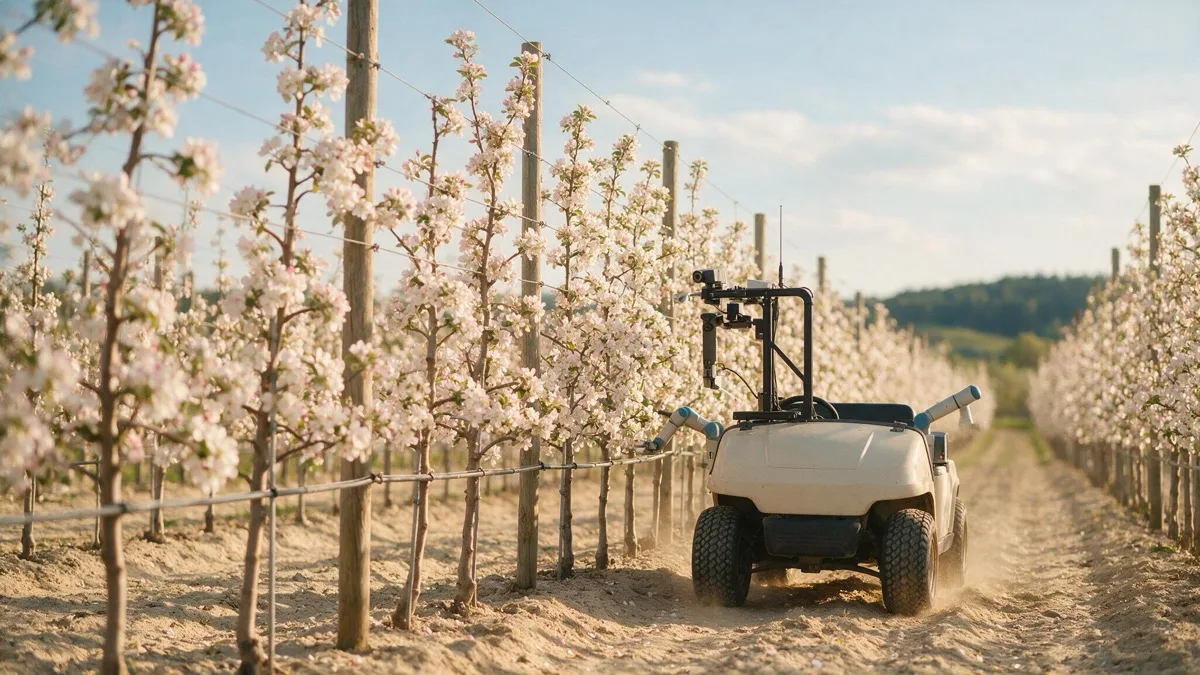
Robotic blossom thinning is not yet something you can buy. In research plots a robotic arm thins about 60 to 67 percent of targeted flowers at 7 to 9 seconds per cluster, too slow for commercial use. What is sold today is the vision layer: camera systems that count and size fruit to sharpen your thinning.
That split is the whole story, and most of the marketing you will see blurs it. So before you budget for a machine that isn't on the shelf, it helps to separate what the robots can already see from what they still can't do with their hands.
Thinning is the last big orchard job still done mostly by hand and chemical guesswork, and it carries the highest stakes. Get the crop load right and you hit good fruit size, secure next year's bloom, and grade out well. Get it wrong in either direction and you pay for it.
Under-thin and the tree carries too many fruit. They stay small, drop into low-value grades, and the tree pours so much energy into seed that it skips flower buds for the following spring. That is biennial bearing, and it turns one bad call into a two-year penalty. Over-thin and you leave yield and money on the ground.
Extension researchers who study this put the economic swing between good and bad crop-load decisions on the order of $10,000 to $20,000 per hectare in fruit value. That is not a rounding error. It is the difference between a profitable block and a break-even one.
The recipe most modern apple growers now follow is precision crop load management, a three-step funnel. First, precision pruning to a set bud load, roughly 1.5 to 2.0 flower buds for every fruit you want to harvest. Second, precision chemical thinning to knock the numbers close to target during and just after bloom. Third, precision hand thinning to finish the job and clean up what chemistry missed. Robotics is being aimed squarely at steps two and three, because that is where the labor and the guesswork pile up.
The short version: hand thinning is expensive, and the crews to do it are getting harder to find.
Hand thinning apples runs roughly $1,000 to $2,000 per acre. A 2024 Washington State University Gala enterprise budget pegged fruit thinning at about 54 hours per acre, or close to $1,033 per acre, with farm labor landing near $23.75 an hour fully loaded. Multiply that across a whole ranch and thinning becomes one of the largest hand-labor lines in the budget.
Extension guidance is blunt about it: hand thinning "usually is not a viable option" at scale, simply because it costs too much and the labor is too scarce. That is exactly why chemical thinning is the current default, and why any tool that promises to trim hand-thinning hours gets a serious look.
The macro picture sharpens the point. Trade analyses in 2024 showed even solid 90 to 110 bin per acre orchards struggling to clear profitability targets against high labor costs and interest rates. When margins are that tight, the pitch for automated thinning stops being a gadget and starts being a survival tool. That pressure, more than any single robot, is the real adoption driver.
Robotic thinning does not arrive to an empty field. It has to beat a tool many growers already own: the Darwin string thinner, a tractor-mounted spinning-string blossom thinner that has been in orchards for years.
The Darwin works. Studies show it cuts thinning time by roughly 27 to 33 percent compared with hand thinning alone. On stone fruit it has reduced crop load by about 47 percent and pushed 22 to 31 percent more fruit into the higher size categories. On apple scaffolds it has trimmed crop load anywhere from 21 to 50 percent against a hand-thinned control. If your only goal is "faster than a hand crew," the string thinner already delivers.
Its limitation is exactly the gap the robots are chasing. The Darwin is non-selective. It cannot tell a keeper flower from a cull, so it strips whatever the strings reach, and it can bruise spurs, tear leaves, and damage foliage in the process. That bluntness is why adoption stalled where it did. It is a hedge trimmer, not a surgeon.
So the honest case for a robotic thinner is not speed. Darwin already has speed. The prize is selectivity: removing the right flowers and leaving the right ones, at a labor cost a hand crew can't sustain. That is the one thing neither the string thinner nor the spray tank can do.
In the lab, and moving, but not on a dealer lot.
The most concrete published system comes from Washington State University's agricultural robotics group. Their design pairs a six-axis robotic arm with a deep-learning vision system, a depth camera, and a miniature string end-effector, essentially a tiny string trimmer on a robot wrist. In a commercial Envy block on a V-trellis, the system thinned 67.2 percent of targeted flowers at 9.0 seconds per cluster using one approach path, and 59.4 percent at 7.2 seconds per cluster using another.
Read those numbers honestly. Roughly 60 to 67 percent efficacy is a real milestone for selective work, but 7 to 9 seconds per cluster is a research rate, not a commercial one. A mature tree can carry hundreds of clusters. At eight seconds each, a single arm cannot keep pace with a bloom window that lasts only days. Throughput, not accuracy, is the wall these systems still have to climb.
Two parallel research threads are worth watching. One is machine vision that estimates the 3D position of small green fruitlets so an arm can reach them for post-bloom thinning. The other, and possibly the faster route to market, is vision-guided precision spraying: cameras that spot individual green fruit and trigger a targeted dose of chemical thinner instead of blanketing the whole canopy. That approach rides existing spray hardware, which means it could reach commercial orchards before any mechanical arm does. Keep both in view; the arm is the headline, but the smart sprayer may get there first.
The eyes, not the hands.
The commercial wedge right now is crop-load vision. Systems in this category, such as those from Orchard Robotics, mount a camera rig on a tractor or utility vehicle, image the canopy as you drive the rows, and use trained models to count and size flowers and fruit. That data feeds a cloud record that informs pruning, thinning, labor planning, and harvest timing. The company behind FruitScope raised a $22 million Series A in September 2025, which tells you where investor confidence is pointing: at sensing and decisions, not at robot arms.
Here is the distinction that matters for your budget. A crop-load camera does not remove a single blossom. It tells you and your crew where the tree is overset, how hard to thin, and which blocks to hit first. It makes chemical and hand thinning smarter instead of replacing them. That is a narrower promise than "robot does the thinning," but it is a real, buyable one, and it pays off with the labor you already have.
For a working grower, that reframes the whole purchase. You are not buying a machine to do the job. You are buying better eyes so the people doing the job waste fewer passes and fewer dollars.
You prepare the orchard, not the equipment shed. The low-regret moves pay off with today's vision tools and position you for whatever ships next.
The biggest one is canopy architecture. Robots, and even the camera systems, work best on narrow, planar, high-density trellis systems: V-trellis, tall spindle, and fruiting walls. A simplified, two-dimensional canopy is easier to see, easier to reach, and easier to thin, whether the thinner is a string, a spray nozzle, an arm, or a person on a platform. If you are replanting a block this year, factor "machine-thinnable and machine-pickable architecture" into the design now, well before the thinning robot exists. That decision is a lot cheaper to make at planting than to retrofit later.
The second is consistency. Uniform tree structure and spacing make every downstream tool, mechanical or robotic, more effective and more predictable. The third is data habits. If you start recording crop-load numbers, thinning decisions, and outcomes now, you build the history that makes a vision system useful the day you turn it on. None of this requires new capital. It just requires deciding that the orchard you plant today should be one a machine can work tomorrow.
If you want the running version of this ag-tech reality check, block by block and season by season, that is the kind of monitoring Manley Farms tracks. Follow along or sign up for the updates so the next tool that actually ships doesn't catch you retrofitting.
Split it three ways and you will not get burned. Vision is now: crop-load cameras are real, buyable, and they sharpen the thinning you already do. Vision-guided sprayers are near: targeted chemical thinning that rides existing spray gear is the likely next commercial step. Selective mechanical arms are several years out and throughput-limited: impressive in the plot, not ready for the row.
The same crop-load logic applies to peaches, pears, and cherries, even though the robotics work is furthest along in apples. So this season, do the boring, high-return things. Nail your precision pruning bud counts. Run your chemical thinning tight and time it well. If you are buying technology, buy the eyes, not the promise of the hands. And if you are planting, plant a canopy a machine can reach. That is how you win on fruit size this year and stay ready for the year the robot finally shows up.
No. A robotic selective thinner is still in university research, not on the market. The best-published field system thins about 60 to 67 percent of targeted flowers at 7 to 9 seconds per cluster, which is far too slow for a commercial bloom window. What you can buy today is crop-load vision that counts and sizes fruit to guide your existing thinning.
A crop-load camera is the eyes; a thinning robot would be the hands. Camera systems drive your rows, count and size flowers and fruit, and tell you where and how hard to thin. They do not remove a single blossom. A thinning robot would physically pull flowers or fruit, and no such machine is commercially available yet.
No. The Darwin is a tractor-mounted spinning-string blossom thinner that saves roughly 27 to 33 percent of thinning time, but it is non-selective. It strips whatever the strings reach and can damage spurs and leaves. A robotic thinner's whole purpose is selectivity, removing the right flowers and leaving the keepers, which the string thinner cannot do.
Hand thinning apples runs roughly $1,000 to $2,000 per acre. A 2024 Washington State University Gala budget put fruit thinning near 54 hours per acre at about $1,033 per acre, with farm labor around $23.75 an hour. That cost, plus a shrinking labor supply, is the main reason growers are watching thinning automation so closely.
Focus on the orchard, not the equipment. Plant narrow, planar, high-density trellis systems such as V-trellis or fruiting walls so a machine can see and reach the canopy. Keep tree structure uniform, and start recording crop-load and thinning data now. These moves cost nothing extra, pay off with today's vision tools, and position you for future robotic thinning.
Join our list for practical guides on farm tech, precision agriculture, and tools that work.