
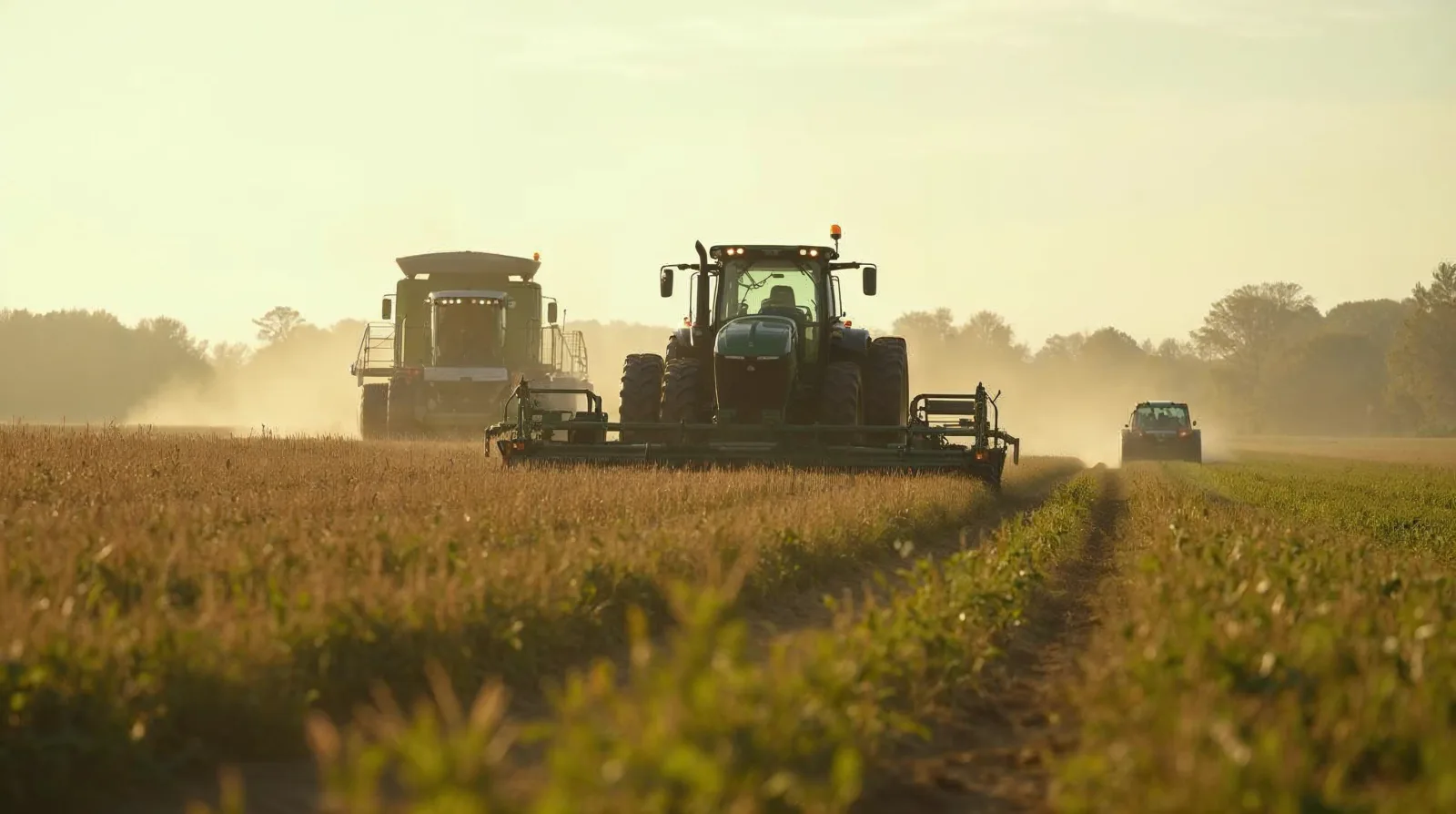
Robotic mechanical weeders use cameras and computer vision to tell a crop plant from a weed, then kill the weed with a blade, tine, or laser instead of a chemical. For row crops they come in three forms: camera-guided cultivators, self-driving weeding robots, and laser weeders. The best fit depends on your crop value and weed pressure.
Anyone who has watched a jug of glyphosate climb in price while the weeds it used to kill keep coming back knows the problem this technology is trying to solve. Herbicide-resistant waterhemp, Palmer amaranth, and marestail have spread across a lot of ground, the chemistry that once handled them is thinning out, and the labor you would need to hand-weed instead is either too expensive or not there at all. Robotic and camera-guided mechanical weeders are the machinery industry's answer: let a computer do the seeing and let steel or light do the killing.
This is not science fiction anymore. Machines are working commercially in vegetable fields across California, Arizona, and the Salinas Valley, and the same makers are now pushing into organic corn and soybeans. But there is a lot of marketing noise around this equipment, the price tags are serious, and where these machines actually pay is narrower than the sales videos suggest. Here is a straight look at what the equipment does, what it costs, and where it fits on a working farm.
Three pressures are driving interest, and they stack on top of each other.
The first is herbicide resistance. Once a weed population shrugs off your go-to chemistry, you are into tank mixes, layered residuals, and more passes - all of which cost money and none of which are permanent. A weeder that physically removes the plant does not care whether that plant is resistant. There is no selection pressure building toward a "mechanical-resistant" pigweed.
The second is the shrinking herbicide toolbox itself. In a lot of specialty and vegetable crops there were never many labeled products to begin with, and some of the old standbys are being pulled or restricted. For an organic grower there is no herbicide option at all - weeding is done with steel, flame, plastic, or hands. That is exactly why the first commercial robotic weeders landed in high-value organic vegetables: the alternative was a crew of people on their knees.
The third is labor. Hand-weeding a field of lettuce or onions can run hundreds of dollars an acre and depends on finding a crew willing to do brutal stoop work. That labor is getting harder to find and more expensive every season. A machine that replaces even part of that crew changes the math in a hurry.
Put those three together and you can see why a piece of equipment that costs as much as a combine is getting a serious look. The question is never "is this cool." The question is whether it takes out enough cost or risk to earn its keep on your acres.
Robotic mechanical weeding is not one product. It is three fairly different approaches, and lumping them together is the fastest way to make a bad buying decision.
This is the most established and the most affordable category, and for a lot of farms it is the right place to start. A camera-guided cultivator is a hoeing rig mounted on the back of a tractor. A video camera reads the crop rows in real time and a hydraulic side-shift frame keeps the hoe blades or tines precisely centered between the rows, even when the tractor wanders or the ground pulls the implement sideways. The operator drives; the vision system handles the steering of the tool.
Garford's Robocrop is one of the best-known systems. It analyzes the camera image to find the plant lines and adjusts the hoe frame to hold the tines between the rows, with accuracy generally around 15mm - and better than 10mm when soil-engaging discs are added. Working speeds run roughly 8 to 15 kilometers per hour depending on crop and row spacing. Einböck's CHOPSTAR is a spring-tine cultivator built for both conventional and organic row crops that can be fitted with the same kind of camera-guided steering. Steketee's EC-Weeder is a fully configurable hoeing machine that adapts to row widths from 15 cm all the way out to 150 cm, with working widths up to 17 meters on the big frames.
The important limit: a standard camera-guided cultivator works the ground between the rows, not the weeds inside the row right next to your crop plants. That in-row zone is where the hard weeds hide. To reach it you need an intra-row tool - Garford's Robocrop InRow, for example, uses a rotating disc that swings around each crop plant to clear the weeds between plants in the row. Those intra-row systems are slower and more expensive, but they are what turns a cultivator from "handles the easy 80 percent" into a real weeding solution.
Camera-guided cultivators are the practical entry point because they bolt onto equipment and skills you already have. You keep your tractor and your operator, you add vision-guided precision, and you get the herbicide reduction without betting the farm on a robot.
The next step up removes the operator. These are self-propelled robots that drive the field themselves, using cameras and AI to identify each plant and actuate mechanical tools - blades, knives, or tines - to remove weeds while sparing the crop, in many cases reaching the weeds inside the row.
FarmWise built the Titan, an autonomous cultivator that uses cameras to spot weeds and mechanically knock them out, including weeds inside the row. The Titan FT-35 is a roughly three-ton platform with sub-inch crop-and-weed discrimination, and it carried a price in the neighborhood of $350,000. In a signal of where this end of the market is heading, FarmWise was acquired by Taylor Farms - one of the largest fresh-produce processors - in April 2025, folding the technology into a big grower's own operation.
Stout AgTech has been building its Smart Cultivator since 2019. It uses machine vision and AI to eliminate weeds and cultivate the ground in a single pass, and it is designed to hitch to a tractor rather than drive itself, which keeps a familiar power unit in the loop. Naïo Technologies, out of France, offers a lineup of true autonomous machines - the small Oz, the larger Dino built to straddle vegetable beds, and bigger platforms - all using vision to find the crop rows and steer spiked and star-toothed tools for precise hoeing.
The pitch for autonomous weeders is that they take the labor out of the cab as well as out of the field, and they can run long hours. The catch is that they are expensive, most of them are sized and priced for high-value vegetable ground, and an unattended robot in your field is a real change in how you manage risk, service, and downtime.
The newest and most talked-about approach skips the blade entirely. A laser weeder uses deep-learning vision to identify each weed and then fires a high-power laser to heat the weed's growing point until the plant dies. Nothing enters the soil, no chemical is applied, and the crop is never touched.
Carbon Robotics is the company that made this commercial. Its LaserWeeder carries a bank of high-power lasers - the platform is often described as running around 30 lasers firing under AI guidance - mounted in an implement pulled behind a tractor. In February 2025 the company launched the LaserWeeder G2 line: lighter, modular, and built to run up to twice as fast as the original. Carbon Robotics reported its platform treated more than 250,000 acres of row crops across the U.S. and Canada during the 2024 growing season, which tells you this is past the demo stage.
Importantly for grain farmers, the G2 line added models - the G2 1200 and G2 1800 - aimed specifically at organic corn and soybean operations, not just vegetables. That is the first serious push of this technology out of specialty crops and toward the broadacre ground most Midwestern farms actually grow.
The independent evidence is encouraging. In field trials run at Rutgers in New Jersey and Cornell AgriTech in New York during 2024, and published in Pest Management Science in 2025, laser weeding controlled weeds as well as or better than pre- and post-emergence herbicides on beet, spinach, and pea - cutting weed biomass by 97 percent or more, with crop injury holding around 1 percent in peas and 2 to 3 percent in spinach and beets. That is a credible, peer-reviewed result, not a vendor slide.
The economics are the open question. Original LaserWeeder units were reported in the seven-figure range, and while the G2 line was explicitly introduced to bring modular, lower-cost options to more farm sizes and budgets, this is still a very large capital purchase. Carbon Robotics estimates growers can cut weeding costs by up to 80 percent with an ROI in two to three years - treat that as a manufacturer estimate on high-value ground, not a promise for every field.
All three families lean on the same core trick: a camera looks at the ground, and a trained model decides, pixel by pixel, what is crop and what is weed. Early systems mostly recognized "a plant is in the row line, so it is the crop" - good enough to steer a hoe between rows. Newer systems are trained on thousands of images to tell an actual crop seedling from a weed seedling even when they are inches apart and look similar, which is what lets a machine work inside the row without taking out your crop.
Two things follow from that. First, these machines want good, consistent conditions - clean rows, decent light, plants at a recognizable stage. Dust, glare, a ragged stand, or weeds that are already big can all degrade the seeing. Second, the systems improve as their training data grows, so a machine bought today may get better at your specific crops through software updates. Ask any dealer how their vision model handles your crop and your worst weeds specifically. A system trained on lettuce and carrots is not automatically good at soybeans and waterhemp.
Here is the honest map, because the marketing blurs it.
Robotic and camera-guided mechanical weeding pays most clearly where three things are true: the crop is high-value, herbicide options are thin or banned, and hand-weeding is expensive. That describes organic and conventional vegetables almost perfectly, which is why that is where the machines went first and where nearly all the working units are today - lettuce, onions, carrots, brassicas, spinach, tomatoes.
Broadacre corn and soybeans at conventional scale are a harder sell, and it is worth being blunt about why. On a conventional corn-bean operation, a burndown plus a residual herbicide program is still cheap and fast per acre compared with a six-figure robot crawling the field. The machine has to displace a low-cost incumbent, and today it usually can't on price alone.
The exception - and it is a real and growing one - is organic corn and soybeans, where there is no herbicide and weed control is the single biggest headache. That is exactly the ground Carbon Robotics is targeting with the G2 1200 and 1800, and it is where the camera-guided cultivators from Garford, Einböck, and Steketee already earn their keep. If you farm organic row crops, this equipment is worth a serious pencil-out now. If you farm conventional corn and beans, watch it closely but expect the economics to take several more seasons to reach you.
The other place it fits is as a resistance-management tool rather than a pure cost play. If resistant weeds are forcing you into ever more expensive chemical programs with diminishing results, a mechanical or laser pass that removes escapes - and puts zero selection pressure on the weed population - can be worth more than its per-acre cost suggests. That value is real but harder to put on a spreadsheet.
There is no single price because there is no single machine, but here is the shape of it.
A camera-guided cultivator - the tractor-pulled kind - is the most affordable entry, and it uses a tractor and operator you already have. It is the category most farms should price first.
Autonomous mechanical weeders run into the low-to-mid six figures; the FarmWise Titan FT-35 was around $350,000, and that is representative of that class.
Laser weeders are the top of the market - original units were reported around seven figures, with the newer G2 line built to offer smaller, more modular, lower-cost configurations.
Whatever the sticker, the number that matters is cost per acre over the life of the machine against what you spend now on herbicide, application, and hand labor combined - plus the value of the risk you take off the table. Run that math on your own acres and your own weed pressure. A machine that pays in two years on $8,000-per-acre lettuce may never pay on $600-per-acre soybeans, and no brochure will tell you that.
That last one matters. Some makers and custom operators will run the machine on your ground for a per-acre fee, which lets you test the fit against your crops and weeds without a six-figure commitment.
Robotic mechanical weeders are no longer a promise - they are working equipment, most of it in high-value vegetables, with a credible and growing push into organic corn and soybeans. Camera-guided cultivators are the practical first step for most farms because they add precision to gear you already run. Autonomous and laser machines are powerful but priced for high-value ground and specific problems, chiefly organic production and hard herbicide-resistant weeds.
The technology is real, the weed control is proven, and the trend line points down on price. But the decision is still a cold one: match the machine to a crop where herbicide is expensive, restricted, or banned, and where labor is scarce, and it can pay. Buy it because the video looked impressive, and it becomes the most expensive cultivator you ever parked in the shed. Price the problem first, then price the machine.
Most working machines today are in high-value vegetables, where herbicide options are thin and hand-weeding is expensive. The clear exception is organic corn and soybeans - Carbon Robotics now offers LaserWeeder G2 models aimed specifically at organic grain, and camera-guided cultivators are widely used in organic row crops. Conventional corn and beans are a harder economic fit because cheap herbicide programs are tough to beat on price alone.
It depends entirely on the type. Camera-guided cultivators that mount on your own tractor are the most affordable and are the sensible first thing to price. Autonomous mechanical weeders run into the low-to-mid six figures - the FarmWise Titan FT-35 was around $350,000. Laser weeders were originally reported in the seven-figure range, though newer modular models are built to be smaller and less expensive. Judge any of them on cost per acre over the machine's life, not the sticker.
Basic camera-guided cultivators work between the rows and leave the in-row weeds - the hardest ones - untouched. Reaching weeds inside the row requires an intra-row tool, such as a rotating disc that swings around each plant, or a machine with plant-level vision like an autonomous weeder or a laser weeder. In-row capability is slower and costs more, but it is what makes the difference between partial and full weed control.
In independent field trials at Rutgers and Cornell in 2024, published in 2025, laser weeding controlled weeds as well as or better than conventional herbicides on beet, spinach, and pea, cutting weed biomass by 97 percent or more with minimal crop injury. That is peer-reviewed evidence on specialty crops. The open question is not effectiveness - it is whether the machine's cost pencils out on your particular acres.
No. A machine that physically removes or destroys the plant does not care whether that weed shrugs off your chemistry, and it puts no selection pressure on the population toward resistance. That makes robotic weeding a genuine resistance-management tool, not just a cost play - which can be worth more than the per-acre price suggests when herbicide-resistant weeds are driving up your chemical program.
If you farm organic row crops or high-value vegetables where herbicide is banned or scarce and hand-weeding is costly, this equipment is worth a serious pencil-out today - start by pricing a camera-guided cultivator and ask about renting or custom application before buying. If you farm conventional corn and beans, watch the technology closely but expect the economics to take several more seasons to reach your scale.
Join our list for practical guides on farm tech, precision agriculture, and tools that work.