
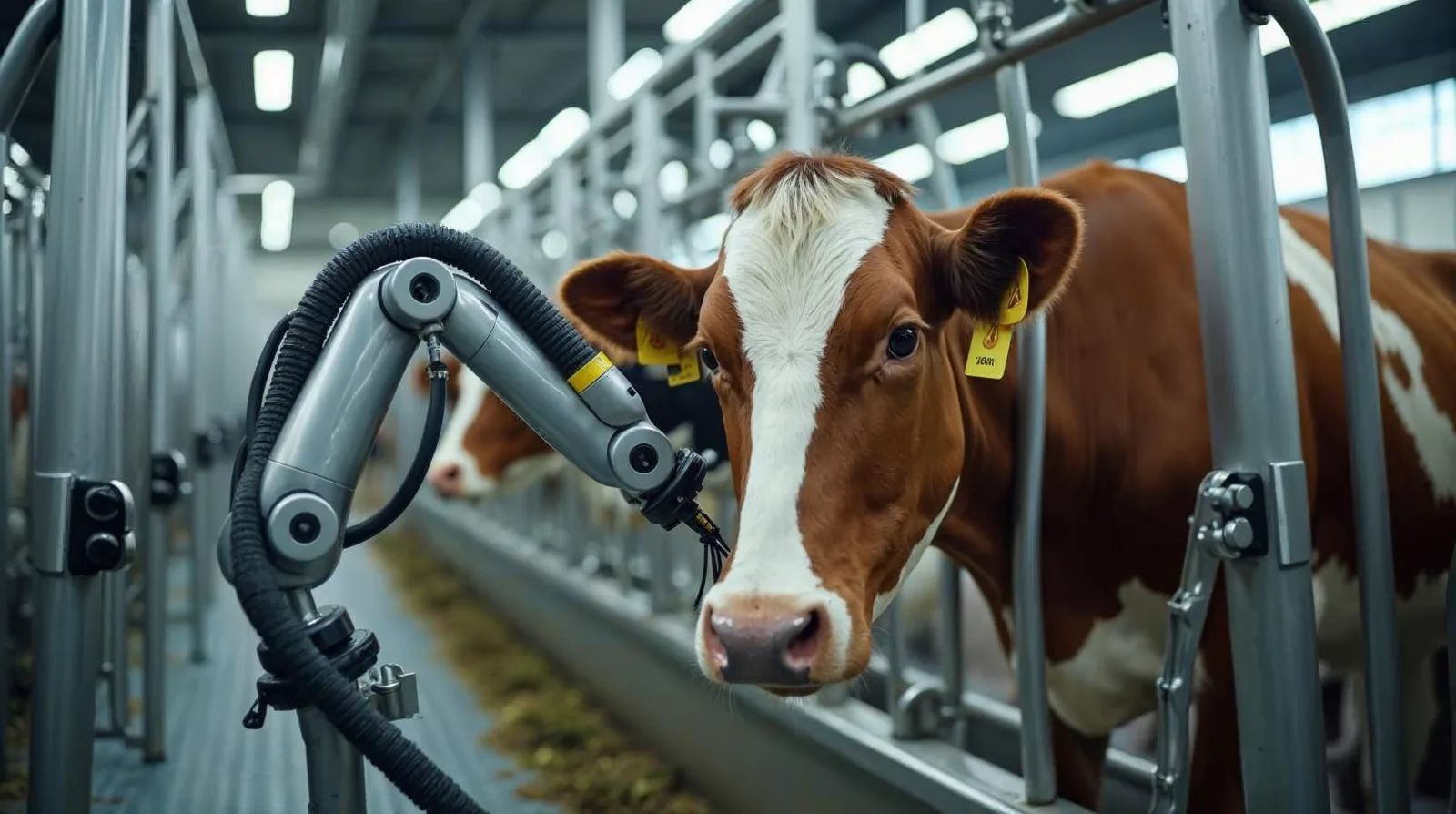
Running a small dairy in 2025 means solving a labor problem that isn't going away. Finding reliable milkers for twice or three-times daily conventional parlor work is hard in most regions, and the people you do find cost significantly more than they did five years ago. Meanwhile, the cows don't care about your staffing situation - they need to be milked on schedule.
Robotic milking systems have been commercially available since the mid-1990s, and there are now enough installations with enough operating history to take an honest look at what they do and don't deliver. This article is aimed at dairies in the 60 to 240 cow range thinking seriously about whether an automatic milking robot belongs in their operation. The numbers are real, the tradeoffs are real, and if you're hoping for a technology that solves everything, you'll be disappointed. If you're hoping for a tool that genuinely shifts labor structure and can improve milk yield per cow, you have reason to pay attention.
In a conventional milking parlor - flat barn, herringbone, rotary - you move cows to the equipment on your schedule. Twice a day, you're in the parlor, and so are the cows, whether they want to be or not. A voluntary milking dairy operates on the cow's schedule instead. The robotic milking system sits in or adjacent to the barn, and cows walk into it on their own, get milked, and walk out. No one is standing at the parlor gate at 5 a.m. pushing animals through.
The core of the system is a milking box - an enclosed stall with a robotic arm, teat detection hardware, and an automated cluster. When a cow enters the box, she's identified by a transponder (usually an ear tag or collar) the system reads electronically. The robot knows her milking history: how long since her last visit, what her expected milk volume is, which quarters are which, and any flags from her last milking session.
The robot then performs prep and attachment automatically. This looks roughly like this in most commercial systems:
Attachment typically takes 60 to 90 seconds once the system has established the teat map for a given cow. First-time or difficult-teat cows take longer. The whole process from entry to exit runs roughly 5 to 8 minutes per cow per visit.
The voluntary element is what makes this fundamentally different from parlor milking. Cows, left to self-select, tend to visit 2.5 to 3.2 times per day on average across a herd. Higher-producing cows in early lactation often visit more frequently; dry and late-lactation animals less so. More milkings per day generally produces more milk per cow - the udder pressure stimulus drives production - and this is one of the primary reasons dairies with robots report production bumps after the switch.
There are three manufacturers with strong North American market presence for single-box robotic milking systems. There are others, but for a first installation on a smaller dairy, you'll spend most of your time evaluating these three.
Lely Astronaut A5
Lely is the original commercial robot milker and still has the largest installed base globally. The A5 is their current flagship. It uses a robotic arm that approaches from the side, with a camera-based teat detection system. Lely units are typically installed in a free-flow barn configuration, meaning cows can move between the resting area, the feeding area, and the milking box without passing through a forced selection gate. The philosophy is maximum cow freedom.
Throughput on a well-tuned A5 installation is roughly 50 to 70 cows per robot, depending on cow temperament, barn layout, and fetch discipline. The A5 also generates a substantial data stream per cow - quarter milk weights, SCC estimation, activity (which ties into estrus detection), and rumination data via collar sensor if you run the Qwes collar system.
DeLaval VMS V300 and V310
DeLaval's voluntary milking system line - the VMS V300 and the newer V310 - uses a slightly different approach. The V310 in particular has a redesigned arm and teat detection system that DeLaval claims reduces attachment failures and time per milking. DeLaval also offers guided-flow barn configurations where the milking box is positioned in a selection gate, so cows moving from rest to feed must pass through and either get milked or be diverted if they've visited too recently.
Guided-flow layouts tend to reduce fetch work because the barn design pushes cows toward the robot regularly. The tradeoff is a more constrained barn layout and some additional cost in barn infrastructure.
GEA DairyRobot R9500
GEA's entry into the single-box robot market came later, but the R9500 has built a reasonable reputation particularly in larger herds where multiple units are installed in parallel. GEA offers both free-flow and guided-flow barn options. The R9500 uses a multi-box concept where multiple robot units can be networked together with a shared management software platform - useful for dairies planning to expand from one box to two or three over time.
For a first-time buyer, the R9500 is a legitimate option, though GEA's service network is thinner than Lely or DeLaval in some regions, and service response time matters when your primary milking system goes down.
Choosing Between Them
Honest advice: the machine brand matters less than the local dealer and service network. These robots require regular maintenance and occasional emergency service. A Lely dealer who can be on your farm within two hours when an arm malfunctions at 2 a.m. is worth more than a marginally better machine from a dealer four hours away. Get references from farms in your region running each system. Talk to farmers who've had service calls, not just farmers whose robots are running well.
This is where most farmers start, and where a lot of wishful thinking tends to creep in. Let's be straight about what the numbers do and don't show.
Installation Cost
A single-box robotic milking system - one robot unit installed and commissioned - typically runs in the range of $150,000 to $250,000. The wide range reflects barn construction requirements, geographic installation costs, and whether you're retrofitting an existing barn or building new infrastructure.
The robot hardware itself is often quoted in the $170,000 to $200,000 range for a new unit. That does not include the barn modifications, which can add $30,000 to $100,000 or more depending on what you're starting with. New build construction to house a single robot is at the higher end of that range; a reasonable existing free-stall barn that can be reconfigured may be at the lower end.
Plan for $200,000 to $250,000 all-in as a working assumption for a single robot installation if you don't already have a barn well-suited to the layout. If you're building from scratch and need new construction, add accordingly.
Two-robot installations don't double that cost proportionally - you amortize some infrastructure, some software licensing, and some installation work across both units - but you should still budget $350,000 to $450,000 for a two-box system with appropriate barn work.
Cows Per Robot and Throughput
A single robot can handle roughly 50 to 70 cows in most real-world North American installations. Sixty to 65 is a reasonable planning number. Above that, the box becomes a bottleneck - cows start queuing, visit frequency drops, and some animals give up and go back to the resting area, which means more fetching and lower production.
If you run 120 cows, plan for two robots. If you run 180 to 200 cows, plan for three. The economics of this scale fairly linearly, so a 60-cow dairy and a 120-cow dairy with two robots are roughly comparable on a per-cow basis.
Labor Savings
This is the main driver of the economics for most small dairies. A conventional twice-a-day parlor on a 60-cow dairy typically requires 4 to 6 labor hours per day in the parlor itself, depending on parlor efficiency, prep time, and clean-up. Three-times-a-day milking for high producers adds more.
A single-robot installation on the same 60-cow herd typically requires 1.5 to 3 labor hours per day in direct milking-related work - and much of that is monitoring, fetch work for cows who haven't visited, and troubleshooting rather than stand-at-the-parlor time. The robot handles the actual milking around the clock.
At $18 to $22 per hour - a rough current range for dairy labor in many markets - the annual labor cost savings on a 60-cow dairy can run $30,000 to $55,000. That's a real number. It doesn't account for the full-time equivalent you might reduce, whether that's a hired employee or your own 4 a.m. alarm.
Milk Production Changes
Most dairies see a production increase of 5 to 15 percent per cow after transitioning to a robotic milking system, attributable primarily to the higher milking frequency voluntary milking enables. If your herd was averaging 70 pounds per day at twice-a-day milking, 75 to 80 pounds per day at 2.8 milkings per day is a reasonable expectation, though results vary significantly by herd genetics, nutrition, and management. Don't put 15 percent in your spreadsheet unless you have a good reason to believe your herd is underproducing relative to its potential.
Payback Period
Putting rough numbers together: $230,000 installed cost, $35,000 per year in labor savings, $12,000 per year in milk revenue increase from higher production on a 60-cow herd at a conservative $20 per hundredweight. That's roughly $47,000 per year in combined benefit, suggesting a payback period somewhere around 5 years before interest.
Finance the robot over 10 years at current rates and the annual debt service is in the range of $28,000 to $32,000. The economics are tighter but can work if the labor savings are real and the production gains materialize.
What kills the economics is an underperforming herd - cows that don't adapt to voluntary milking, SCC problems that discount your milk price, or a barn layout that creates so many fetch cows that your labor savings evaporate. Those are the scenarios to stress-test before you sign anything.
The barn situation is frequently the biggest practical challenge in adopting a robotic milking system, particularly for existing dairies.
Free-Flow vs. Guided-Flow
In a free-flow barn, cows move freely between resting, feeding, and milking areas. The robot sits in an open traffic pattern. Cows visit voluntarily without architectural coercion. This approach requires less barn modification and gives cows the most behavioral freedom. The downside is that lazy or low-producing cows may visit infrequently, and high producers in early lactation may visit excessively.
Guided-flow - also called forced selection or smart-selection gating - uses the barn layout to route all cows past the robot. Cows moving from the resting area toward feed must pass through a selection gate. The system reads the cow's ID and routes her either into the robot queue (if she's eligible for milking) or through a bypass gate back to the feed area. This reduces fetch work significantly because cows are automatically reminded of the robot on every trip to the feed bunk.
The guided-flow approach requires more infrastructure - the gate system, specific traffic lanes, and a barn layout that supports the flow - and it constrains your flexibility somewhat. But for herds where fetch cows are a significant problem, guided-flow can make the difference between a functional operation and a daily headache.
Retrofit vs. New Build
Retrofit installations are possible, and many small dairies do them. The key requirements are:
Old stanchion barns generally don't convert well. Older tie-stall setups require significant reconfiguration. A reasonably modern free-stall barn is the most workable starting point.
New construction gives you the layout right from the start, but adds substantial capital cost. The argument for building right is that a poorly laid-out barn costs you in labor and production for the life of the investment.
Fetching Cows
No matter what the sales materials suggest, you will fetch cows. Voluntary milking means some cows don't volunteer often enough. Any cow who hasn't visited the robot in 10 to 12 hours needs to be found and sent to the box. Most farms with a single robot are fetching somewhere between 5 and 20 percent of the herd on any given day.
Fetching takes time - maybe an hour or two per day depending on herd size and how many animals you're chasing - and it requires someone who knows cattle behavior well enough to move animals without stressing them. It also requires a barn layout where you can actually find and move individual cows without disrupting the whole herd.
High fetch rates are usually a signal of a problem: a cow in pain that avoids the robot, a robot malfunction, a cow with a teat placement the camera is struggling with, a social hierarchy issue near the box entrance, or feed that's too far from the robot in a free-flow layout. When your fetch work is climbing, it's worth diagnosing the cause rather than just accepting it as the cost of doing business.
Switching to a robotic milking system doesn't just change the milking process. It changes how you manage the whole herd.
Somatic Cell Count and Udder Health
SCC management is more demanding on a robot dairy, not less. The robot's conductivity sensor gives you per-quarter, per-milking conductivity readings, which is more granular than what most parlor dairies track. That data is genuinely useful for early mastitis detection - you can catch a subclinical case before it becomes clinical. But catching it only helps if you act on the alert.
New robot dairies sometimes see SCC drift upward in the first 6 to 12 months as they learn to interpret and respond to the data. It takes time to understand which alerts are real and which are false positives, and to build the daily check routine that catches developing cases before they become premium milk discounts.
The robot's cleaning system - rotating brushes, pre-spray - is adequate but not equivalent to a skilled human prep job on every teat. Teat condition and consistency of cleaning require ongoing attention. Some herds find that teat end scores worsen slightly after the transition, particularly if the brush settings or post-dip concentration isn't dialed in.
Feeding to the Robot
In free-flow systems, one common management strategy is to deliver a portion of each cow's concentrate ration at the robot box as an incentive to visit. The robot dispenses pellets based on each cow's individual allocation while she's being milked. This pulls cows toward the robot and rewards frequent visitors.
This works, but it requires that your total ration accounting stays accurate. Cows eating concentrates at the robot box plus TMR at the bunk need to have the robot ration counted against their total intake. Overfeeding concentrate is easy and expensive.
Using the Data
The data management platform that comes with a robotic milking system is one of the genuine value additions. Lely's Horizon system, DeLaval's DelPro, and GEA's DairyPlan all provide per-cow milking frequency, quarter yield, conductivity history, activity, and rumination. If you actually use this data, you can manage individual cows more precisely than is practical in a conventional parlor.
The "if you actually use it" part matters. The data is only valuable if it's reviewed regularly and acted on. Dairies that check their robot data once a week are not getting the same management benefit as dairies reviewing alerts daily. Budget time for data review in your daily routine.
Transition and Training
Introducing cows to a robotic milking system takes time. Heifers entering the herd for the first time usually adapt faster than mature cows with established milking habits. Plan for two to four weeks of intensive management during the transition - more fetching, more hands-on time at the box getting animals comfortable with the equipment, and monitoring for cows who refuse to enter at all.
Some cows simply don't adapt. A small percentage - roughly 5 to 10 percent in difficult transitions - may need to be managed out of the herd if they consistently resist the robot and require daily fetching. This is more common with older cows making the switch from parlor milking.
A robotic milking system is not a universal solution. Here is an honest take on what kind of operation benefits from one.
A good fit if:
A poor fit if:
If you've worked through the numbers and think a robotic milking system fits your operation, here's what to do before and after signing the contract.
Before purchase:
Visit multiple farms running the system you're considering. Visit farms that are happy with it and, if you can find them, farms that had problems. Ask specifically about service response time from the local dealer, what the most common failures are, and what downtime looks like when a major component fails.
Get an independent barn assessment. Have someone - an extension engineer, a consultant who doesn't sell robots - look at your facility and give you an honest read on what retrofit will actually cost and whether your traffic flow will support the system. Manufacturers' sales engineers will tell you what they need to tell you to sell the machine.
Run your own labor savings math based on current wage rates and actual hours, not industry averages. Ask your milk plant what SCC discount thresholds look like and what the penalty is if you drift above them during transition.
After installation:
Expect the first 90 days to be harder than you thought. Every farm goes through a transition period. Budget the time and don't panic if your labor hours in month one look nothing like the projections.
Assign daily data review to a specific person at a specific time. Morning review of overnight alerts before the barn chores start is a common approach. Alerts sitting unread until afternoon cost you milk and udder health.
Keep your service contract current. The robot's mechanical components - the arm, the brushes, the cluster, the peristaltic pumps - wear, and wear rates accelerate if maintenance is deferred. Skipping a scheduled service to save $500 and then having an unplanned breakdown during peak lactation is an expensive lesson.
On the question of used robots:
A used robot can significantly reduce the capital entry cost. Machines come off lease, operations consolidate, and there's a secondary market. Used units from reputable dealers with service history documentation can be a legitimate option. The risk is that you inherit wear and unknown history in components that are expensive to replace. Have a qualified technician inspect any used unit before purchase and get clarity on whether the manufacturer's service network will still support the model.
A robotic milking system is a real tool that solves a real problem - labor scarcity and the grind of twice-a-day conventional parlor management - for a specific range of operations. It's not a low-cost option, it's not hands-off, and it's not right for every dairy. But for a 60 to 180 cow operation where labor is the binding constraint and the facilities can support the transition, the economics can work, the production data is genuine, and the management model - monitoring and responding to per-cow data rather than standing in a parlor - suits how many smaller dairies want to run.
The farmers I've talked to who are satisfied with their robots - a few years into the transition, past the difficult early period - consistently say the same things. They sleep better, not because the robot eliminates work but because the work that remains doesn't require a 4 a.m. alarm. Fetch cows and data review happen on their schedule rather than the cows' schedule. The high producers get milked more often, and the milk check reflects it.
The farmers who are dissatisfied are typically those who underestimated the barn work, overcounted the labor savings, or didn't build the daily management habits the system requires. The robot is only as good as the management around it.
If you're seriously evaluating this, the next step is not reading another article. It's visiting three farms in your region that are running the machine you're considering, with a specific list of questions about their real-world experience. That will tell you more than any manufacturer demo or industry average ever will.
Roughly 50 to 70 cows in most real-world North American installations, with 60 to 65 a reasonable planning number. Push past that and the box becomes a bottleneck: cows start queuing, visit frequency drops, and some give up and go back to rest, which means more fetching. Plan two robots for 120 cows and three for a 180 to 200 cow herd.
A conventional twice-a-day parlor on 60 cows typically needs 4 to 6 labor hours a day, while a single-robot herd needs about 1.5 to 3 hours, much of it monitoring and fetching rather than standing at the parlor. At $18 to $22 an hour that works out to roughly $30,000 to $55,000 a year in labor savings, which is the main driver of the economics.
On a 60-cow herd, about $230,000 installed against roughly $35,000 a year in labor savings plus $12,000 in extra milk revenue points to a payback near five years before interest. Financed over ten years, the annual debt service runs $28,000 to $32,000, so the math only works if the labor savings and the 5 to 15 percent production gains actually materialize.
Most single-robot farms fetch somewhere between 5 and 20 percent of the herd on any given day, because some cows will not volunteer often enough. Any cow that has not visited the box in 10 to 12 hours needs to be found and sent to it. A climbing fetch rate is usually a signal of a problem, such as a cow in pain, a robot malfunction, or a barn-flow issue near the box.
Join our list for practical guides on farm tech, precision agriculture, and tools that work.