
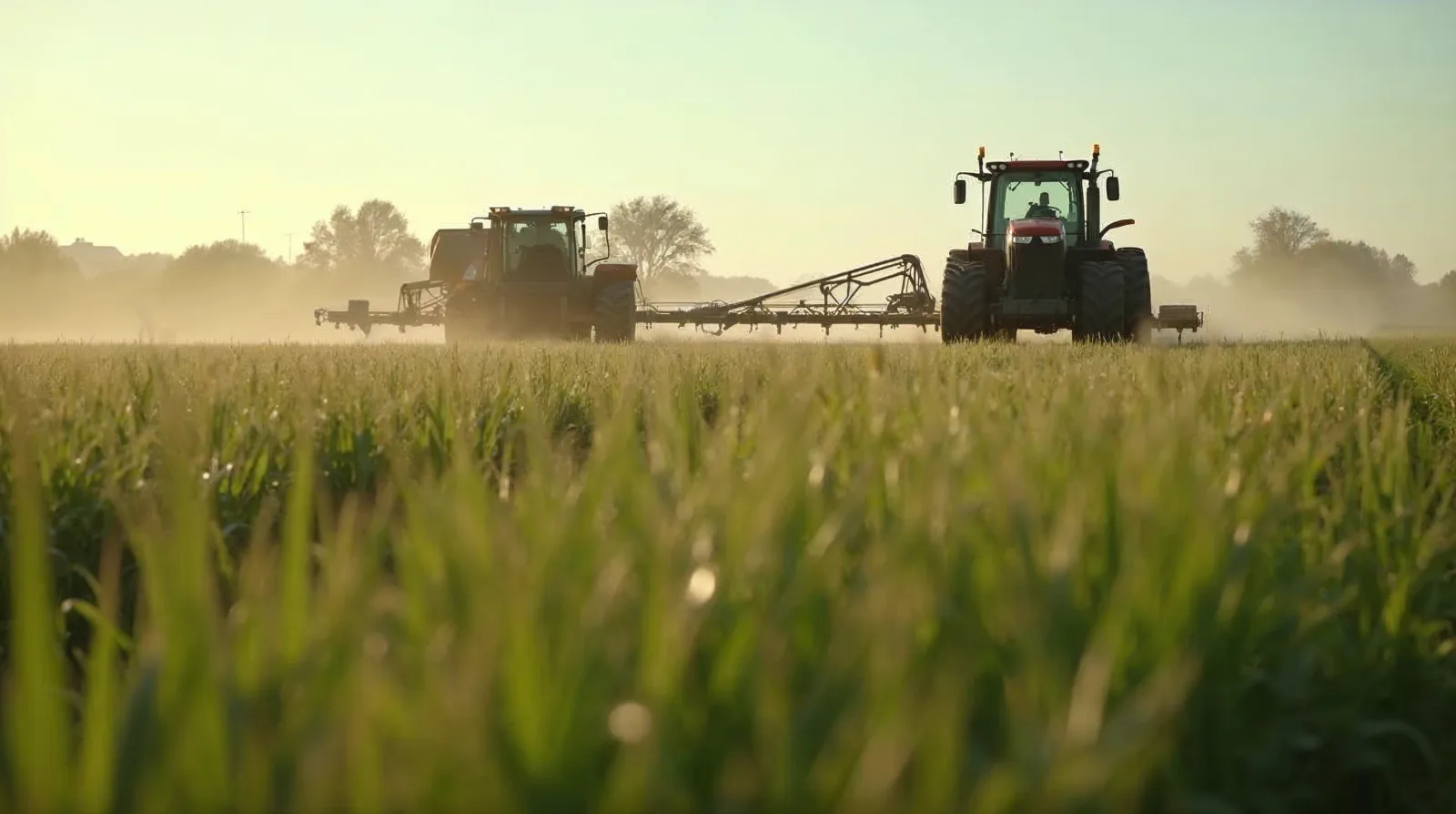
The herbicide bill is one of the largest controllable line items on a row crop operation, and it has been creeping up for two decades. Glyphosate-resistant weeds have forced operators back into residual chemistry, residual chemistry has forced overlapping passes and tank mixes, and tank mixes have pulled in active ingredients that cost three to five times what glyphosate cost when it was still doing the heavy lifting on its own. The net result is per-acre herbicide costs that range from $35 on the simplest soybean program to over $90 on heavy palmer amaranth ground in the Mid-South. For a 4,000 acre operation, the difference between a routine year and a heavy resistance year on weed control alone is enough to cover a piece of equipment.
See and Spray technology - the umbrella term for camera-based, machine learning driven targeted herbicide application - is the most credible cost reduction lever on that line item that has come along since the original glyphosate-tolerant trait. The pitch is simple. Instead of broadcasting herbicide across every square foot of a field, the sprayer carries cameras that look at the ground in real time, identifies where weeds actually are, and triggers individual nozzles to spray only those spots. The herbicide saved on the bare ground is the headline number, and the documented savings on real operations now sit consistently in the 50 to 70 percent range for post-emergent applications.
This article is the working operator's look at See and Spray in 2026. It covers what the technology actually does, what it does not do, the major systems available now, the herbicides that work and the ones that do not, the field conditions that make or break performance, the integration story with the rest of the spraying operation, the real numbers on cost and payback, the data and warranty implications, and the operations that should be looking hard at adoption now versus the ones that should wait.
The core idea is straightforward. A sprayer boom carries a row of cameras spaced along its length, typically one camera every three to six feet. Each camera looks at a strip of ground directly under the boom as the sprayer moves through the field. An onboard computer processes the camera feeds in real time, runs a trained image recognition model on each frame, and identifies the locations of weeds within the camera's field of view. When a weed is detected, the computer calculates which nozzle on the boom is currently positioned over that weed - accounting for the speed of the sprayer, the lag time between the camera capture and the nozzle position, and the spray pattern of the nozzle - and sends an electrical signal to open that specific nozzle for the brief moment needed to deliver herbicide to the weed.
The whole sequence happens in a fraction of a second, multiple times per second, across dozens of cameras and hundreds of nozzles. A modern See and Spray boom processes something like 100 frames per second per camera, runs a weed detection model on each frame, calculates nozzle timing for any detected weeds, and triggers individually addressable solenoid valves on each nozzle. The engineering required to make this work at sprayer speeds of 12 to 18 miles per hour is substantial, and most of the systems on the market now represent five to ten years of development by major equipment companies and well-funded startups.
The weed detection itself is computer vision running deep learning models trained on hundreds of thousands of labeled images of weeds in crops at various growth stages, lighting conditions, and field backgrounds. The models are typically trained for specific crops - corn, soybeans, cotton are the most developed - and for the major weed species present in the regions where the equipment is sold. The accuracy of the detection is the make-or-break variable, and it is also the variable that the marketing material tends to oversimplify.
There are two operational modes that matter for understanding what these systems do in the real world. Green-on-brown spraying is the easier task. The sprayer is operating on bare soil between cropping passes, typically a burndown application before planting or between cuttings in some perennial systems, and the camera only needs to distinguish green plants from brown soil. Any green is a weed in this context, and the model can be very simple. Green-on-brown systems work reliably, have been on the market for over a decade in some form, and produce the largest herbicide savings because the percentage of bare ground in a fallow field is typically 80 to 95 percent.
Green-on-green spraying is the much harder task and the one that has been the recent breakthrough. The sprayer is operating in a growing crop, and the cameras need to distinguish between the crop plants and the weed plants while both are green. The model has to recognize that this row of green is corn that should not be sprayed and that other green between the rows is waterhemp that should be sprayed. This is genuinely difficult because crop and weed leaves can look similar, especially at certain growth stages, and because the lighting and field conditions vary continuously through the day. Green-on-green systems are the recent generation of See and Spray and are the ones driving the current adoption curve.
The market has developed enough that there are now several real options for an operator considering this technology, with different price points, capabilities, and integration paths.
John Deere offers See and Spray Premium as a factory option on their newer self-propelled sprayers and as a retrofit kit for some existing machines. The system uses cameras spaced along the boom and runs proprietary models trained on the major weeds in corn, soybeans, and cotton. The factory installation is the cleanest integration with the rest of the John Deere ecosystem, including the Operations Center for application records, the StarFire receiver for field positioning, and the existing prescription map workflow.
The pricing on the factory option has come down significantly from the original launch and now runs in the range of $80,000 to $130,000 depending on boom width and machine configuration. The retrofit pricing is somewhat lower for the equipment but adds installation labor that varies by dealer. The subscription cost for the analytical layer and software updates runs $5,000 to $15,000 per year depending on acreage and feature level.
The system performs reliably for the major problem weeds in row crops in the corn belt and Mid-South. The performance in cotton has continued to improve and is now operationally acceptable for most of the major weeds in cotton-growing regions. The performance in less common crops or with less common weeds is more variable and depends heavily on whether the model has been trained on the specific weed-crop combination.
Case IH offers a competing system through their AIM Command precision spraying platform combined with the Augmenta acquisition for the imaging and detection layer. The combined system is functionally similar to John Deere's offering and competes on similar specifications and pricing. The integration with Case IH AFS Pro 1200 displays and the rest of the Case IH precision platform is the differentiator for operations already running Case equipment.
The Case system has been somewhat behind John Deere in detection model maturity for some weed species but has closed most of the gap in the last two seasons. The factory pricing and subscription costs are in the same general range as John Deere, with some flexibility for fleet customers.
Greeneye is one of the major aftermarket players, offering a system that retrofits to almost any sprayer regardless of brand. The system installs camera bars and the necessary control electronics on existing booms and integrates with existing sprayer monitors through an additional display. The retrofit-anything approach is the major appeal for operations with mixed equipment fleets or with newer non-See-and-Spray-equipped sprayers that they do not want to trade.
The pricing model is different from the factory systems. The hardware is sometimes leased or sold at lower upfront cost, with the bulk of the economics coming from per-acre subscription fees that run in the range of $4 to $8 per acre for fields run through the system. This pricing makes the math attractive at lower acreages where a six-figure factory system would not pencil out, but expensive at very high acreages where a flat fee structure would be cheaper.
The detection models are competitive with the factory systems for the major weeds and in some cases better for specific regional weed species where Greeneye has invested in training. The integration with non-John-Deere sprayers is the main advantage and the main reason operators consider this option.
Several smaller players, including Ecorobotix from Switzerland and a handful of others, focus on specialty crops, vegetables, and sugar beets where the row crop systems have not been trained or where the application requirements are different. These systems often use ultra-targeted application that places a few milliliters of herbicide on individual weeds rather than triggering full nozzle spray patterns. The economics in high-value specialty crops are often even better than in row crops because the per-acre herbicide costs are higher to start with.
Several European companies have developed See and Spray equivalents with different design philosophies, particularly around ultra-low-rate herbicide application and integration with mechanical weed control. Some of these systems are now available in North America, primarily for organic operators who want targeted thermal or mechanical weeding triggered by the same camera detection that would normally trigger a herbicide spray.
Not every herbicide program is compatible with See and Spray application. The technology is best suited for contact and systemic post-emergent products where the savings come from not spraying the bare ground between weeds. Several categories of products do not work well with the targeted approach.
Residual herbicides that need to be applied to the entire soil surface to provide pre-emergent control of weeds that have not yet germinated obviously cannot be saved by targeted application. Spraying a residual on only the spots where weeds are visible defeats the entire purpose of the residual product. Most operators run residuals as a separate broadcast application before or after the See and Spray pass, which means the See and Spray savings only apply to the post-emergent portion of the program.
Soil-applied burndowns that benefit from soil contact across the full surface are similar in that targeted application reduces their effectiveness. The trade-off is sometimes worth it when the burndown product is expensive and the weed pressure is patchy, but the math has to be evaluated on a field-by-field basis.
Contact herbicides like glufosinate, paraquat, and the diquat-based products work well with targeted application because they only need to hit the weed they are killing. The savings on these products in heavy-resistance soybean programs have been significant, and these are typically the products driving the largest payback calculations.
Systemic post-emergent products like glyphosate, the synthetic auxins, and the various ALS inhibitors also work well with targeted application, with the caveat that some species have growth habits that benefit from broader spray patterns. A weed with leaves that fold or hang in a way that limits direct interception can sometimes be missed by a tightly targeted nozzle pattern. The system manufacturers have developed application algorithms that adjust nozzle timing and spray pattern width based on weed size and species to address this.
Some of the newer Group 14 and Group 15 chemistries are also compatible with targeted application and are getting added to See and Spray programs in cotton and soybeans where multi-mode resistance management requires multiple effective sites of action in each pass.
The marketing demos for See and Spray are typically run under near-ideal conditions - moderate weed pressure, good lighting, clean field background, well-defined weed species. Real field conditions vary enormously and the performance variation is the thing that determines whether an operation gets the headline savings or something much less.
Weed density is the first major variable. The savings calculation depends on the percentage of bare ground in the field. A field with 5 percent ground cover by weeds saves 95 percent of the herbicide compared to a broadcast application. A field with 60 percent ground cover by weeds only saves 40 percent, and a field with 90 percent ground cover saves almost nothing. The technology is most valuable in fields with light to moderate weed pressure and provides progressively less benefit as pressure increases. Operations with severe resistance issues that have weed pressure approaching uniform coverage may find that the targeted application provides minimal savings and that the benefit is mostly in application precision rather than herbicide reduction.
Crop and weed growth stage matters significantly for green-on-green systems. The detection accuracy is best when the crop and weed have visibly different leaf shapes and growth habits. Very early season applications when the crop is small and the weeds are small can be challenging because both look similar in the imagery. Late season applications when the crop canopy has closed are different in that the canopy hides the weeds from the cameras. The sweet spot for green-on-green spraying tends to be the middle vegetative stages when both are clearly distinguishable but the crop has not yet closed in.
Lighting conditions affect detection accuracy in ways that are not always obvious. Direct overhead sun can wash out features in high-contrast situations. Cloudy conditions are often actually better for detection because the lighting is more uniform. Early morning and late evening applications can have shadow problems where the cameras misinterpret shadows as plant features or vice versa. Some of the newer systems have improved their handling of variable lighting, but the operator still needs to think about the time of day for application.
Field cleanliness and previous crop residue can interfere with detection. Heavy corn residue in a no-till soybean field can confuse green-on-brown detection by providing brown features that look enough like soil to confuse the model. Some weed species growing among heavy residue are harder to detect than the same species in cleaner fields. The operators with the best success rates tend to have residue management programs that complement the spraying program.
Speed and boom height affect both detection and application accuracy. The cameras have a finite frame rate and the computer has a finite processing speed, which means that very high travel speeds can degrade detection accuracy as the system has less data per square foot of ground. Most systems are rated for normal sprayer speeds up to 16 to 18 miles per hour, but the practical sweet spot for accuracy is often a touch slower than the manufacturer's maximum rated speed.
See and Spray does not exist in isolation. It has to integrate with the rest of the spraying operation including the prescription mapping, the application records, the rate controllers, the boom plumbing, and the regulatory compliance documentation.
The application record question is one of the practical challenges. Traditional broadcast application records are simple - the field got X gallons per acre of Y product on Z date. See and Spray records are more complex because the rate effectively varies across the field depending on where weeds were detected. Most of the systems generate application maps that show actual sprayed area as a percentage of total field area, with calculations of total product used. These maps are useful for operational analysis and have become acceptable for most regulatory purposes, but the format and detail required varies by state and by program.
The boom plumbing has to support individually addressable nozzle control, which is now standard on most newer sprayers but is a significant additional cost on retrofits to older equipment. The pulse-width modulation systems that drive turn compensation on existing precision sprayers provide most of the necessary plumbing for See and Spray, which is one reason operators with PWM-equipped sprayers have an easier upgrade path.
The tank mixing for See and Spray requires some adjustment from traditional broadcast programs. Because only a fraction of the boom output is being applied per acre on average, the carrier volume needs to be adjusted to maintain effective coverage on the spots that do get sprayed. Most systems run higher concentration tank mixes with somewhat lower carrier volumes per detected weed area, with the exact ratios depending on the herbicide labels and the specific application.
The regulatory and compliance picture has evolved as the technology has matured. The state regulators have generally accepted See and Spray application as equivalent to traditional application from a label compliance standpoint, with the caveat that operators need to be able to document what was applied where. The atmosphere is now considerably more friendly to the technology than it was in the early days when some regulators were uncertain how to handle it.
The economics depend heavily on the operation, the crop, the herbicide program, and the equipment situation, but a few representative scenarios illustrate the range.
A 4,000 acre corn and soybean operation running standard pre and post-emergent programs with moderate weed pressure typically spends $45 to $65 per acre on herbicides across the program. A See and Spray system that provides 60 percent savings on the post-emergent applications - which represent maybe 60 percent of the total program cost - saves something in the range of $16 to $24 per acre on the post-emergent products. On 4,000 acres, that is $64,000 to $96,000 per year in herbicide savings alone.
Against that, the operation has to amortize the equipment cost - call it $100,000 over a five-year useful life, or $20,000 per year - plus the subscription fee of perhaps $10,000 per year. Net savings on the herbicide side after the equipment cost runs $34,000 to $66,000 per year, which is a clear positive payback for an operation at this scale.
The payback math gets more complicated in two directions. Operations with heavier weed pressure save less because the targeted application has less bare ground to skip. Operations with lighter pressure save more on a percentage basis but typically have lower base herbicide costs to start with, so the absolute savings are smaller. The sweet spot for the strongest payback is operations with moderate to moderately-heavy weed pressure, premium-cost herbicides in the program, and large enough acreage to spread the equipment cost.
Custom application businesses face different math. The custom rate for See and Spray application can be charged at a premium over conventional spraying, and the herbicide savings flow back to the customer rather than the applicator. The applicator's payback comes from the premium service rate, the ability to win business that requires the technology, and the operational efficiency of carrying less herbicide for a given coverage area.
Smaller operations - say, under 1,500 acres - have a harder time making the math work on factory-installed systems. The Greeneye style aftermarket systems with per-acre subscription pricing are often the better fit at smaller scale, or alternatively the operation can hire custom application from a service provider who has invested in the equipment.
The data side of See and Spray raises some questions that operators are now thinking about more carefully than in the early days.
The image data captured by the system is technically detailed information about the field, the weed pressure, the crop condition, and indirectly about the operation's management practices. The system manufacturers all have data policies that govern what they do with this information. Most policies allow the manufacturer to use aggregated or anonymized data for model improvement, with varying degrees of opt-out for the operator. Reading the data policy carefully before signing the subscription agreement is worth doing, particularly for operations that consider their field-level data to be sensitive business information.
The model improvement question is its own consideration. The detection models get better when they are trained on more diverse data, including data from your fields. Operators contributing data to the training are providing value to the manufacturer that flows back to all users in the form of better model accuracy. Some operators are now asking for compensation for this contribution, similar to the discussions that have happened around yield data and other precision agriculture data flows.
The warranty implications of See and Spray application are mostly favorable. The manufacturers stand behind the herbicide application performance when the system is operated within specifications, and the application maps provide good documentation if there is a dispute about coverage or efficacy. The herbicide manufacturers have also generally adapted their warranty programs to accept See and Spray application as compatible with their products, though this required some negotiation in the early years.
The technology has matured enough that the recommendation framework is reasonably clear.
Operations over 3,000 row crop acres with moderate weed pressure and premium herbicide programs should be running the numbers seriously now. The payback math is favorable for most operations in this category, and the technology is mature enough to be operationally reliable. The decision is more about which system fits the equipment and operational situation than whether to adopt at all.
Operations with heavy resistance issues and high weed pressure should look at See and Spray more carefully but not assume it solves their problem. The herbicide savings will be smaller in heavy pressure situations, and the technology does not change the underlying need for resistance management through diversified rotations, residual chemistry, and mechanical methods where appropriate. The technology can be part of a resistance management program but is not a substitute for one.
Smaller operations under 1,500 acres should evaluate the Greeneye-style retrofit options or consider hiring custom application from service providers who have invested in factory equipment. The math on factory-installed systems is hard at smaller scale and the operation can usually access the technology through other paths.
Operations running mixed equipment fleets with sprayers from multiple manufacturers should look hard at the aftermarket retrofit options for the consistency of having one detection platform across the fleet. The integration tradeoffs versus the factory systems are real, but the operational simplicity of one system can be worth the tradeoffs.
Operations in specialty crops, vegetables, and sugar beets should look at the systems specifically designed for their crops rather than trying to adapt row crop systems. The economics in high-value crops are often very strong for the specialty platforms, and the row crop platforms often do not have appropriate detection models for non-row-crop weeds.
Several developments worth watching are likely to shape the technology over the next several years.
Multi-product application from single sprayer passes is in development from several manufacturers. The idea is that the sprayer can carry two or three different herbicides in separate tanks and apply different products to different weed species detected in the same pass. This would compress what currently takes multiple passes into a single pass and could change the herbicide program economics significantly.
Variable rate within targeted application is also developing. Rather than applying a uniform rate everywhere a weed is detected, the system could adjust the rate based on weed size, density of the patch, or crop stage. This would extend the herbicide savings and could improve efficacy on the harder-to-control weed species.
Integration with mechanical weeding for organic operators continues to develop, with detection systems triggering precision tillage tools or thermal weeders rather than sprayers. The economics in some organic systems are attractive enough that this is a real growth area.
The detection model improvements continue to come. Each generation handles more weed species, more crops, more growth stages, and more environmental conditions. The performance gap between the best systems and the field weed scout has narrowed substantially and continues to narrow.
The herbicide manufacturer relationships are evolving as the volume of product moved through See and Spray applications grows. Some manufacturers are now offering See and Spray-specific formulations or pricing programs, which could further improve the economics for adopting operators.
See and Spray is one of the rare agricultural technology adoptions where the cost reduction is real, well documented, and within reach for a significant share of the row crop industry. The 60 percent savings number in the marketing material is achievable in real operations under reasonable field conditions, and the equipment payback math works for operations of moderate scale and above.
The technology does not solve the underlying challenges of resistance management, residual product economics, or the need for diversified weed control programs. It does provide a meaningful cost reduction lever on the post-emergent portion of the program and a precision improvement that has value beyond the direct herbicide savings.
For operations evaluating the technology, the key questions are the scale fit for the equipment economics, the herbicide program compatibility with targeted application, the field condition fit for the detection accuracy, and the operational fit with the rest of the spraying program. Operations that fit on these dimensions should be moving forward. Operations that do not fit yet should keep watching as the technology continues to mature and the economics continue to improve.
The herbicide bill is one of the largest controllable costs in row crop production, and See and Spray is the most credible reduction lever to come along in years. The operations that adopt it well will have a meaningful cost advantage over the ones that wait, and that advantage is likely to grow as the technology continues to develop.
Factory systems from John Deere and Case IH run roughly $80,000 to $130,000 depending on boom width, plus a $5,000 to $15,000 annual software subscription. Aftermarket retrofits like Greeneye shift most of the cost to per-acre fees of about $4 to $8 per acre, which pencils out better at lower acreage where a six-figure factory system will not.
Documented savings on post-emergent passes sit consistently in the 50 to 70 percent range, but the number tracks bare ground. A field with 5 percent weed cover saves about 95 percent of the herbicide, while a field at 90 percent cover saves almost nothing. The technology pays best under light to moderate weed pressure, not on ground approaching uniform resistance.
Green-on-brown spraying runs on bare soil and only distinguishes any green plant from brown ground, so the model is simple and has been available for over a decade. Green-on-green is the recent breakthrough: the cameras must tell crop from weed while both are green, a genuinely hard task at certain growth stages, and it is what is driving current adoption.
No. Residual herbicides need to reach the entire soil surface to stop weeds that have not yet germinated, so targeted spraying defeats their purpose. Most operators run residuals as a separate broadcast pass, meaning See and Spray savings apply only to the post-emergent portion of the program. Contact products like glufosinate and paraquat, by contrast, suit targeted application well.
Join our list for practical guides on farm tech, precision agriculture, and tools that work.