
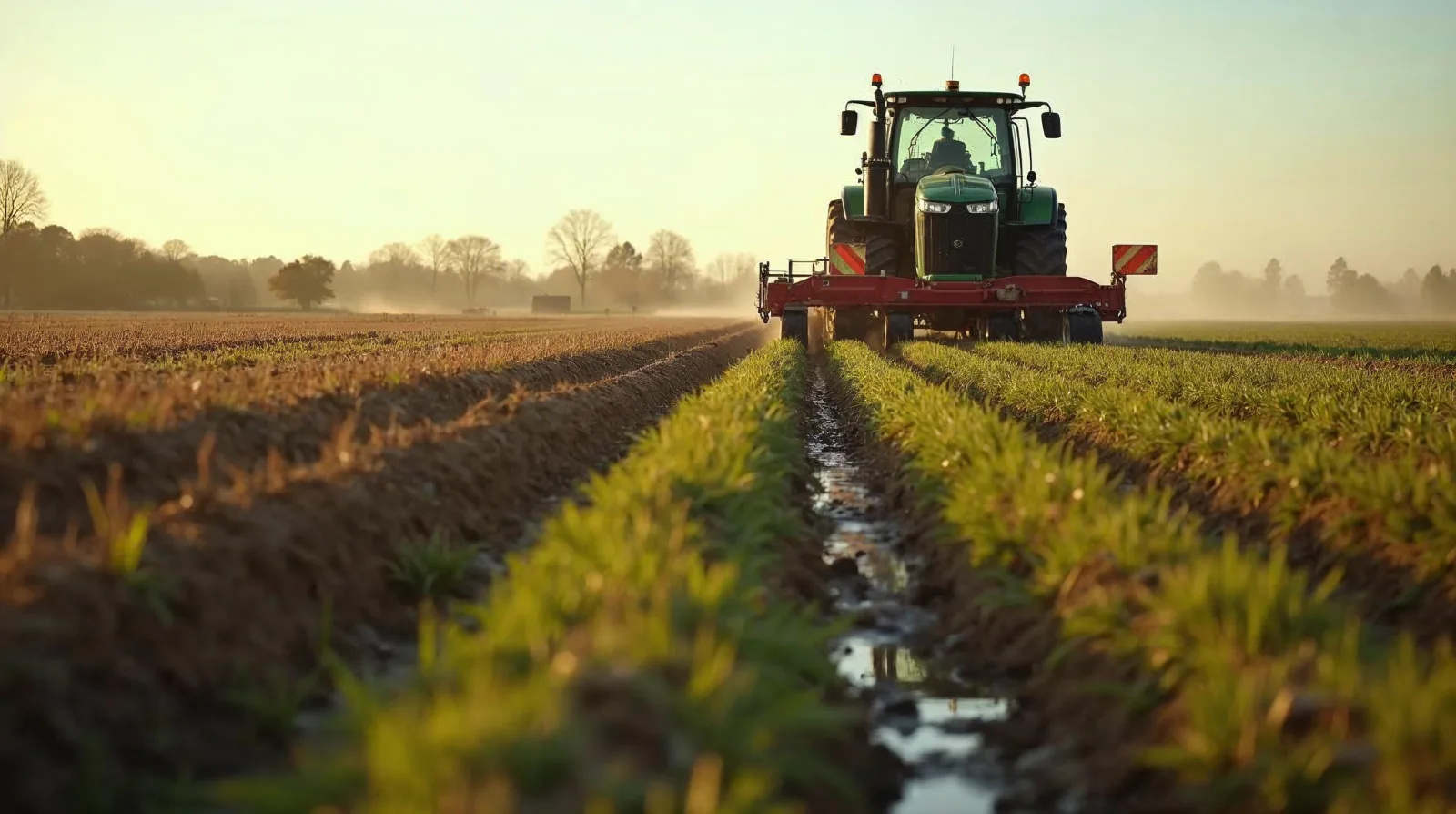
Conventional tile drainage is one of the most consequential investments a row-crop operation ever makes, and once it is in the ground it is treated as if the work is done. The tile pulls water off the field whenever the field has water to give, the lateral runs to the main, the main runs to the outlet, and the outlet runs to the ditch. The system has no off switch. In the spring, when soil moisture is the limiting factor and the crop has not yet been planted, the tile pulls water out anyway. In the summer, when a corn crop in pollination would benefit from a foot of subsoil moisture, the tile pulls water out anyway. In the fall, after harvest, when there is no crop in the field but the nitrate load in the soil profile is at its annual peak, the tile pulls that nitrate-laden water straight to the ditch.
Smart tile drainage, sometimes called controlled drainage or drainage water management, is the version of the same system with an off switch installed at the outlet. A water control structure replaces the open pipe that runs to the ditch. Stop logs or an actuator-driven gate raise and lower the water level inside the tile main on a schedule the operator sets. Add water-level sensors and the structure becomes remote-monitored. Add an actuator and a controller and the structure becomes remote-operated. The investment per outlet is modest compared to the original tile system, the yield impact is real and repeatable in the right soils, and the nitrate load reduction at the outlet is large enough that several state cost-share programs will pay a meaningful share of the install. This guide is the practical version of what the technology actually does, where it works, where it does not, and how to think about the math.
The simplest description of a controlled drainage system is a water control structure installed near the outlet of a tile main. The structure is a vertical concrete or polymer box, typically 24 to 30 inches square in cross-section and four to six feet deep, with the tile main entering on one side and exiting on the other. Inside the box, a slotted track holds removable boards or stop logs. The boards stack to whatever height the operator chooses. Water entering the box from the upstream tile cannot exit until it rises above the top board.
In drainage mode, the boards are pulled and the box behaves like a straight piece of pipe. Water flows through unimpeded. In storage mode, the boards are stacked and the upstream tile backs up. The water table in the field above the tile rises until it reaches the height of the top board, at which point overflow resumes. The result is a water table held at a chosen depth - typically anywhere from the surface down to the natural tile depth of three to four feet - rather than allowed to drop to the natural drainage depth of the tile.
The structure has three operating positions through the year. In the late fall and winter, the boards stay in place and the water table stays high. The point of holding water in this period is not crop-related; it is to prevent the bulk of the season's nitrate load from leaving the field through the tile. The microbial activity that converts soil nitrate to nitrogen gas, called denitrification, only happens in saturated soil, and a saturated soil in November is doing exactly the work an operator would want a wetland to do.
In the early spring, before planting, the boards come out and the field drains conventionally so the soil dries enough to support equipment and seedbed preparation. The window from boards-out to planting is usually two to four weeks depending on soil and weather.
In the growing season, the boards go back in but at a lower height. The water table is held at a depth below the planting zone but above the natural tile depth, often around 30 to 36 inches. The point in this period is to retain subsoil moisture for the crop without saturating the root zone. A corn root system pulls water from depths of three feet or more in mid-summer, and a controlled drainage structure that holds the water table at 36 inches gives the crop a reliable subsoil reservoir to draw from during dry weeks. After harvest, the boards go back to maximum height and the system returns to winter storage mode.
The structure is not a new technology. AgriDrain Water Gates, Hickenbottom risers, and similar products have been on the market in the Midwest for decades. What is new is the layering of sensors, telematics, and remote actuators on top of the basic structure, which moves the system from a manual, twice-a-year board adjustment to a continuous water-level management system that can be operated from a phone.
Controlled drainage is a technology that lives or dies on field topography. The structure can only hold water as high as the lowest point upstream of it. On a perfectly flat field, a single structure can manage the water level across the entire drainage area of a tile main. On a sloped field, the structure only manages the water level for the section of field directly upslope of the structure within the elevation difference of the boards.
Practically, this means controlled drainage is well-suited to fields with less than half a percent slope, marginally suited to fields with half to one percent slope, and not well-suited to fields with more than one percent slope unless the system is broken into multiple stages with a structure on each. The flat black soils of central Illinois, the prairie pothole region of Iowa and Minnesota, the lake plain soils of Indiana and Ohio, and the coastal plain soils of the Carolinas and the Delta are where the technology has the most acres in production. Rolling glacial-till country in northern Indiana and southern Michigan can work with multi-stage installs. Steep rolling fields in southern Iowa and western Illinois generally cannot.
The other field characteristic that matters is soil texture. Controlled drainage works because raising the water table backs water up into the soil profile, where the crop can use it. That requires a soil with enough vertical hydraulic connectivity to actually move the water from the tile zone up into the root zone within a useful timeframe. Heavy clay soils with poor vertical permeability hold water at the tile depth without much of it making the trip up to root level, and the yield benefit in those soils is often small. Loam soils, silt loams, and sandy loams give the best response. Pure sands hold too little water against gravity to benefit much.
The third factor is the existing tile system. A controlled drainage retrofit is much cheaper than a new install, but it requires a tile system that was designed and laid out in a way that supports water-level control. Random tile, where laterals run wherever they were needed in problem spots, is harder to control than pattern tile, where the laterals are laid out in a regular grid at consistent spacing and depth. A field with a single main and a known elevation can have a structure installed at the outlet for a few thousand dollars. A field with three random outlets and unknown lateral elevations may need significant rework before a controlled drainage retrofit is practical.
There is also a real question of whether a particular field needs the technology at all. Drainage water management makes the most sense on fields that are reliably wet enough in the spring to need drainage but reliably dry enough in mid-summer to benefit from subsoil moisture retention. Fields that flood every year regardless of tile, fields that never need supplemental moisture in mid-summer, and fields that are already pattern-irrigated do not get a meaningful benefit from controlled drainage. The classic candidate field is one where the operator sees drought stress on the crop in some Julys but never has to delay planting because the tile cannot keep up in April.
The yield impact of controlled drainage has been studied by Ohio State, Purdue, the University of Illinois, USDA-ARS, and several extension programs going back twenty years. The numbers are reasonably consistent across the literature, with variation that tracks the field-level factors above.
For corn on suitable soils, the average yield benefit from controlled drainage versus conventional drainage runs roughly five to fifteen bushels per acre across years, with the larger numbers coming in dry years and the smaller numbers in normal years. In wet years, the benefit can be zero or slightly negative if the structure is not opened in time to drain a saturated profile before planting. The variation across years is the headline. A controlled drainage system does not produce a consistent five-bushel boost every year; it produces a large boost in dry years, a small boost in normal years, and a possible drag in wet years if managed poorly.
For soybeans, the picture is similar but smaller in absolute bushels. The percentage benefit is roughly the same, but soybeans yield about a third of corn in bushels per acre, so a five percent benefit is a smaller bushel number. Soybeans are also less sensitive to short droughts than corn, which compresses the benefit further.
The compounding factor is that controlled drainage is one of the few moisture-management tools that actually mitigates drought risk on tile-drained land. A typical row-crop operation in the eastern Corn Belt has no irrigation at all, so the only options for managing dry-year risk are crop insurance, hybrid selection, and tile management. Of those, tile management is the only one that puts physical water in front of the crop. In a year where corn yield is being determined by available subsoil moisture in late July, a controlled drainage system that has held an extra two inches of water in the profile through June is doing real work that nothing else on the operation is doing.
The operator's discipline matters more than the equipment. A structure that gets its boards adjusted on schedule produces the published yield benefits. A structure that gets installed and then forgotten about - left in spring drainage mode through July, or left in winter storage mode into the planting window - produces no benefit and possibly a drag. The technology pays back the operators who actually manage it.
The basic controlled drainage structure is a manual device. The operator drives to the structure twice or four times a year, pulls or replaces boards by hand, and writes the depth and date in a notebook. That is the version that the bulk of the published yield data is based on, and it works. Sensors and telemetry are an upgrade layer that addresses the labor and timing weaknesses of the manual version, not a replacement for the basic structure.
The most useful sensor is a simple water-level sensor inside the structure itself. A pressure transducer at the bottom of the structure reads the water column above it, which translates directly to the water table depth at the structure. With a cell modem and a simple cloud dashboard, the operator gets a live reading of the water level at every structure on the operation without driving anywhere. The value of this is not just remote monitoring - it is being able to see when the water level has hit the top board and is overflowing, when it has dropped below the boards because of dry weather, and when a heavy rain has spiked the level fast enough to suggest the boards need to come out.
The second useful sensor is a flow meter or weir at the outlet. A flow measurement at the outlet pipe, combined with the water-level sensor inside the structure, gives the operator a complete picture of how much water is leaving the field and when. For operations participating in nutrient-load tracking programs - some state cost-share programs require measured load reductions to qualify for the larger payments - the flow data is what closes the loop on the documentation side.
Soil moisture sensors at multiple depths upstream of the structure add a complementary picture. A water-level sensor in the structure tells the operator what the water table is doing. A 12-inch and 24-inch and 36-inch soil moisture sensor in the field tells the operator what is happening in the root zone. The combination is more useful than either alone, especially in mid-summer when the question is whether the held water is actually reaching the roots.
The remote actuator is the upgrade that lets the operator change the board height from a phone instead of driving to the structure. Several manufacturers, including AgriDrain and various smaller integrators, sell electric actuators that raise and lower a gate inside the structure on demand. The actuator runs off a small solar panel and battery, with a cell modem for the network connection. The hardware cost runs roughly $3,000 to $6,000 per structure for the full sensor-and-actuator package on top of the base structure cost.
The actuator changes the management discipline meaningfully. Operators who would only adjust a manual structure four times a year may end up making a dozen or more adjustments through the season once the friction of the trip is removed. A heavy storm forecast can be met by opening the gate the night before. A dry stretch can be met by closing the gate two weeks earlier than the spring schedule would have called for. The yield benefit from active management versus passive seasonal management has not been as well studied as the basic technology, but the operator-side intuition is that responsive management is more valuable in years when the weather is unusual, which is increasingly most years.
What does not add value, at least at current prices, is over-instrumented field-level monitoring. A structure with a water-level sensor and a flow meter is well-monitored. A structure with twelve soil moisture sensors at six depths is over-monitored relative to the decisions a field operator can actually make on the data. The right sensor count is the count that produces decisions the operator would make differently with the data than without it.
The nitrate-load story is the part of controlled drainage that has been driving state and federal cost-share programs over the last decade. The mechanism is straightforward. Tile drainage moves water - and any nitrate dissolved in that water - from the field to the ditch. A field that drains water through October and November moves a substantial fraction of its annual nitrate load in those months, when there is no crop to take up nitrogen and when soil microbial nitrification of fall manure or residue has produced fresh nitrate in the profile. Holding the water in the field over winter starves the system of nitrate-laden flow at the outlet and lets the saturated soil microbially reduce the nitrate to nitrogen gas before the next spring's drainage.
The published reductions are large. Across multiple multi-year studies, controlled drainage reduces annual nitrate load at the outlet by roughly 30 to 50 percent versus uncontrolled drainage on the same field. The percentage varies with the depth and duration of winter holding, the soil type, and the crop rotation, but the floor is meaningful and the ceiling is large. A field that loses 25 pounds per acre per year of nitrate-N to tile drainage under conventional management can be expected to lose 12 to 18 pounds per acre under reasonably-managed controlled drainage.
Several state programs have built cost-share structures around this. Iowa, Illinois, Indiana, Ohio, and Minnesota all have controlled drainage cost-share programs through their soil and water conservation districts, often funded jointly by NRCS EQIP and state nutrient reduction strategies. Payment rates vary by year and program but commonly cover 50 to 75 percent of the structure cost, with some programs requiring documented water-level management for a five- to ten-year contract period. Operators considering an install should check current rates with the local NRCS office and the state SWCD.
The Mississippi River Basin Healthy Watersheds Initiative and the Great Lakes Restoration Initiative also fund controlled drainage as a priority practice in their target watersheds, often with higher cost-share rates and more flexible eligibility than the state-level programs.
The documentation requirements are not trivial but are not unreasonable either. Most programs require records of board positions through the year, structure inspection reports, and in some cases water-level data from a sensor. Operations with sensor-equipped structures generate the documentation as a side effect of the monitoring system, which is one of the underappreciated reasons to spend the extra dollars on the sensor package.
Controlled drainage holds water that arrives on the field as rainfall. Subirrigation goes further and pumps water back up the tile to actively raise the water table when rainfall has not been enough. The hardware overlap with controlled drainage is significant - the same water control structure that holds water can be used as a delivery point for pumped water - and a subset of operations with strong controlled drainage installs are gradually adding pump capacity to convert the system to true subirrigation.
The economics are different from regular irrigation. A pivot or drip system requires a clean water source, significant installation cost, and operating energy to push water through emitters. Subirrigation through the existing tile system requires a pump at the structure, a water source - typically a pond, ditch, or shallow well - and the energy to lift the water from the source to the field elevation. The capital cost runs from $150 to $400 per acre depending on water source and pumping head, which is materially less than the $1,000-plus per acre cost of pivot irrigation.
The yield response is also different. A pivot waters from above and delivers a measured inch or two on demand. Subirrigation raises the water table from below and depends on the soil to wick water up into the root zone. The response is slower, less precise, and not as effective in soils with poor vertical conductivity. On the right soils, however, the yield response from subirrigation can match or approach surface irrigation at a fraction of the capital cost. Several Iowa and Indiana research stations have published multi-year subirrigation trials with corn yield benefits of 20 to 50 bushels per acre versus rainfed in dry years on suitable fields.
For most operations, subirrigation is a future step, not a current decision. The right path is usually a controlled drainage install first, two to four years of operation to confirm the field is responding well to water-level management, and then a subirrigation upgrade if the conditions justify it. The structure and the tile main investment carry over.
A controlled drainage retrofit is a half-day to two-day job depending on access and structure size. The contractor excavates the existing main near the outlet, cuts in the structure box, ties the upstream and downstream tile to the box's inlet and outlet, backfills, and stabilizes the surface. A single-structure retrofit on an accessible main in suitable conditions runs roughly $3,000 to $6,000 in 2026 dollars for the structure and install, before the sensor and actuator package.
Sizing is a function of the drainage area served by the main. Most agricultural structures handle drainage areas from 20 to 80 acres per structure, with larger boxes or multi-stage installs for larger areas. Oversizing is cheap relative to the rest of the install and worth doing if the operator may add more tile feeding the same outlet later.
Outlet elevation matters. The structure has to be set deep enough that the maximum-board-height water level is above the top of the upstream main but below the surface of the field. On flat fields this is usually trivial. On fields with even slight relief upstream of the outlet, the structure depth has to be calculated from a survey to ensure the water table can be raised without surfacing in low areas of the field.
Multiple structures on a single field, staged at different elevations along the main, are how systems get extended onto fields with more relief. The cost-per-acre goes up, but the system can manage water levels across a much wider range of topography. Multi-stage designs are now common in northern Indiana, southern Michigan, and parts of Minnesota where the prairie pothole landscape produces significant local relief over short distances.
Annual maintenance is light. The structure itself has no moving parts in the basic version. Boards get inspected for warping or rot, the box gets cleaned of sediment, and the outlet area gets checked for erosion. Sensor-equipped structures need battery checks, antenna inspections, and occasional sensor cleanings. Actuator-equipped structures add a yearly mechanical check on the actuator and gate seals.
The most common mistake is installing the structure and then running the boards on a fixed calendar schedule regardless of weather. The schedule-based approach captures most of the nitrate-load benefit but only part of the yield benefit, and in a year with unusual weather it can produce negative outcomes. The fix is to either commit to active management with regular monitoring or to invest in the sensor and actuator package that makes responsive management low-friction.
The second common mistake is leaving the boards in too long in the spring. A field with the boards still in on April 20 in a normal year is going to plant late, and the planting delay costs more bushels than the held water gains back. The right rule of thumb is to pull the boards three to four weeks before normal planting date and adjust based on actual soil conditions.
The third common mistake is leaving the boards out too long in the early summer. The crop benefits from subsoil moisture starting in late June or early July, when the corn is tasseling and the soybean is filling pods. A structure that goes back into hold mode on August 1 is too late. The right timing is usually to start raising the water table to mid-summer levels in mid- to late June, before the dry weather hits, so the soil has time to equilibrate.
The fourth common mistake is treating the structure as a set-and-forget purchase. The yield benefits scale with the management, not with the hardware. An operation that hires a custom service or assigns a single team member to manage the structures across the operation gets a different result than one that bolts the structures on and walks away.
The decision framework is short. The field has to be flat enough or split into stages to actually hold water. The soil has to have enough vertical conductivity to move held water into the root zone. The existing tile has to be laid out in a way that supports water-level control or the budget has to allow for retrofit work. The operator has to be willing to manage the structures actively or pay for sensor-and-actuator hardware that reduces management friction. The yield benefit has to be large enough on the operation's typical year-to-year mix to justify the per-acre install cost. The cost-share programs available in the state have to be checked, because they materially change the math.
The fields most likely to clear all five tests are the same ones that drove the original tile investment two or three generations ago - the flat, productive, occasionally-droughty cropland that defines a large share of the eastern Corn Belt and the prairie-pothole Midwest. On those acres, controlled drainage is one of the better return-on-invested-capital decisions available in 2026, particularly in combination with the layered sensor and actuator technology that makes active management practical without adding labor. The investment is not zero and it is not free of management commitment, but the yield, the nitrate load, and the cost-share economics line up in favor of the practice on the right field, and the right field is more common than most operators assume.
On suitable soils, controlled drainage averages roughly 5 to 15 bushels per acre of corn versus conventional drainage, with the larger numbers in dry years and smaller numbers in normal ones. In wet years the benefit can be zero or slightly negative if the boards are not pulled in time to drain a saturated profile before planting. The yield gain scales with active management, not with the hardware alone.
A single-structure retrofit on an accessible tile main runs roughly $3,000 to $6,000 in 2026 dollars for the box and install. The full sensor-and-actuator package that allows remote operation adds another $3,000 to $6,000 per structure. State cost-share programs through NRCS EQIP and soil and water conservation districts commonly cover 50 to 75 percent of the structure cost, so check local rates first.
Across multiple multi-year studies, controlled drainage cuts annual nitrate load at the tile outlet by roughly 30 to 50 percent versus uncontrolled drainage on the same field. A field losing 25 pounds per acre per year of nitrate-N under conventional management typically drops to 12 to 18 pounds under reasonably managed controlled drainage, because saturated winter soil microbially converts nitrate to nitrogen gas before spring.
Controlled drainage suits fields with less than half a percent slope, is marginal from half to one percent, and is not well suited above one percent unless the system is broken into multiple staged structures. The box can only hold water as high as the lowest point upstream of it, so on rolling ground each structure manages only the section within the elevation range of its boards.
Join our list for practical guides on farm tech, precision agriculture, and tools that work.