
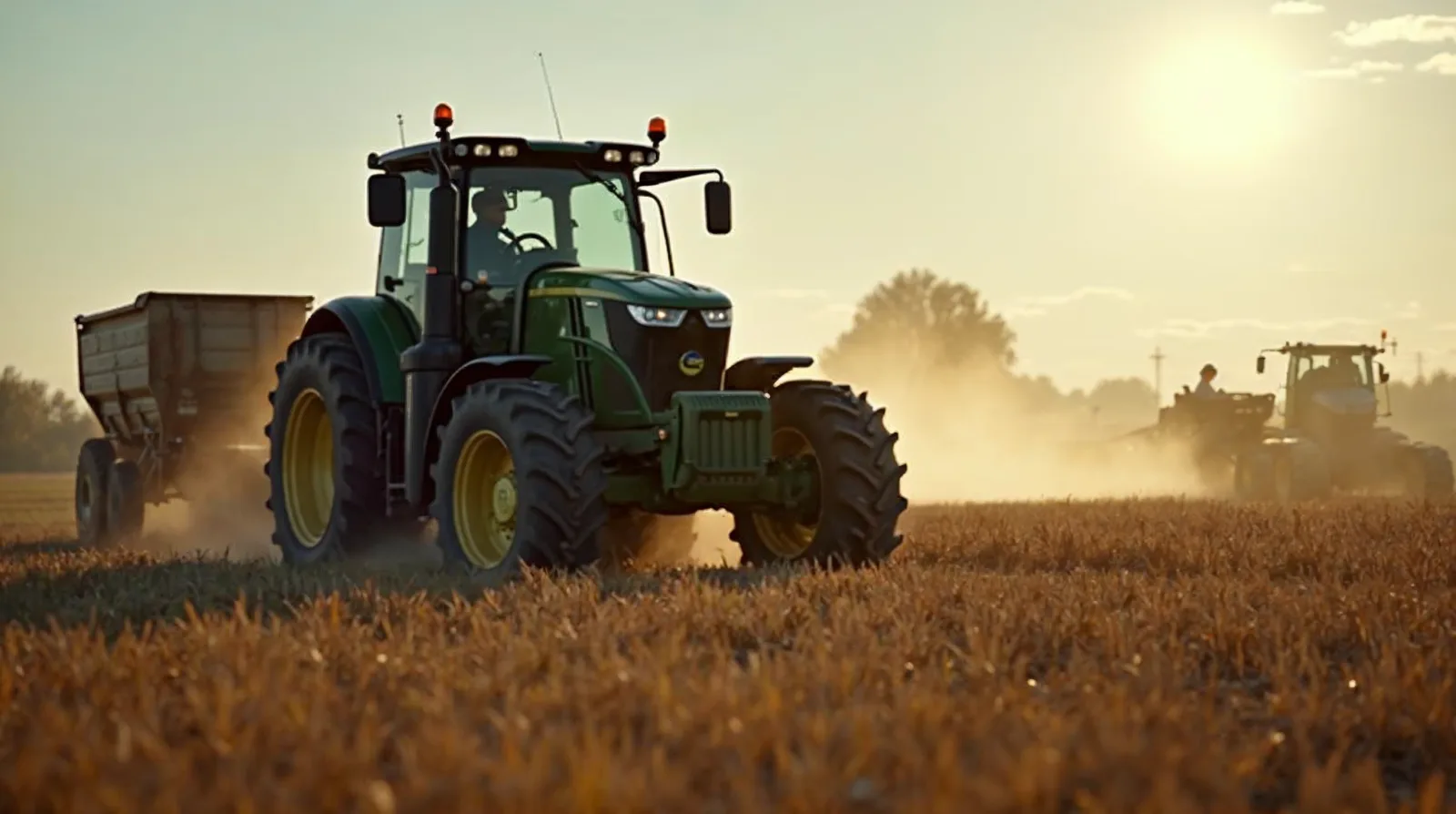
A modern row-crop tractor leaves the dealer with more sensors than a 2005 airliner. Engine load, fuel rate, hydraulic pressure, ground speed, slip percentage, coolant temperature, DEF level, hours on each major component, GPS position, and a hundred CAN-bus messages per second are all being measured continuously regardless of whether the operator looks at any of them. Telematics is the bridge between that data being trapped inside the tractor and being available somewhere a farm manager can actually use it. Done well, telematics turns a mixed fleet into a managed asset and gives the operator visibility into fuel waste, premature wear, and idle time that would otherwise stay invisible until a repair bill landed. Done poorly, it becomes another subscription that nobody reads and that occasionally locks the customer into a single-color equipment yard.
This guide is the practical version of fleet telematics for a working farm in 2026. It covers what telematics actually measures, the strengths and gotchas of the major OEM platforms - JDLink, AGCO Connect, AFS Connect, MyCNHi - the aftermarket and independent options that have matured into real alternatives, the specific fuel and downtime savings operators can expect, the integration problem on mixed-color fleets, the data ownership questions that have become contentious in the last few years, and the ROI math for whether a paid telematics subscription is worth the line item. If you are running anything from a single 200-horsepower row-crop tractor to a fleet of fifty mixed pieces of equipment, the right telematics setup pays for itself; the trick is picking the one that actually fits the operation.
The starting point is being clear about what the data layer covers, because the marketing tends to lump everything into one bucket and the actual capabilities differ significantly between systems.
At the most basic level, every modern telematics box reports GPS position, engine on/off state, and basic engine hours. This is enough to answer two questions that are surprisingly hard to answer without it - where is the equipment right now, and is it running. For a multi-farm operation, a contract operation, or a leased fleet, that alone is worth something.
The next layer is engine and machine performance data. Engine load percentage, fuel consumption rate in gallons per hour, ground speed, PTO engagement, hydraulic flow, transmission temperature, DEF level, and exhaust aftertreatment status. This is the data that supports actual fleet management decisions - which tractor is the most fuel-efficient on a given task, which operator is running the equipment hardest, when the next service is due, and whether a derate event is about to put a machine down.
The third layer is implement-specific data. A tractor pulling a planter reports planting metrics like population, downforce, vacuum, and spacing if the planter is connected to the tractor's ISOBUS network. A tractor pulling a tillage tool reports working depth, slip, and fuel per acre. A combine reports yield, moisture, header height, and grain loss. The implement data is where telematics shifts from fleet management to agronomic decision support, and it is also the layer where data ownership gets most contested.
The fourth layer is diagnostic and prognostic data. Active fault codes, predictive maintenance alerts based on hours and operating conditions, oil sample correlations, and component-level health scores. This is the layer that delivers the "downtime avoidance" value that telematics vendors emphasize, and it is also the layer where the major OEM systems pull ahead of independent solutions because the diagnostic detail comes straight from the controller area network at the engine and powertrain level.
A working farm does not necessarily need all four layers on every machine. A grain cart that runs three weeks per year does not need diagnostic prognostics. A 600-horsepower 4WD running 1,500 hours per year almost certainly does. The right telematics setup matches the data layer to the value at risk on each piece of equipment.
Every major manufacturer now sells a telematics platform branded to fit alongside the tractor color. The capabilities have converged enough that the differences are smaller than the marketing suggests, but the differences that remain are operationally significant.
John Deere's platform is JDLink, with the data dashboard sold as Operations Center. JDLink is the most mature of the OEM systems by a comfortable margin. Coverage is excellent across the Deere line from compact utility tractors through 9R 4WDs and S-series combines, and the data depth on green equipment is best-in-class. Operations Center includes work order management, prescription generation, and the John Deere Field View which is a practical tool for in-cab visualization of completed and remaining work. The catch is the subscription model. Modern Deere equipment ships with a complimentary JDLink subscription that runs out at three years, after which the customer pays roughly $500 to $750 per machine per year for the connectivity and analytics tier most operations want. The data is portable in the sense that Operations Center exports to standard formats, but the integrated experience falls apart if the connectivity subscription lapses, and several diagnostic features are tier-locked.
CNH's platform spans Case IH, New Holland, and Steyr under the AFS Connect and PLM Connect brands, with the underlying technology now harmonized as MyCNHi for back-office integration. The platform has improved sharply since the 2022 generation. Coverage on newer Magnums, Optums, and Steigers is strong, the AFS Pro 1200 in-cab display is a credible competitor to the Deere 4640, and CNH has been more flexible than Deere on data export to third-party tools. The pricing model is similar to JDLink in the $400 to $700 per machine per year range after the initial complimentary period.
AGCO's platform covers Fendt, Massey Ferguson, Challenger, and Valtra under AGCO Connect and the Fuse smart farming framework. AGCO has made the most aggressive commitments around data interoperability, and Fendt machines specifically have a clean integration path with third-party ag software. The hardware platform on newer Fendt 700 and 900 series tractors, particularly the FendtONE generation, is excellent. Outside of Fendt, the experience on older Massey and Challenger equipment is more mixed, with some pieces effectively requiring a retrofit to participate fully in the telematics ecosystem.
Kubota, Mahindra, Kioti, LS, and the other Asian manufacturers have telematics offerings that vary from rudimentary to credible. Kubota's KubotaNow on the M and M7 series is a basic but functional system. The smaller manufacturers tend to either offer a Trimble-based or independent platform on the larger units and nothing on the compacts. For an operation running a mixed Kubota and other-color fleet, the OEM-only path is rarely the right answer below the M7 / M8 class.
The general rule on OEM telematics is that the experience is excellent on current-generation flagship equipment, acceptable on mid-tier current equipment, and increasingly thin as the equipment ages. A 2018 Magnum on AFS Connect 2.0 is not going to deliver the same visibility as a 2024 Magnum on the current generation regardless of how much the operation pays in subscriptions. The decision matrix has to start with how old the fleet actually is.
The independent telematics market has matured significantly over the past five years, and an operation running mixed-color or older equipment now has real options outside the OEM platforms.
The category leaders are Trimble Ag, AgLeader, FarmQA, FarmLogs (now part of Bushel), Conservis, and Granular for the agronomic and analytics side, paired with hardware-side providers like CalAmp, Geotab for fleet, ZTR, and Ravven on the OBD-II / J1939 telematics box layer. The model is straightforward - a J1939 or OBD-II box plugs into the tractor's diagnostic port, reads the broadcast CAN-bus messages, adds GPS and cellular connectivity, and feeds a unified dashboard that does not care what color the equipment is.
The strength of the independent path is mixed-fleet visibility. A farm running Deere, Case, and Fendt in the same shop can see all three on a single dashboard with comparable metrics, which is something no OEM platform delivers. The pricing tends to be more flexible, with hardware running $300 to $800 per box and connectivity at $15 to $40 per machine per month rather than the OEM subscription model.
The weakness is data depth. A J1939 telematics box reads what the tractor's CAN-bus broadcasts in standardized form, which covers the engine and powertrain layer well but does not include all the proprietary OEM messages that encode component-specific diagnostics. An independent box on a Deere tractor will report engine load, fuel rate, and ground speed accurately, but it will not generate the predictive maintenance alerts that JDLink generates from the proprietary message set. The agronomic data layer is similarly thinner unless the operation invests in implement-side telemetry independently.
A practical pattern that has worked for several operations is to keep OEM telematics on the newest flagship equipment - the units where predictive maintenance is most valuable and the subscription cost is justified by hours of use - and use independent telematics on older equipment, smaller utility tractors, and mixed-color fleet pieces where basic visibility is enough. The single-pane dashboard is sacrificed on the OEM-flagship pieces, but the math usually works out in favor of mixed coverage.
A specific note on the aftermarket spray drone, sprayer, and self-propelled equipment market - several specialty manufacturers have integrated their telematics directly with operational dashboards like RDO Equipment's MyConnectedFleet, which reads OEM data via cooperation agreements and presents it alongside independent fleet data. These integration layers are still maturing but are worth checking before committing to a pure-OEM or pure-independent approach.
Fuel is where telematics delivers the most quantifiable savings, and the numbers are large enough on a multi-tractor operation that the subscription pays for itself before any other benefit.
The headline metric is gallons per acre on tillage and seeding operations. A typical primary tillage pass with a 25-foot disk and a 350-horsepower tractor consumes 2.5 to 4 gallons per acre depending on soil conditions, depth, and operator technique. Telematics data exposes the variance - the same tractor and tool pulled by two different operators on adjacent fields will routinely show 20 to 30 percent fuel rate differences, with the higher number coming from running deeper than necessary, running faster than the engine prefers, or running with the throttle pinned in conditions that do not require it. On a thousand-acre tillage operation at $3.50 diesel, a 0.5 gallon per acre operator-driven swing is $1,750 in a single pass. Across primary tillage, secondary tillage, and seeding, the same swing is $4,000 to $6,000 per season per tractor. That number alone covers the subscription on the most expensive OEM telematics tier.
Idle time is the second large fuel category. Most operators dramatically underestimate how much time their tractors spend idling - waiting at the field edge, waiting for the seed truck, waiting at the elevator, sitting through lunch. Telematics data routinely shows 15 to 30 percent of total engine hours are idle on equipment that the operator believes is mostly working. At 1.5 to 2.5 gallons per hour of idle on a typical row-crop tractor, that is 200 to 500 gallons of fuel per machine per year burned to no productive purpose, plus the corresponding wear on the engine. An idle-shutdown alert and a basic operator scorecard cuts idle time by half within a season on most operations, which is a $700 to $1,500 per machine per year fuel saving on top of the agronomic side.
Engine load matching is the third and most operator-skill-dependent category. Modern diesel engines are most efficient at roughly 70 to 85 percent rated load. Below that, fuel per horsepower-hour rises sharply because parasitic losses become a larger fraction of total output. Above that, fuel rate rises faster than work output. A telematics dashboard that shows operators their average engine load percentage on each task, paired with a brief training session on shifting up and throttling back, drops fuel rate by 8 to 15 percent on tillage and PTO operations across the fleet without any equipment changes.
The fourth category is logistics and routing. Telematics shows an operator at the office where each piece of equipment is and where it is heading, which exposes the avoidable trips - the tractor that drove the long way home because the operator did not know the shorter route was available, the planter that was deadheaded across the operation when it could have stayed and finished an adjacent field, the grain cart that ran half-empty because the harvest sequence was not optimized. The savings here are operation-specific and not as cleanly attributable, but on a multi-square-mile operation they are not trivial.
A reasonable composite estimate for a well-managed single-tractor operation is $1,500 to $3,500 per year in fuel savings from telematics-driven operator and management changes. On a five-tractor operation it scales to $8,000 to $15,000 per year. These numbers assume the data is actually being used, not just collected; the telematics that is bought and never opened delivers nothing.
The fuel side is the easy part of the ROI argument. The downtime side is harder to quantify but in many operations is the larger value.
The mechanism is straightforward. A diesel engine on the verge of a major failure rarely fails without warning - oil consumption changes, fuel rate drifts, exhaust temperatures rise, fault codes fire intermittently before becoming hard faults. A human operator routinely misses or normalizes these signals. A telematics platform with active fault monitoring catches them and flags them while the repair is still a $400 sensor replacement instead of a $40,000 in-frame.
The data is mature on the cost side. John Deere has published case studies showing JDLink-equipped fleets averaging 12 to 18 percent less unplanned downtime than non-connected fleets in the same farm operation. Case IH and AGCO have similar internal numbers. Independent telematics providers report comparable results on the engine and powertrain layer, with the gap being the loss of the proprietary OEM diagnostics that catch the most subtle precursor signals.
In practical terms, the value of an avoided in-season failure is the value of the work that would have been lost during the repair. A 2-day breakdown during planting in Iowa or a 3-day breakdown during corn harvest in Illinois has a real cost in foregone yield, late penalties at the elevator, additional dryer shrink, and operator overtime that often runs into five figures per machine per event. One avoided event in a five-year period pays for the entire telematics subscription and then some.
A specific operational pattern that delivers the most value is pairing telematics data with regularly scheduled oil samples. The oil sample catches contamination and wear-metal trends that the on-board sensors cannot see, while the on-board sensors catch real-time anomalies that the oil sample only reveals weeks later. The combination - oil samples every 250 hours and continuous telematics monitoring - is the closest a farm operation can get to the maintenance discipline that aviation and over-the-road trucking achieve, and it has dramatic effects on engine and transmission longevity.
The piece that telematics does not fix is the parts and service capacity at the dealer. A predictive alert that says the turbocharger is going to fail in the next 50 hours is worthless if the dealer does not have the part in stock. The right way to use predictive alerts is to push longer-lead-time parts onto the operation's shelf in advance during the off-season, which requires the kind of inventory planning that smaller operations sometimes resist. The platforms that are starting to integrate parts ordering directly into the telematics dashboard - JDLink with John Deere parts integration is the furthest along - are partially solving this, but the underlying constraint is dealer capacity, not data.
Most operations do not run a single color, and the integration problem on mixed fleets is the single biggest practical limitation of telematics in 2026.
The cleanest path is to standardize on a single OEM if the operation can absorb the trade-in cost, which most cannot. The next-cleanest path is the all-independent approach using J1939 telematics boxes across the fleet, with the OEM telematics on each piece allowed to lapse. This works but loses the proprietary OEM diagnostic depth on the flagship equipment.
The compromise that more operations are landing on in 2026 is dual-data, where each piece of equipment runs both its OEM telematics on the data tier most useful for that piece and an independent telematics box for the unified fleet view. Hardware costs add a few hundred dollars per machine, subscription costs add a few hundred per year per machine, and the operation gets both the OEM diagnostic depth on the new flagship equipment and the unified fleet dashboard for management.
A new option that has emerged with more vigor in the last 18 months is the AGCO-led DataConnect alliance, where AGCO, CNH, Topcon, Trimble, and others publish a standard API that allows competitor platforms to read each other's telemetry with the customer's permission. John Deere has not joined. The alliance does not solve the JDLink problem but does cleanly cover the rest of the major lines, and several independent dashboards now read AGCO Connect, AFS Connect, and Trimble data side-by-side using the standard.
The path forward over the next two to three years is likely a combination of regulatory pressure - the U.S. and EU have both signaled interest in mandating data interoperability for ag equipment - and commercial pressure as operations refuse to renew JDLink subscriptions in favor of platforms that play with their other equipment. The 2027 model year is when several of these pressures are expected to land in shipping product.
The data ownership question has gone from theoretical to operational over the past three years and is now a routine consideration in equipment purchasing.
The contractual baseline on most OEM telematics platforms is that the customer owns the agronomic data generated on their farm but grants the manufacturer a broad license to use the data for product development, aggregated industry analytics, and dealer service. The customer can withdraw consent and delete data on most platforms but in some cases this also disables features. Reading the terms of service before signing is no longer optional for an operation of any size.
The Right to Repair movement has had its largest impact in this space. Several U.S. state laws and a 2023 federal advisory have established the customer's right to access diagnostic data, repair tools, and software updates without dealer-only gatekeeping. Implementation has been uneven and active litigation continues, but the practical effect is that the OEM platforms have become more transparent about diagnostic access and more willing to license repair tools to independent shops than they were five years ago. The trajectory is in the customer's favor.
The question that an operation should ask before subscribing to any telematics platform is what happens if the operation decides to leave the platform. Specifically - is the historical data exportable, does the in-cab display continue to function with reduced features, and are the prescription files written in a format that other vendors can read. The answer on most major OEM platforms is now reasonable, but the details vary and the contract is the relevant document, not the marketing.
A simple ROI calculation for telematics on a typical operation looks like this.
For a single 350-horsepower row-crop tractor running 1,000 hours per year on a 1,500-acre operation, the cost side is roughly $600 per year for the OEM subscription on a 4-year-old machine or $400 per year for an independent J1939 setup. The benefit side is approximately $1,500 per year in fuel savings from operator behavior changes plus an amortized $2,000 per year in avoided downtime over a 5-year period. Net benefit is $2,900 to $3,100 per machine per year. Payback is under three months on the subscription alone.
For a five-machine mixed fleet on a 6,000-acre operation, the cost side scales to roughly $3,000 per year on subscriptions plus $1,500 in hardware amortization. The benefit side is approximately $10,000 in fuel savings plus $8,000 in avoided downtime plus several thousand in logistics savings that are harder to quantify. Net benefit is $13,000 to $20,000 per year. Payback is well under one season.
The numbers do not work as well at the small-operation end. A single 75-horsepower utility tractor on a 200-acre operation does not generate enough hours of use for the fuel savings or the downtime avoidance to justify the subscription, and the basic GPS-and-hours functionality available from a $20 per month independent box is usually all that is needed. The crossover is somewhere around 400 to 600 hours per year per machine on equipment with significant repair exposure.
The numbers also do not work for equipment near the end of its useful life. A telematics subscription on a 25-year-old tractor that is being kept around for occasional snow blowing or barn-yard work is a waste of money regardless of how cheap the box is. The operation should know which of its equipment falls into this category and not let telematics-everywhere thinking override the actual use pattern.
A practical telematics setup for a typical mid-size operation in 2026 looks like this. The flagship equipment - the newest 200-plus-horsepower row-crop tractor, the combine, the self-propelled sprayer - runs the OEM telematics on the active subscription tier. The mid-tier equipment that is 5 to 10 years old runs an independent J1939 box with a basic fleet management subscription. The utility equipment under 100 horsepower runs nothing or a very basic GPS-and-hours tracker if theft is a concern.
The dashboard side is a single fleet management view that pulls the independent telematics directly and pulls the OEM data either through a partnership integration or through manual export-and-upload on a weekly cadence. The agronomic side is a separate workflow that uses the OEM displays in-cab and exports prescription and as-applied data to the operation's farm management software at the end of each pass.
A weekly review is the discipline that makes the data useful. Fifteen minutes on a Monday morning looking at idle time, fuel rate, fault codes, and upcoming maintenance is enough to convert telematics from a passive log into an active management tool. Without that discipline, the subscription is wasted.
For an operation considering its first telematics setup, the practical advice is to start with the highest-value piece of equipment, run a season's worth of data, and confirm the math on that piece before scaling to the rest of the fleet. The case for telematics is not weakened by a phased rollout, and the lessons learned on the first installation make every subsequent installation cheaper and more effective.
The trajectory of farm telematics in 2026 is clear. Hardware costs are flat to falling, subscription costs are slowly declining as competition increases, data interoperability is improving, and the analytical sophistication of the dashboards is rising. The operation that delays adopting until a hypothetical perfect setup arrives is leaving real money on the table every season. The setup does not have to be perfect; it has to be running.
A well-managed single-tractor operation typically saves $1,500 to $3,500 a year, scaling to $8,000 to $15,000 on a five-tractor fleet. The savings come from three levers: cutting idle time, which often runs 15 to 30 percent of engine hours at 1.5 to 2.5 gallons an hour, matching engine load to the efficient 70 to 85 percent band, and exposing operator-driven fuel-rate swings of 20 to 30 percent on the same tillage pass.
Modern John Deere equipment ships with a complimentary JDLink subscription that runs out at three years. After that, the connectivity and analytics tier most operations want costs roughly $500 to $750 per machine per year, and some diagnostic features are locked to higher tiers. CNH's AFS Connect runs a similar $400 to $700 per machine per year after its own complimentary period.
Yes, using independent J1939 telematics boxes that plug into each tractor's diagnostic port and feed one color-blind dashboard. Hardware runs $300 to $800 per box with connectivity at $15 to $40 per machine per month. The trade-off is losing proprietary OEM diagnostic depth. The AGCO-led DataConnect alliance also shares telemetry across CNH, Topcon, and Trimble platforms, though John Deere has not joined.
Yes. John Deere case studies show JDLink-equipped fleets averaging 12 to 18 percent less unplanned downtime than non-connected fleets, because predictive alerts catch a failing part while it is still a $400 sensor rather than a $40,000 in-frame. The strongest results come from pairing continuous monitoring with oil samples every 250 hours, so wear-metal trends and real-time anomalies are both caught.
Join our list for practical guides on farm tech, precision agriculture, and tools that work.