
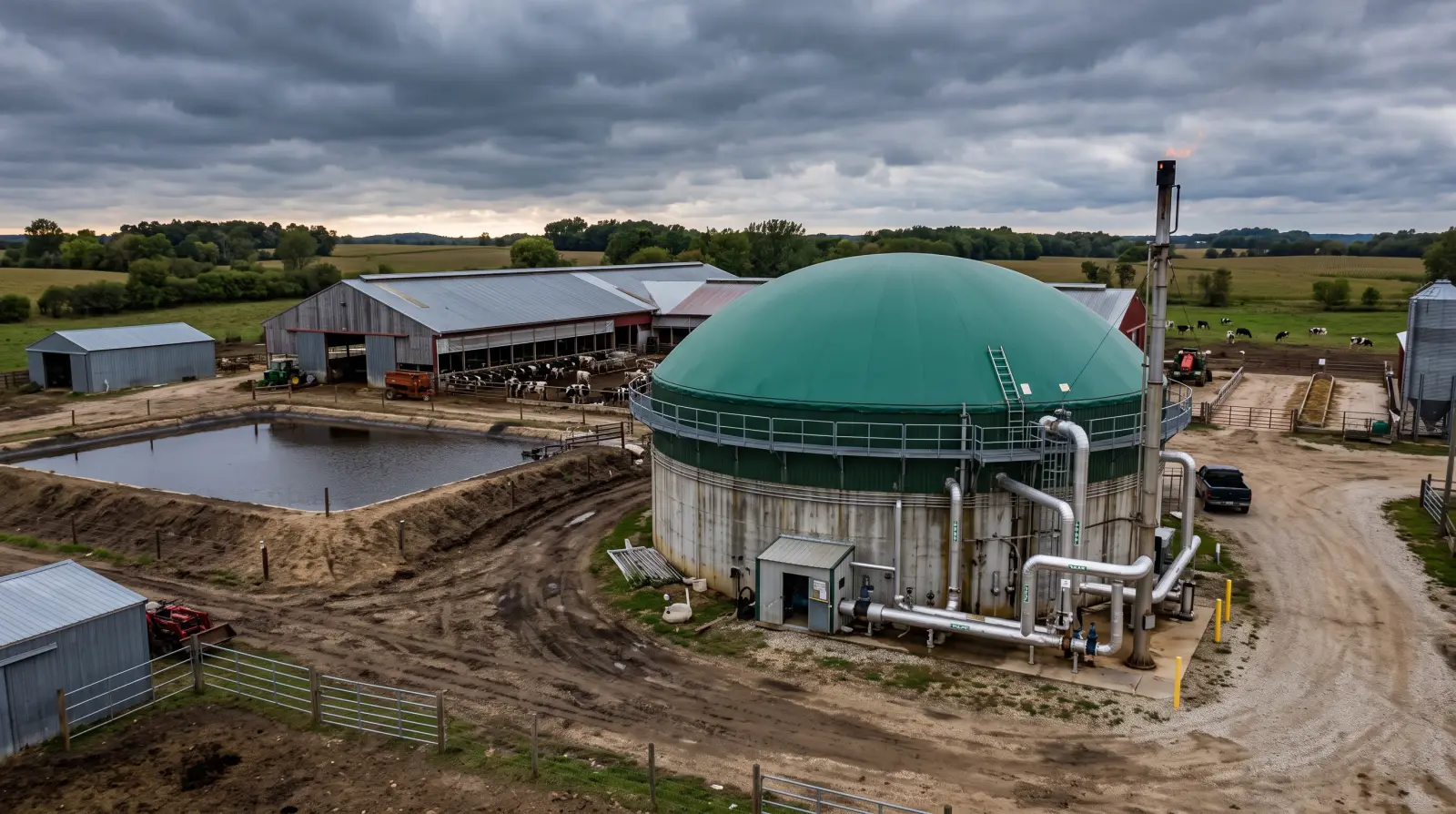
An on-farm anaerobic digester is a sealed, oxygen-free tank where bacteria break down manure into biogas, bedding-grade fiber, and treated liquid. It is not really an energy project. It is a manure-management and revenue-diversification decision whose economics are carried by scale and carbon credits, not by the gas, and it fits only large dairies.
Read that last part again, because it is the whole piece. The picture people carry around is a cow-powered generator that pays the electric bill and cleans up the smell. That picture is not wrong, exactly, but it is aimed at the wrong farm and it leads with the smallest number on the page. The gas a digester makes is real and it is genuinely small. What makes a modern digester pencil out is a stack of three revenue streams, and the fuel is the thinnest layer in the stack.
So this is a decision guide, not a brochure. By the end you should know the three ways a digester makes money, which of the four digester types matches how you handle manure, and the honest answer to the only question that matters: is this for my operation? For roughly nine out of ten dairies in this country, the answer as a standalone unit is no, and there are better paths worth naming.
An anaerobic digester is a sealed tank kept free of oxygen, where naturally occurring bacteria eat the volatile solids in manure and give off gas. Think of it as a stomach with no cow attached. Manure goes in one end, and three products come out, not one.
The first product is biogas, which is roughly 50 to 70 percent methane, 30 to 40 percent carbon dioxide, and traces of hydrogen sulfide and other gases. That mix carries about 600 BTU per cubic foot, against roughly 1,000 BTU per cubic foot for the pipeline natural gas you buy. That gap matters, and we will come back to it, because it is the reason raw biogas and pipeline-ready renewable natural gas are two different projects with two different price tags.
The second product is digestate, the material that comes out the back end. Run it through a screw press or a rotary screen and it splits into a fibrous solid and a liquid. The fiber is the part most people never hear about and it is worth real money, which is section three.
The third product is a treated liquid effluent that still holds nearly all the nitrogen and phosphorus that went in, just in a changed form. Digestion does not make nutrients disappear. Hold that thought too, because it is where a lot of digester dreams quietly deflate.
The single most useful reframe: a digester is a three-output machine. Anyone selling it to you on the gas alone is showing you one leg of a three-legged stool.
Three ways, and they are stacked in reverse order of how most people rank them.
Energy is the smallest slice. You burn the biogas in an engine-generator to make electricity, or you scrub it up to renewable natural gas and truck or pipe it to the grid. Either way the raw fuel value is modest. Penn State's research digester produced about 40 to 57 cubic feet of biogas per cow per day. Since roughly 200 cubic feet of biogas holds the energy of a single gallon of gasoline, a hundred cows make the daily energy equivalent of about 20 gallons of gas. Put a price on it and the ag-finance desks land on a startling figure: at 2022 natural gas prices, a typical cow generated only about 70 dollars of gas revenue for the entire year, and the value of the fuel is typically the smallest share of the revenue stream. That 70-dollar number is a 2022 illustration, not today's price, but the shape holds. The gas is the garnish.
Digestate is the underrated middle. The fibrous solids pressed out of the digestate are recycled manure solids, or RMS, and they make a genuinely good, self-sustaining bedding for freestall and bedded-pack dairies. Roughly 20 to 40 percent of the total solids is this coarse, nutrient-poor fiber, and digestion reduces volatile solids and pathogens and makes the fiber easier to separate cleanly. A dairy buying sand or sawdust or straw by the truckload can offset a real recurring cost with bedding it produces on-site, and some operations sell the surplus as a soil amendment or peat substitute. For a working dairy this bedding offset is often the most durable, farmer-owned benefit in the whole system. It is also the one that does not depend on a politician.
Credits are the business model. This is the uncomfortable truth. Modern renewable natural gas dairy projects stack California Low Carbon Fuel Standard credits, federal Renewable Fuel Standard credits known as RINs, and, for projects that broke ground in time, a federal investment tax credit. These credits do not top up the economics. They are the economics. Renewable natural gas from dairy manure can earn credit value that is sometimes more than 15 times the price of the fossil natural gas itself. Nobody would build most of these projects for the gas. They build them for the credits.
Which sets up the risk that has to sit right next to the reward.
Because the credit prices move, and they have moved hard.
California Low Carbon Fuel Standard credits fell from roughly 200 dollars per metric ton in 2021 to around 60 dollars per ton in 2024. That is not a wobble. That is a two-thirds haircut on the revenue stream that carries the whole project. RIN credits have held more steadily, recently around 3 dollars each, and in a notable shift the revenue from RINs surpassed the revenue from Low Carbon Fuel Standard credits for the first time over the past couple of years. Meanwhile the federal investment tax credit phase-out drove a rush of construction in late 2024 as developers scrambled to break ground before the deadline.
Sit with what that means for a farmer. These are 10 to 20 year assets. A digester underwritten on 2021 credit prices, then run into 2024 prices, can be operating a complex piece of infrastructure at a loss through no fault of the operator. The whole asset class is, at bottom, a bet on policy. Low Carbon Fuel Standard is a California program. RINs depend on the federal Renewable Fuel Standard. The tax credit is phasing out. None of those are things you control from a barn in the middle of the country.
There is a second trap worth naming plainly. Many dairy renewable natural gas deals are structured by third-party developers who own the digester and, crucially, own the credits. The farmer supplies the manure and often ends up handling bedding, while the developer captures the credit upside. That can still be a fair deal if it takes the capital risk off your books. Just go in knowing which slices of that three-legged stool you actually own. The agronomic benefits, the odor reduction, the pathogen knockdown, the bedding, those are durable and yours. The credit windfall is real but borrowed from a policy regime that can change. Match the reason you build to the benefit you actually control.
There are four common designs, and the deciding variable is not your herd size or your climate first. It is the total solids content of your manure, which is really a question of whether you flush or scrape.
| Type | Best manure handling | Total solids | Notes | Rough U.S. count |
|---|---|---|---|---|
| Plug flow | Scraped, thicker | 11 to 13% | Most common dairy system; long narrow heated tank; about 15 to 20 day retention | ~91 sites / ~260k cows |
| Complete mix | Scraped or mixed feedstocks | 2 to 10% | Heated, stirred tank; handles food-waste co-digestion | ~70 systems / ~110k cows |
| Covered lagoon | Flushed, dilute | Under 2% | Gas-tight cover over an existing lagoon; ambient temperature, so output swings with weather; warm climates | ~50 systems / ~210k cows |
| Fixed film | Lower-solids streams | Low | Microbes grow on media; less common | Few |
Those counts are from the EPA AgSTAR program's 2021-era tally, so read them as roughly, not as a current census. The pattern is what matters. If you scrape and your manure is thick, a plug flow tank is the default dairy answer and the most common one running today. If you take in a wider or wetter mix, or you want to co-digest food waste from a nearby processor, a complete mix tank handles it. If you flush with lots of water and sit in a warm climate, a covered lagoon puts a cap over a lagoon you may already have, though gas output will rise and fall with the seasons because it runs at ambient temperature. Fixed film is the specialist option for low-solids streams.
Pick the type by how manure already moves on your farm, not by a brochure photo. The manure handling decides the digester, and it connects straight to how you think about the rest of your manure management technology.
Here is the fact the brochures bury. Anaerobic digestion is generally economically viable only for large dairies, above roughly 500 cows and really 1,000 or more once you count construction and staffing. The practical floor for a standalone unit is usually at least 200 cows, and constructing and maintaining an individual digester for a small farm is usually financially unviable.
Now the kicker: roughly 90 percent of U.S. dairies have fewer than 200 cows. So for the vast majority of dairies in this country, a standalone digester is simply out of reach, and no amount of enthusiasm changes that math.
If you are one of the large operations, the capital numbers give you a sense of scale. EPA AgSTAR cites on-farm digester costs from about 400,000 dollars to 5 million dollars, often around 1.2 million. Older per-cow datasets put covered lagoon systems near 869 dollars per cow and plug flow near 1,114 dollars per cow in 2014 dollars, with renewable natural gas projects averaging around 947 dollars per cow. Treat every one of those as a dated range, not a quote. What separates winners from losers is operations, not just capital: profitable digesters in one review averaged about a dollar per cow per year in operating cost against nearly three dollars for the unprofitable ones, and a California review found 7 of 12 dairy digesters profitable after subsidies while 5 were not. Budget 2 to 3 percent of total investment a year for operation and maintenance, plus engine rebuilds roughly every two and a half years on electricity projects.
If you are one of the 90 percent, you have three honest options, and none of them is buying a tank you cannot fill:
Modular small-scale digesters have been demonstrated at pilot scale for 25 to 500 cow farms, but economic feasibility is still largely a challenge at small scales. Do not let a pilot photo talk you into a production commitment.
Three things it will not do, each of which has bitten a real farm.
It does not reduce your nutrients. The effluent contains almost all of the nitrogen that was in the raw manure. Digestion converts organic nitrogen to ammonium, which is more plant-available, but the total nitrogen and phosphorus load is essentially conserved. You still need the same acres to spread on, you still need a nutrient-management plan, and if anything the more-available nitrogen raises the stakes on spreading it right. Concentrating and exporting nutrients off-farm is possible with separators and struvite or ammonia stripping, but that is another capital step bolted on top, not a free byproduct.
It does not make pipeline gas by itself. Raw biogas at 600 BTU with carbon dioxide and hydrogen sulfide in it is not what goes into a natural gas pipeline. Getting to renewable natural gas means an upgrading and scrubbing step, which is different equipment and a different project budget. Do not let anyone blur biogas and renewable natural gas into one line item.
It does not run itself. A digester is a second business bolted onto your dairy, effectively a small power plant or gas plant, with its own staffing, its own safety exposure, and its own downtime. Methane is explosive and hydrogen sulfide is toxic, so this is not a set-and-forget tank. The gap between the profitable and unprofitable digesters is largely an operations story, which means it comes down to whether you have the people and the discipline to run it well.
A digester is a powerful tool for the right operation and a money pit for the wrong one. The right operation is a large dairy that wants to solve manure handling, produce its own bedding, cut odor and pathogens, and, with clear eyes about policy risk, capture a credit-driven energy income on top. The wrong operation is a small dairy sold on the gas, because the gas is the smallest number on the page and the scale is not there.
If you are weighing this, do two things before you talk to a developer. Get a current feasibility study with today's credit prices, not 2021's, and look up your region in the live EPA AgSTAR digester database to see what is actually running near you. And if you would rather have the next honest ag-tech breakdown land in your inbox instead of hunting for it, the Manley Farms email list is where these go first. We do the homework so you can make the call.
Usually not as a standalone unit. Digesters are generally viable only above roughly 500 cows, and the practical floor is about 200, yet around 90 percent of U.S. dairies are smaller than that. For most small operations the realistic paths are a shared community digester, co-digestion with off-farm food waste for extra gas and tipping fees, or simply waiting until the scale or a co-op makes the math work.
Less than most people expect. One cow's manure yields only about 40 to 57 cubic feet of biogas a day, worth roughly 70 dollars of energy per cow per year at 2022 gas prices. The fuel is typically the smallest share of the revenue. The real income comes from bedding-grade recycled manure solids and, above all, carbon credits like California's Low Carbon Fuel Standard and federal RINs.
Biogas is the raw output of a digester, about 50 to 70 percent methane and 600 BTU per cubic foot, mixed with carbon dioxide and hydrogen sulfide. Renewable natural gas, or RNG, is biogas that has been upgraded and scrubbed to near-pipeline quality, close to 1,000 BTU per cubic foot. Making RNG requires extra cleaning equipment, so it is a larger and separate project from simply burning biogas for electricity.
No. Digestion changes the form of nitrogen and phosphorus but conserves the total load. The effluent holds almost all the nitrogen the raw manure had, now as more plant-available ammonium. You still need the same land base and a nutrient-management plan. Exporting nutrients off-farm is possible with added separation and stripping equipment, but that is a separate capital investment, not a built-in benefit.
It depends mostly on your manure's solids content, set by whether you flush or scrape. Scraped, thicker manure at 11 to 13 percent solids suits a plug flow tank, the most common dairy design. A wider or wetter mix, or food-waste co-digestion, fits a complete mix tank. Dilute flushed manure under 2 percent solids in a warm climate suits a covered lagoon. Match the digester to how manure already moves on your farm.
Join our list for practical guides on farm tech, precision agriculture, and tools that work.