
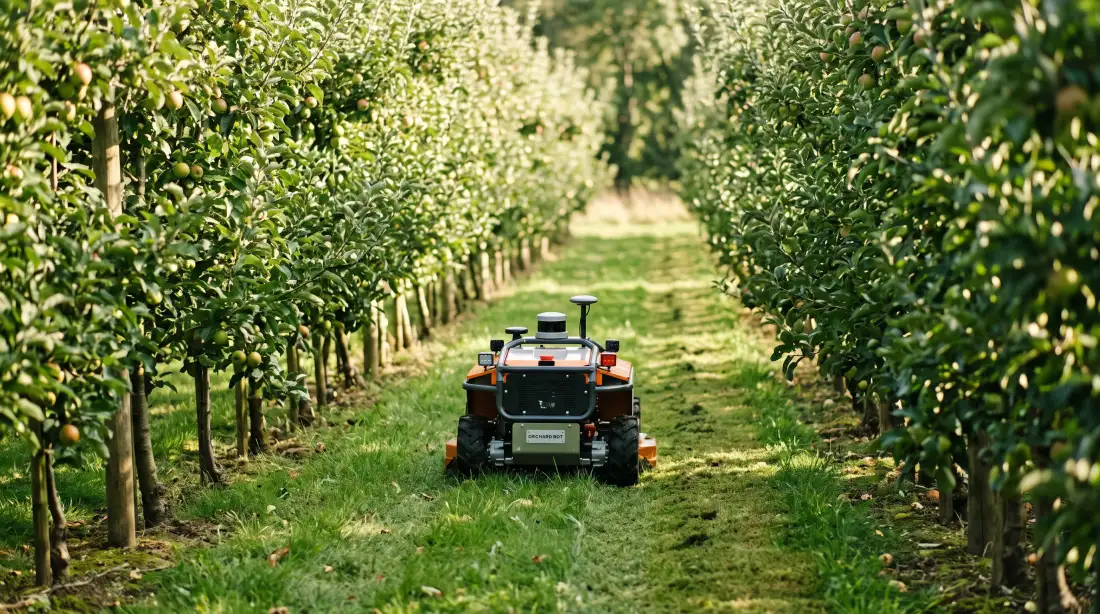
On a farm, "autonomous mower" means two different machines. Slow solar crawlers like Vitirover manage the orchard and vineyard floor, replacing herbicide and tillage. Self-driving zero-turns like RC Mowers and Scythe mow maintained open grass with less labor. Neither one tops a rank summer pasture or clears brush - that stays a tractor's job.
That single split is the whole article, and vendor marketing works hard to hide it. A brochure shows you a robot gliding down a row of grapevines, then shows another one mowing a wide green field, and lets you assume they are the same purchase pointed at your ground. They are not. One is a 55-pound solar machine that crawls under 1 km/h and lives in the block full time. The other is a 60-inch commercial deck that clears two acres an hour on maintained turf. Buy the wrong one for your surface and you either overspend on a lawn robot that bogs down in tall forage, or you wait a week for a slow crawler to do a job you needed done this afternoon.
Here is the plain version, sorted by the ground you actually have.
Split the phrase by surface and the confusion clears immediately. There is no single "farm robot mower." The machines for sale fall into two families that look different, cost different, move at wildly different speeds, and solve different problems.
The first family is orchard and vineyard floor robots. Their job is vegetation management: keeping the cover crop and weeds down between and under perennial rows, chemical-free, so you stop making herbicide and tillage passes. They are small, slow, and continuous. They do not mow fast because mowing fast is not the point.
The second family is open-ground turf robots. Their job is labor: mowing maintained grass without a person on the seat. These are self-driving commercial zero-turns and stand-ons, built for the kind of even, regularly cut grass you would otherwise put a lawn mower over.
Keep those two jobs apart the entire time you shop. A slow solar crawler will never mow your ballfield, and a self-driving zero-turn will never do chemical-free weed control under your grapevines. They are not two brands of the same tool. They are two different tools that share an unfortunate name.
Because the surface dictates the machine, and the two surfaces could not be further apart.
Under a row of high-value trees or vines, the problem is not that the grass is tall. The problem is that you are spending money and passes to keep the floor clean, either spraying herbicide or dragging a tiller, and both have real costs beyond the fuel. A floor robot solves that by nibbling the cover down continuously, day after day, so it never gets ahead of you. Slow is fine. It has all season.
On open ground, the problem is labor. You have acres of grass that need cutting on a schedule, and the person to cut it is expensive, hard to hire, and could be doing something else. A turf robot solves that by mowing nights and weekends while one operator supervises several machines at once. Here speed matters, because you are replacing a mowing crew, not a sprayer.
Same word, opposite economics. One replaces a chemical bill; the other replaces a wage.
The reference product here is Vitirover, a French machine out of Saint-Emilion built specifically to replace chemicals and tillage under perennial crops. It is worth knowing the numbers, because they tell you exactly what this class of robot is and is not.
Vitirover weighs roughly 23 to 27 kg (about 50 to 60 pounds) and runs entirely on an integrated solar panel feeding a lithium-ion battery. That gives it up to 16 hours of operation a day, of which about 5 to 6 hours is active mowing on a good day's sun. It cuts at an adjustable 2 to 4 inches and crawls at under 1 km/h, roughly 500 meters an hour. For navigation it uses multi-constellation GNSS (GPS, GLONASS, BeiDou, Galileo) with Trimble RTK positioning, plus inertial sensors and cameras.
Now the number that reframes everything: coverage is about one hectare per robot over roughly ten days, near a tenth of a hectare a day. You do not buy one Vitirover to mow a vineyard in a morning. You deploy a fleet that lives in the block permanently and keeps the floor nibbled down all season. That is the honest model, and it is a feature, not a flaw. Continuous slow grazing is what lets it replace the herbicide and the tiller instead of just replacing the guy on the mower.
On price, Vitirover runs near 10,000 euros for the robot plus its charging station to buy, or a subscription from roughly 2,100 euros per robot per year without assistance up to 3,100 euros with full support. It shows up in vineyards, orchards, solar (photovoltaic) parks, and along railway margins - anywhere someone needs chemical-free vegetation control and can let it work slowly.
On maintained open grass, the machines for sale in the United States are commercial turf robots, and they say so plainly. Three are worth knowing.
RC Mowers A-60. A 60-inch commercial deck covering 1.5 to 2.5 acres an hour, with one operator supervising up to three machines at once. It uses Smart GPS with RTK mapping and reusable mow plans, and carries a $199 a month connection and data fee, first year included. RC Mowers lists its customers openly: sports fields, airports, distribution centers, universities, hospitals, public campuses. Maintained grounds, not agriculture. The page makes no pasture or rough-terrain claim, and that omission is the tell.
Scythe M.52. An all-electric machine running a 52-inch deck at 1.5 to 2 acres an hour with 8-plus hours on a charge. Its sensor stack is heavy: 8 cameras for 360-degree vision, 12 ultrasonic sensors, RTK GNSS, and two IMUs. Setup is supervised autonomy, meaning you drive the boundary of a mow zone once and it remembers it. Scythe sells it as Robots-as-a-Service - no purchase price, a base lease plus a per-autonomous-acre fee - and reports deployment across 30 states and around 2 billion square feet mowed. One ownership note to keep current: Autonomous Solutions, Inc. (ASI) acquired Scythe Robotics on March 11, 2026, reported as continuity rather than a wind-down.
Greenzie on the Wright Autonomous Stander ZK. This is the retrofit play. Greenzie is an autonomy kit that turns a proven commercial chassis into a self-driver, most visibly the Wright stand-on ZK (a 40 HP gas machine with drive-by-wire). It averages about 2.1 autonomous acres an hour, with more than 200 Greenzie-equipped mowers in the field, and the Wright ZK ships with a 3-year autonomous service agreement and no monthly or per-acre fee. Greenzie has found its strongest traction on college campuses and commercial landscaping.
Here is the comparison in one place:
| Machine | Deck | Rate | Power | Model |
|---|---|---|---|---|
| RC Mowers A-60 | 60 in | 1.5-2.5 ac/hr | - | Buy + $199/mo data |
| Scythe M.52 | 52 in | 1.5-2 ac/hr | All-electric | Robots-as-a-Service |
| Greenzie / Wright ZK | Stand-on | ~2.1 ac/hr | Gas EFI | Buy + 3-yr service, no per-acre fee |
You have the same choice here that you have with smart sprayers: buy a purpose-built machine, or retrofit autonomy onto a chassis you trust.
Purpose-built (Scythe, RC Mowers) means the whole machine was designed around the sensors and the software. It is clean, integrated, and generally sold as a service so the maker keeps the risk. Retrofit (Greenzie) means you put the autonomy on a commercial mower that already has a track record, so you are not betting the field on a brand-new drivetrain at the same time you bet on brand-new software.
Neither is wrong. If you already run a commercial fleet you like, retrofit lets you upgrade what you own. If you are starting fresh and want somebody else holding the maintenance risk, the service-model machines are built for exactly that.
If you have followed RTK GPS for tractor guidance, you already understand these mowers. It is the same backbone.
Every open-ground machine here skips the buried perimeter wire that consumer robot mowers rely on. Instead they use RTK GPS for centimeter-level positioning, backed by cameras, depth sensors, and ultrasonic for obstacle detection, and a drive-the-boundary-once, save-the-plan setup. RC Mowers calls them reusable mow plans; Scythe says drive it once; Greenzie leans on machine-learning and depth cameras. Vitirover adds its RTK GNSS on top of vision for the slow, precise crawl under the vines.
The practical upshot: no trenching, no wire to cut with the next tillage pass, and a mow plan you build one time and reuse. It is the positioning technology you already know, doing the steering instead of just drawing a line on a screen.
Toward fleets of small machines, not one giant robot. At CES 2025, Kubota showed a smart autonomous electric zero-turn built around cooperative multi-machine operation, with the explicit pitch of doing more with several smaller machines rather than one industrial-sized one - less investment, less risk. Kubota also showed KATR, an all-terrain robot whose four hydraulically articulated legs keep a stable platform on slopes and rough ground, aimed at agriculture, forestry, and construction.
Read those as shown-at-CES, not on-the-lot-today, but the direction matters. The majors are betting on coordinated small units, and KATR is a real shot at the one problem today's flat-ground turf robots have not solved: slopes and broken terrain.
This is the honest limit, and it is the most useful sentence in the article. None of the open-ground robots above is built for tall pasture or brush.
Every one of them is engineered for maintained grass at lawn heights: regular, frequent cuts on relatively even ground. Rank summer growth, wet or heavy forage, hidden rocks, ditches, steep or broken pasture, and woody brush are all outside their design envelope. Push a $10,000 to $25,000 turf robot into that and you will damage it or bog it down. The vendors know this, which is why not one of their spec pages claims pasture or rough terrain. The absence of the claim is the claim.
Topping a real pasture or clearing brush is a different category entirely: an autonomous tractor pulling an implement, not a robot mower. If that is your job, you are shopping for autonomous tractors, and the mowers on this page are the wrong aisle.
Three surfaces, three answers.
Orchard or vineyard floor. A Vitirover-class solar crawler fleet, run continuously to replace herbicide and tillage. Accept that it is slow and that you deploy several. That is the design, and it works.
Maintained lawns and fields. A self-driving zero-turn or stand-on (RC Mowers, Scythe, Greenzie) on grass you would otherwise cut like a lawn. One operator, several machines, nights and weekends.
Rank pasture or brush. Not a robot mower at all. That is autonomous-tractor-and-implement territory.
On the money: the labor math is real - one person running three machines that mow off-hours is a genuine saving where wages are high and grass needs cutting often. But treat the payback-in-years and dollars-per-acre figures floating around the market blogs as loose estimates, not farm numbers. Your actual return depends on your acreage, your wage rates, and how often the ground truly needs a cut. Decide the surface first. The machine follows from it.
If you are weighing one of these against your own ground and want the specs and the honest limits in one place before you talk to a dealer, that is exactly what our free ag-tech briefings are for. Drop your email and we will send the plain-language breakdowns as we work through each category, no sales pitch attached.
It is one of two very different machines. Slow, solar-powered floor robots like Vitirover manage weeds and cover crop under orchard and vineyard rows, replacing herbicide and tillage. Self-driving commercial zero-turns like RC Mowers and Scythe mow maintained open grass with far less labor. The right one depends entirely on your surface, and neither handles rough pasture.
Not a rank or brushy one. Every commercial turf robot on the market is built for maintained grass at lawn heights on relatively even ground. Tall or wet forage, hidden rocks, ditches, steep ground, and woody brush are outside their design envelope. Topping real pasture or clearing brush is an autonomous-tractor-and-implement job, not a robot-mower job.
It depends on the class. Open-ground turf robots like the RC Mowers A-60 and Scythe M.52 run 1.5 to 2.5 acres an hour on maintained grass. A solar orchard crawler like Vitirover is the opposite: about a tenth of a hectare a day, so you run a fleet that lives in the block rather than one fast machine.
No. Unlike consumer robot mowers, these commercial machines use RTK GPS for centimeter-level positioning, backed by cameras and ultrasonic sensors for obstacle detection. You drive the boundary of a mow zone once, the machine saves the plan, and it reuses it. There is no wire to bury and nothing to cut on your next tillage pass.
Yes. Greenzie sells an autonomy kit that retrofits onto a proven commercial chassis, most visibly the Wright Autonomous Stander ZK, with more than 200 equipped machines in the field. Retrofitting lets you keep a drivetrain you already trust and add the self-driving layer, rather than betting on a brand-new machine and new software at once.
Join our list for practical guides on farm tech, precision agriculture, and tools that work.