
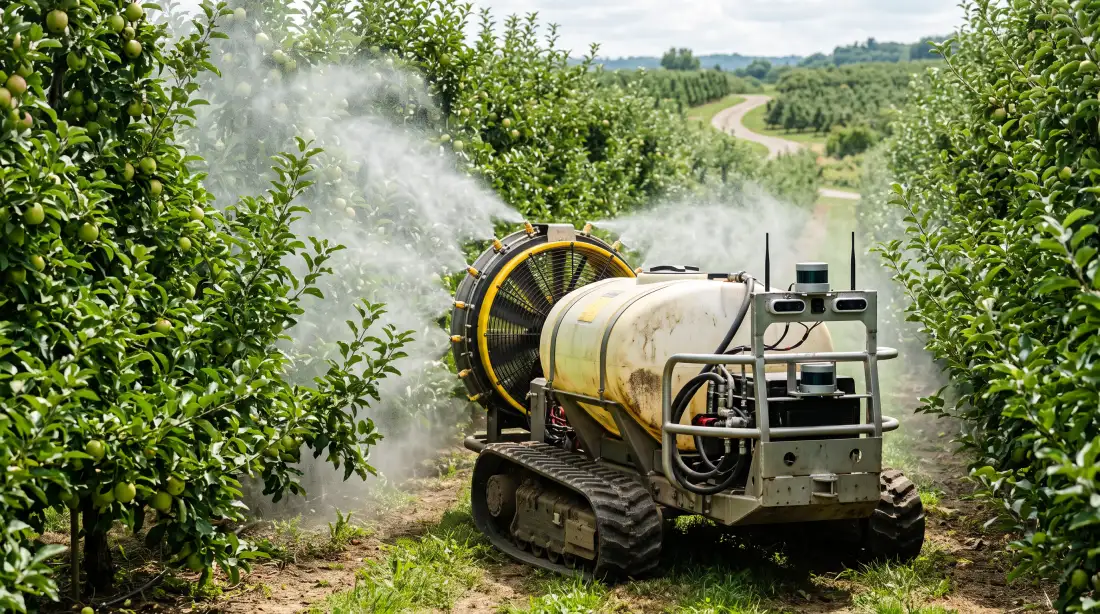
A "smart" orchard sprayer is really two separate upgrades wearing one label. Sensor-guided control uses LiDAR or ultrasonic scanning to dose each tree by its actual canopy, cutting chemical use 30 to 85 percent. Autonomous navigation removes the driver from the seat. One solves a chemical problem, the other solves a labor problem, and most growers only need the first.
That distinction is the whole game, and marketing works hard to blur it. A brochure will show you a self-driving machine gliding down a vineyard row and call it "smart," letting you assume the two things are the same purchase. They are not. You can buy either one alone, both together, or neither, and the math behind each decision is completely different. Get it wrong and you either overspend on a robot that still wastes chemical, or you skip the one upgrade that would have paid for itself in a couple of seasons.
Here is the plain version, from the seat of a sprayer instead of a sales deck.
Split the word "smart" into its two real jobs and everything gets clearer.
The first job is control: deciding where the spray goes and how much comes out. A sensor reads the tree in front of you and adjusts the flow to match, nozzle by nozzle, instead of throwing a fixed curtain at every tree the same way. This is the layer that saves chemical and water.
The second job is navigation: deciding who steers. An autonomous sprayer drives itself down the rows using GPS and its own sensors, so nobody has to sit on the machine at 4 a.m. This is the layer that saves labor.
They are independent. A self-driving sprayer with no sensor control still oversprays every tree; it just does it without a driver. A twenty-year-old air-blast rig fitted with a retrofit control kit sprays smart but needs a person on the seat. The confusion costs money, so keep the two words apart the entire time you are shopping.
A standard air-blast sprayer is a fan and a set of nozzles that blows a constant wall of spray at the tree row. It does the same thing over a mature, dense apple tree as it does over a young whip half that size, and it keeps spraying right through the gaps where there is no tree at all. USDA researchers describe the conventional approach bluntly as "one size fits all."
The result is a lot of product that never lands on a leaf. Spray drifts past the canopy into the air, and it falls onto bare ground between trunks and rows. That loss is worst early in the season, when trees are small or still dormant and the canopy is a fraction of what the sprayer is calibrated for. You are paying full rate to coat a lot of dirt and sky.
That waste is not a minor inefficiency to shrug at. It is the entire reason the intelligent-control layer exists, and it is where the savings come from.
This is the upgrade that matters most for the average orchard or vineyard, and it comes from a genuinely credible source.
The anchor technology is the USDA intelligent sprayer, developed by agricultural engineer Heping Zhu at the Agricultural Research Service's Application Technology Research Unit in Wooster, Ohio. The project started in 2009 as a nine-university collaboration, so these are not vendor claims dressed up as science. A laser (LiDAR) scanner images each tree's size, shape, and foliage density as the sprayer moves, and a variable-rate system doses each nozzle zone to match the real canopy in front of it. Over a gap between trees, the nozzles shut off. Over a dense section, flow climbs. Over a thin one, it drops.
The USDA field results, measured across apple, grape, peach, blueberry, pecan, citrus, and nursery crops in nine states plus Australia, are the strongest numbers in this whole category:
The mechanism underneath is per-nozzle pulse-width modulation, the same PWM control we broke down in our guide to PWM sprayer nozzle control. Each nozzle is switched and modulated on its own by a solenoid, so it is not "spray the row or don't." It is continuous, zone-by-zone dosing, which is exactly why the savings run so high instead of the modest trim you would get from a simple whole-boom shutoff.
Both work. The choice is accuracy against cost, not function against failure, and any honest write-up should say so.
Peer-reviewed reviews of orchard variable-rate sprayers rank LiDAR as the most promising sensor because it builds a high-precision 3D model of the canopy. In field trials, LiDAR systems have applied on the order of 46 percent less spray than conventional while keeping similar coverage inside the canopy. It is the sharper instrument.
Ultrasonic sensors are the older, cheaper option, and researchers still call them attractive precisely because they cost less. Ultrasonic variable-rate systems have been shown to cut drift and ground loss substantially while improving how much product actually reaches the leaves. They are less precise than a laser, but "less precise" here still means a large reduction over a dumb constant curtain.
So the decision is not whether the cheaper sensor works. It does. The decision is how much precision your crop value justifies paying for. High-value blocks reward the LiDAR accuracy; on tighter margins, ultrasonic still earns its keep.
Yes, and this is the single most useful fact in the article: you do not have to buy a new sprayer to get the intelligent-control layer.
The USDA system was commercialized in 2019 by Smart Guided Systems of Indianapolis as the Smart-Apply Intelligent Spray Control System, sold as a kit that retrofits to, in the vendor's words, "virtually any air-blast sprayer." You keep the tank, the fan, and the frame you already own and bolt on the brains. The kit adds a LiDAR scanning sensor, PWM solenoid valves that turn each nozzle into its own variable-rate sprayer, a GPS for travel speed, a flow controller, a Wi-Fi router for cloud data, and a tablet for the operator.
The vendor's own reported savings sit in the same ballpark as the independent USDA figures, which is a good sign: chemical and water use down an average of 50 percent, runoff cut up to 97 percent, and airborne drift cut up to 83 percent. Read those as marketing numbers rather than lab results, but note that they line up with the government figures instead of wildly overshooting them.
The 2023 Generation 2 update tells you where this product sits on the maturity curve. It was mostly a ruggedization pass: half the electrical connectors, a single sealed power harness with a circuit breaker instead of fuses, a tougher tablet, support for up to 40 nozzles on bigger sprayers, and multilingual screens. The savings numbers carried over unchanged. When a vendor stops chasing bigger headline percentages and starts hardening the wiring and deepening the recordkeeping, the value proposition has stabilized. That is a buyable, proven tool now, not a research prototype, and the cloud records it keeps double as spray-application documentation for compliance.
The second layer, self-driving, is real and it is past the pilot stage, but be honest about what it buys you.
The reference product is GUSS, the Global Unmanned Spray System, founded by Dave Crinklaw in 2018 in Kingsburg, California. Its machines self-drive orchard and vineyard rows using GPS, LiDAR, and their own software, and a single operator can supervise up to eight of them at once from a laptop. As of 2025 the fleet had topped 250 machines, 2.6 million acres sprayed, and more than 500,000 autonomous hours. The lineup includes a full-size Orchard GUSS, a Mini GUSS built roughly a quarter smaller for high-density plantings and vineyards, a herbicide version for spot-spraying weeds, and an announced electric option. Those model dimensions come from trade coverage rather than a formal spec sheet, so treat them as ballpark.
Here is the part the brochures skip: autonomy by itself is a labor solution, not a chemical one. A GUSS machine running plain, non-sensing nozzles oversprays exactly like any other air-blast rig. It simply does it without a person on the seat. The reason to buy autonomy is that you cannot find, keep, or afford enough sprayer operators to cover your acreage, or you want to move night spraying off your crew. The input savings live entirely in the control layer. If you want both, you run the control layer on top of the autonomous carrier.
Toward one machine that does both, under one owner.
John Deere and GUSS formed a joint venture in 2022, and Deere announced the full acquisition of GUSS in late summer 2025. Deere already had the Smart Apply intelligent-control line in its Operations Center. Owning GUSS puts the self-driving carrier and the sensor-guided dosing under the same roof, so an autonomous base and per-tree control can ship as a single stacked product instead of two separate buys.
That is the real "so what" of the category. The industry is not choosing between autonomy and intelligent control; it is layering one on top of the other. For a grower deciding today, the merger is a signal about direction, not a reason to wait. The control layer already pays for itself on its own, whether or not you ever add a robot underneath it.
Two different checks, two different justifications.
The retrofit control kit is the high-ROI move for most orchards and vineyards. It is the smaller check, it bolts onto the sprayer you already run, and it pays back through chemical and water savings that are largest on high-value crops. This is the upgrade to make first, and for many growers it is the only one they need.
Full autonomy is a large-acreage labor play. It is a much bigger capital outlay, and the honest way to justify it is labor scarcity and scale, not chemical savings. If you are spraying thousands of acres and cannot staff the seats, the math can work. If you are not, it usually does not, at least not yet.
A word on payback dollars: the specific figures floating around the web (platform prices in the tens of thousands, payback pegged at some exact number of years) come from thin, inconsistent market reports. Treat any hard "it pays back in X years" claim with suspicion and run the numbers on your own crop value, acreage, and current chemical bill. The direction is reliable; the precise dollar figures on the open web are not.
One more piece of the "how much do I save" question is timing, because the smartest dose in the world is wasted if you spray into the wrong window. Before the next pass, line up the weather with our free Spray Window Planner. Time the window, then spray it smart.
A smart orchard sprayer uses sensors to spray each tree by its actual size and canopy density instead of blasting a constant curtain at every tree. LiDAR or ultrasonic scanners map the canopy as the machine moves, and per-nozzle valves dose each zone to match, shutting off over gaps. The result is far less wasted chemical and drift.
USDA field trials across apple, grape, peach, and other crops recorded pesticide reductions of 30 to 85 percent, drift beyond the canopy cut up to 87 percent, and ground loss cut up to 90 percent, worth roughly $56 to $812 per acre a year. The commercial retrofit kit reports similar numbers, averaging around a 50 percent cut in chemical and water use.
Yes. The USDA-developed system is sold commercially as a retrofit kit (Smart Apply) that fits virtually any air-blast sprayer. You keep your tank, fan, and frame and add a LiDAR sensor, PWM nozzle valves, GPS, a flow controller, and a tablet. You do not have to buy a whole new sprayer to get the chemical savings, which is why it is the higher-return upgrade for most growers.
Autonomous means the sprayer drives itself with no operator on the seat; smart (intelligent control) means it senses each tree and doses accordingly. They are separate. An autonomous machine with no sensor control still oversprays, just without a driver. Autonomy solves a labor problem; intelligent control solves a chemical problem. A machine can have either, both, or neither.
Both work; the choice is accuracy versus cost. LiDAR builds a high-precision 3D model of the canopy and is the more accurate option, applying up to about 46 percent less spray than conventional in trials. Ultrasonic is cheaper and less precise but still cuts drift and ground loss substantially. High-value crops justify LiDAR's accuracy; tighter margins can start with ultrasonic.
GUSS Automation of Kingsburg, California is the reference maker, with a fleet that has sprayed over 2.6 million acres and models for orchards, high-density plantings, and spot herbicide work. One operator can run up to eight machines at once. John Deere, which also owns the Smart Apply intelligent-control line, fully acquired GUSS in 2025, putting autonomy and sensor dosing under one roof.
Join our list for practical guides on farm tech, precision agriculture, and tools that work.