
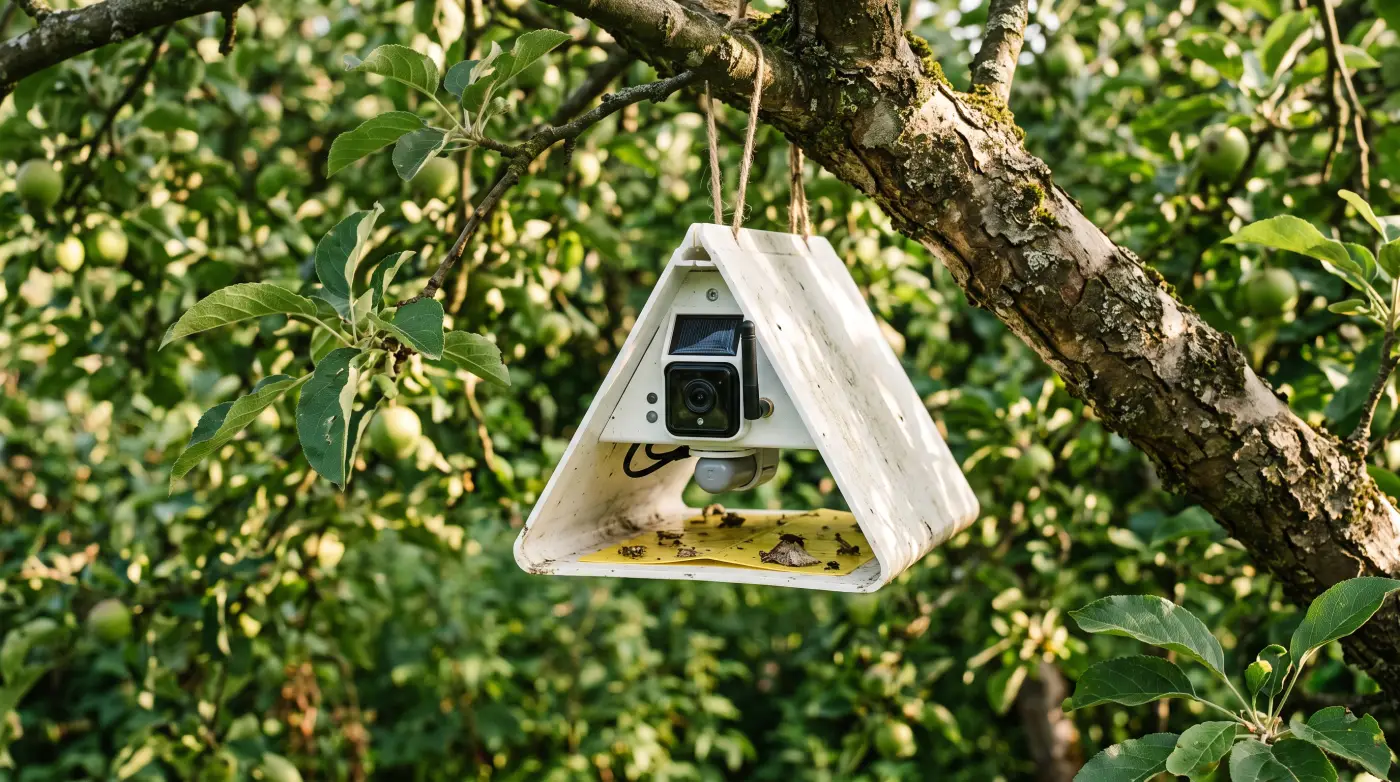
The bug can't read a calendar. That sounds obvious until you look at how most spray decisions actually get made: the third week of May, because that's when we always do it. The trouble is that "always" is a date, and the pest you're trying to hit doesn't care what the date is. It cares how warm it's been.
An insect is cold-blooded. Its development speeds up when it's warm and stalls when it's cool, so a hot early spring can run a pest two weeks ahead of the calendar, and a cold one can push it two weeks behind. Spray on a fixed date and you're aiming at a moving target with your eyes closed. Some years you'll be early, hitting a life stage the insecticide barely touches. Some years you'll be late, after the larvae have already bored in where no spray can reach. You paid for the pass either way.
There's a better way to keep time, and the science behind it has been settled in university extension circles for decades: count the heat, not the days. This is what a degree day model does, and paired with a pheromone trap it answers the two questions every spray decision rests on. The model tells you when the pest is vulnerable. The trap tells you if it's even there. Here's how the two fit together, and how to start using the first one this week for nothing.
A degree day is a unit of accumulated heat. The idea is simple: an insect needs a certain amount of warmth to move from one life stage to the next, and you can add that warmth up day by day until it crosses the threshold where, say, the eggs hatch.
The standard formula most extension tools use is straightforward. Take the day's high and low temperature, average them, and subtract a base temperature:
[(daily high + daily low) / 2] - base temperature
If that number is positive, it's the degree days that day earned. Add each day's value to a running total and you have accumulated degree days. When the total reaches the threshold for the life stage you care about, that's your window.
The base temperature is the lower threshold below which the insect essentially stops developing, and it's different for every pest. Codling moth uses a base of 50°F. Western bean cutworm uses 38°F. Many models also set an upper threshold, a temperature above which development stops speeding up, so a brutal heat wave doesn't overstate the count. You don't have to memorize any of this. The tools do the arithmetic. What matters is the principle: heat units track insect development far more reliably than dates do, because heat units are what the insect is actually responding to.
Here's the part that surprises people. The hard, valuable layer of this whole system, the modeling, is free.
Cornell's NEWA (Network for Environment and Weather Applications) offers more than 30 IPM tools and over a dozen degree day calculators, drawing on a network of grower-owned weather stations across the region. USPest.org, hosted by Oregon State University's Integrated Plant Protection Center, pulls from more than 15,000 public weather stations to build degree day maps at roughly 800-meter resolution, with documented models for dozens of pests. Plenty of states run their own equivalents too, like Wisconsin's AgWeather thermal models, which are live and updating for the current season.
The workflow is the same on any of them. Pick your location, pick your pest, and the tool shows you accumulated degree days and where you sit relative to the treatment window. You can do this today, on a phone, standing in the field, for zero dollars. If you take one thing from this article, make it this: before you spend a cent on hardware, go pull up your state's degree day tool and find the model for your worst pest. The cheapest, highest-return move in pest management is also the one almost nobody starts with.
There's a catch, and it's the part farmers get wrong most often. A degree day model is a clock, and every clock needs a starting point. That starting point is called the biofix.
For some pests the biofix is just a fixed date, often January 1 or March 1, and the model accumulates from there. But for many of the pests that matter most, the biofix is a biological event you have to observe. The classic one is the first sustained catch of moths in a pheromone trap. That first flight is the signal that the season's generation is active, and it's the moment you start the degree day clock running toward the spray window.
This is the hinge of the entire system, so it's worth stating plainly: for many pests, the model can't run until a trap tells it when to start. Get the biofix wrong, set it a week early or a week late, and every prediction downstream is off by that same amount. A perfect model with a bad start date is a confident wrong answer. This is exactly why the trap and the model are not competing tools. They're two halves of one instrument.
A degree day model is a prediction. It tells you when a pest should be vulnerable in a normal year for your area. What it cannot tell you is whether that pest actually showed up in your field this year, or how many of them.
That's the trap's job. A pheromone trap is baited with a species-specific lure, a synthetic version of the scent a female releases to attract males. Hang it in the right spot and it pulls in the target pest and almost nothing else, so the count you read is a clean signal of that one species' presence and pressure. The trap answers the question the model can't: is it here, and is it bad enough to act on?
Skip this step and the model can lead you straight into a wasted pass. Imagine the degree day tool says you're dead in the egg-hatch window for a pest, so you spray, but a trap would have shown you that pest never arrived in numbers worth treating. You just paid for product, fuel, and time to control an insect that wasn't a problem. The model points you at the right week. The trap confirms there's actually something there to spray. You want both before you commit to the cost of an application.
A traditional pheromone trap works, but somebody has to drive out and read it, often across a lot of acres, often more than once a week. That windshield time is where the smart trap earns its keep.
A smart, or automated, trap is the same pheromone lure with a few additions: a camera over the sticky surface, image recognition that identifies and counts the target species, and a cell connection that sends the count to your phone without anyone driving the trap line. Most commercial units also pair the trap with a small on-site weather node, which means the same device that's counting moths is also feeding temperature data straight into your degree day model. The trap sets the biofix automatically when it logs that first flight, and the weather node runs the clock. It's the full loop in one box.
Be clear-eyed about what you're buying, though. The honest, defensible benefit of a smart trap is better-timed sprays and far less scouting labor, not fewer pests and not guaranteed yield. The image recognition is good and getting better, but it's a tool for catching the timing and saving the legwork, not a silver bullet that makes pests disappear. Buy it for what it actually delivers.
Codling moth in apples and pears is the textbook case for degree day plus trap, and the numbers show why it's so trap-intensive: Washington State University researchers recommend roughly one trap per 2.5 acres for codling moth monitoring. Cornell's NEWA codling moth tool runs on base 50°F degree days from biofix to flag treatment windows. If you're in tree fruit, this workflow was practically built for you.
But row crop and forage growers have degree day models too. For alfalfa weevil, scouting typically starts around 300 weevil degree days as eggs begin to hatch, peak feeding falls roughly in the 600 to 800 degree day range, and the action threshold is around 40% tip feeding. For western bean cutworm, Nebraska's model (base 38°F, upper 75°F, accumulating from March 1) puts 25% of moth flight complete near 2,577 accumulated degree days, which is the cue to start scouting for eggs, while the treatment threshold in non-Bt corn is around 5 to 8% of plants with eggs or larvae.
Notice the pattern in those examples. The degree days tell you when to go look. A percent-infested scouting threshold still tells you whether to spray. Don't let a trap count alone pull the trigger. Treat these figures as examples for those specific pests, too. Base temperatures and thresholds change pest to pest and sometimes region to region, so go find the model for your pest on NEWA or USPest.org rather than borrowing a number from a different insect.
This is where most "best smart trap" roundups go quiet, so here's the straight version. Automated traps are sold as a service, not a box off a shelf. You're buying hardware plus the AI identification, the pheromone emitters, the little weather stations, and the data platform, bundled at a service level matched to your operation.
Trade reporting puts commercial automated traps in the neighborhood of $850 to $1,000 per unit, or framed by season, roughly $400 to $1,000 per trap per season. One entrant, CropVue, has targeted around $25 per acre per year assuming about one trap and one weather node per 10 acres. Treat those as reported ranges, not quotes, because this market moves and the biggest names, Semios and Trapview, decline to discuss pricing publicly precisely because every operation gets a custom plan.
So budget the way the system actually works: by acres covered and traps needed, using the per-pest trap density (codling moth's roughly one per 2.5 acres is a good anchor), not by a single sticker price. The right question isn't "what does a trap cost," it's "how many traps does my pest and my acreage require, and what's that worth against the scouting hours it replaces."
Put it together and the discipline is simple. The model says when. The trap says if. A field scouting threshold says whether. All three beat the calendar, and the first two are free or cheap to start.
Automated hardware pays off when the math favors it: high-value crops where a mistimed spray or a missed pest costs real money, and labor-tight operations where nobody has time to drive a trap line twice a week across a lot of ground. Tree fruit is the obvious fit. For a lot of row crop and forage pests, though, the right answer is the free degree day model plus a handful of hand-read pheromone traps. You get most of the timing benefit for almost none of the cost.
Wherever you land on the hardware question, the first move is the same and it's free. Pull up your state's degree day tool, find your pest, and start timing by the bug instead of the calendar.
One practical companion worth knowing about: a degree day model tells you the day the pest is vulnerable, but it can't tell you whether the weather will let you spray that day. That's the gap our Spray Window Planner fills, checking wind, rain, temperature, and humidity to find the safe windows for an application. Used together, the model picks the day and the planner confirms you can actually get the pass on. If you'd like new ag-tech write-ups like this one as they post, join the email list and we'll send them your way.
The bug still can't read a calendar. The good news is you don't have to either.
Average the day's high and low temperature, then subtract the pest's base temperature; a positive result is that day's degree days, which you add to a running total. When the accumulated total reaches the threshold for a life stage, that stage is due. Base temperatures differ by pest, for example 50 degrees Fahrenheit for codling moth and 38 degrees for western bean cutworm.
The biofix is the start date the degree day clock counts from. For some pests it is a fixed calendar date, but for many it is a biological event you observe, most often the first sustained catch of moths in a pheromone trap. Set the biofix a week early or late and every downstream prediction shifts by that same amount, which is why traps and models work together.
Yes. A degree day model predicts when a pest should be vulnerable in a normal year, but it cannot tell you whether that pest actually arrived in your field or in numbers worth treating. A pheromone trap answers that with a clean, species-specific count. Spraying on the model alone can send you after an insect that never showed up, wasting product, fuel, and time.
Automated traps are sold as a service bundling hardware, AI identification, pheromone emitters, weather nodes, and a data platform. Trade reporting puts them around 850 to 1,000 dollars per unit, or roughly 400 to 1,000 dollars per trap per season. CropVue has targeted about 25 dollars per acre per year. Budget by acres and trap density, and remember the underlying degree day models are free.
Join our list for practical guides on farm tech, precision agriculture, and tools that work.