
USDA removed the federal restricted use pesticide record keeping requirements, including the old 14-day rule, effective July 11, 2025. Many applicators must still keep records. The duty now comes from state law, the EPA Worker Protection Standard, the product label and, for commercial applicators, EPA's state-plan minimums. Deadlines and retention depend on which rule reaches you.
If you learned the 14-day rule at a recertification meeting, you learned it correctly. It just stopped being the rule. Plenty of pages still recite it as current, and when we checked in November 2026, USDA's own Q&A page still loaded with no notice of the change.
The useful question now is which of four rules applies to your operation, and whether one record can clear the strictest of them. It can. This is a working guide, not legal advice. Your state pesticide agency has the final word.
USDA's Agricultural Marketing Service published the final rule on May 12, 2025 (90 FR 20083). The operative line is three words long: "Remove part 110." That part held the rule older guides still quote: write down a restricted use application within 14 days and keep it for two years.
USDA removed the regulation that enforced the federal rule. The statute behind it, 7 U.S.C. 136i-1, still appears in the US Code.
USDA's explanation matters more to you than the rule itself. The federal program "was defunded and closed on September 30, 2012." Since then, 23 state programs have run their own, either inspecting when complaints are filed or folding record checks into other inspection visits. Other states dropped random inspections, but many "have continued to conduct pesticide recordkeeping inspections when a complaint is registered against a certified applicator."
So nobody is pulling your name off a federal list. The inspection worth preparing for starts with a phone call to your state agency, and the likeliest call is about drift. Your record's reader is an investigator working out what happened on one field, on one morning.
Four rules can reach the same pass across the same field, and they do not cancel each other out.
Not sure a product is restricted? It says so on the label's front panel, and EPA keeps a Restricted Use Products report.
This is why no honest article can give you one number. A sample from each state's text:
| State | Who it covers | When to write it | How long to keep it |
|---|---|---|---|
| Washington | Certified applicators and anyone applying pesticide to more than 1 acre of agricultural land in a year | Same day | 7 years |
| Ohio (university summary) | Private applicators, restricted use products | Date of application | 3 years |
| Minnesota | Commercial and noncommercial applicators | Within 5 days | 5 years |
| Oregon | Pesticide operators | Ask the state | 3 years |
| California | Pesticide use reports, filed through the County Agricultural Commissioner | Ask your county | Ask your county |
The Minnesota and Oregon rows do not settle what private applicators owe in those states. Your state may differ from everything here, so find your agency on the National Pesticide Information Center's state list and ask three things: who has to keep records, by when, and for how long.
One thing the older guides miss: the old federal list never asked for a start time, a stop time or the weather. A record that passed that rule can fail Washington, Minnesota or a current dicamba label today. So build to the superset once and stop worrying about which list applies.
In the last column, WPS is the Worker Protection Standard, Commercial is EPA's state-plan minimum, WA and MN are those state rules, and Label is the 2026 Stryax dicamba label.
| Record field | What to write | Who asks for it |
|---|---|---|
| Applicator | Name and license number, plus anyone spraying under your supervision | Commercial, WA, MN, Label |
| Customer | Name and address, if you spray for hire | Commercial, WA, MN |
| Date | Month, day and year | All five |
| Start and stop time | Clock times for the application | WPS, WA, Label (Commercial wants time, MN wants completion time) |
| Location | Section, township and range, GPS, or a map | All five |
| Crop or site | Exactly as the label names it | WPS, Commercial, WA, Label |
| Area treated | Acres actually sprayed | Commercial, WA, MN, Label |
| Product name | Brand name from the label | All five |
| EPA Reg. No. | From the label | All five |
| Active ingredient | From the label | WPS |
| Total amount | Product used, in label units | Commercial, WA, Label |
| Rate | Amount per acre | WA, MN |
| Concentration | Product per 100 gallons, or gallons per acre | WA |
| REI | Hours, from the label | WPS |
| Safety data sheet | A copy, on file | WPS |
| Wind | Speed and direction, measured at the field | WA, MN, Label |
| Temperature | Measured at the field | WA, MN, Label |
| Tank mix partners | Each product with its EPA Reg. No. | Label |
| Nozzle and pressure | Tip used and pressure set | Label |
| Equipment | Apparatus license plate | WA |
| Target pest and PHI | Your own notes | Good practice |
Most of these come from USDA's former brochure on the removed rule. It no longer carries legal weight, and it is still the clearest writing on the subject.
Washington wants wind direction, estimated speed and temperature "obtained in close proximity to the application site." The 2026 Stryax label goes further. It wants air temperature at boom height, and wind speed and direction at or above boom height, when you start and every time you refill the tank. It also wants National Weather Service documentation of the forecast high for that day and the next.
Notice that the label asks for the forecast and the reading as separate items. A forecast is what you planned around. A reading is what happened.
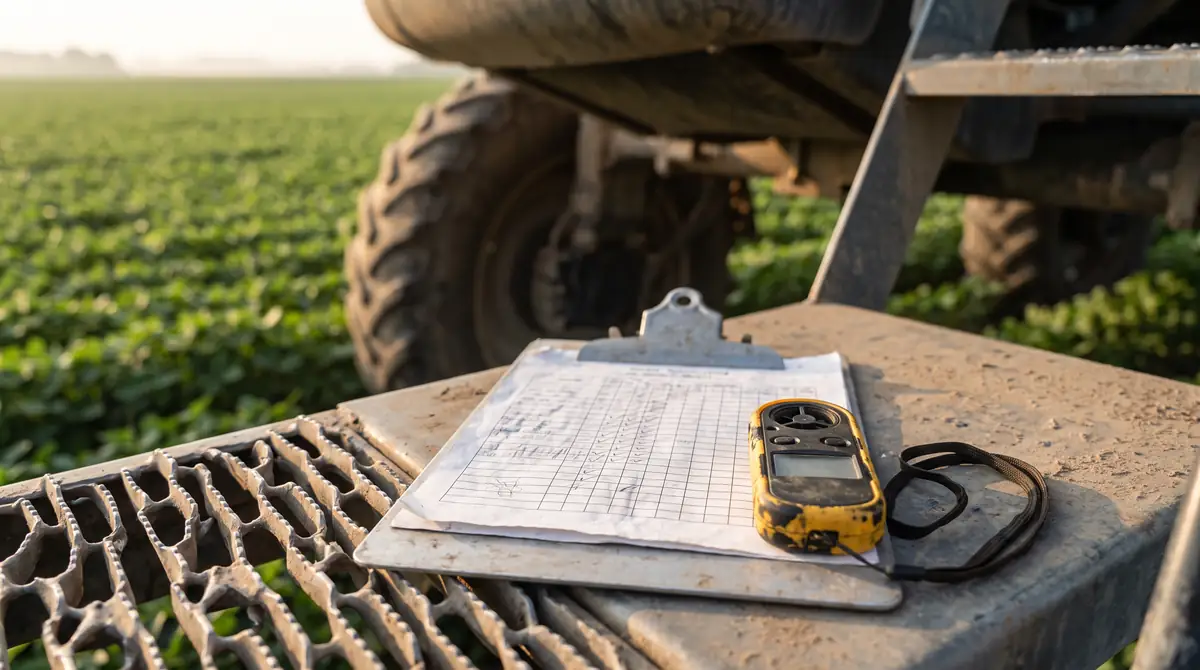
Use the Spray Window Planner or a radar app to pick the window. Then take the wind reading in the field with a handheld meter and write the number down. Illinois Extension recommends recording on-site wind even though Illinois does not require it.
The fair objection: if the federal rule is gone and inspections start with complaints, why bother? For a private applicator in a state with no rule, with nobody else working on the place, using only labels with no record language, that argument holds. It is a narrower group than it sounds, and it is exactly the farmer with nothing to show when a neighbor's vineyard cups.
Illinois Extension says many applicators treat their records as an "insurance policy" against false accusations. Assemble the file in this order:
Give copies and keep your originals. And leave the record alone once the phone rings. An entry written the day you sprayed is evidence. An entry filled in after a complaint is a story.
Records also pay off with nobody watching. Rotation restrictions run on product and date, so without a record next spring's planting decision rests on memory.
40 CFR 170.311 requires the rows tagged WPS in the table above, for each application. Post them within 24 hours after the application ends. They stay up until at least 30 days after the last REI ends, or until workers and handlers are no longer on the establishment, whichever comes first. Then retain them on the establishment for two years after the REI expires. That clock starts at REI expiry, not at the spray date, so anything you purge at exactly two years from application is short.
Workers, handlers and treating medical personnel can all ask for access.
The trap is the family exemption. Under 40 CFR 170.601, on an establishment majority-owned by one immediate family, owners need not provide these protections to themselves or their immediate family. That is an exemption for family members, not for family farms. Hire one non-family worker or handler and the requirement is back.
Over-the-top dicamba is the cleanest example. The Stryax label, stamped February 6, 2026, lists 24 record items, including proof of dicamba training, purchase receipts for the product and its required volatility and drift agents, a copy of the label, a sensitive crop registry check, the buffer determination, and sprayer cleanout. Keeping those records even counts as one runoff mitigation point on that label. Its registrant's form says to generate them "as soon as practical after application" and to check with your state. If you remember a 72-hour deadline, that came from older labels. The registration has been challenged in court, so confirm its status with your state before planning around it.
Fumigants are the other category to watch. Illinois Extension notes that many require site-specific management plans and post-application summaries kept for two years. Read the record section of every label you buy.
Whichever one you will fill out the day you spray. Illinois Extension notes that no standard form is required, as long as the information is complete, legible and accessible to those with a legal right to it. Washington adds that a record has to be in a format acceptable to its department.
A clipboard in the cab is hard to beat for a same-day habit. The risk with any digital record is retention. Seven years is longer than most phones last, so back it up on a schedule and keep a printed copy in the shop.
We built a free spray log for this job, Manley Farms Records. It captures the core fields above, plus humidity and PHI, and prints a report. It is a good way to get the record down the day you spray, and you should know its limits:
Winter is the time to set this up. Call your state agency, get its three answers, and have your form built before the first pass of 2027. For the rest of the paperwork, see our guide to farm record keeping software.
No. The federal rule giving private applicators 14 days to record a restricted use application was part of 7 CFR Part 110, which USDA removed effective July 11, 2025. Record keeping itself did not end. State law, the Worker Protection Standard, EPA's state-plan minimums for commercial applicators and product labels can all still require records, sometimes on a much shorter deadline.
There is no single national number now. Commercial applicators must keep restricted use records at least two years under EPA's state-plan minimums, and Worker Protection Standard records stay on site two years after the restricted-entry interval ends. States set their own terms: three years for Ohio private applicators, five for Minnesota commercial and noncommercial applicators, seven in Washington.
Owners on a farm majority-owned by one immediate family do not have to provide the WPS posting and record protections to themselves or immediate family members. The exemption stops there. Once a worker or handler from outside the family is on the place and the 30-day trigger is met, the requirement applies. State record rules can apply regardless of who owns the farm.
Often, yes. The Worker Protection Standard covers general-use and restricted use products alike when the label carries WPS language and workers or handlers are on the establishment. Some states go further: Washington's rule reaches all pesticides for certified applicators and anyone treating more than one acre of agricultural land in a year. Elsewhere a record may be optional, and it is still worth keeping.
No national form is required. Illinois Extension notes that any system works if it holds the required information and stays legible and available to people with a legal right to see it. Some states add conditions. Washington requires a format acceptable to its department, and Minnesota allows an invoice to serve as the record if it contains the required information.
Join our list for practical guides on farm tech, precision agriculture, and tools that work.